Bambu Lab PETG Basic vs Polymaker PETG
Bambu Lab PETG Basic vs Polymaker PETG on maker data: speed, temperatures, drying, spools, AMS fit. Pick Bambu for an AMS, Polymaker for high-flow printing.
On this page (12 sections)
Pick Bambu Lab PETG Basic if you print on a Bambu Lab printer with an AMS and want the spool's RFID tag to load its settings. Pick Polymaker PETG if you want a PETG its maker sells as high-flow, for an open-frame or non-Bambu printer. Both are general-purpose PETG with overlapping nozzle windows, so the differences are in speed guidance, setup, and spool. Polymaker gives up to 300 mm/s on a 0.4 mm nozzle, while Bambu's data sheet gives a print speed below 200 mm/s. Bambu ships PETG Basic on a plastic spool that fits the AMS's documented spool size and lists a chamber temperature range. Polymaker ships on cardboard and says no enclosure is needed.
Who this comparison is for
This page is for anyone choosing between these two specific spools: Bambu Lab PETG Basic in Black (30105) with spool, and Polymaker PETG in Black (SKU PB05001, the new formula), both 1.75 mm and 1 kg. Polymaker PETG replaces the older PolyLite PETG, which Polymaker says will be discontinued, so check you're buying the new-formula spool. If you're still deciding whether PETG is the right material, start with PLA vs PETG. If you want more options than these two, see our PETG filament shortlist.
| Product | Best for | Skip if | Link |
|---|---|---|---|
| Bambu Lab PETG Basic (Black (30105), 1.75 mm, 1 kg, with spool) | Functional and outdoor-use parts on Bambu Lab printers and AMS. | The part needs heat resistance above about 68 °C (TDS HDT at 1.8 MPa). | View on Amazon (opens Amazon in a new tab) |
| Polymaker PETG (Black, 1.75 mm, 1 kg (new formula)) | Functional brackets and fixtures, indoors or in shade, that need more toughness than PLA. | You can't keep filament dry, or the part needs heat resistance well above 65 °C (TDS HDT at 1.8 MPa). | View on Amazon (opens Amazon in a new tab) |

How we compared them
This is a research-based comparison. Every figure below comes from the makers' own data sheets and product pages, listed in the sources. We haven't tested either filament, so nothing here is a measured result of ours. Where a maker states something about its own product, such as less stringing or better layer bonding, we label it as the maker's claim.
We only put numbers side by side where both makers publish the same kind of value. Where they don't, or where the test setups differ, we say so rather than force a comparison.
Side-by-side specs
| Bambu Lab PETG Basic | Polymaker PETG | |
|---|---|---|
| Variant | Black (30105), 1.75 mm, 1 kg, with spool | Black (PB05001, new formula), 1.75 mm, 1 kg |
| Nozzle temperature | 230–260 °C (TDS) | 240–260 °C (TDS) |
| Bed temperature | 65–75 °C (TDS) | 60–70 °C (TDS) |
| Build surface | Cool Plate SuperTack, Textured PEI, or Smooth PEI; glue recommended | PC and textured PEI (TDS) |
| Chamber or enclosure | Chamber temperature 35–50 °C (TDS) | Enclosure "Not Needed" (TDS) |
| Cooling fan | 0–60% (TDS) | 20–60% (TDS) |
| Maker's speed figure | Below 200 mm/s (TDS) | Up to 300 mm/s on a 0.4 mm nozzle (TDS); over 500 mm/s with high-flow nozzles (product page) |
| Nozzle sizes listed | 0.2, 0.4, 0.6, 0.8 mm (TDS) | Settings based on a 0.4 mm nozzle (TDS) |
| Drying | 65 °C for 8 h in a blast drying oven; 80 °C for 12 h on an X1, P or H2 Series heatbed; 65 °C for 8 h in an AMS 2 Pro or AMS HT | 60 °C for 6 h (TDS); the product page also shows 65 °C for 4 h (see below) |
| Storage | Print and store below 20% RH, sealed with desiccant | Polymaker "highly" recommends printing and storing from a PolyBox or PolyDryer box |
| Spool | Plastic (ABS, rated to 70 °C), 200 mm diameter, 67 mm high | Cardboard; dimensions not published on the product page |
| RFID tag | Yes, print settings readable by the AMS | None mentioned on Polymaker's pages |
| AMS position | TDS: AMS, AMS 2 Pro, AMS HT, AMS lite; store page: "All AMS Series Compatible" | Product page: "works seamlessly with AMS and multi-material systems" |
| Refill without spool | Sold by Bambu Lab | Not offered on the product page |
Temperatures, build plate, and enclosure
The nozzle windows overlap at 240–260 °C, and Bambu's starts 10 °C lower. The bed ranges sit next to each other, 65–75 °C for Bambu and 60–70 °C for Polymaker. Bambu recommends glue stick or liquid glue on its plates, and its store page warns that PETG Basic "adheres strongly to the PEI plate," so let the plate cool before removing a print. Polymaker's page says a textured PEI plate gives the best results, and suggests a thin layer of glue stick as a release layer on smooth PEI or glass.
On enclosures the makers word things differently:
- Bambu's data sheet lists a 35–50 °C chamber temperature.
- Bambu's filament guide says PETG prints on open-frame or enclosed printers but recommends an enclosed printer, so low room temperatures don't weaken the bond between layers.
- Polymaker says its PETG "prints smoothly without requiring an enclosure."
- Polymaker's printing tips add that closing an enclosure "may also help improve layer adhesion."
Start from your printer's own PETG profile either way.
Speed: different numbers, not a like-for-like measure
This is the clearest difference in intent, but the figures aren't directly comparable. Polymaker calls its PETG a "high-flow formulation," while Bambu doesn't position PETG Basic as a high-speed grade.
| Source | What it says |
|---|---|
| Polymaker data sheet and print settings | Up to 300 mm/s on a 0.4 mm nozzle |
| Polymaker product page | "over 500 mm/s with high-flow nozzles" |
| Polymaker FAQ | "up to 500mm/s or greater" with a high-flow nozzle |
| Bambu PETG Basic data sheet | Print speed below 200 mm/s |
Neither maker defines its figure the same way, so read them as each maker's guidance, not as a measured race.
Strength and heat figures: same standards, different specimens
Both makers publish mechanical and heat data using the same named test standards: ISO 527 for tensile, ISO 178 for bending, ISO 75 and ISO 306 for heat, and ISO 1183 for density. The specimens weren't prepared the same way, though. Bambu printed its specimens on an X1-Carbon at 255 °C on a 70 °C bed at 150 mm/s with 100% infill, and its data sheet says it doesn't recommend annealing PETG Basic prints. Polymaker printed at 240 °C on an 80 °C bed with 100% infill, two shells, three top and bottom layers, and the cooling fan off, and doesn't state a print speed. Print settings and cooling both change PETG results, so these are each maker's figures, not a head-to-head.
| Same-standard figure | Bambu Lab PETG Basic | Polymaker PETG |
|---|---|---|
| Heat deflection, ISO 75, 1.8 MPa | 68 °C | 65 °C |
| Heat deflection, ISO 75, 0.45 MPa | 71 °C | 69 °C |
| Vicat softening, ISO 306 | 69 °C | 75 °C |
| Density, ISO 1183 | 1.25 g/cm³ | 1.30 g/cm³ |
| Tensile strength X-Y / Z, ISO 527 | 51 ± 1 / 35 ± 6 MPa | 47.96 ± 4.88 / 45.71 ± 1.76 MPa |
| Elongation at break X-Y / Z, ISO 527 | 9.5 ± 0.7 / 5.2 ± 1.4% | 9.33 ± 6.57 / 3.54 ± 2.35% |
| Bending strength X-Y / Z, ISO 178 | 75 ± 3 / 56 ± 4 MPa | 80.08 ± 3.53 / 57.65 ± 5.63 MPa |
| Bending modulus X-Y / Z, ISO 178 | 1950 ± 50 / 1740 ± 40 MPa | 2277.34 ± 198.09 / 1958.74 ± 126.39 MPa |
We left impact strength out of the table. Both use ISO 179, but Bambu's data sheet gives "Impact Strength" (34.2 ± 4.1 kJ/m² X-Y) without saying whether the bar was notched, while Polymaker gives a notched figure (4.95 ± 0.55 kJ/m² X-Y) and an unnotched one (20.24 ± 3.95 kJ/m² X-Y). We also left out water absorption, because Bambu measures at 25 °C and 55% RH and Polymaker at 23 °C and 70% RH.
Two things hold whatever the caveats. Both heat deflection figures sit in the mid-60s to low 70s °C, so neither PETG suits parts near engines, heaters, or a hot car dashboard. And each maker's comparison claims are against other products, not each other. Bambu's store page says PETG Basic "matches the strength of PLA Basic," citing its own figures, and Polymaker says its PETG is "less brittle and more impact-resistant than PLA." Polymaker's product page also gives "approximately 70 °C HDT," which is higher than the 65 °C at 1.8 MPa in its own data sheet, so use the data sheet figure with its load.
Spools and the AMS
PETG Basic, in this listing, comes on Bambu's ABS spool, 200 mm across and 67 mm high, rated to 70 °C. That fits the AMS's documented spool range of 50–68 mm wide and 197–202 mm in diameter. Its RFID tag carries the print settings, which the AMS reads, and Bambu's data sheet lists it for the AMS, AMS 2 Pro, AMS HT, and AMS lite. Bambu also sells it as a refill without a spool, which needs a reusable spool.
Polymaker PETG ships on cardboard. Polymaker moved all its filaments to recycled cardboard spools in 2021, with 4 mm pressed cardboard faces. Its FAQ answers "Is this material AMS compatible?" with "Yes! All Polymaker spools now have hardened edges that roll great in the AMS." Bambu's own AMS notes are more cautious about cardboard in general. They "highly recommend" plastic spools that fit correctly, and "strongly advise" a spool adapter or adapter ring for cardboard spools, to reduce slippage and debris. Polymaker doesn't publish the spool's dimensions on the product page, so check it against your unit. Our AMS filament compatibility guide covers spool sizes and adapters in more detail.
Drying and storage
PETG takes on moisture, and both makers say so. Their drying settings differ, and each has a wrinkle.
- Bambu Lab PETG Basic. The data sheet gives 65 °C for 8 hours in a blast drying oven, 80 °C for 12 hours on an X1, P or H2 Series heatbed, or 65 °C for 8 hours in an AMS 2 Pro or AMS HT, plus storage below 20% RH with desiccant. The 80 °C heatbed figure is above the 70 °C rating Bambu gives its ABS spool, so follow Bambu's drying instructions for how to set that up. The store page says PETG Basic has "lower sensitivity to moisture compared to typical PETG filaments," but the same page calls it "highly moisture-absorbent" and says to dry it thoroughly if it has sat above 50% RH for more than 72 hours.
- Polymaker PETG. The data sheet, the print settings, and the printing tips give 60 °C for 6 hours, and the printing tips add a longer cycle if the spool has been exposed for a long time. The product page's Technical Specifications panel shows 65 °C for 4 hours instead. We list the data sheet value. Polymaker says the filament ships pre-dried in resealable vacuum barrier bags, and calls PETG "very hygroscopic."
Check your dryer's documentation before heating either spool. Our filament dryer vs dry box guide and filament storage guide cover the options.
What each maker says it's for
- Bambu Lab PETG Basic. Bambu says the upgraded formula delivers "PLA-level strength while maintaining its signature toughness," with resistance to water, UV, and temperature for outdoor accessories, and reduced stringing. Its examples include holders, wall hooks, brackets, clips, garden labels, and bathroom accessories.
- Polymaker PETG. Polymaker describes a "cost-effective, high-flow filament" for prototypes and end-use parts, with "superior inter-layer bonding, low warping, and a clog-free experience." Its examples include gears, brackets, fixtures, outdoor tools, sports accessories, and cosplay props.
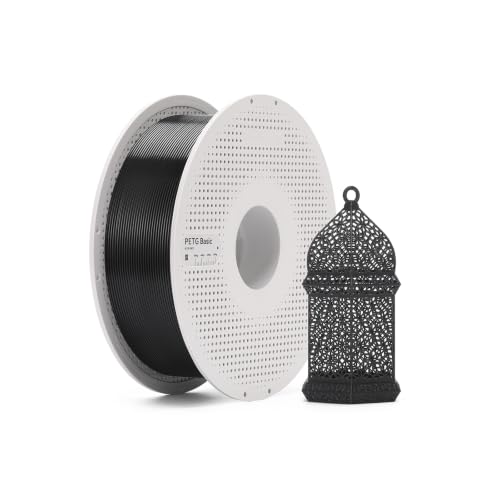
Bambu Lab PETG Basic (Black (30105), 1.75 mm, 1 kg, with spool)
- Best for
- Functional and outdoor-use parts on Bambu Lab printers and AMS.
- Skip this if
- The part needs heat resistance above about 68 °C (TDS HDT at 1.8 MPa).
Specs, strengths, and limitations
- Material
- PETG
- Diameter
- 1.75 mm
- Net filament
- 1000 g (filament only, not packaged weight)
- Format
- plastic spool
- Maker's nozzle range
- 230–260 °C
- Manufacturer states the upgraded formula delivers PLA-level strength while keeping PETG toughness.
- Manufacturer states enhanced resistance to water, UV, and temperature for outdoor accessories.
- Manufacturer states the refined formula reduces stringing.
- Heat resistance tops out around 68 °C: the TDS lists HDT 68 °C at 1.8 MPa (71 °C at 0.45 MPa).
- Needs drying and storage below 20% RH per the TDS; the ABS spool is rated only to 70 °C.

Polymaker PETG (Black, 1.75 mm, 1 kg (new formula))
- Best for
- Functional brackets and fixtures, indoors or in shade, that need more toughness than PLA.
- Skip this if
- You can't keep filament dry, or the part needs heat resistance well above 65 °C (TDS HDT at 1.8 MPa).
Specs, strengths, and limitations
- Material
- PETG (high-flow)
- Diameter
- 1.75 mm
- Net filament
- 1000 g (filament only, not packaged weight)
- Format
- cardboard spool
- Maker's nozzle range
- 240–260 °C
- Manufacturer states it is less brittle and more impact-resistant than PLA.
- Manufacturer states it prints without an enclosure and works with AMS and multi-material systems.
- Manufacturer states a high-flow formulation for speeds up to 300 mm/s with a 0.4 mm nozzle.
- Moisture-sensitive: the TDS recommends drying at 60 °C for 6 h and printing from a dry box.
- Heat resistance is limited: the TDS lists HDT 65 °C at 1.8 MPa (69 °C at 0.45 MPa).
- Cardboard spool: Polymaker says its spools have hardened edges that work in the AMS, but Bambu Lab's general AMS guidance recommends an adapter or ring for cardboard spools. Check your unit.
Verdict: which should you buy?
Choose Bambu Lab PETG Basic if…
- You print on a Bambu Lab printer and want the AMS to read settings from the spool's RFID tag.
- You want a plastic spool that matches the AMS's documented spool size without an adapter.
- You print in an enclosed printer and want a data sheet that lists a chamber range and four nozzle sizes.
Choose Polymaker PETG if…
- You want a PETG its maker sells as high-flow, with up to 300 mm/s on a standard 0.4 mm nozzle.
- You print on an open-frame or non-Bambu printer and want a maker that says no enclosure is needed.
- You prefer a cardboard spool and are happy to check its fit in your feeder, or add an adapter if your material system's maker recommends one.
Safety and limits
How this page was checked
Every temperature, speed, drying setting, spool detail, and test figure above comes from the manufacturer documents in the sources section, retrieved on 2026-10-09. We haven't printed with either filament for this page, so nothing here is a measured result of ours. Values vary by color and revision, and makers do reformulate, so check the current data sheet for your spool. Read more in our editorial standards and affiliate disclosure.
PETG: what to check before you buy a spool ↗Sources
- Bambu PETG Basic Technical Data Sheet V3.0, Bambu Lab
- PETG Basic (Bambu Lab US Store), Bambu Lab
- Polymaker PETG Technical Data Sheet V3.0, Polymaker
- Polymaker PETG product page, Polymaker
- Polymaker transitions all filaments onto 100% recycled cardboard spools, Polymaker
- Filament guide: printer, nozzle, AMS, build plate and glue compatibility, Bambu Lab
- Notes for AMS, Bambu Lab
This page is research-based: we have not tested the products or methods ourselves. It draws on the manufacturer documentation and sources listed. Exact settings and fit always defer to your printer and filament makers.
Keep reading

PLA vs PETG: Choosing for the Actual Project
How to choose between PLA and PETG by what the part has to do: heat, stiffness, toughness, print ease, stringing, and build-plate release.
Which Filaments Work in Bambu's AMS and AMS lite
Bambu's own rules for the AMS and AMS lite: unsupported materials, TPU, damp or brittle filament, cardboard spools, spool sizes, and the external spool route.

Filament dryer vs dry box: drying and storage explained
A dry box keeps dry filament dry; a dryer removes moisture that is already in it. How to tell which problem you have, and what to do safely.