Best PETG Filament (2026): Functional-Part Spools by Printer
The best PETG filament for functional parts: standard and high-speed 1.75 mm spools matched on maker data for temperatures, drying, spools and build plates.
On this page (15 sections)
For most printers, start with Polymaker PETG (new formula): it has a full data sheet, and Polymaker says it needs no enclosure and works with AMS and other multi-material systems. Prusament PETG publishes the most detailed tolerance data, at 1.75 ± 0.02 mm. On a Bambu Lab printer, Bambu Lab PETG Basic comes on an AMS-ready plastic spool. For high-speed machines, ELEGOO PETG HF and ELEGOO Rapid PETG are listed for speeds below 600 mm/s, and Creality Hyper PETG is Creality's fast grade. eSUN PETG suits outdoor fixtures but needs the hottest bed here, and Overture High Speed PETG is a TDS-backed option on a cardboard spool. The makers that publish heat figures put these grades in the same broad heat band, so the fit rule is practical: choose the spool whose temperatures, drying advice, spool format and smooth-PEI guidance match your printer.
Quick picks
| Need | Pick | Why |
|---|---|---|
| Default for most printers | Polymaker PETG (new formula) | Full TDS; Polymaker says it needs no enclosure and works with AMS and other multi-material systems |
| Documented diameter tolerance | Prusament PETG | 1.75 ± 0.02 mm, with measured data published for individual spools |
| For a Bambu AMS | Bambu Lab PETG Basic | TDS lists AMS, AMS 2 Pro, AMS HT and AMS Lite; ships on a plastic spool |
| For high-speed printers | ELEGOO PETG HF | Speeds below 600 mm/s at the usual 230–260 °C PETG nozzle range |
| Outdoor fixtures | eSUN PETG | eSUN marks it UV resistant and says it withstands sun and rain, within PETG's heat limits |
Picks are matched to documented needs, not scored.
Who is this PETG shortlist for?
This page is for people printing brackets, enclosures, clips, mounts, and other working parts. These parts need more toughness or warmth tolerance than PLA, but the material should still print on an open-frame machine. If you're still deciding between materials, start with PLA vs PETG. If the part will sit in direct sun or a hot car, see the alternatives section below first.
PETG grades are not interchangeable. Each brand tunes its own formula, and the settings below are that maker's numbers for that exact product. Read them as starting points for your own printer.
| Product | Best for | Skip if | Link |
|---|---|---|---|
| Polymaker PETG (Black, 1.75 mm, 1 kg (new formula)) | Functional brackets and fixtures, indoors or in shade, that need more toughness than PLA. | You can't keep filament dry, or the part needs heat resistance well above 65 °C (TDS HDT at 1.8 MPa). | View on Amazon (opens Amazon in a new tab) |
| Prusa Research Prusament PETG (Jet Black, 1.75 mm, 1 kg) | Functional parts, brackets, and larger prints that need more toughness than PLA. | The part needs heat resistance above about 68 °C (TDS HDT at 0.45 and 1.8 MPa), or you want a matte finish that hides layer lines. | View on Amazon (opens Amazon in a new tab) |
| Bambu Lab PETG Basic (Black (30105), 1.75 mm, 1 kg, with spool) | Functional and outdoor-use parts on Bambu Lab printers and AMS. | The part needs heat resistance above about 68 °C (TDS HDT at 1.8 MPa). | View on Amazon (opens Amazon in a new tab) |
| eSUN PETG (Solid Black, 1.75 mm, 1 kg) | Everyday PETG for outdoor and functional parts from a long-established brand. | Your bed can't reach 75 °C or the part needs heat resistance above about 60 °C (TDS heat distortion temperature 64 °C at 0.45 MPa). | View on Amazon (opens Amazon in a new tab) |
| Overture High Speed PETG (Black, 1.75 mm, 1 kg) | Budget functional parts and outdoor fixtures that need more toughness than PLA. | You need a plastic spool, or heat resistance above about 70 °C (Vicat 75 °C on the TDS, 85.1 °C in the FAQ; no HDT published). | View on Amazon (opens Amazon in a new tab) |
| ELEGOO PETG HF (Black, 1.75 mm, 1 kg) | Fast everyday PETG on high-speed printers, at the usual PETG temperature range. | You can't dry filament before printing, or need heat resistance above about 65 °C (product page HDT 69 °C at 0.45 MPa). | View on Amazon (opens Amazon in a new tab) |
| ELEGOO Rapid PETG (Black, 1.75 mm, 1 kg) | Fast functional PETG prints on high-speed printers. | Your hotend can't hold 260–270 °C, or you can't dry filament before printing. | View on Amazon (opens Amazon in a new tab) |
| Creality Hyper PETG (Black, 1.75 mm, 1 kg) | Fast PETG prints on Creality K-series and other high-speed printers. | You want a fully documented filament or feed from a CFS/AMS without a spool adapter. | View on Amazon (opens Amazon in a new tab) |



How we chose and checked these
Every product had to meet these criteria:
- A verified, exact variant. Each one is a specific color and 1 kg size, matched to the manufacturer's own listing. That includes the model or SKU where the maker publishes one.
- Current manufacturer specifications. Most makers publish a technical data sheet (TDS), and ELEGOO publishes a full spec table on each product page. We checked each one on 2026-10-06 for nozzle and bed ranges, drying settings, and heat figures. Creality is the exception: its Hyper PETG settings come from the spool label in Creality's own product photo, and we flag that gap in its section.
- Published build-surface and drying guidance where it exists. PETG's two most common problems are bonding too hard to smooth PEI and stringing from damp filament. Prusa's PETG guide lists both.
- Spool information. This matters for dryers and automatic material systems.
Black is used for every spool. Other colors can differ slightly, so check the listing for the color you buy.
A note on the heat numbers
The heat figures on this page and on the product cards use different test loads (0.45 MPa or 1.8 MPa) or a different test altogether (Vicat softening), so they aren't directly comparable from one brand to the next. Each figure below names its load or method.
Polymaker, Prusa, and Bambu (for PETG Basic) test HDT to ISO 75 at two loads. Compare figures at the same load only:
| Product | HDT at 0.45 MPa | HDT at 1.8 MPa | How the heat specimens were printed (per TDS) |
|---|---|---|---|
| Polymaker PETG | 69 °C | 65 °C | Not stated (its printing settings cover the tensile, bending, and impact bars: 240 °C nozzle, fan off) |
| Prusament PETG | 68 °C | 68 °C | Not stated (its printing footnote covers the mechanical test bars: 250 °C nozzle, Original Prusa i3 MK3) |
| Bambu PETG Basic | 71 °C | 68 °C | "All the specimens": 255 °C nozzle, X1-Carbon |
Each maker printed its test specimens differently, so a gap of two or three degrees shouldn't decide your purchase. All three sit in the same broad band. If your part may get close to 65 °C, PETG is the wrong material. Prusa's datasheet says its values depend heavily on print settings. Polymaker's says its typical values aren't for design specifications. Bambu's says real model performance depends on printer, settings, and geometry.
The other makers publish fewer or different figures, and our records don't confirm the test standard for each, so treat these as rough guides only:
| Product | Published heat figure |
|---|---|
| eSUN PETG | HDT 64 °C at 0.45 MPa |
| Overture High Speed PETG | Vicat softening 75 °C (TDS) or 85.1 °C (product page FAQ), a different test from HDT |
| ELEGOO PETG HF | HDT 69 °C at 0.45 MPa; Vicat 70 °C |
| ELEGOO Rapid PETG | HDT 72 °C at 0.45 MPa; Vicat 70 °C |
| Creality Hyper PETG | None published |
Polymaker PETG (new formula)
Polymaker sells two PETG lines on the same store page. This pick is the newer Polymaker PETG, which the store labels "New Formula." It is not the older PolyLite PETG, which the store now marks "Old Formula." The two have different settings. Polymaker's PETG TDS V3.0 for the new formula lists 240 to 260 °C at the nozzle, a 60 to 70 °C bed, and 20 to 60% part cooling. Older PolyLite PETG guidance is cooler and uses less fan, so don't reuse an old profile without checking.
Polymaker describes this grade as high-flow: up to 300 mm/s with a 0.4 mm nozzle per the TDS. The product page says over 500 mm/s is possible only with high-flow nozzles. The product page also says it needs no enclosure and works with AMS and other multi-material systems. Its FAQ says Polymaker spools now have hardened edges for AMS use.
For build plates, the TDS recommends PC or textured PEI. The product page says to use a thin layer of glue stick as a release layer on smooth PEI or glass. Polymaker gives drying as 60 °C for 6 hours. It "highly" recommends printing and storing from its PolyBox or PolyDryer box, and the store FAQ calls PETG "very hygroscopic."

Polymaker PETG (Black, 1.75 mm, 1 kg (new formula))
- Best for
- Functional brackets and fixtures, indoors or in shade, that need more toughness than PLA.
- Skip this if
- You can't keep filament dry, or the part needs heat resistance well above 65 °C (TDS HDT at 1.8 MPa).
Specs, strengths, and limitations
- Material
- PETG (high-flow)
- Diameter
- 1.75 mm
- Net filament
- 1000 g (filament only, not packaged weight)
- Format
- cardboard spool
- Maker's nozzle range
- 240–260 °C
- Manufacturer states it is less brittle and more impact-resistant than PLA.
- Manufacturer states it prints without an enclosure and works with AMS and multi-material systems.
- Manufacturer states a high-flow formulation for speeds up to 300 mm/s with a 0.4 mm nozzle.
- Moisture-sensitive: the TDS recommends drying at 60 °C for 6 h and printing from a dry box.
- Heat resistance is limited: the TDS lists HDT 65 °C at 1.8 MPa (69 °C at 0.45 MPa).
- Cardboard spool: Polymaker says its spools have hardened edges that work in the AMS, but Bambu Lab's general AMS guidance recommends an adapter or ring for cardboard spools. Check your unit.
Who should skip it: readers who can't keep filament dry while printing, and anyone with a dryer or feeder that doesn't handle cardboard spools well. Check your dryer or AMS maker's guidance on cardboard before buying.
Prusament PETG
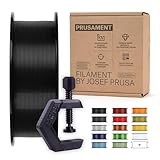
Prusament PETG is made by Prusa Polymers. Its datasheet (v1.1) is the most detailed on this page about tolerance. It lists 1.75 ± 0.02 mm, and Prusa publishes measured data for individual spools. The TDS lists a nozzle at 250 ± 10 °C, a heatbed at 80 ± 10 °C, 50% cooling, and print speeds up to 200 mm/s. Prusa's PETG guide doesn't call for an enclosure.
Prusa is the most explicit maker about smooth PEI. The TDS lists satin and powder-coated sheets, and smooth PEI only "with a glue stick." Prusa's PETG guide warns: "Do not print on the smooth PEI sheet as the adhesion may be too strong!" The product page lists stringing ("may require occasional drying"), poor bridging, and a glossy surface that highlights imperfections as limitations. For drying, Prusa's drying guide gives 55 °C for 6 hours for PETG.
Prusa says its spools are recycled polycarbonate. Spools made from October 2025 carry an OpenPrintTag NFC tag, but stock sold through Amazon may be on either the older or newer spool design.

Prusa Research Prusament PETG (Jet Black, 1.75 mm, 1 kg)
- Best for
- Functional parts, brackets, and larger prints that need more toughness than PLA.
- Skip this if
- The part needs heat resistance above about 68 °C (TDS HDT at 0.45 and 1.8 MPa), or you want a matte finish that hides layer lines.
Specs, strengths, and limitations
- Material
- PETG
- Diameter
- 1.75 mm
- Net filament
- 1000 g (filament only, not packaged weight)
- Format
- plastic spool
- Maker's nozzle range
- 240–260 °C
- Manufacturer states high strength and durability with low shrinking and warping.
- Manufacturer states diameter precision of ±0.02 mm and publishes measured data for every spool.
- Manufacturer states it is easier to sand than PLA.
- Prusa lists possible stringing that may require occasional drying, and poor bridging.
- Strong bed adhesion: Prusa warns to take care removing prints, recommends textured, satin or PP sheets, and says to avoid smooth PEI (glue stick if used).
- Heat resistance tops out around 68 °C: the TDS gives HDT 68 °C at both 0.45 and 1.8 MPa.
Who should skip it: anyone who wants a matte surface to hide layer lines, or whose only plate is smooth PEI and who would rather not use glue as a release layer.
Bambu Lab PETG Basic
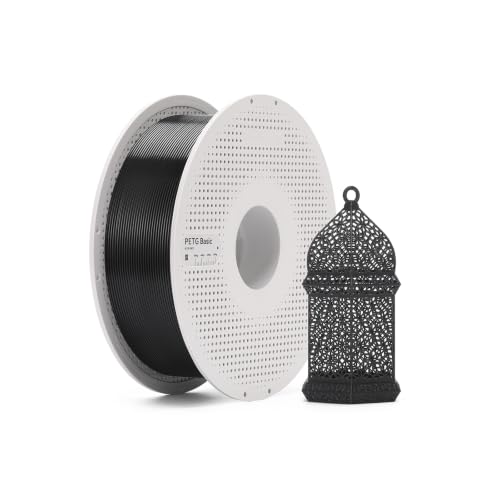
This is the black PETG Basic with spool (color code 30105), not the refill. Bambu sells the refill separately and notes it must be used with a spool. Bambu's PETG Basic TDS V3.0 lists 230 to 260 °C at the nozzle, a 65 to 75 °C bed, and 0 to 60% cooling. It lists Cool Plate SuperTack, Textured PEI, and Smooth PEI as compatible plates, and glue stick or liquid glue as "Recommended."
Bambu's broader filament guide says PETG is "Not recommended" on its regular Cool Plate or PLA Plate. Don't confuse that with SuperTack. It also recommends an enclosed printer for PETG, to keep low ambient temperatures from weakening layer bonds. On enclosed machines, Bambu advises opening the front door or removing the top glass when the heatbed is set above 60 °C for PETG, so the filament doesn't soften in the extruder.
The TDS lists compatibility with all Bambu printers and with AMS, AMS 2 Pro, AMS HT, and AMS Lite. The spool is ABS rated to 70 °C, 200 mm in diameter and 67 mm tall. Bambu's drying settings are 65 °C for 8 hours in a blast drying oven or in AMS 2 Pro and AMS HT. Printing and storage should stay below 20% RH, sealed with desiccant. Bambu says the formula delivers "PLA-level strength," resists water and UV, and reduces stringing. Those are Bambu's own claims.
Bambu Lab's US store says its PETG HF "is discontinued and will not be restocked once sold out" and points buyers to PETG Basic, so we no longer list PETG HF here.
Bambu Lab PETG Basic (Black (30105), 1.75 mm, 1 kg, with spool)
- Best for
- Functional and outdoor-use parts on Bambu Lab printers and AMS.
- Skip this if
- The part needs heat resistance above about 68 °C (TDS HDT at 1.8 MPa).
Specs, strengths, and limitations
- Material
- PETG
- Diameter
- 1.75 mm
- Net filament
- 1000 g (filament only, not packaged weight)
- Format
- plastic spool
- Maker's nozzle range
- 230–260 °C
- Manufacturer states the upgraded formula delivers PLA-level strength while keeping PETG toughness.
- Manufacturer states enhanced resistance to water, UV, and temperature for outdoor accessories.
- Manufacturer states the refined formula reduces stringing.
- Heat resistance tops out around 68 °C: the TDS lists HDT 68 °C at 1.8 MPa (71 °C at 0.45 MPa).
- Needs drying and storage below 20% RH per the TDS; the ABS spool is rated only to 70 °C.
Who should skip it: anyone who needs heat resistance near 68 °C (HDT at 1.8 MPa), and anyone whose dryer runs hotter than the spool's 70 °C rating.
eSUN PETG
eSUN PETG (Solid Black) is a standard grade with a dated data sheet. eSUN's TDS V2.0 (July 2025) lists a 230–260 °C nozzle, 100% fan, and a speed below 150 mm/s. It needs the hottest bed on this page, at 75–90 °C. eSUN's TDS marks it UV resistant, and its product page says it withstands sun and rain outdoors. That suits outdoor fixtures, within PETG's heat limits. Heat distortion is 64 °C at 0.45 MPa. Drying is 60 °C for more than 8 hours.
eSUN's own numbers vary between documents. The product page gives a 240–260 °C nozzle, and the page describes a "new formula" while the Amazon listing is an older one whose text may predate it. eSUN doesn't state the spool material for this product.

eSUN PETG (Solid Black, 1.75 mm, 1 kg)
- Best for
- Everyday PETG for outdoor and functional parts from a long-established brand.
- Skip this if
- Your bed can't reach 75 °C or the part needs heat resistance above about 60 °C (TDS heat distortion temperature 64 °C at 0.45 MPa).
Specs, strengths, and limitations
- Material
- PETG
- Diameter
- 1.75 mm
- Net filament
- 1000 g (filament only, not packaged weight)
- Format
- other
- Maker's nozzle range
- 230–260 °C
- Manufacturer states it combines PLA's easy printing with ABS's toughness.
- Manufacturer TDS lists UV resistance, and the product page states it withstands sun and rain outdoors.
- Manufacturer publishes a dated TDS with print and drying settings.
- Needs a hot bed: the TDS lists 75–90 °C build platform temperature.
- Heat resistance is limited: the TDS lists a heat distortion temperature of 64 °C (0.45 MPa).
- eSUN's own guidance varies between its TDS and product page (nozzle 230 vs 240 °C start).
Skip it if your bed can't reach 75 °C, or the part needs heat resistance above about 60 °C (eSUN lists heat distortion at 64 °C at 0.45 MPa).
Overture High Speed PETG
Overture states its PETG combines PLA's ease with ABS's strength and impact resistance, and lists excellent weather and water resistance. Its product page and TDS V5.2 give a 230–260 °C nozzle and a 65–70 °C bed, and the TDS recommends Overture's own build surface or textured PEI. The TDS gives a Vicat softening temperature of 75 °C, while the FAQ on its product page gives 85.1 °C, and Overture doesn't explain the difference. Vicat is a different test from the HDT figures above.
Drying needs care. Overture says to dry at 60 °C for 5 hours and warns that over-drying can make the filament brittle, so don't leave it in the dryer longer. Both the product page and the TDS list a printing speed below 300 mm/s, and the TDS bases its settings on a 0.4 mm nozzle. It ships on cardboard, per Overture's FAQ, which suggests a reusable spool adapter designed for cardboard spools if you prefer plastic.

Overture High Speed PETG (Black, 1.75 mm, 1 kg)
- Best for
- Budget functional parts and outdoor fixtures that need more toughness than PLA.
- Skip this if
- You need a plastic spool, or heat resistance above about 70 °C (Vicat 75 °C on the TDS, 85.1 °C in the FAQ; no HDT published).
Specs, strengths, and limitations
- Material
- PETG
- Diameter
- 1.75 mm
- Net filament
- 1000 g (filament only, not packaged weight)
- Format
- cardboard spool
- Maker's nozzle range
- 230–260 °C
- Manufacturer states it combines the ease of PLA with the strength and impact resistance of ABS.
- Manufacturer states excellent weather and water resistance for outdoor use.
- Manufacturer publishes a TDS with mechanical data and drying settings.
- Moisture-sensitive: Overture says to keep it dry and to dry at 60 °C for 5 h, warning that over-drying makes it brittle.
- Heat resistance is limited: the TDS lists Vicat softening at 75 °C; the product FAQ and wiki give 85.1 °C.
- Ships on a cardboard spool; Overture's FAQ suggests a reusable spool adapter if you prefer plastic.
Skip it if you need a plastic spool for an AMS, or a documented high-speed profile.
ELEGOO PETG HF
PETG HF is ELEGOO's high-flow PETG at the usual PETG temperatures. ELEGOO's product page lists a 230–260 °C nozzle, a 65–75 °C bed with glue recommended, no enclosure needed, and speeds below 600 mm/s, while recommending moderate speeds for the most consistent quality. Heat deflection is 69 °C at 0.45 MPa. It suits fast functional printing on high-speed machines whose hotends top out around 260 °C.
ELEGOO says drying is required before use, at 60 °C for 8 hours. The spool is cardboard. ELEGOO notes that an AMS can rub the paper spool, and offers a printable ring.

ELEGOO PETG HF (Black, 1.75 mm, 1 kg)
- Best for
- Fast everyday PETG on high-speed printers, at the usual PETG temperature range.
- Skip this if
- You can't dry filament before printing, or need heat resistance above about 65 °C (product page HDT 69 °C at 0.45 MPa).
Specs, strengths, and limitations
- Material
- PETG (high-flow)
- Diameter
- 1.75 mm
- Net filament
- 1000 g (filament only, not packaged weight)
- Format
- cardboard spool
- Maker's nozzle range
- 230–260 °C
- Manufacturer states it supports print speeds up to 600 mm/s with smooth extrusion.
- Manufacturer lists it as impact resistant and easy to print.
- Manufacturer publishes full print settings and mechanical data on the product page.
- ELEGOO says drying is required before use (60 °C for 8 h).
- Heat resistance is limited: the product page lists a heat deflection temperature of 69 °C (0.45 MPa).
- ELEGOO says the AMS can rub the spool's paper tray and cause it to delaminate; it offers a printable ring.
Skip it if you can't dry filament before printing, or need heat resistance above about 65 °C (HDT 69 °C at 0.45 MPa).
ELEGOO Rapid PETG
Rapid PETG is ELEGOO's other fast grade, and it runs hotter. ELEGOO lists a 240–270 °C nozzle, a 65–75 °C bed with glue recommended, speeds below 600 mm/s, and no enclosure required, with a 25–50 °C chamber. It states low warping and shrinkage and water and weather resistance. Heat deflection is 72 °C at 0.45 MPa, although test methods differ between makers.
ELEGOO says drying is required before use, at 60 ± 5 °C for 8 hours. It ships on ELEGOO's cardboard spool, with the same printable ring offered for AMS use.

ELEGOO Rapid PETG (Black, 1.75 mm, 1 kg)
- Best for
- Fast functional PETG prints on high-speed printers.
- Skip this if
- Your hotend can't hold 260–270 °C, or you can't dry filament before printing.
Specs, strengths, and limitations
- Material
- PETG (high-speed)
- Diameter
- 1.75 mm
- Net filament
- 1000 g (filament only, not packaged weight)
- Format
- cardboard spool
- Maker's nozzle range
- 240–270 °C
- Manufacturer states it supports printing speeds up to 600 mm/s.
- Manufacturer states low warping and shrinkage, and lists it as water and weather resistant for outdoor use.
- Manufacturer states dimensional accuracy of ±0.02 mm.
- ELEGOO says drying is required before use (60 °C for 8 h).
- Runs hotter than most PETG: ELEGOO lists a 240–270 °C nozzle.
- Cardboard spool may rub and delaminate in an AMS; ELEGOO offers a printable ring.
Skip it if your hotend can't hold 260–270 °C, or you can't dry filament before printing.
Creality Hyper PETG
Hyper PETG is Creality's high-speed grade, and its documentation is the thinnest on this page. Creality's store page has no spec table or TDS. The figures come from the spool label in Creality's own product photo: 220–260 °C nozzle, 60–80 °C bed, 50% fan, 30–600 mm/s, and 1 kg net. Creality's materials buying guide gives a lower speed, "up to 300mm/s." Creality states high toughness, impact and chemical resistance, and weather resistance. It suits Creality K-series and other fast printers fed from a regular spool holder.
Creality publishes no drying setting or heat figure for it. Creality doesn't state the spool material in text; its product images show a spool printed "Spool made from recycled material." On its Hyper PLA page, Creality says paper spools aren't recommended in the CFS or other multi-color boxes.

Creality Hyper PETG (Black, 1.75 mm, 1 kg)
- Best for
- Fast PETG prints on Creality K-series and other high-speed printers.
- Skip this if
- You want a fully documented filament or feed from a CFS/AMS without a spool adapter.
Specs, strengths, and limitations
- Material
- PETG (high-speed)
- Diameter
- 1.75 mm
- Net filament
- 1000 g (filament only, not packaged weight)
- Format
- other
- Maker's nozzle range
- 220–260 °C
- Manufacturer states quick printing; the spool label lists 30–600 mm/s, while a store image and Creality's buying guide give 300 mm/s.
- Manufacturer states high toughness and impact resistance, and excellent chemical resistance.
- Manufacturer states it is waterproof and weather resistant.
- Creality publishes no TDS: heat resistance and drying settings are undocumented.
- Creality doesn't state the spool material; its Hyper PLA page says paper spools aren't recommended in the CFS or other multi-color boxes.
Skip it if you want a fully documented filament, or you plan to feed it from a CFS or AMS without an adapter.
What should you check before buying PETG?
Before buying any of these, check your own hardware against the maker's data rather than assuming fit:
- Diameter. Every spool here is 1.75 mm. They won't work in a 2.85 mm printer.
- Hotend temperature. The upper end of most ranges here is 260 °C, and Prusament's centre point is 250 °C. ELEGOO Rapid PETG goes to 270 °C. Confirm your hotend's rated maximum in your printer maker's documentation.
- Bed temperature. The ranges run from 60 °C (Polymaker and Creality) to 90 °C (Prusament's upper tolerance and eSUN, whose range starts at 75 °C). A heated bed is needed.
- Build surface. Polymaker, Prusa, and Bambu call for a textured or alternative surface, or glue as a release layer, on smooth PEI. Overture recommends its own build surface or textured PEI, and ELEGOO recommends glue. eSUN and Creality don't publish plate guidance for these products. See textured vs smooth build surfaces and the Build plates: what to check before you buy ↗. If you use glue, how to clean a build plate covers removing the residue.
- Spool format. Polymaker, Overture, and ELEGOO use cardboard spools, while Prusament and Bambu PETG Basic use plastic. Creality doesn't state Hyper PETG's spool material in text; its product images show a spool printed "Spool made from recycled material." eSUN doesn't state its spool material. Bambu publishes its spool size, and Overture's PETG wiki page gives its spool as 200 mm across and 65.6 mm high with a 55 mm hub, but the others don't publish dimensions for these listings. Check that the spool fits your dryer or automatic material system.
- Nozzle. These are unfilled PETG, and Bambu's filament guide says unfilled PETG doesn't need a hardened nozzle. Our worn nozzle guide covers which filaments do wear nozzles.
How should you dry and store PETG?
The makers disagree on drying, so use the figures for your spool. Prusa gives 55 °C for 6 hours, Polymaker gives 60 °C for 6 hours, Overture 60 °C for 5 hours (and warns that over-drying causes brittleness), eSUN 60 °C for more than 8 hours, ELEGOO 60 °C for 8 hours (± 5 °C for Rapid PETG, and required before use for both its grades), and Bambu 65 °C for 8 hours for PETG Basic. Creality publishes no drying setting for Hyper PETG. Bambu's general filament guide rates standard PETG drying as "Recommended." Polymaker treats its grade as very hygroscopic. Damp PETG tends to string and bubble, so dry the spool before you change retraction settings. Our stringing guide covers the other causes one change at a time, and PETG printing problems covers sticking, blobs and weak layers.
A dedicated dryer or dry box is the practical choice. Prusa notes that home ovens often can't hold a low enough temperature precisely. See filament dryer vs dry box and the Dryers & dry boxes: what to check before you buy ↗.
Alternatives
- PLA suits indoor parts at room temperature where stiffness and easy printing matter more than toughness. See our PLA filament shortlist and the PLA hub.
- ASA is worth considering for parts in strong sun or real heat. It runs hotter and generally needs an enclosure; Bambu's guide lists 90 to 100 °C beds and enclosed printers for ASA. Read ABS vs ASA first.
- Not sure what you need? The filament finder narrows materials by use case.
How this page was checked
This is a research-based shortlist. We haven't printed these spools for this page, and nothing here comes from our own test prints. Every setting, heat figure and spool detail above comes from the manufacturer documents in the sources section, checked on 2026-10-06. Check the current data sheet for your spool before relying on a number. Read more about our process in our editorial standards and affiliate disclosure.
PETG: what to check before you buy a spool ↗Head-to-head comparisons
Deciding between two products on this page? Each comparison puts both makers’ specs side by side and says who should choose which.
Sources
- Overture FAQs, Overture
- PETG | Overture Wiki, Overture
- The Buying Guide for Creality 3D Printing Materials, Creality
- Polymaker PETG product page, Polymaker
- Polymaker PETG Technical Data Sheet V3.0, Polymaker
- Prusament PETG Jet Black 1kg, Prusa Research
- Prusament PETG technical datasheet (v1.1), Prusa Polymers
- Bambu PETG Basic Technical Data Sheet V3.0, Bambu Lab
- Filament guide material table, Bambu Lab
- PETG material guide, Prusa Research
- Drying filament, Prusa Research
- eSUN PETG Filament Technical Data Sheet V2.0, eSUN
- eSUN PETG product page, eSUN
- Overture High Speed PETG 3D Printer Filament 1.75mm, Overture
- Overture PETG Technical Data Sheet V5.2, Overture
- ELEGOO PETG HF product page, ELEGOO
- ELEGOO Rapid PETG product page, ELEGOO
- Hyper Series PETG 3D Printing Filament 1kg, Creality
- Hyper Series PLA 3D Printing Filament 1kg, Creality
This page is research-based: we have not tested the products or methods ourselves. It draws on the manufacturer documentation and sources listed. Exact settings and fit always defer to your printer and filament makers.
Keep reading

PLA vs PETG: Choosing for the Actual Project
How to choose between PLA and PETG by what the part has to do: heat, stiffness, toughness, print ease, stringing, and build-plate release.
Stringing troubleshooting: moisture, temperature, and motion settings
How to diagnose stringing and oozing one change at a time: check filament moisture, nozzle temperature, retraction, and travel settings before buying parts.

Filament dryer vs dry box: drying and storage explained
A dry box keeps dry filament dry; a dryer removes moisture that is already in it. How to tell which problem you have, and what to do safely.