Which Filaments Work in Bambu's AMS and AMS lite
Bambu's own rules for the AMS and AMS lite: unsupported materials, TPU, damp or brittle filament, cardboard spools, spool sizes, and the external spool route.
On this page (10 sections)
Bambu Lab's AMS and AMS lite are built for standard PLA and PETG, and Bambu's own filament guide lists both as compatible. Spools must also fit: Bambu gives 50–68 mm wide and 197–202 mm in diameter for the AMS, and 40–68 mm wide with a 53–58 mm center hole for the AMS lite. Bambu says three kinds of filament are not recommended for either unit: filament that is too soft, such as TPU 95A and damp PVA or BVOH; filament that is too brittle; and filament that is too hard and rough, such as certain brands of carbon or glass fiber filament. The AMS lite is stricter than the AMS. For the AMS, Bambu recommends plastic spools, or an adapter for cardboard ones. Anything that doesn't qualify can still be printed from the printer's external spool holder.
Who this guide is for
This guide is for Bambu Lab owners who want to know whether a spool will feed through their AMS or AMS lite before they buy it. It covers the original AMS and the AMS lite sold with the A1 and A1 mini. Bambu's filament guide also mentions newer units, the AMS 2 Pro and AMS HT. If you own one of those, check its own documentation as well. If you're specifically buying for an A1 or A1 mini, see our A1 and A1 mini filament page. For other Bambu printers, our filament pages for the A2L, P1S and P1P, P2S, X1-Carbon and X1E, H2D and H2S and H2C include the AMS notes for each.
The three kinds of filament Bambu says to keep out
Bambu's filament guide says that "AMS and AMS lite have specific requirements for the physical properties of filaments," and that three types are not recommended:
- Too soft. Bambu's examples are "TPU 95A/85A/83A/80A, damp PVA or BVOH." It says these "cannot pass smoothly through the AMS / AMS lite channel, and can easily cause loading/unloading failures, clogging, and other issues."
- Too brittle. Bambu's examples are "certain brands of PET-CF, PLA Wood, PA-CF/GF, PAHT-CF/GF." It says these "can easily break inside the AMS / AMS lite channel."
- Too hard and rough. Bambu's examples are "certain brands of PET-CF, PA-CF/GF, PAHT-CF/GF, PLA-CF/GF." It says these "can easily wear down the internal feed channel."
Bambu adds a longer-term warning: a filament "might load and unload smoothly at first," but rough or abrasive materials, "such as carbon fiber or glow filaments, can eventually grind down the internal PTFE feed channels." Its compatibility table describes loading and unloading only, so a "Compatible" entry isn't a promise about long-term wear. For glow filament's effect on nozzles as well, see why different colors of the same filament print differently.
Is the AMS lite stricter than the AMS?
Bambu says the AMS has "an extra transmission gear that works together with the extruder gear to provide stronger feeding force," so it "can handle some softer or rougher filaments." The AMS lite lacks that mechanism. As a result, Bambu's filament guide lists PETG-CF and PLA Wood as compatible with the AMS but not recommended for the AMS lite.
The guide's compatibility table gives these entries:
| Material | AMS / AMS lite, per Bambu's filament guide |
|---|---|
| Standard PLA (including PLA Basic, Matte, Silk, Tough) | Compatible |
| PETG, PETG HF, PETG Translucent | Compatible |
| PLA-CF/GF | Bambu PLA-CF: Compatible |
| PETG-CF | AMS: Compatible. AMS lite: Not Recommended |
| PLA Glow | Not Recommended |
| PVA, BVOH (dry) | Compatible |
| TPU | Not Compatible |
| ABS, ABS-GF | AMS: Compatible. AMS lite: Not Recommended |
| ASA, PC | Compatible |
| PA-CF/GF, PAHT-CF/GF | Bambu PA-CF, PAHT-CF Compatible |
| PET-CF/GF, PPA-CF/GF, PPS-CF/GF | Not Compatible |
The table defines standard PLA as PLA without hard, large-particle fillers. It excludes PLA-CF, PLA-GF, PLA Sparkle and PLA Marble. Where an entry names a Bambu product, such as Bambu PLA-CF, it doesn't extend to other brands' versions of that material.
For ASA and PC, Bambu's own store pages are stricter than this table. The product pages for Bambu ASA, PC and PC FR each list "AMS 2 Pro, AMS HT & AMS Compatible" and "AMS lite NOT Compatible." Those pages cover Bambu's own spools, so for those three we follow the store pages.
Bambu's AMS lite store page lists "TPE, TPU, PVA (wet), BVOH (wet), Bambu PET-CF / PA6-CF / TPU 95A" and "other brand filament that contains carbon fiber or glass fiber" as unsupported. It lists Bambu PLA Glow and Bambu PETG-CF as not recommended because they "can generate loading errors and / or will cause faster wear to the AMS lite components." Bambu's older AMS lite FAQ still names Bambu PLA-CF and PETG-CF as carbon-fiber filaments that work in the AMS lite, so its own pages disagree on PETG-CF; we follow the newer store page and filament guide.
Compatibility with the AMS isn't the same as compatibility with your printer. A footnote on the AMS lite store page says that before printing, compatibility between the filament and the printer "needs to be considered." For example, Bambu's filament guide lists ABS and ASA as not recommended on open-frame printers such as the A1.
Can you use TPU in the AMS?
TPU causes more confusion than any other material. Bambu's documentation says:
- The AMS notes page says to avoid "flexible materials, including TPU, TPE, or absorbent PVA, as they may get stuck inside the AMS feed tube during printing."
- The AMS lite FAQ lists TPU that "cannot be used with AMS lite: 95A, 85A, 83A, 80A, or lower hardness," and TPU that "can be used with AMS lite: 77D, 55D, or higher hardness."
- Bambu's A1 AMS lite setup guide says to avoid TPU "(except AMS for TPU)." The A1 mini version of the same guide doesn't include that exception.
- Bambu's store page for TPU for AMS, a 68D grade, says "All AMS Series Compatible" and "Seamless AMS & AMS lite Integration." Its page for TPU 95A HF says "All AMS Series NOT Compatible."
These pages don't fully agree. The filament guide's table and the AMS lite store page list TPU as not compatible without naming TPU for AMS as an exception. The AMS lite FAQ does allow TPU of 55D or harder, but Bambu doesn't say anything similar for the AMS. TPU for AMS is the TPU Bambu itself sells for its AMS units. Treat soft TPU, 95A or lower from any brand, as an external-spool material, and check the maker's AMS guidance before loading any other TPU. Overture, for example, marks its TPU 95A "AMS & AMS lite NOT Compatible." Overture TPU 95A vs SUNLU TPU 95A covers both makers' AMS guidance. Our TPU compatibility guide explains hardness grades and feeding in more detail.

Bambu Lab TPU for AMS (Gray (53102), 1.75 mm, 1 kg, filament with spool)
- Best for
- Multicolor prints on a Bambu Lab printer with AMS where you need tough, impact-resistant TPU parts.
- Skip this if
- You need a soft, highly flexible part (85A–95A) rather than a firm 68D one.
Specs, strengths, and limitations
- Material
- TPU (AMS-compatible)
- Diameter
- 1.75 mm
- Net filament
- 1000 g (filament only, not packaged weight)
- Hardness
- 68D
- Format
- plastic spool
- Maker's nozzle range
- 220–240 °C
- Manufacturer states it is optimized for the AMS, and its store page marks it compatible with all AMS series, including the AMS lite.
- Manufacturer states it prints up to 60% faster than Bambu TPU 95A HF and greatly reduces stringing.
- Manufacturer states its RFID tag carries the print settings, which the AMS reads.
- At 68D it is much stiffer than typical 95A TPU, so parts are tough rather than soft and squishy.
- Manufacturer says it must be dried before use and kept moisture-free during printing to prevent stringing.
- Not compatible with a 0.2 mm stainless steel nozzle, per Bambu Lab's store page.
At 68D, TPU for AMS is much firmer than 95A TPU. Our comparison of TPU for AMS and TPU 95A HF goes through the two on Bambu's own data. It suits tough, impact-resistant parts, not soft and squishy ones. Bambu says to dry it before use.
Damp and brittle filament
Moisture changes how filament behaves in the feeder. Bambu's examples of "too soft" include damp PVA and BVOH, and the compatibility table lists PVA and BVOH as compatible only when dry. The AMS lite store page lists wet PVA and BVOH as unsupported. Before engineering materials go in an AMS, Bambu says to "dry the filament first."
Brittle filament snaps in the feed path. Bambu's examples include certain brands of PET-CF, PLA Wood and nylon-CF/GF blends. If a spool snaps when you bend it by hand, keep it out of the AMS and use the external spool holder. Our filament dryer vs dry box guide covers drying options, and the filament storage guide covers keeping spools dry.
Which spools fit the AMS and AMS lite?
AMS. Bambu's AMS notes say it "supports spools with a width of 50-68 mm and a diameter of 197-202 mm," and recommend Bambu filament, "which has been thoroughly tested to work with the AMS."
AMS lite. The AMS lite FAQ says it "supports spools with a width of 40-68 mm and an inner diameter of 53-58 mm." Bambu doesn't publish a maximum spool weight on the pages we checked. It does advise putting heavier spools in slots 2 and 3 and lighter ones in slots 1 and 4, which keeps the unit's center of gravity lower and more stable.
Cardboard. For the AMS, Bambu says: "We highly recommend using filament with plastic spools that fit correctly inside the AMS." If you use cardboard spools, it "strongly" advises "a Spool Adapter/Spool Adapter Ring to reduce the risk of slippage and debris getting left behind in the AMS." For the AMS lite, Bambu's store page says its spring-loaded holder "grips the spool at the center hole, improving spool compatibility especially for those paper spools." That still means checking the width and center hole.
Some filament makers address this too. ELEGOO offers a printable filament ring for its paper spools, because "AMS will rub the bottom paper tray." Polymaker says its PETG "works seamlessly with AMS and multi-material systems." ELEGOO doesn't publish spool dimensions on the product pages we checked. Polymaker's product pages don't list them either, but its FAQ does: its 1 kg cardboard spool has a 55 ± 1 mm inner hole, a 200 ± 1 mm diameter and a 65.6 ± 2 mm width, and weighs 140 ± 7 g, while its 0.75 kg cardboard spool is 50.6 ± 2 mm wide and weighs 125 ± 7 g. Check those figures against the ranges above, or measure before you load.

Polymaker PETG (Black, 1.75 mm, 1 kg (new formula))
- Best for
- Functional brackets and fixtures, indoors or in shade, that need more toughness than PLA.
- Skip this if
- You can't keep filament dry, or the part needs heat resistance well above 65 °C (TDS HDT at 1.8 MPa).
Specs, strengths, and limitations
- Material
- PETG (high-flow)
- Diameter
- 1.75 mm
- Net filament
- 1000 g (filament only, not packaged weight)
- Format
- cardboard spool
- Maker's nozzle range
- 240–260 °C
- Manufacturer states it is less brittle and more impact-resistant than PLA.
- Manufacturer states it prints without an enclosure and works with AMS and multi-material systems.
- Manufacturer states a high-flow formulation for speeds up to 300 mm/s with a 0.4 mm nozzle.
- Moisture-sensitive: the TDS recommends drying at 60 °C for 6 h and printing from a dry box.
- Heat resistance is limited: the TDS lists HDT 65 °C at 1.8 MPa (69 °C at 0.45 MPa).
- Cardboard spool: Polymaker says its spools have hardened edges that work in the AMS, but Bambu Lab's general AMS guidance recommends an adapter or ring for cardboard spools. Check your unit.
Polymaker says all its spools now have hardened edges that "roll great in the AMS." It calls this PETG "very hygroscopic," so keep it dry.
Refills and Bambu's reusable spools
Bambu sells many filaments as refills without a spool, to load onto a Bambu reusable spool. Bambu's wiki lists two types. The low-temperature spool (ABS, up to 70 °C) is for PLA and PETG. The high-temperature spool (ABS + PC, up to 90 °C) also covers ABS, ASA, PC, TPU and several fiber-filled grades. The temperature rating matters if you dry filament on the spool. Bambu's guide walks through loading a refill so the coil sits tight against the spool, which helps prevent tangles.
Bambu's PLA Basic and PETG Basic are sold with a spool, and Bambu's store pages mark both "All AMS Series Compatible." Their TDSs list a 200 mm × 67 mm ABS spool rated to 70 °C, which is within both units' width limits.
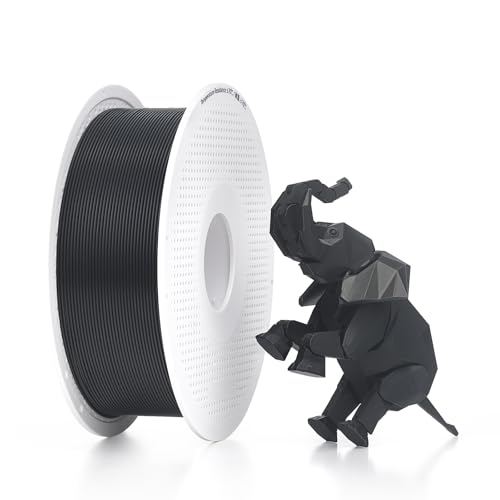
Bambu Lab PLA Basic (Black (10101), 1.75 mm, 1 kg, with spool)
- Best for
- Everyday PLA on Bambu Lab printers and AMS units (the TDS lists AMS-friendly 200 × 67 mm spool dimensions).
- Skip this if
- The part will see heat, or you'd rather buy the cheaper refill and reuse a spool.
Specs, strengths, and limitations
- Material
- PLA
- Diameter
- 1.75 mm
- Net filament
- 1000 g (filament only, not packaged weight)
- Format
- plastic spool
- Maker's nozzle range
- 190–230 °C
- Manufacturer states it is designed for high-speed printing, reaching 250–300 mm/s.
- Manufacturer states excellent toughness and Z-layer strength compared with general PLA.
- Manufacturer TDS lists AMS-friendly spool dimensions (200 mm × 67 mm).
- Not suited to parts exposed to heat: the TDS lists a heat deflection temperature of 54 °C (1.8 MPa).
- The ABS spool is rated to 70 °C, which limits drying temperature on the spool.
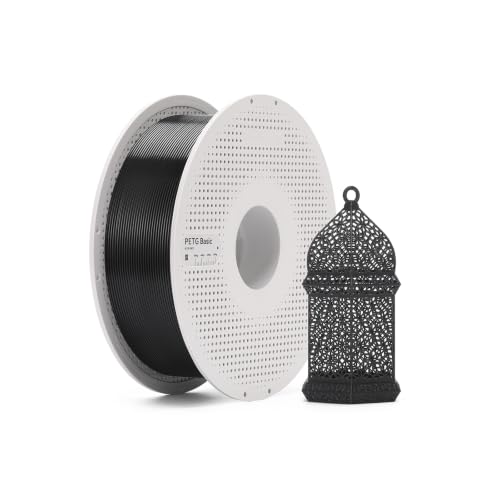
Bambu Lab PETG Basic (Black (30105), 1.75 mm, 1 kg, with spool)
- Best for
- Functional and outdoor-use parts on Bambu Lab printers and AMS.
- Skip this if
- The part needs heat resistance above about 68 °C (TDS HDT at 1.8 MPa).
Specs, strengths, and limitations
- Material
- PETG
- Diameter
- 1.75 mm
- Net filament
- 1000 g (filament only, not packaged weight)
- Format
- plastic spool
- Maker's nozzle range
- 230–260 °C
- Manufacturer states the upgraded formula delivers PLA-level strength while keeping PETG toughness.
- Manufacturer states enhanced resistance to water, UV, and temperature for outdoor accessories.
- Manufacturer states the refined formula reduces stringing.
- Heat resistance tops out around 68 °C: the TDS lists HDT 68 °C at 1.8 MPa (71 °C at 0.45 MPa).
- Needs drying and storage below 20% RH per the TDS; the ABS spool is rated only to 70 °C.
What if the AMS can't take your filament?
Use the printer's external spool holder. The filament feeds straight to the toolhead and bypasses the AMS. Bambu's A1 guide to printing from an external spool covers loading. You insert the filament into the PTFE tube, push it to the toolhead, and load it from the printer screen. Other models have their own guides, so follow the one for your printer.
You lose automatic color changes and automatic filament backup for that material. Bambu's own advice for TPU, brittle filament and fiber-filled filament on the AMS lite is to "use external spool placement."
Checklist before loading a spool
- Is the material on Bambu's compatibility list for your unit, AMS or AMS lite? Check the exact brand where Bambu names one.
- Is it TPU? If it is 95A or softer, use the external spool holder. Bambu's TPU for AMS is the exception it documents.
- Is it dry? Damp PVA and BVOH count as "too soft," and Bambu says to dry engineering materials first.
- Does it snap when bent, or feel rough? Keep brittle or abrasive filament out.
- Does the spool fit? AMS: 50–68 mm wide, 197–202 mm in diameter. AMS lite: 40–68 mm wide, 53–58 mm center hole.
- Is it cardboard? For the AMS, use an adapter or a reusable spool. For the AMS lite, check the fit, and consider the maker's ring if it offers one.
How this guide was checked
This is a research-based guide. We have not run these filaments through an AMS or AMS lite for it. Every rule, quote and dimension comes from Bambu Lab's wiki and store pages, or from the filament makers' pages listed in the sources. All were retrieved on 2026-10-07. Bambu updates its documentation as it releases new units and materials, and its pages don't always agree with each other, as noted for TPU. Check the current version for your unit. Read more in our editorial standards.
PLA: what to check before you buy a spool ↗Sources
- Filament guide: printer, nozzle, AMS, build plate and glue compatibility, Bambu Lab
- Notes for AMS, Bambu Lab
- AMS lite FAQ, Bambu Lab
- First print with AMS lite (A1), Bambu Lab
- First print with AMS lite (A1 mini), Bambu Lab
- AMS lite (store page and tech specs), Bambu Lab
- Refill filament with Bambu Reusable Spool, Bambu Lab
- First print with external spool (A1), Bambu Lab
- TPU for AMS, Bambu Lab
- TPU 95A HF, Bambu Lab
- PLA Basic, Bambu Lab
- PETG Basic, Bambu Lab
- Bambu PLA Basic Technical Data Sheet V3.0, Bambu Lab
- Bambu PETG Basic Technical Data Sheet V3.0, Bambu Lab
- Polymaker PETG product page, Polymaker
- Polymaker FAQ (Spool Questions), Polymaker
- ELEGOO PLA product page, ELEGOO
- Overture TPU 95A product page, Overture
- ASA product page, Bambu Lab
- PC product page, Bambu Lab
- PC FR product page, Bambu Lab
This page is research-based: we have not tested the products or methods ourselves. It draws on the manufacturer documentation and sources listed. Exact settings and fit always defer to your printer and filament makers.
Keep reading

TPU Compatibility: Extruder Path, Hardness, and Feeding Systems
Whether a TPU will feed in your printer depends on its Shore hardness, your extruder path, and whether it goes through an automatic material system.

Nozzles for Abrasive Filaments: Carbon Fiber, Glass Fiber, and Glow
Which filaments wear out nozzles, how brass, stainless, hardened, coated, and ruby-tipped nozzles differ, and how to find the right part for your exact hotend.

Filament dryer vs dry box: drying and storage explained
A dry box keeps dry filament dry; a dryer removes moisture that is already in it. How to tell which problem you have, and what to do safely.