Bambu Lab PLA Basic vs Polymaker PolyLite PLA
Bambu PLA Basic and Polymaker PolyLite PLA compared on maker data: temps, speed, spools, and AMS fit. Pick Bambu for fast AMS prints, PolyLite for any printer.
On this page (12 sections)
Pick Bambu Lab PLA Basic if you print fast on a Bambu Lab printer with an AMS and want a plastic spool with an RFID tag the AMS reads. Pick Polymaker PolyLite PLA if you print at moderate speeds on almost any printer and want a wider bed range and no-enclosure guidance. Both are standard PLA with the same published nozzle window, 190–230 °C, so the real differences are what each maker built them for and what they ship on. Bambu Lab says PLA Basic is designed for high-speed printing. Polymaker says PolyLite PLA is designed for reliability and ease of printing, says it isn't designed for high-speed printing, and ships it on a cardboard spool.
Who this comparison is for
This page is for anyone choosing between these two specific spools: Bambu Lab PLA Basic in Black (10101) with spool, and Polymaker PolyLite PLA in Black, both 1.75 mm and 1 kg. If you're still deciding whether PLA is the right material, start with PLA vs PETG. If you want more PLA options, the PLA filament shortlist covers twelve, and Bambu PLA Basic vs ELEGOO PLA sets PLA Basic against another everyday PLA.
| Product | Best for | Skip if | Link |
|---|---|---|---|
| Bambu Lab PLA Basic (Black (10101), 1.75 mm, 1 kg, with spool) | Everyday PLA on Bambu Lab printers and AMS units (the TDS lists AMS-friendly 200 × 67 mm spool dimensions). | The part will see heat, or you'd rather buy the cheaper refill and reuse a spool. | View on Amazon (opens Amazon in a new tab) |
| Polymaker PolyLite PLA (Black, 1.75 mm, 1 kg) | Everyday PLA prints, prototypes, and display models where a documented, easy-printing PLA is wanted. | The part will sit in a hot car, near heat sources, or needs toughness beyond standard PLA. | View on Amazon (opens Amazon in a new tab) |


How we compared them
This is a research-based comparison. Every figure below comes from the makers' own data sheets, product pages, and wikis, listed in the sources. We haven't tested either filament, so nothing here is a measured result of ours. Where a maker states something about its own product, such as being easy to print or having stronger layer adhesion, we label it as the maker's claim.
We only put numbers side by side where both makers publish the same kind of value. Where they don't, or where the test setups differ, we say so rather than force a comparison.
Side-by-side specs
| Bambu Lab PLA Basic | Polymaker PolyLite PLA | |
|---|---|---|
| Variant | Black (10101), 1.75 mm, 1 kg, with spool | Black, 1.75 mm, 1 kg |
| Nozzle temperature | 190–230 °C (TDS) | 190–230 °C (TDS) |
| Bed temperature | 35–45 °C (TDS) | 25–60 °C (TDS) |
| Build surface | Cool Plate, High Temperature Plate, or Textured PEI Plate, with glue | PC and textured PEI, glue when needed |
| Chamber or enclosure | Chamber temperature 25–45 °C (TDS) | Enclosure "No Needed" (TDS) |
| Maker's speed figure | Below 300 mm/s (TDS settings); "up to 250–300 mm/s" (TDS description) | 50–200 mm/s (TDS); 40–60 mm/s (product page print settings) |
| Drying | 50 °C for 8 h in a blast drying oven, or 60–70 °C for 12 h on an X1 Series heatbed | 55 °C for 6 h, only if the material has absorbed moisture |
| Storage | Below 20% RH, sealed with desiccant | Not stated on the pages we checked |
| Spool | Plastic (ABS, rated to 70 °C), 200 mm diameter, 67 mm high | Cardboard; dimensions not published on the product page |
| RFID tag | Yes, print settings readable by the AMS | None mentioned on Polymaker's pages |
| AMS position | Store page: "All AMS Series Compatible" | Polymaker FAQ: spools have "hardened edges that roll great in the AMS" |
| Refill without spool | Sold by Bambu Lab | Polymaker says it doesn't sell refills |
Temperatures and build plate
The nozzle windows are identical on paper, 190–230 °C in both data sheets. The bed ranges are not. Bambu lists 35–45 °C with glue on its own plates. Polymaker lists a wider 25–60 °C on PC or textured PEI, with glue only when needed, and says no enclosure is needed. Polymaker's wiki adds that PolyLite PLA has "no special requirements" and can print "on any printer in any setup." That wider window is useful if your printer's bed runs cool or warm, or you aren't on Bambu plates. Neither number is a promise for your exact printer, so start from your printer's own PLA profile.
Speed: different numbers, not a like-for-like measure
This is the clearest difference in intent, but the figures can't be compared directly. Polymaker's own pages also disagree with each other.
| Source | What it says about speed |
|---|---|
| Bambu TDS | PLA Basic "is designed for high-speed printing" and "can easily achieve printing speeds up to 250-300 mm/s" |
| Bambu store page | "up to 258mm/s" with a 0.4 mm nozzle, 0.4 mm line width, and 0.2 mm layer height |
| Polymaker TDS | 50–200 mm/s |
| Polymaker product page | 40–60 mm/s in the print settings; the spec panel shows a maximum of 60 mm/s |
| Polymaker wiki | PolyLite PLA is "not designed for high speed printing" |
Neither maker defines its speed figure the same way, so read them as each maker's guidance, not as a measured race. What is clear is the intent: Bambu tunes PLA Basic for fast printers, and Polymaker doesn't position PolyLite PLA for that.
Strength and heat figures: same standards, different specimens
Both makers publish mechanical and heat data using the same named test standards, ISO 527 for tensile, ISO 178 for bending, ISO 179 for impact, and ISO 75 and ISO 306 for heat. The specimens weren't prepared the same way, though. Bambu printed its specimens at 220 °C on a 35 °C bed at 200 mm/s and says all were annealed and dried at 55 °C for 8 hours before testing. Polymaker printed at 230 °C on a 50 °C bed, doesn't state a print speed, and leaves its annealing setting blank. Print settings and annealing both change PLA results, so these are each maker's figures, not a head-to-head.
| Same-standard figure | Bambu Lab PLA Basic | Polymaker PolyLite PLA |
|---|---|---|
| Heat deflection, ISO 75, 1.8 MPa | 54 °C | 58 °C |
| Heat deflection, ISO 75, 0.45 MPa | 57 °C | 60 °C |
| Vicat softening, ISO 306 | 57 °C | 63 °C |
| Tensile strength X-Y / Z, ISO 527 | 35 ± 4 / 31 ± 3 MPa | 52.3 ± 0.3 / 40.5 ± 0.5 MPa |
| Elongation at break X-Y, ISO 527 | 12.2 ± 1.8% | 6.3 ± 0.6% |
| Notched Charpy impact X-Y, ISO 179 | 7.9 ± 1.2 kJ/m² | 3.3 ± 0.2 kJ/m² |
Two things hold whatever the caveats. Both heat figures sit in the 50s and low 60s °C, so neither PLA is suited to a hot car, a sunny windowsill, or parts near heat. And Bambu's store-page claim of "stronger layer adhesion, enhanced impact resistance" is a comparison against "other standard PLA filaments on the market," not a published test against PolyLite PLA.
Spools and the AMS
This is the practical difference for many buyers. PLA Basic, in this listing, comes on Bambu's ABS spool, 200 mm across and 67 mm high, rated to 70 °C. That fits the AMS's documented spool range of 50–68 mm wide and 197–202 mm in diameter. Its RFID tag carries the print settings, which the AMS reads. Bambu also sells PLA Basic as a refill without a spool, which needs a reusable spool.
PolyLite PLA ships on cardboard. Polymaker moved all its filaments to recycled cardboard spools in 2021, with 4 mm pressed cardboard faces. Its FAQ answers "Is this material AMS compatible?" with "Yes! All Polymaker spools now have hardened edges that roll great in the AMS." Bambu's own AMS notes are more cautious about cardboard in general. They "highly recommend" plastic spools that fit correctly, and "strongly advise" a spool adapter or adapter ring for cardboard spools, to reduce slippage and debris. Polymaker doesn't publish the spool's dimensions on the product page, so check it against your unit. Our AMS filament compatibility guide covers spool sizes and adapters in more detail.
Drying and storage
Both makers publish drying settings, and they differ. Bambu gives 50 °C for 8 hours in a blast drying oven, or 60–70 °C for 12 hours on an X1 Series heatbed, plus storage below 20% RH with desiccant. Mind the 70 °C rating of the ABS spool if you dry on the spool. Polymaker gives 55 °C for 6 hours, and its product page says to dry only if the material has absorbed moisture. Polymaker doesn't publish a temperature rating for its cardboard spool. Check your dryer's documentation before heating either one. Our filament dryer vs dry box guide and filament storage guide cover the options.
What each maker says it's for
- Bambu Lab PLA Basic. Bambu calls it "the easiest-to-use filament" and "beginner friendly," designed for high-speed printing, with RFID settings for the AMS. Its store page says it is compatible with "all printers, AMS, build plate, and nozzles," and the TDS lists 0.2, 0.4, 0.6, and 0.8 mm nozzles.
- Polymaker PolyLite PLA. Polymaker describes it as "a high-quality PLA designed for reliability and ease of printing" that prints with standard PLA settings on any printer, with the cooling fan at full for best surface quality.
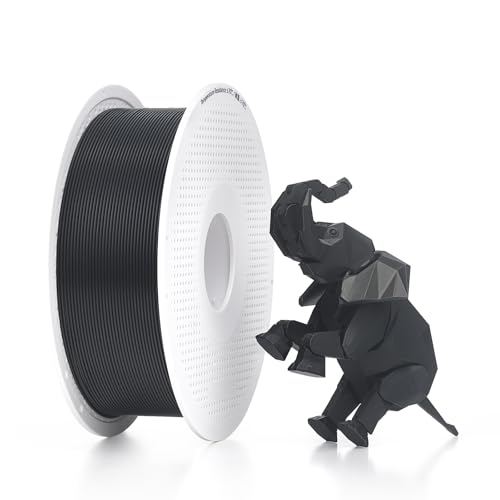
Bambu Lab PLA Basic (Black (10101), 1.75 mm, 1 kg, with spool)
- Best for
- Everyday PLA on Bambu Lab printers and AMS units (the TDS lists AMS-friendly 200 × 67 mm spool dimensions).
- Skip this if
- The part will see heat, or you'd rather buy the cheaper refill and reuse a spool.
Specs, strengths, and limitations
- Material
- PLA
- Diameter
- 1.75 mm
- Net filament
- 1000 g (filament only, not packaged weight)
- Format
- plastic spool
- Maker's nozzle range
- 190–230 °C
- Manufacturer states it is designed for high-speed printing, reaching 250–300 mm/s.
- Manufacturer states excellent toughness and Z-layer strength compared with general PLA.
- Manufacturer TDS lists AMS-friendly spool dimensions (200 mm × 67 mm).
- Not suited to parts exposed to heat: the TDS lists a heat deflection temperature of 54 °C (1.8 MPa).
- The ABS spool is rated to 70 °C, which limits drying temperature on the spool.

Polymaker PolyLite PLA (Black, 1.75 mm, 1 kg)
- Best for
- Everyday PLA prints, prototypes, and display models where a documented, easy-printing PLA is wanted.
- Skip this if
- The part will sit in a hot car, near heat sources, or needs toughness beyond standard PLA.
Specs, strengths, and limitations
- Material
- PLA
- Diameter
- 1.75 mm
- Net filament
- 1000 g (filament only, not packaged weight)
- Format
- cardboard spool
- Maker's nozzle range
- 190–230 °C
- Manufacturer states PolyLite PLA is designed for reliability and ease of printing.
- Manufacturer TDS lists no enclosure needed and a wide 190–230 °C nozzle window.
- Manufacturer publishes a full TDS with mechanical, thermal, and drying data.
- Not suited to parts exposed to heat: the TDS lists a heat deflection temperature of 58 °C (1.8 MPa).
- Cardboard spool: Polymaker says its spools have hardened edges that work in the AMS, but Bambu Lab's general AMS guidance recommends an adapter or ring for cardboard spools. Check your unit.
Verdict: which should you buy?
Choose Bambu Lab PLA Basic if…
- You print on a Bambu Lab printer and want the AMS to read settings from the spool's RFID tag.
- You run fast profiles and want a PLA its maker tunes for high-speed printing.
- You want a plastic spool that matches the AMS's documented spool size without an adapter.
Choose Polymaker PolyLite PLA if…
- You print on a non-Bambu or open-frame printer at moderate speeds, and want the wider 25–60 °C bed range.
- You prefer a cardboard spool and are happy to check its fit in your feeder, or add an adapter if your material system's maker recommends one.
- You want a full published data sheet from a maker that positions this grade for easy, reliable printing rather than speed.
Safety and limits
How this page was checked
Every temperature, speed, drying setting, spool detail, and test figure above comes from the manufacturer documents in the sources section, retrieved on 2026-10-07. We haven't printed with either filament for this page, so nothing here is a measured result of ours. Values vary by color and revision, and makers do reformulate, so check the current data sheet for your spool. Read more in our editorial standards and affiliate disclosure.
PLA: what to check before you buy a spool ↗Sources
- Bambu PLA Basic Technical Data Sheet V3.0, Bambu Lab
- PLA Basic (Bambu Lab US Store), Bambu Lab
- PolyLite PLA Technical Data Sheet V5.4, Polymaker
- PolyLite PLA product page, Polymaker
- PolyLite PLA (Polymaker wiki), Polymaker
- Polymaker transitions all filaments onto 100% recycled cardboard spools, Polymaker
- Notes for AMS, Bambu Lab
This page is research-based: we have not tested the products or methods ourselves. It draws on the manufacturer documentation and sources listed. Exact settings and fit always defer to your printer and filament makers.
Keep reading

Best PLA Filament (2026): Everyday Spools Matched to Your Printer
The best PLA filament for your printer and job: standard, tough, high-speed and matte spools with published maker data, each matched to the reader it suits.
Which Filaments Work in Bambu's AMS and AMS lite
Bambu's own rules for the AMS and AMS lite: unsupported materials, TPU, damp or brittle filament, cardboard spools, spool sizes, and the external spool route.
PLA vs PETG: Choosing for the Actual Project
How to choose between PLA and PETG by what the part has to do: heat, stiffness, toughness, print ease, stringing, and build-plate release.