Best PLA Filament (2026): Everyday Spools Matched to Your Printer
The best PLA filament for your printer and job: standard, tough, high-speed and matte spools with published maker data, each matched to the reader it suits.
On this page (19 sections)
For most printers, start with Polymaker PolyLite PLA: its data sheet lists a wide 190–230 °C nozzle window and no enclosure needed, which suits modest hotends and unheated or lightly heated beds. On a Bambu Lab printer with an AMS, choose Bambu Lab PLA Basic, which loads without adapters. For other fast machines, ELEGOO Rapid PLA+ is rated up to 600 mm/s, and Creality Hyper PLA RFID is the one for Creality's CFS. Prusament PLA suits Prusa printers and anyone who values documented diameter precision. ELEGOO PLA and Overture High Speed PLA are documented standard alternatives. For more toughness, Polymaker PolyLite PLA Pro publishes an impact figure, and eSUN PLA+ is a modified grade. For a low-gloss finish, choose Polymaker Panchroma Matte, Overture Matte PLA or Bambu Lab PLA Matte. The fit rule: match the spool to your printer's speed, feeder and spool format. None of these suits heat, sun or outdoor use.
Quick picks
| Need | Pick | Why |
|---|---|---|
| Default for most printers | Polymaker PolyLite PLA | Full TDS with a 190–230 °C nozzle, a 25–60 °C bed and no enclosure needed |
| Prusa printers and diameter precision | Prusament PLA | Prusa publishes measured data for every spool and states ±0.02 mm |
| For a Bambu AMS | Bambu Lab PLA Basic | Made for Bambu printers; the spool loads into the AMS without adapters |
| For high-speed printers | ELEGOO Rapid PLA+ | ELEGOO rates it for printing speeds up to 600 mm/s |
| Matte finish | Polymaker Panchroma Matte PLA | A smooth matte surface that helps hide layer lines |
Picks are matched to documented needs, not scored.
Who is this PLA shortlist for?
This page is for anyone buying PLA for everyday printing: display models, prototypes, organizers, and light-duty household parts. It assumes a 1.75 mm printer and a 1 kg spool. If your part will live in a car, near a heater, or outdoors, start with our PLA vs PETG guide instead. PLA softens at fairly low temperatures, and a different material may fit better. For PETG options, see the sibling PETG filament shortlist.
| Product | Best for | Skip if | Link |
|---|---|---|---|
| Polymaker PolyLite PLA (Black, 1.75 mm, 1 kg) | Everyday PLA prints, prototypes, and display models where a documented, easy-printing PLA is wanted. | The part will sit in a hot car, near heat sources, or needs toughness beyond standard PLA. | View on Amazon (opens Amazon in a new tab) |
| Prusa Research Prusament PLA (Jet Black, 1.75 mm, 1 kg) | Precise everyday PLA prints, especially on Prusa printers with stock profiles. | The part needs heat, UV, or mechanical-stress resistance. | View on Amazon (opens Amazon in a new tab) |
| eSUN PLA+ (Black, 1.75 mm, 1 kg) | Everyday prints that need a bit more toughness than standard PLA. | The part will be outdoors or near heat, or you need a guaranteed plastic spool. | View on Amazon (opens Amazon in a new tab) |
| Bambu Lab PLA Basic (Black (10101), 1.75 mm, 1 kg, with spool) | Everyday PLA on Bambu Lab printers and AMS units (the TDS lists AMS-friendly 200 × 67 mm spool dimensions). | The part will see heat, or you'd rather buy the cheaper refill and reuse a spool. | View on Amazon (opens Amazon in a new tab) |
| Polymaker PolyLite PLA Pro (Black, 1.75 mm, 1 kg) | Functional PLA parts, props, and prototypes that need more drop resistance than standard PLA. | The part will see heat above about 55 °C (TDS HDT 58 °C at 1.8 MPa) or needs to flex. | View on Amazon (opens Amazon in a new tab) |
| ELEGOO PLA (Black, 1.75 mm, 1 kg) | Budget everyday PLA prints on most 1.75 mm printers. | You run an AMS and don't want to print a spool ring, or the part will see heat. | View on Amazon (opens Amazon in a new tab) |
| Overture High Speed PLA (Black, 1.75 mm, 1 kg) | Budget-friendly everyday PLA prints from a brand that publishes a TDS. | You need a plastic spool or a documented high-speed profile. | View on Amazon (opens Amazon in a new tab) |
| ELEGOO Rapid PLA+ (Black, 1.75 mm, 1 kg) | Fast everyday PLA on high-speed printers; ELEGOO names its Neptune 4 series. | You print slowly anyway, or the part will see heat. | View on Amazon (opens Amazon in a new tab) |
| Creality Hyper PLA RFID (Black, 1.75 mm, 1 kg, RFID plastic spool) | Creality CFS users, such as K2 Plus owners, who want PLA the CFS recognizes automatically. | You want a fully documented filament or don't use a Creality CFS. | View on Amazon (opens Amazon in a new tab) |
| Polymaker Panchroma Matte PLA (Charcoal Black, 1.75 mm, 1 kg, with spool) | Display models, prototypes, and decor where a low-gloss finish that hides layer lines matters. | You want a glossy finish or the part needs toughness or heat resistance. | View on Amazon (opens Amazon in a new tab) |
| Overture Matte PLA (Black, 1.75 mm, 1 kg) | Display models where a matte look matters more than strength. | The part carries load across layers or needs heat resistance. | View on Amazon (opens Amazon in a new tab) |
| Bambu Lab PLA Matte (Charcoal (11101), 1.75 mm, 1 kg, with spool) | Matte-finish models and decor on Bambu Lab printers with AMS. | The part will see heat, or you don't need a matte finish. | View on Amazon (opens Amazon in a new tab) |


How did we choose these spools?
A product made the list only if it met all of these criteria:
- Published manufacturer specifications. Most makers publish recommended nozzle temperatures in a full TDS or a product-page spec table with heat and drying data. Creality is the exception: it publishes no TDS or spec table for Hyper PLA RFID, and we flag that gap in its section.
- An exact variant we could verify. Each catalog record ties one Amazon listing to one manufacturer product, color, diameter (1.75 mm), and net filament mass (1 kg). For example, Polymaker's SKU PA02001 and Bambu's color code 10101 match the model numbers on the listings. Where a listing's model number doesn't match, we say so.
- Documented spool format, or an honest gap. Spool material affects how a spool behaves in a dryer or an automatic material system, so we recorded what each maker states, and flagged it where they don't.
- No glow, wood, or carbon-filled grades. One matte grade carries a nozzle note: Overture's wiki calls its Matte PLA a "Slightly abrasive material," with a hardened nozzle "recommended for long-term use." Our worn nozzle guide covers the signs of wear.
We left out a listing whose net filament mass the maker doesn't document. The spools are not all the same grade, so a head-to-head "winner" would be misleading.
Polymaker PolyLite PLA (Black, 1.75 mm, 1 kg)
Polymaker's TDS (V5.4) describes PolyLite PLA as "designed for reliability and ease of printing". It lists a wide nozzle window of 190–230 °C, a build plate of 25–60 °C, and no enclosure needed. That makes it a sensible default for printers with modest hotends or unheated or lightly heated beds. The TDS gives heat deflection of 58 °C at 1.8 MPa (ISO 75). Polymaker's wiki also notes that PolyLite PLA is not designed for high-speed printing, so if you print fast on a newer machine, check its speed ceiling (50–200 mm/s in the TDS) against your profile.
Spool format is the main caveat. PolyLite PLA ships on a cardboard spool. Polymaker's wiki states that its spools now have "hardened edges that roll great in the AMS," but cardboard can still behave differently from plastic in some feeders and dryers. Check your own unit's documentation before relying on it.

Polymaker PolyLite PLA (Black, 1.75 mm, 1 kg)
- Best for
- Everyday PLA prints, prototypes, and display models where a documented, easy-printing PLA is wanted.
- Skip this if
- The part will sit in a hot car, near heat sources, or needs toughness beyond standard PLA.
Specs, strengths, and limitations
- Material
- PLA
- Diameter
- 1.75 mm
- Net filament
- 1000 g (filament only, not packaged weight)
- Format
- cardboard spool
- Maker's nozzle range
- 190–230 °C
- Manufacturer states PolyLite PLA is designed for reliability and ease of printing.
- Manufacturer TDS lists no enclosure needed and a wide 190–230 °C nozzle window.
- Manufacturer publishes a full TDS with mechanical, thermal, and drying data.
- Not suited to parts exposed to heat: the TDS lists a heat deflection temperature of 58 °C (1.8 MPa).
- Cardboard spool: Polymaker says its spools have hardened edges that work in the AMS, but Bambu Lab's general AMS guidance recommends an adapter or ring for cardboard spools. Check your unit.
Skip it if you want a high-speed-oriented PLA, or your material system or dryer requires plastic spools.
Prusament PLA (Jet Black, 1.75 mm, 1 kg)
Prusament is the only product on this page whose maker publishes measured data for every individual spool. Prusa states a diameter tolerance of ±0.02 mm and says each spool's diameter, ovality, and weight are recorded along its length. Prusa also says each color is checked against a reference recipe, so replacement spools should match. The Prusament material page lists a nozzle temperature of 210 ± 10 °C and a bed of 40–60 °C, with a heated bed optional. It warns that parts start to lose mechanical strength above 60 °C and that UV resistance is low.
It suits readers on Prusa printers, where stock profiles exist, and anyone printing multi-part assemblies where dimensional consistency matters. Prusa's full data sheet (v1.1) comes in the tech sheet download on the material page. It lists a print speed of up to 200 mm/s and a heat deflection temperature of 55 °C (ISO 75) at both 0.45 and 1.80 MPa. Its strength figures are tensile yield strength and unnotched Charpy impact on Prusa's own printed specimens, so check each maker's property and method before comparing numbers.
Since October 2025, Prusament ships on a redesigned spool made from recycled polycarbonate with a plastic core. Older Prusament spools have black plastic sides pressed onto a cardboard core. In its October 2025 announcement, Prusa said redesigned spools are 3 mm slimmer for wider multi-material compatibility and carry an OpenPrintTag NFC tag. Amazon stock may be on either the older or the newer spool, so don't assume the slimmer version.

Prusa Research Prusament PLA (Jet Black, 1.75 mm, 1 kg)
- Best for
- Precise everyday PLA prints, especially on Prusa printers with stock profiles.
- Skip this if
- The part needs heat, UV, or mechanical-stress resistance.
Specs, strengths, and limitations
- Material
- PLA
- Diameter
- 1.75 mm
- Net filament
- 1000 g (filament only, not packaged weight)
- Format
- plastic spool
- Maker's nozzle range
- 200–220 °C
- Manufacturer states diameter precision of ±0.02 mm and publishes measured data for every spool.
- Manufacturer states low warping, suitable for large prints.
- Manufacturer states guaranteed color consistency between batches.
- Not suited to heat or outdoor use: Prusa lists 55 °C temperature resistance and low UV resistance.
- Prusa suggests PETG or PC Blend for mechanically stressed parts, and lists PLA as difficult to sand.
Skip it if you need heat or UV resistance, or the part will carry mechanical stress. Prusa itself points to PETG or PC Blend for those jobs.
eSUN PLA+ (Black, 1.75 mm, 1 kg)
eSUN PLA+ is a modified grade, and eSUN's TDS (Feb 2026, V1.0) says its strength is "significantly improved compared with ordinary PLA." Treat that as eSUN's claim about its own recipe. "PLA+" from another brand is a different product. It prints hotter than standard PLA, with eSUN listing a nozzle range of 210–230 °C and a bed of 45–60 °C, so it suits hotends that comfortably hold 220 °C or more. The TDS gives a printing speed below 300 mm/s, drying at 50 °C for 8–12 hours, and UV resistance "NO". eSUN's official store states a diameter tolerance of ±0.03 mm.
The heat numbers need care. eSUN reports a heat distortion temperature of 53.78 °C at 0.45 MPa using GB/T 1634, while Polymaker and Bambu use ISO 75. Methods and loads differ, so don't read the figures as a precise ranking. All of them say "not for hot environments."
Spool format is unconfirmed for this Amazon listing. eSUN's own store lists a cardboard spool for 1 kg PLA+ and offers a printable adapter for the Bambu Lab AMS. Expect cardboard, and plan for an adapter if you use an AMS.

eSUN PLA+ (Black, 1.75 mm, 1 kg)
- Best for
- Everyday prints that need a bit more toughness than standard PLA.
- Skip this if
- The part will be outdoors or near heat, or you need a guaranteed plastic spool.
Specs, strengths, and limitations
- Material
- PLA (PLA+ (eSUN enhanced PLA))
- Diameter
- 1.75 mm
- Net filament
- 1000 g (filament only, not packaged weight)
- Format
- other
- Maker's nozzle range
- 210–230 °C
- Manufacturer states strength is significantly improved compared with ordinary PLA.
- Manufacturer states low warping and stable dimensions.
- Manufacturer TDS recommends a printing speed below 300 mm/s.
- Not suited to heat: the TDS lists a heat distortion temperature of 53.78 °C (0.45 MPa).
- eSUN's TDS lists no UV resistance, so it is not for outdoor parts.
- Spool material isn't documented for this listing; a cardboard spool may need an adapter in some AMS units.
Skip it if your hotend struggles above 210 °C, the part will be outdoors, or you need a guaranteed plastic spool.
Bambu Lab PLA Basic (Black 10101, 1.75 mm, 1 kg, with spool)
Bambu's TDS (V3.0) says PLA Basic "is designed for high-speed printing" and can reach 250–300 mm/s, with "excellent toughness and Z-layer strength" compared with general PLA. It lists a nozzle range of 190–230 °C and a bed of 35–45 °C on a Cool Plate, High Temperature Plate, or Textured PEI Plate, with glue as surface preparation. Heat deflection is 54 °C at 1.8 MPa (ISO 75).
This listing is the version with spool. Bambu also sells refills without one. The TDS states the spool is ABS rated to 70 °C, 200 mm in diameter and 67 mm high. That rating matters if you dry it on the spool: Bambu's own drying settings are 50 °C for 8 hours in a blast drying oven, or 60–70 °C for 12 hours on an X1 Series heatbed. It suits Bambu Lab owners who want to load a spool into the AMS without adapters.
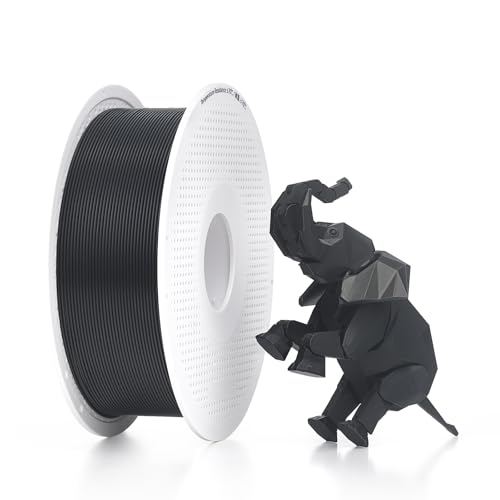
Bambu Lab PLA Basic (Black (10101), 1.75 mm, 1 kg, with spool)
- Best for
- Everyday PLA on Bambu Lab printers and AMS units (the TDS lists AMS-friendly 200 × 67 mm spool dimensions).
- Skip this if
- The part will see heat, or you'd rather buy the cheaper refill and reuse a spool.
Specs, strengths, and limitations
- Material
- PLA
- Diameter
- 1.75 mm
- Net filament
- 1000 g (filament only, not packaged weight)
- Format
- plastic spool
- Maker's nozzle range
- 190–230 °C
- Manufacturer states it is designed for high-speed printing, reaching 250–300 mm/s.
- Manufacturer states excellent toughness and Z-layer strength compared with general PLA.
- Manufacturer TDS lists AMS-friendly spool dimensions (200 mm × 67 mm).
- Not suited to parts exposed to heat: the TDS lists a heat deflection temperature of 54 °C (1.8 MPa).
- The ABS spool is rated to 70 °C, which limits drying temperature on the spool.
Skip it if you print on a slow or open-frame non-Bambu machine and don't need the high-speed tuning, or you already have empty Bambu spools and could use a refill.
Polymaker PolyLite PLA Pro (Black, 1.75 mm, 1 kg)
PolyLite PLA Pro is Polymaker's toughened PLA. Polymaker states it combines high toughness and rigidity with the ease of printing of regular PLA, and its TDS lists a notched Charpy impact strength of 17.1 kJ/m² (X-Y). The settings match standard PolyLite closely, with a 190–230 °C nozzle, a 30–60 °C bed, 50–200 mm/s, no enclosure needed, and drying at 55 °C for 6 hours. It suits functional prototypes, props, and household parts that may get dropped.
Heat is the limit. The TDS lists heat deflection of 58 °C at 1.8 MPa, the same as PolyLite PLA, and Polymaker says it isn't for projects needing high heat resistance or flexibility. It ships on Polymaker's cardboard spool. The TDS file is named V5.4 but the document is headed V5.5.

Polymaker PolyLite PLA Pro (Black, 1.75 mm, 1 kg)
- Best for
- Functional PLA parts, props, and prototypes that need more drop resistance than standard PLA.
- Skip this if
- The part will see heat above about 55 °C (TDS HDT 58 °C at 1.8 MPa) or needs to flex.
Specs, strengths, and limitations
- Material
- PLA (PLA Pro (toughened PLA))
- Diameter
- 1.75 mm
- Net filament
- 1000 g (filament only, not packaged weight)
- Format
- cardboard spool
- Maker's nozzle range
- 190–230 °C
- Manufacturer states it combines high toughness and high rigidity with the ease of printing of regular PLA.
- TDS lists notched Charpy impact strength of 17.1 kJ/m² (X-Y).
- Manufacturer publishes a full TDS with mechanical, thermal, and drying data.
- Not for heat: the TDS lists a heat deflection temperature of 58 °C (1.8 MPa), and Polymaker says it is not for projects needing high heat resistance or flexibility.
- Cardboard spool: Bambu Lab strongly advises a spool adapter or adapter ring for cardboard spools in the AMS.
- Polymaker now calls this the 'Old Formula' and sells a separate 'New Formula' Polymaker PLA Pro; check which version an Amazon listing ships.
Skip it if the part will see heat above about 55 °C, needs to flex, or your feeder or dryer needs a plastic spool.
ELEGOO PLA (Black, 1.75 mm, 1 kg)
ELEGOO PLA is a standard PLA with its full settings and mechanical data on the product page rather than in a separate TDS. ELEGOO lists a 190–230 °C nozzle, a 35–65 °C bed, speeds below 300 mm/s, no enclosure or glue required, and a dimensional accuracy of ±0.02 mm. It says to print and store it at 20% RH or below, sealed with desiccant, and lists drying at 50 ± 5 °C for 8 hours as "Recommended." Heat deflection is 57 °C at 0.45 MPa, with a Vicat softening temperature of 62 °C. It suits everyday printing on most 1.75 mm printers.
The spool is cardboard. ELEGOO itself notes that an AMS can rub the paper spool, and offers a printable filament ring to prevent that. The Amazon listing reports no model number, so we matched it to ELEGOO's store by its exact title.

ELEGOO PLA (Black, 1.75 mm, 1 kg)
- Best for
- Budget everyday PLA prints on most 1.75 mm printers.
- Skip this if
- You run an AMS and don't want to print a spool ring, or the part will see heat.
Specs, strengths, and limitations
- Material
- PLA
- Diameter
- 1.75 mm
- Net filament
- 1000 g (filament only, not packaged weight)
- Format
- cardboard spool
- Maker's nozzle range
- 190–230 °C
- Manufacturer states dimensional accuracy of ±0.02 mm.
- Manufacturer says neither an enclosure nor build-plate glue is required, and lists a minimum nozzle of 0.2 mm.
- Manufacturer publishes full print settings and mechanical data on the product page.
- Not suited to heat: the product page lists a heat deflection temperature of 57 °C (0.45 MPa).
- Cardboard spool: ELEGOO itself notes AMS units can rub the paper spool and offers a printable ring.
Skip it if you run an AMS and don't want to print a spool ring, or the part will see heat.
Overture High Speed PLA (Black, 1.75 mm, 1 kg)
Overture states a diameter tolerance of ±0.02 mm, measured with CCD cameras and closed-loop extrusion control, and says each spool is dried for 24 hours and vacuum-sealed. Its product page lists a 190–220 °C nozzle, a 25–60 °C bed, and drying at 50 °C for 7 hours. The TDS (V5.1) gives a Vicat softening temperature of 64.2 °C. It suits everyday standard PLA printing at moderate speeds.
The "High Speed" name needs care. The product page says up to 300 mm/s, but Overture's own TDS recommends 40–70 mm/s, so don't assume a fast profile without testing on your printer. Overture's FAQ says it uses cardboard spools, which may need an adapter in some AMS units. The Amazon listing's model field is unreliable, so we matched it to Overture's store by title, color, and size.

Overture High Speed PLA (Black, 1.75 mm, 1 kg)
- Best for
- Budget-friendly everyday PLA prints from a brand that publishes a TDS.
- Skip this if
- You need a plastic spool or a documented high-speed profile.
Specs, strengths, and limitations
- Material
- PLA
- Diameter
- 1.75 mm
- Net filament
- 1000 g (filament only, not packaged weight)
- Format
- cardboard spool
- Maker's nozzle range
- 190–220 °C
- Manufacturer states diameter tolerance of ±0.02 mm using CCD cameras and closed-loop extrusion control.
- Manufacturer states each spool is dried for 24 hours and vacuum-sealed.
- Manufacturer publishes a TDS plus nozzle, bed, and drying settings on the product page.
- Not suited to heat: the TDS lists a Vicat softening temperature of 64.2 °C.
- Overture's own speed guidance conflicts (product page up to 300 mm/s, TDS 40–70 mm/s).
- Cardboard spool: for plastic spools, Overture's FAQ suggests its refill products or 'a reusable spool adapter designed for cardboard spools.'
Skip it if you need a plastic spool or a documented high-speed profile.
ELEGOO Rapid PLA+ (Black, 1.75 mm, 1 kg)
Rapid PLA+ is ELEGOO's high-speed grade. ELEGOO states enhanced fluidity for printing speeds up to 600 mm/s and lists a 200–230 °C nozzle, a 35–65 °C bed, and drying at 50 ± 5 °C for 8 hours. It suits fast everyday printing on high-speed machines.
Read "Plus" as speed rather than toughness. ELEGOO's own impact figure for Rapid PLA+ (50.4 kJ/m², X-Y) is lower than for its standard PLA (66.2 kJ/m²), although it states higher flexural modulus and elongation at break. Heat deflection is 57 °C at 0.45 MPa. ELEGOO states all Rapid PLA+ ships on a cardboard spool, and offers a printable ring for AMS use.

ELEGOO Rapid PLA+ (Black, 1.75 mm, 1 kg)
- Best for
- Fast everyday PLA on high-speed printers; ELEGOO names its Neptune 4 series.
- Skip this if
- You print slowly anyway, or the part will see heat.
Specs, strengths, and limitations
- Material
- PLA (high-speed PLA+)
- Diameter
- 1.75 mm
- Net filament
- 1000 g (filament only, not packaged weight)
- Format
- cardboard spool
- Maker's nozzle range
- 200–230 °C
- Manufacturer states enhanced fluidity for printing speeds up to 600 mm/s.
- Manufacturer states high flexural modulus and elongation at break, making it resistant to brittleness and cracking.
- Manufacturer states dimensional accuracy of ±0.02 mm.
- Not suited to heat: the product page lists a heat deflection temperature of 57 °C (0.45 MPa).
- ELEGOO's own impact figure is lower than its standard PLA (50.4 vs 66.2 kJ/m² X-Y), so 'Plus' is about speed more than toughness.
- Cardboard spool may rub and delaminate in an AMS; ELEGOO offers a printable ring.
Skip it if you print slowly anyway, want a tougher PLA, or the part will see heat.
Creality Hyper PLA RFID (Black, 1.75 mm, 1 kg)
Hyper PLA RFID is for owners of Creality printers with the CFS multi-color system. Creality states the CFS recognizes its RFID tag and applies settings automatically, and that the plastic RFID spool is the version to choose for the CFS. It lists printing speeds of 30–600 mm/s and says it is tougher than traditional PLA variants.
This is the thinnest documentation on the page. Creality publishes no TDS or spec table for this product. The "1.75mm 1kg" comes from the spool label in Creality's own product photo, and the label doesn't say "net". The label's print temperature is too small to read reliably, so we don't give a nozzle range. There is no published bed temperature, drying setting, or heat figure, so rely on the settings the CFS reads from the RFID tag, and check Creality's guidance for your printer.

Creality Hyper PLA RFID (Black, 1.75 mm, 1 kg, RFID plastic spool)
- Best for
- Creality CFS users, such as K2 Plus owners, who want PLA the CFS recognizes automatically.
- Skip this if
- You want a fully documented filament or don't use a Creality CFS.
Specs, strengths, and limitations
- Material
- PLA (high-speed)
- Diameter
- 1.75 mm
- Net filament
- 1000 g (filament only, not packaged weight)
- Format
- plastic spool
- Manufacturer states an RFID tag lets the Creality CFS recognize the filament and apply settings automatically.
- Manufacturer states printing speeds of 30–600 mm/s.
- Manufacturer states it is tougher than traditional PLA variants.
- Creality publishes no TDS or text spec table for this product, so heat resistance, bed temperature, and drying settings are undocumented.
- RFID benefits apply only to Creality's CFS system.
Skip it if you don't use a Creality CFS, or you want a fully documented filament.
Polymaker Panchroma Matte PLA (Charcoal Black, 1.75 mm, 1 kg, with spool)
Panchroma Matte is the renamed PolyTerra PLA. Polymaker states it gives a smooth matte surface and is designed for ease of use and fast printing, up to 300 mm/s in its Panchroma TDS (V2.1). The product page lists a 190–230 °C nozzle, a 25–60 °C bed, and drying at 55 °C for 6 hours. It suits display models, prototypes, and decor where a low-gloss surface helps hide layer lines.
Polymaker positions it for models and decorative prints rather than heat-exposed or load-bearing parts, and the TDS gives a Vicat softening temperature of 63 °C. This listing is the version with a spool, which Polymaker labels "New Packaging". It is cardboard, and Polymaker sells a refill separately.

Polymaker Panchroma Matte PLA (Charcoal Black, 1.75 mm, 1 kg, with spool)
- Best for
- Display models, prototypes, and decor where a low-gloss finish that hides layer lines matters.
- Skip this if
- You want a glossy finish or the part needs toughness or heat resistance.
Specs, strengths, and limitations
- Material
- PLA (matte)
- Diameter
- 1.75 mm
- Net filament
- 1000 g (filament only, not packaged weight)
- Format
- cardboard spool
- Maker's nozzle range
- 190–230 °C
- Manufacturer states it gives a smooth matte surface in a wide range of colors.
- Manufacturer states it is designed for ease of use and fast print speeds; the TDS lists up to 300 mm/s.
- Manufacturer publishes temperature, bed, speed, and drying settings on the product page.
- Polymaker positions it for prototypes, models, and decorative prints rather than heat-exposed or load-bearing parts (TDS Vicat softening temperature 62 °C).
- Cardboard spool: Bambu Lab strongly advises a spool adapter or adapter ring for cardboard spools in the AMS.
Skip it if you want a glossy finish, or the part needs toughness or heat resistance.
Overture Matte PLA (Black, 1.75 mm, 1 kg)
Overture states its Matte PLA has a frosted, gloss-free finish that conceals layer lines, and that rafts, brims, and tree supports remove easily. Its TDS (V5.1) lists a 190–230 °C nozzle, 60–300 mm/s, and a warmer bed than most here at 50–70 °C. Drying is 50 °C for 7 hours per the product page. It suits display pieces where looks matter most.
The trade-off is layer strength. Overture's product page lists Z-axis layer adhesion of 10.9 MPa, against 38.9 MPa for its standard PLA, so parts are weaker across layers. The TDS gives a Vicat softening temperature of 62.9 °C. Overture's wiki cheat sheet calls it a "Slightly abrasive material" and adds, "Hardened nozzle recommended for long-term use." It ships on cardboard, per Overture's FAQ.

Overture Matte PLA (Black, 1.75 mm, 1 kg)
- Best for
- Display models where a matte look matters more than strength.
- Skip this if
- The part carries load across layers or needs heat resistance.
Specs, strengths, and limitations
- Material
- PLA (matte)
- Diameter
- 1.75 mm
- Net filament
- 1000 g (filament only, not packaged weight)
- Format
- cardboard spool
- Maker's nozzle range
- 190–230 °C
- Nozzle
- Abrasive: the maker recommends a wear-resistant nozzle
- Manufacturer states a frosted, gloss-free finish that conceals layer lines.
- Manufacturer states easy removal of rafts, brims, and tree supports.
- TDS lists printing speeds of 60–300 mm/s.
- Product page lists Z-axis layer adhesion of 10.9 MPa, much lower than Overture's standard PLA (38.9 MPa), so it is weaker across layers.
- Not suited to heat: Vicat softening temperature is 62.9 °C per the TDS.
- Ships on a cardboard spool; Overture's FAQ suggests a reusable spool adapter if you prefer plastic.
- Overture's wiki calls it slightly abrasive and recommends a hardened nozzle for long-term use.
Skip it if the part carries load across layers or needs heat resistance.
Bambu Lab PLA Matte (Charcoal 11101, 1.75 mm, 1 kg, with spool)
PLA Matte is Bambu Lab's matte grade for its own printers and the AMS. Bambu's TDS (V3.0) lists a 190–230 °C nozzle, a 35–45 °C bed with glue recommended, and printing below 300 mm/s. The spool is ABS rated to 70 °C, 200 mm in diameter and 67 mm high, with an RFID tag that carries print settings. Drying is 50 °C for 8 hours in a blast drying oven, or 60–70 °C for 12 hours on an X1 Series heatbed. It suits matte-finish models on Bambu Lab printers with an AMS.
It is the least heat-tolerant spool here on paper, with heat deflection of 52 °C at 1.8 MPa. The Amazon listing reports a model number that doesn't match Bambu's 11101 color code, although its title, color, and size match Bambu's store. Before buying, check that the listing names Charcoal and includes the spool.

Bambu Lab PLA Matte (Charcoal (11101), 1.75 mm, 1 kg, with spool)
- Best for
- Matte-finish models and decor on Bambu Lab printers with AMS.
- Skip this if
- The part will see heat, or you don't need a matte finish.
Specs, strengths, and limitations
- Material
- PLA (matte)
- Diameter
- 1.75 mm
- Net filament
- 1000 g (filament only, not packaged weight)
- Format
- plastic spool
- Maker's nozzle range
- 190–230 °C
- Manufacturer states a matte finish and printing speeds up to 250–300 mm/s.
- Manufacturer TDS lists AMS-friendly spool dimensions (200 mm × 67 mm), and the store page lists an RFID tag with embedded print settings.
- Manufacturer publishes a full TDS with drying, thermal, and mechanical data.
- Not suited to heat: the TDS lists a heat deflection temperature of 52 °C (1.8 MPa).
- The ABS spool is rated to 70 °C, which limits drying temperature on the spool.
Skip it if the part will see heat, or you don't need a matte finish.
What should you check before buying PLA?
- Diameter. Every spool here is 1.75 mm. If your printer uses 2.85 mm or 3 mm filament, none of these listings fits.
- Nozzle temperature. Most published windows run from 190 °C to 230 °C (all three Polymaker grades, both Bambu grades, ELEGOO PLA, and Overture Matte PLA). The exceptions are Overture High Speed PLA at 190–220 °C, Prusament at 200–220 °C (210 ± 10 °C), ELEGOO Rapid PLA+ at 200–230 °C, and eSUN PLA+ at 210–230 °C. Check your hotend's documented maximum and your slicer profile.
- Bed and surface. The recommended bed ranges differ by maker, from Bambu's 35–45 °C to Overture Matte PLA's 50–70 °C, and Creality publishes none for Hyper PLA RFID. Follow your build plate maker's guidance too. Our textured vs smooth build surfaces guide covers the trade-offs, and how to clean a build plate covers caring for each surface.
- Spool format vs dryers and material systems. Cardboard (all three Polymaker grades, both Overture and both ELEGOO grades, and probably eSUN) and plastic (Prusament, both Bambu grades, and Creality Hyper PLA RFID) spools behave differently in automatic material systems and some dryers. Check your AMS or feeder documentation, and the spool's own temperature rating before drying on it. The dryers hub explains drying options.
- Speed. If your printer runs fast profiles, compare the published print-speed range rather than assuming every PLA keeps up.
Alternatives to consider
- Need heat, weather, or impact resistance? PLA is the wrong family. Read PLA vs PETG or PLA vs ASA, or browse the PETG hub.
- Need flexible parts? See the TPU hub.
- Want silk, wood, or glow finishes? Those are separate grades with their own data sheets. Start at the specialty hub, and note that filled materials may need a hardened nozzle.
- Not sure which material fits the job? Try the filament finder.
Storage, drying, and safety
PLA is less moisture-sensitive than many materials, but every maker here except Creality publishes a drying setting, and Bambu specifies storage below 20% RH. Use the setting for your exact product, not a generic one. Our filament storage guide and dryer vs dry box guide cover the details. If damp filament causes wispy strings, stringing troubleshooting walks through the competing causes, and PLA printing problems covers other common PLA faults.
How this page was checked
This is a research-based shortlist. We have not printed with these spools for this page, so there are no test results, scores, or "we found" claims here. Every temperature, drying setting, heat figure, and spool detail above comes from the manufacturer documents listed in the sources section, which were retrieved on 2026-10-06 (the Prusament PLA data sheet on 2026-10-14). Values vary by exact product, color, and revision, and makers do reformulate. Check the current data sheet for your spool before relying on a number. Read more about our process in our editorial standards and affiliate disclosure.
PLA: what to check before you buy a spool ↗Head-to-head comparisons
Deciding between two products on this page? Each comparison puts both makers’ specs side by side and says who should choose which.
- Bambu Lab PLA Basic vs ELEGOO PLA
- Bambu Lab PLA Basic vs Polymaker PolyLite PLA
- Bambu Lab PLA Matte vs Polymaker Panchroma Matte PLA
- Creality Hyper PLA RFID vs ELEGOO Rapid PLA+
- eSUN PLA+ vs Polymaker PolyLite PLA Pro
- Overture Matte PLA vs Bambu Lab PLA Matte
- Overture PLA vs ELEGOO PLA
- Prusament PLA vs Polymaker PolyLite PLA
Sources
- PolyLite PLA Technical Data Sheet V5.4, Polymaker
- PolyLite PLA (Polymaker wiki), Polymaker
- Prusament PLA Jet Black 1kg, Prusa Research
- Prusament PLA material page, Prusa Research (Prusament)
- Prusament PLA Technical Datasheet v1.1 (tech sheet download from the material page), Prusa Polymers
- The OpenPrintTag is here: redesigned Prusament spool, Prusa Research
- eSUN PLA+ Technical Data Sheet (Feb 2026, V1.0), eSUN
- eSUN PLA+ 1.75mm 3D Filament 1kg (official store), eSUN
- Bambu PLA Basic Technical Data Sheet V3.0, Bambu Lab
- PolyLite PLA Pro Technical Data Sheet, Polymaker
- Panchroma Matte PLA product page, Polymaker
- Panchroma Technical Data Sheet V2, Polymaker
- Overture High Speed PLA 3D Printer Filament 1.75mm, Overture
- Overture PLA Technical Data Sheet V5.1, Overture
- Overture Matte PLA 3D Printer Filament 1.75mm, Overture
- FAQs, Overture
- Overture Matte PLA Technical Data Sheet V5.1, Overture
- Overture Filament Cheat Sheet (Overture 3D Wiki), Overture
- ELEGOO PLA product page, ELEGOO
- ELEGOO Rapid PLA Plus product page, ELEGOO
- Bambu PLA Matte Technical Data Sheet V3.0, Bambu Lab
- Hyper PLA RFID 3D Printing Filament 1kg, Creality
- Hyper Series PLA 3D Printing Filament 1kg, Creality
This page is research-based: we have not tested the products or methods ourselves. It draws on the manufacturer documentation and sources listed. Exact settings and fit always defer to your printer and filament makers.
Keep reading

PLA vs PETG: Choosing for the Actual Project
How to choose between PLA and PETG by what the part has to do: heat, stiffness, toughness, print ease, stringing, and build-plate release.

Filament storage: sealed containers, desiccant, and moisture exposure
How to keep opened spools dry with sealed containers, the right desiccant and a hygrometer, and why storage cannot fix filament that is already wet.
Stringing troubleshooting: moisture, temperature, and motion settings
How to diagnose stringing and oozing one change at a time: check filament moisture, nozzle temperature, retraction, and travel settings before buying parts.