EIBOS Easdry vs eSUN eBOX Lite
EIBOS Easdry and eSUN eBOX Lite single-spool boxes compared on maker data. Pick EIBOS to dry filament, eSUN to keep dry filament warm while printing.
On this page (12 sections)
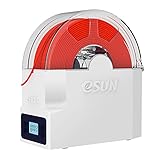
Pick the EIBOS Easdry if you want to set a drying temperature and check your spool against a published size. Pick the eSUN eBOX Lite if your filament is already dry and you want to keep one spool warm and covered while it prints. Both are single-spool heated boxes that you can print from, and both weigh about 1 kg. EIBOS documents the Easdry as a dryer, with a knob that sets 40–65 °C, a PTC heater with a fan, a humidity readout, a published spool limit, and a user manual. eSUN describes the eBOX Lite as a storage box that keeps filament at a constant temperature and humidity while it prints, and its FAQ says it "is not suitable for drying filaments with serious water absorption and high temperature (such as nylon, PEEK and other filaments that need high temperature drying)." eSUN's product page gives no temperature, power, timer, or maximum spool size.
Who this comparison is for
This page is for anyone choosing between these two specific products: the EIBOS Easdry in its US 120 V version, and the eSUN eBOX Lite as sold for the US market. Both hold one spool, so the questions are whether you need to dry wet filament or keep dry filament dry while it prints, whether your spools fit, and how much published detail you want before you buy. If you're still deciding whether you need a heated dryer or a sealed box, start with our filament dryer vs dry box guide, and for what to check in any dryer, see how to choose a filament dryer. For more dryers, including ones that run hotter than 65 °C, see the filament dryer shortlist. We've also compared the eSUN eBOX Lite with the SUNLU FilaDryer S2.
| Product | Best for | Skip if | Link |
|---|---|---|---|
| EIBOS Easdry Filament Dryer (US 120 V, single spool) | Keeping a single 1 kg spool of PLA, PETG, or TPU dry while printing. | Your spools are wider than 72 mm or you need temperatures above 65 °C. | View on Amazon (opens Amazon in a new tab) |
| eSUN eBOX Lite (US listing (eSUN's page names no plug or power-supply version)) | Keeping an already-dry 1 kg spool of PLA or PETG warm and dry while it prints. | You need to recover wet nylon or other filaments that require high-temperature drying. | View on Amazon (opens Amazon in a new tab) |

How we compared them
This is a research-based comparison. Every figure below comes from each maker's own product page and, for the Easdry, EIBOS's user manual, all listed in the sources. We haven't tested either box, so nothing here is a measured result of ours. Where a maker describes its own product, such as "more uniform heat" or "revive" old spools, we label it as the maker's claim.
The two makers don't publish the same kinds of numbers. EIBOS gives a temperature range, power, humidity range, spool limits, and size in a data sheet, a tech specs table, and its manual, and they don't always agree. eSUN's product page gives the size, weight, filament diameters, and spool weights, but no temperature, power, or maximum spool size. We searched eSUN's site, including its download center, and found no eBOX Lite manual or data sheet. Where eSUN doesn't state a figure, we say so rather than fill the gap from retailer listings.
Side-by-side specs
| EIBOS Easdry | eSUN eBOX Lite | |
|---|---|---|
| Variant | US 120 V plug, single spool | US listing; eSUN's page names no plug or power-supply version |
| What the maker calls it | "A DRYER & STORAGE BOX" (product page) | "A cost-effective storage filament dryer with constant temperature and humidity" (product page) |
| Temperature control | Knob, 40–65 °C, "Based on 25°C environment temperature" (tech specs and manual) | Not stated on eSUN's product page |
| Heater | 45 W PTC heater with built-in fan (product description) | Arc-shaped PI heating sheet with a heat-conduction metal plate and a turbo fan (product page) |
| Power figure | 45 W rated (data sheet); 55 W maximum (tech specs and manual) | Not stated |
| Input | AC 120 V, 60 Hz for the US version | Not stated |
| Humidity display | Hygrometer, RH 10–99% | Not described; eSUN's FAQ mentions a screen and buttons but not what the screen shows |
| Timer | None listed; the manual describes a power switch and a temperature knob, but no timer | Not stated |
| Spool fit | Smaller than Φ220 × 72 mm, centre hole larger than Φ50 mm | 0.5 kg and 1 kg spools; maximum dimensions not stated |
| Filament diameters | 1.75 mm (spec tables and manual); 1.75, 2.85, 3.00 mm (description) | 1.75, 2.85, 3.0 mm |
| Product size | 225 × 225 × 103 mm | 238 × 104 × 215 mm, axes not labelled |
| Net weight | 1 kg | 1115 g |
| Desiccant | Two desiccant slots | Not described |
| Cover | "Transparent cover" (manual diagram) | Transparent PC upper cover |
| Feeding while printing | "Filament can be used while in the box" | Keeps "constant temperature and humidity during printing" (FAQ) |
| Materials the maker names | Nylon, PLA, PVA, PC, TPU, PETG, PA, wood, ABS, silk | No list; "not suitable" for nylon, PEEK, and other filaments that need high-temperature drying |
Drying or keeping dry: what each maker says it's for
This is the main difference, and it comes from the makers themselves.
- EIBOS Easdry. EIBOS says the Easdry "is specifically made for the purpose of drying 3D printer filament, intended to remove the moisture from a spool of filament caused by ambient exposing," and that it works "as both storage box and filament holder." It claims the box can dry "wet or brittle 3D printer filament" and "revive" old spools. Those are EIBOS's claims, with no drying test on its page.
- eSUN eBOX Lite. eSUN calls it a "storage filament dryer" with a "heating function." Its product page FAQ answers "Why is the drying effect not very noticeable?" directly: "eBOX Lite only has the function of maintaining constant temperature and humidity during printing. It is not suitable for drying filaments with serious water absorption and high temperature (such as nylon, PEEK and other filaments that need high temperature drying). It is not suitable to promote the drying function." Its feature list still mentions "stable drying performance," but the FAQ makes clear eSUN positions it as a heated box for filament that's already dry.
Temperature: published or not
EIBOS gives a 40–65 °C range, set by turning a knob with "main types of filaments marked for your fast use." EIBOS calls this an "infinite adjustable temperature mode." Its tech specs table and manual add that the range is "Based on 25°C environment temperature," and EIBOS doesn't say how the range changes in a colder or warmer room. The manual says the dryer "adopts non-pole temperature regulation, please select suitable position according to the actual situation."
eSUN's product page doesn't give a temperature for the eBOX Lite, either a range or a maximum. It describes the heating parts, which it says "produce more uniform heat," and a turbo fan for an internal heat cycle, but no figures. Without a published temperature, you can't check the eBOX Lite against a filament maker's drying table.
EIBOS's suggested settings
EIBOS publishes suggested drying settings in a product image headed "RECOMMEND OPTIMAL SETTING TIME &TEMPERATURE," with a warning to "follow the recommended temperature for 3D filament, otherwise the filament will be melted!" Its manual repeats the times as a "Knob Drying Time" table, which it says was "tested in the laboratory at 25℃" and is "for reference only." eSUN publishes no settings for the eBOX Lite.
| Material | EIBOS Easdry temperature (image text) | EIBOS Easdry time (image and manual) |
|---|---|---|
| PLA | 40–45 °C | More than 4 h |
| TPU | 45–50 °C | More than 4 h |
| ABS | 50–55 °C | More than 2 h |
| PETG | 55–60 °C | More than 2 h |
| PC | 60–65 °C | More than 8 h |
| PA | Above 65 °C | More than 12 h |
EIBOS's PA setting is above the 65 °C top of the Easdry's own range, and EIBOS doesn't explain how the box reaches it. Filament makers publish their own drying temperatures, which can differ from these, so check the drying guidance for your exact spool first. If it calls for more than 65 °C, plan as if the Easdry doesn't reach it, and if you have only the eBOX Lite, eSUN's own FAQ says it isn't the tool for high-temperature drying.
Spool fit and capacity
- EIBOS Easdry. EIBOS gives a spool size smaller than Φ220 × 72 mm with an inner size larger than Φ50 mm, in its data sheet, tech specs, product image, and manual. The manual has you thread the filament through an outlet hole, put the spool in, and adjust the "Silicone loop to prevent the filament spool from sliding." It also warns: "Please make sure the spool won't attach the transparent cover."
- eSUN eBOX Lite. eSUN says it is "easily accommodating 0.5KG and 1KG filament spools," but its product page gives no maximum diameter or width.
Spool sizes vary by brand, so measure yours. The Easdry's 72 mm width limit is narrow, so a wide 1 kg spool may not fit. With the eBOX Lite, eSUN gives only spool weights, so "holds a 1 kg spool" doesn't tell you whether a particular spool will fit.
Feeding the printer and storage
Both are meant to feed a printer while the spool sits inside.
- EIBOS Easdry. EIBOS says "Filament can be used while in the box." A product image headed "3 OUTLETS FOR SMOOTH EXTRUSION" shows a top hole, a front side hole, and a rear side hole, and the manual's diagram labels outlet holes on the top, front, and back. EIBOS lists two desiccant slots at the corners to "keep your filament in longer drying condition," and claims "Sealed protection, comprehensive dust-proof and damp." The package photo on the product page shows a Teflon tube, while the manual lists only the dryer and a power cord.
- eSUN eBOX Lite. eSUN describes it as keeping filament at constant temperature and humidity "during printing," calls it "strictly moisture-proof and dust-proof," and says the transparent cover "allows real-time observation of filaments usage." It doesn't describe the outlet on the product page.
Neither maker publishes how the filament outlet is sealed or what tube size it takes, and neither names a printer or multi-material feeder it's been tested with, so we make no compatibility claim for either.
Power, footprint, and humidity
EIBOS's data sheet gives a rated power of 45 W, while its tech specs table and manual give a maximum power of 55 W, and the US version runs on AC 120 V, 60 Hz. eSUN's product page gives no power figure.
The two weigh about the same: EIBOS lists 1 kg net, and eSUN lists 1115 g. Their shapes differ. EIBOS lists the Easdry as 225 × 225 × 103 mm, and a product image labels it 22.5 cm high, 22.5 cm wide, and 10.5 cm deep. eSUN lists the eBOX Lite as 238 × 104 × 215 mm without labelling the axes, so check the product photos before planning desk space.
For humidity, EIBOS lists a separate hygrometer with a 10–99% RH range, powered by an LR44 (AG13) battery with a stated "Battery life: 7 months since assembled." A product image claims "Humidity can be reduced to 10%," which is EIBOS's claim without test conditions. eSUN's FAQ mentions a screen on the eBOX Lite but its product page doesn't say whether it shows humidity, temperature, or both.

EIBOS Easdry Filament Dryer (US 120 V, single spool)
- Best for
- Keeping a single 1 kg spool of PLA, PETG, or TPU dry while printing.
- Skip this if
- Your spools are wider than 72 mm or you need temperatures above 65 °C.
Specs, strengths, and limitations
- Capacity
- One spool smaller than Φ220 × 72 mm with a centre hole larger than Φ50 mm (EIBOS)
- Part rated to
- 65 °C (your printer's own hotend limit may be lower)
- Maker notes
- EIBOS data sheet: temperature 40–65 ℃, rated power 45 W (PTC heater with built-in fan), humidity range RH 10–99%. The tech specs table lists 'Maximum power 55W' and 40~65 °C 'Based on 25°C environment temperature'. EIBOS lists product size 225 × 225 × 103 mm, net weight 1 kg. Filament diameter: both EIBOS spec tables list 1.75 mm only; the product description lists 1.75 / 2.85 / 3.00 mm. No timer is listed; the manual describes a power switch and a temperature knob only, with drying times 'for reference only'. The manual lists 'Package containing: Filament dryer x1, Power cord x1'; the product-page package photo also shows a Teflon tube and a manual. Package size is 265 × 265 × 135 mm in the data sheet but 270 × 270 × 140 mm in the tech specs table and manual.
- Manufacturer lists an adjustable 40–65 °C range from a 45 W PTC heater with a fan.
- Manufacturer lists a humidity readout covering RH 10–99%.
- Manufacturer lists a low-profile 225 × 225 × 103 mm body.
- 65 °C maximum is low for nylon and other engineering filaments.
- Spools must be smaller than Φ220 × 72 mm with a hub larger than Φ50 mm (EIBOS), which rules out many wider spools.
- EIBOS's own power figures differ (45 W rated in the data sheet, 55 W maximum in the tech specs table).

eSUN eBOX Lite (US listing (eSUN's page names no plug or power-supply version))
- Best for
- Keeping an already-dry 1 kg spool of PLA or PETG warm and dry while it prints.
- Skip this if
- You need to recover wet nylon or other filaments that require high-temperature drying.
Specs, strengths, and limitations
- Capacity
- 0.5 kg and 1 kg spools (eSUN). Maximum spool dimensions are not stated on eSUN's product page.
- Maker notes
- eSUN lists size 238×104×215 mm (axes not labelled) and weight 1115 g. Filament diameters 1.75 / 2.85 / 3.0 mm (eSUN). Transparent PC upper cover, arc-shaped heating sheet with a heat-conduction metal plate, and a low-noise turbo fan (eSUN). The Amazon listing gives a 40–55 °C inside temperature range and a 200 × 73 mm maximum spool; eSUN's product page does not state these, so they are not recorded as specifications.
- Manufacturer states it holds 0.5 kg and 1 kg spools at constant temperature and humidity while printing.
- Manufacturer states the transparent PC cover lets you watch the spool.
- Manufacturer lists a compact 1115 g unit.
- eSUN states it 'is not suitable for drying filaments with serious water absorption and high temperature (such as nylon, PEEK and other filaments that need high temperature drying).'
- eSUN's product page does not state a maximum temperature or maximum spool dimensions.
Verdict: which should you buy?
Choose the EIBOS Easdry if…
- You want to set a drying temperature between 40 and 65 °C and see humidity while it runs.
- Your spools are smaller than Φ220 × 72 mm with a centre hole larger than Φ50 mm, and you want a published limit to check against.
- You mostly dry PLA, PETG, TPU, or ABS, and you're happy setting temperature with a knob and timing it yourself.
Choose the eSUN eBOX Lite if…
- Your filament is already dry and you want to keep one 0.5 kg or 1 kg spool warm and covered while it prints.
- You want a transparent cover so you can see how much filament is left.
- You print materials that don't need high-temperature drying, and you don't need a published temperature or power figure.
Safety and limits
How this page was checked
Every specification, setting, and claim above comes from the maker documents in the sources section, retrieved on 2026-10-13. We haven't tested either box for this page, so nothing here is a measured result of ours. EIBOS's Easdry manual is a scanned PDF with no text layer, so we read it from the rendered pages; we found it on EIBOS's download page. EIBOS's own documents differ in places: the data sheet gives 45 W rated power while the tech specs and manual give 55 W maximum, the spec tables list 1.75 mm filament while the description lists 1.75, 2.85, and 3.00 mm, the package size is 265 × 265 × 135 mm in the data sheet and 270 × 270 × 140 mm in the tech specs and manual, and the package photo shows a Teflon tube that the manual's package list doesn't. We've reported each with where it appears. EIBOS's suggested temperatures come from text in a product image, which we've labelled as image text. eSUN's product page is the only eSUN document we used; we found no eBOX Lite manual on eSUN's site, and we haven't used retailer listings, so temperature and spool-size figures for the eBOX Lite that appear elsewhere aren't on this page. Customer reviews and Q&A on both stores weren't used. Read more in our editorial standards and affiliate disclosure.
Dryers & dry boxes: what to check before you buy ↗Sources
- EIBOS 3D Filament Dryer Series X: Easdry, EIBOS
- Easdry user manual, EIBOS
- EIBOS download page, EIBOS
- eBOX Lite product page, eSUN
This page is research-based: we have not tested the products or methods ourselves. It draws on the manufacturer documentation and sources listed. Exact settings and fit always defer to your printer and filament makers.
Keep reading

Best Filament Dryers (2026), by Spool Count and Max Temp
The best filament dryers by need: ten units with published maker specs for one spool, several spools, engineering materials, or drying plus sealed storage.
How to Choose a Filament Dryer: The Specs That Matter
Filament dryer specs checked against makers' data: top temperature vs drying settings, spool fit and heat limits, airflow, humidity, timer and safety.
Filament dryer vs dry box: drying and storage explained
A dry box keeps dry filament dry; a dryer removes moisture that is already in it. How to tell which problem you have, and what to do safely.