Overture TPU 95A vs SUNLU TPU 95A
Two 95A TPUs on maker data: speed, temperatures, retraction, drying, AMS. Pick Overture for slow speeds and clear feeding rules, SUNLU for faster guidance.
On this page (13 sections)
Pick Overture TPU 95A if you're happy to print slowly, at 20–40 mm/s, and want a maker that spells out feeding (direct drive or an external extruder, and no AMS) plus a full drying setting. Pick SUNLU TPU 95A if you have a direct-drive printer and want maker guidance up to 120 mm/s, with one short retraction range. Both are 95A TPUs, the most common flexible grade. Overture's product page and FAQ mark its filament as not compatible with the Bambu Lab AMS. SUNLU says nothing about AMS, Bowden, or direct-drive feeding, and its guidance assumes a warmer bed with glue. Overture gives both a drying temperature and a time, while SUNLU gives a temperature with no time. Where both makers cite the same ISO method, SUNLU reports far higher elongation, but neither describes its specimens fully enough for that to be a measured difference.
Who this comparison is for
This page is for anyone choosing between these two specific 1.75 mm spools: Overture TPU 95A in Black (1 kg), which Overture's own store calls "Matte Black," and SUNLU TPU 95A in Black (1 kg). SUNLU sells 90A and 95A on the same page, and only the 95A is covered here. At 95A, both are firmer than soft 85A grades, which makes them easier to feed, but they're still flexible enough that your printer's feed path matters. If you're not sure what 95A means in practice, start with our TPU hardness guide. For other brands and grades, see the TPU filament shortlist.
| Product | Best for | Skip if | Link |
|---|---|---|---|
| Overture TPU 95A (Black, 1.75 mm, 1 kg) | General-purpose 95A flexible parts such as gaskets, seals, and protective cases. | You plan to feed it through a Bambu Lab AMS or AMS lite, or you want a TPU whose maker recommends it for Bowden printers. | View on Amazon (opens Amazon in a new tab) |
| SUNLU TPU 95A (Black, 1.75 mm, 1 kg) | Budget 95A TPU for everyday flexible parts on a direct-drive printer. | You need clear manufacturer guidance on AMS or Bowden feeding. | View on Amazon (opens Amazon in a new tab) |


How we compared them
This is a research-based comparison. Every figure below comes from the makers' own product pages, data sheets, wiki, and FAQ, listed in the sources, plus Bambu Lab's published AMS rules. We haven't tested either filament, so nothing here is a measured result of ours. Where a maker describes its own product, such as "exceptional resilience and shape recovery" or "No cracking or warping," we label it as the maker's claim.
We only put test figures side by side where both makers name the same test standard and unit. For these two, that's tensile strength and elongation at break, and we explain below what each maker says about its specimens.
Side-by-side specs
| Overture TPU 95A | SUNLU TPU 95A | |
|---|---|---|
| Variant | Black ("Matte Black" on Overture's store), 1.75 mm, 1 kg | Black, 1.75 mm, 1 kg |
| Hardness | 95A, ISO 7619 (TDS) | 95 Shore A, ISO 868 (TDS) |
| Diameter tolerance | ±0.02 mm (wiki) | ±0.02 mm (page text); the page's product description says ±0.03 mm |
| Nozzle temperature | 210–240 °C (product page and wiki); 210–230 °C (TDS and feature text) | 190–210 °C for 50–80 mm/s, or 210–230 °C for 80–120 mm/s (product page and TDS) |
| Bed temperature | 25–60 °C (TDS and wiki); 35–50 °C (product page) | 50–60 °C (product page and TDS); "with Glue" (product page) |
| Build surface | Overture build surface, textured PEI, or blue tape; none or PVA glue (TDS) | PEI (TDS); glue (product page) |
| Cooling fan | On (product page, TDS, and wiki) | Not stated |
| Maker's speed figure | 20–40 mm/s (TDS, wiki, and product page FAQ) | 50–120 mm/s (product page and TDS) |
| Retraction | 1–3 mm at 20–40 mm/s (TDS); "OFF or set to minimal" (product page FAQ) | 0.8–1.2 mm at 30–40 mm/s (TDS) |
| Extruder | Direct drive or an external extruder attachment; no AMS (TPU guide) | Not stated |
| Drying | 70 °C for 7 h (product page, wiki, and drying guide) | 50–60 °C, no time given (product page and TDS) |
| Storage | Sealed container with desiccant (product page FAQ); one-year shelf life unopened, with proper storage (product page) | Below 20% RH, sealed with desiccant, while printing and storing (product page) |
| AMS | "AMS & AMS lite NOT Compatible" (product page) | Not mentioned |
| Spool | Cardboard (FAQ); 200 mm × 65.6 mm, 55 mm hub, about 147 g empty (wiki) | Material and dimensions not published; gross weight 1.3 kg per spool |
| Length | Not stated | About 330 m per 1 kg (product page) |
Speed: slow versus fast guidance
This is the clearest difference. Overture's wiki recommends 20–40 mm/s for TPU 95A, its data sheet gives the same range, and the FAQ on its product page lists "Recommended print speed: 20–40 mm/s." The product page's own specification table leaves printing speed blank. Overture's wiki points to a separate High-Speed TPU, which it says prints "up to 5X faster than standard TPU," and that product isn't covered here.
SUNLU's guidance is much faster. Its product page and data sheet tie speed to nozzle temperature: 190–210 °C for 50–80 mm/s, and 210–230 °C for 80–120 mm/s. The key features list on the same page prints the first band as "50-8mm/s," which looks like a typo for the 50–80 mm/s given everywhere else.
Neither maker names the nozzle size or layer height behind its top speed, except Overture's data sheet, which says its settings are "Based on 0.4 mm nozzle." So these aren't a measured race. Read them as each maker's starting advice for its own filament, and start low on a printer you haven't run TPU through before.
Temperatures and build plates
The nozzle ranges overlap at 210–230 °C. Overture's product page and wiki give 210–240 °C, while its data sheet and the product page's feature text give 210–230 °C. SUNLU goes lower, to 190 °C, but only for its slower speed band.
The beds differ more. Overture's data sheet and wiki give 25–60 °C, and its product page table gives 35–50 °C. Overture lists its own build surface, textured PEI, or blue tape, with either no treatment or PVA glue, and its TPU guide suggests "a light glue stick or adhesive sheet," which "also acts as a release layer for easier removal." SUNLU's product page gives 50–60 °C "with Glue," and its data sheet names a PEI plate. So SUNLU's guidance starts warmer and assumes glue, which matters if your bed runs cool.
Feeding: direct drive, Bowden, and retraction
Overture says more about feeding. Its TPU guide says to "Use either a direct-drive system or a printer with an external extruder attachment," and its extruder guide says Bowden systems "struggle with soft or flexible filaments." Its TPU guide also says "Standard brass nozzles work fine."
SUNLU says its TPU is "Fully compatible with most FDM 3D printers, including Bambu Lab, Creality, Prusa, Anycubic, and more," but doesn't say whether that assumes direct drive, and gives no Bowden guidance on the pages we checked.
On retraction, SUNLU's data sheet gives 0.8–1.2 mm at 30–40 mm/s. Overture's own pages give three different answers:
- Data sheet: 1–3 mm at 20–40 mm/s.
- General TPU guide: 0.5–1.5 mm at 20–30 mm/s.
- Product page FAQ: "Use retraction OFF or set to minimal to prevent clogging and feeding issues."
All three point the same way: keep retraction short and slow. Our TPU compatibility guide covers direct drive, Bowden, and retraction in more detail.
AMS and multi-material systems
Overture is explicit. Its product page says "AMS & AMS lite NOT Compatible," and its FAQ says TPU "is too soft and flexible, which can cause feeding issues, jams, or inconsistent extrusion inside the system." Its extruder guide adds that TPU "should be loaded externally, bypassing the AMS."
SUNLU doesn't mention the AMS or any multi-material system on its TPU page. Its "Bambu Lab" compatibility line is about printers, not the AMS. Bambu's own rules apply to both. Its filament guide lists "TPU 95A/85A/83A/80A" as too soft for the AMS and AMS lite, saying they "cannot pass smoothly through the AMS / AMS lite channel," and its notes for the AMS say to avoid "flexible materials, including TPU, TPE." Feed either spool from an external holder. Our AMS filament compatibility guide collects Bambu's rules for TPU.
Drying and storage
Overture rates TPU's moisture sensitivity as "High" in its drying guide and gives 70 °C (158 °F) for 7 hours on its product page, wiki, and drying guide. Its product page FAQ adds a warning: "Avoid extended drying times, as this can lead to the filament becoming brittle." The data sheet linked from the product page, titled TPU 2.0, gives 70 °C for 8 hours instead.
SUNLU gives a drying temperature of 50–60 °C on its product page and data sheet, but no drying time. It says to keep the filament below 20% RH "(Sealed, with Desiccant)" while printing and storing, and its product description says each spool is vacuum-sealed.
Overture uses cardboard spools, and SUNLU doesn't publish its spool material. Neither maker publishes a spool temperature rating, so check your spool before heating it. Our filament dryer vs dry box guide covers the options.
Same-standard test figures
These are the only figures where both makers name the same test standard and unit. They aren't a head-to-head result, because the makers describe their specimens differently, as explained below the table.
| Property | Standard | Overture TPU 95A | SUNLU TPU 95A |
|---|---|---|---|
| Tensile strength (X-Y) | ISO 527 | 30.1 ± 3.7 MPa | 31 ± 3 MPa, ISO 527/2 at 50 mm/min |
| Elongation at break (X-Y) | ISO 527 | 332.1 ± 15.9% | 900% (TDS); above 900% on the product page |
How the samples were made. Overture's data sheet says its specimens were printed at 225 °C and 30 mm/s on a 30 °C bed with 100% infill, then conditioned at room temperature for 24 hours. It doesn't name the specimen type or test speed. SUNLU names the test speed, 50 mm/min, but its specimen print settings are in a footnote whose labels don't extract as text, leaving only "45 mm/s 230 100% 90," so we don't interpret it. The tensile strengths are close. The elongation gap is large, but with different print settings and no full specimen details from either maker, it isn't a measured difference.
We left these figures out of the table because the makers used different standards or only one maker published a value:
- Hardness. Overture tested to ISO 7619 and SUNLU to ISO 868. Both are Shore durometer methods and both report 95A, but they're different standards.
- Density. Both name ISO 1183. Overture gives 1.18 g/cm³ at 21.5 °C and SUNLU gives 1.21 g/cm³. That's a material property, not a strength test, and it's close either way.
- Impact. SUNLU gives notched Izod impact of 47 ± 5 kJ/m² (X-Y) and unnotched 38 ± 5 kJ/m² (Z-X), to ISO 180. Overture publishes no impact figure.
- Modulus. Overture gives a 100% modulus of 9.7 ± 1.0 MPa (ISO 527). SUNLU lists Young's modulus but leaves it blank.
- Heat. SUNLU leaves heat deflection, glass transition, melting, and Vicat temperatures blank, and gives a 5% decomposition temperature of 300 to ISO 11358, with the unit not shown. Overture publishes no heat figures on its TPU data sheet.
What each maker says it's for
- Overture TPU 95A. Overture says its "95A Shore hardness provides the ideal balance of softness and toughness," with "reliable oil resistance" and "exceptional resilience and shape recovery," for gaskets, seals, protective cases, flexible hinges, wearables, and robotics. Its wiki rates print difficulty as "Moderate. Requires fine-tuned settings."
- SUNLU TPU 95A. SUNLU says TPU 95A "offers an ideal balance of flexibility and strength" with "excellent impact and abrasion resistance," for "sports equipment, wearable items, and parts exposed to mechanical stress," and lists low shrinkage of 0.3–0.5% and "No cracking or warping." It also calls the filament "Beginner-friendly."
Those are each maker's claims, without a published test against the other filament.

Overture TPU 95A (Black, 1.75 mm, 1 kg)
- Best for
- General-purpose 95A flexible parts such as gaskets, seals, and protective cases.
- Skip this if
- You plan to feed it through a Bambu Lab AMS or AMS lite, or you want a TPU whose maker recommends it for Bowden printers.
Specs, strengths, and limitations
- Material
- TPU
- Diameter
- 1.75 mm
- Net filament
- 1000 g (filament only, not packaged weight)
- Hardness
- 95A
- Format
- cardboard spool
- Maker's nozzle range
- 210–240 °C
- Manufacturer states its 95A Shore hardness balances softness and toughness for impact absorption and rebound.
- Manufacturer states it resists oil and recovers its shape after repeated stress.
- Manufacturer states unopened spools have a 1-year shelf life with proper storage.
- The TPU printing tips on Overture's product page say 'Not compatible with AMS or other multi-material systems.'
- Overture marks it 'AMS & AMS lite NOT Compatible', and its FAQ says TPU is too soft for the AMS and can jam or extrude inconsistently.
- Overture's own documents disagree on bed temperature, drying time, and elongation (see notes).
- Manufacturer says to keep it dry before use.
- Overture's TPU wiki says to use a direct-drive system or an external extruder attachment, and its extruder wiki rates Bowden support for flexible filament as 'Limited'; the product page doesn't mention Bowden.
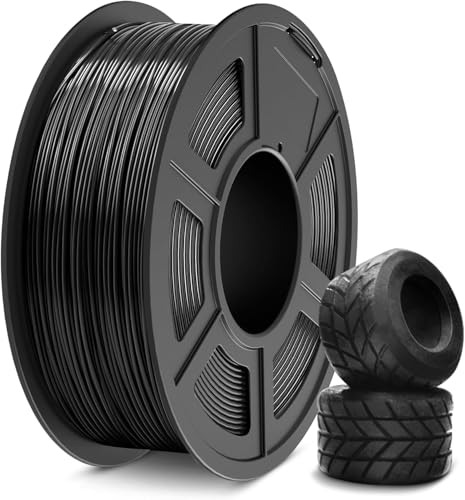
SUNLU TPU 95A (Black, 1.75 mm, 1 kg)
- Best for
- Budget 95A TPU for everyday flexible parts on a direct-drive printer.
- Skip this if
- You need clear manufacturer guidance on AMS or Bowden feeding.
Specs, strengths, and limitations
- Material
- TPU
- Diameter
- 1.75 mm
- Net filament
- 1000 g (filament only, not packaged weight)
- Hardness
- 95A
- Format
- other
- Maker's nozzle range
- 190–230 °C
- Manufacturer lists elongation at break above 900% for TPU 95A.
- Manufacturer states printing speeds of 80–120 mm/s at 210–230 °C.
- Manufacturer states the filament is vacuum-sealed with ±0.02 mm diameter tolerance.
- SUNLU claims compatibility with most FDM printers, including Bambu Lab, but says nothing about AMS or other automatic material systems, or about Bowden extruders.
- No drying time is given, only a 50–60 °C temperature.
- Bed needs 50–60 °C with glue, which is warmer than several other TPUs here.
Verdict: which should you buy?
Choose Overture TPU 95A if…
- You want a maker that spells out feeding: direct drive or an external extruder, and no AMS.
- You're happy to print slowly, at 20–40 mm/s, and want a full drying setting (70 °C for 7 hours).
- You want the spool's exact size to check against your holder or dry box, and a cooler bed range starting at 25 °C.
Choose SUNLU TPU 95A if…
- You have a direct-drive printer and want 95A TPU with maker guidance up to 120 mm/s.
- You want one short retraction range from the maker, 0.8–1.2 mm, rather than several.
- Your bed reaches 50–60 °C and you're happy to use glue.
Safety and limits
How this page was checked
Every temperature, speed, feeding rule, drying setting, and test figure above comes from the manufacturer documents in the sources section, retrieved on 2026-10-10. We haven't printed with either filament for this page, so nothing here is a measured result of ours. Overture publishes two TPU data sheets. Its FAQ links the "OVERTURE TPU" data sheet (V5.1), which we used for test figures and print settings. Its product page links an "OVERTURE TPU 2.0" data sheet that gives 210–240 °C, a 25–60 °C bed, 200 mm/s, and drying at 70 °C for 8 hours, but its extracted text contains two overlapping sets of test figures and specimen conditions, so we didn't use its test figures. Overture's product page, wiki, and data sheets also differ on nozzle and bed ranges, as listed above. SUNLU's US store page redirected when checked, so we used its UK store page and the data sheet linked from it. Parts of SUNLU's data sheet don't extract as text, and we've only used values whose labels were legible. Values vary by color and revision, so check the current documents for your spool. Read more in our editorial standards and affiliate disclosure.
TPU: what to check before you buy a spool ↗Sources
- Overture TPU 95A 3D Printer Filament 1.75mm, Overture
- Overture TPU Technical Data Sheet V5.1, Overture
- Overture TPU 2.0 Technical Data Sheet V5.1, Overture
- TPU Filament — Flexible Guide (Overture 3D Wiki), Overture
- TPU — Flexible Guide (Overture 3D Wiki), Overture
- Bowden vs Direct Drive Extruder (Overture 3D Wiki), Overture
- Filament Drying Guide (Overture 3D Wiki), Overture
- FAQs, Overture
- TPU 90A/95A 3D Printer Filament 1KG (SUNLU UK Store), SUNLU
- TPU 95A Technical Data Sheet, SUNLU
- Filament guide: printer, nozzle, AMS, build plate and glue compatibility, Bambu Lab
- Notes for AMS, Bambu Lab
This page is research-based: we have not tested the products or methods ourselves. It draws on the manufacturer documentation and sources listed. Exact settings and fit always defer to your printer and filament makers.
Keep reading

Best TPU Filament (2026): Flexible Spools by Hardness and Feed Path
The best TPU filament for your printer: eleven flexible spools from 85A to 68D, matched by hardness and feed path (direct drive, Bowden or Bambu Lab's AMS).
TPU Compatibility: Extruder Path, Hardness, and Feeding Systems
Whether a TPU will feed in your printer depends on its Shore hardness, your extruder path, and whether it goes through an automatic material system.
TPU Hardness Explained: 85A, 95A, and 68D
What Shore A and Shore D numbers measure, why 68D TPU is far firmer than 95A, and how hardness changes feeding, AMS use, and the parts you print.