Best TPU Filament (2026): Flexible Spools by Hardness and Feed Path
The best TPU filament for your printer: eleven flexible spools from 85A to 68D, matched by hardness and feed path (direct drive, Bowden or Bambu Lab's AMS).
On this page (19 sections)
For a first TPU on most printers, start with Polymaker PolyFlex TPU95: Polymaker says it works on most desktop printers without specialized hardware. On a Bowden printer, NinjaTek Cheetah 95A is the one its maker names as known to feed well on Bowden. Bambu Lab TPU for AMS is the only product here its maker lists as compatible with the AMS, and at 68D it is far stiffer than the rest. For soft, rubbery parts, NinjaTek NinjaFlex and Siraya Tech Flex TPU (both 85A) and Polymaker PolyFlex TPU90 (90A) need a direct-drive printer, and Polymaker says to make sure your printer "is not setup as Bowden" for TPU90. The other 95A grades are the everyday middle ground. The fit rule: choose by Shore hardness and feed path before brand. Softer grades are harder to push, and every TPU here except TPU for AMS should be fed from an external spool.
Quick picks
| Need | Pick | Why |
|---|---|---|
| Default first TPU for most printers | Polymaker PolyFlex TPU95 | Polymaker states it works on most desktop printers without specialized hardware |
| Bowden printers | NinjaTek Cheetah 95A | NinjaTek names it among its products known to feed well on Bowden printers |
| For a Bambu AMS | Bambu Lab TPU for AMS | The only TPU here marked compatible with all AMS series; firm at 68D |
| Softest parts on direct drive | NinjaTek NinjaFlex 85A | The softest grade on the page, which NinjaTek calls "ideal for direct-drive extruders" |
| Fast flexible parts on a Bambu printer | Bambu Lab TPU 95A HF | Bambu states it prints three times faster than its standard TPU 95A; external spool only |
Picks are matched to documented needs, not scored.
Who is this TPU shortlist for?
This page is for people buying flexible filament for grips, bumpers, seals, gaskets, straps, cases, and similar parts. It assumes a 1.75 mm printer. If you haven't printed TPU before, read our TPU compatibility guide first. It explains what the hardness letters mean, why softer filament is harder to push, and what automatic material systems' makers say about flexibles. The TPU hub has the wider background.
Check the spool size before you compare. Most listings here are 1 kg, but both Polymaker PolyFlex spools hold 0.75 kg and the NinjaTek Cheetah listing is 0.5 kg.
| Product | Best for | Skip if | Link |
|---|---|---|---|
| NinjaTek NinjaFlex 85A (Midnight Black, 1.75 mm, 1 kg) | Very soft, rubbery parts such as seals, gaskets, and grips on a direct-drive printer. | Your printer uses a Bowden extruder or you need fast print times. | View on Amazon (opens Amazon in a new tab) |
| Siraya Tech Flex TPU 85A (Black, 1.75 mm, 1 kg) | Soft wearables such as watch straps, pads, and flexible connectors on a direct-drive printer. | You need a firmer 95A part or plan to feed it through a multi-material system. | View on Amazon (opens Amazon in a new tab) |
| Polymaker PolyFlex TPU90 (Black, 1.75 mm, 0.75 kg) | Soft, comfortable parts such as phone cases and watch straps on a geared direct-drive printer. | Your printer uses a Bowden extruder, or you need 1 kg spools. | View on Amazon (opens Amazon in a new tab) |
| Polymaker PolyFlex TPU95 (Black, 1.75 mm, 0.75 kg) | Flexible covers, grips, bumpers, and seals on printers that handle 95A TPU. | You need a softer TPU than 95A, or fast print times, or your printer is set up as Bowden and you can't print very slowly (Polymaker highly recommends direct drive and says Bowden is possible only at very slow speeds). | View on Amazon (opens Amazon in a new tab) |
| NinjaTek Cheetah 95A (Midnight Black, 1.75 mm, 0.5 kg) | Tough 95A parts such as shock-absorbing mounts and washers when you want faster flexible printing. | You want a 1 kg spool at this listing, or a softer TPU than 95A. | View on Amazon (opens Amazon in a new tab) |
| Overture TPU 95A (Black, 1.75 mm, 1 kg) | General-purpose 95A flexible parts such as gaskets, seals, and protective cases. | You plan to feed it through a Bambu Lab AMS or AMS lite, or you want a TPU whose maker recommends it for Bowden printers. | View on Amazon (opens Amazon in a new tab) |
| SUNLU TPU 95A (Black, 1.75 mm, 1 kg) | Budget 95A TPU for everyday flexible parts on a direct-drive printer. | You need clear manufacturer guidance on AMS or Bowden feeding. | View on Amazon (opens Amazon in a new tab) |
| eSUN eTPU-95A (Black, 1.75 mm, 1 kg) | Flexible insoles, shoe parts, and wear parts on a direct-drive printer run at modest speeds. | Your printer uses a Bowden extruder or you need fast TPU printing. | View on Amazon (opens Amazon in a new tab) |
| ELEGOO TPU 95A (Black, 1.75 mm, 1 kg) | Outdoor and cold-weather flexible parts such as seals and gaskets. | You need documented support for multi-material feeding systems. | View on Amazon (opens Amazon in a new tab) |
| Bambu Lab TPU 95A HF (Black (51100), 1.75 mm, 1 kg, filament with spool) | Fast single-color flexible parts such as bumpers, grips, and cases, fed from an external spool on a Bambu Lab printer. | You want to run flexible filament through an AMS or AMS lite for multicolor prints. | View on Amazon (opens Amazon in a new tab) |
| Bambu Lab TPU for AMS (Gray (53102), 1.75 mm, 1 kg, filament with spool) | Multicolor prints on a Bambu Lab printer with AMS where you need tough, impact-resistant TPU parts. | You need a soft, highly flexible part (85A–95A) rather than a firm 68D one. | View on Amazon (opens Amazon in a new tab) |


The table runs from softest to firmest.
How we chose
A product made the list only if it met all of these criteria:
- A published hardness grade. Each product's maker states its Shore hardness, either in a data sheet or in the product name.
- Published print settings. Each maker publishes nozzle temperatures and, for all but the two NinjaTek products, a numeric bed range. NinjaTek gives "room temperature to 50 °C".
- An exact variant we could verify. Each catalog record ties one Amazon listing to one manufacturer product, color, diameter (1.75 mm), and net filament mass, using the maker's SKU or model number where one is published.
- Feed-path guidance recorded honestly. Where a maker says what extruder or feeding system its TPU suits, we report it. Where it says nothing, we say so rather than guess.
Which TPU suits your extruder and feed path?
| Hardness | Product | What its maker says about the feed path |
|---|---|---|
| 85A | NinjaTek NinjaFlex | TDS: "ideal for direct-drive extruders" |
| 85A | Siraya Tech Flex TPU 85A | Optimized for direct drive; mount the spool above the extruder |
| 90A | Polymaker PolyFlex TPU90 | Direct extruder with geared mechanical advantage required; Bowden will cause issues |
| 95A | Polymaker PolyFlex TPU95 | Works on most desktop printers without specialized hardware |
| 95A | NinjaTek Cheetah | Prints on all types of desktop printers; NinjaTek names it as known to feed well on Bowden |
| 95A | Overture TPU 95A | Marked not compatible with AMS and AMS lite |
| 95A | SUNLU TPU 95A | No extruder or AMS guidance published |
| 95A | eSUN eTPU-95A | Direct drive recommended; usually difficult on a remote (Bowden) extruder, where eSUN suggests trying 20 mm/s or slower |
| 95A | ELEGOO TPU 95A | No extruder or feeding-system guidance published |
| 95A | Bambu Lab TPU 95A HF | Marked not compatible with any AMS series; feed from an external spool |
| 68D | Bambu Lab TPU for AMS | Marked compatible with all AMS series, including AMS lite |
Direct drive. Every product above can be considered on a direct-drive printer, subject to its own speed and nozzle guidance. The 85A and 90A grades are where the extruder matters most. NinjaTek's page for NinjaFlex and Siraya Tech's page for its Flex TPU 85A point to direct drive, and neither page we checked mentions Bowden.
Bowden. Only two makers here give Bowden owners anything to go on. NinjaTek names Cheetah among its products known to feed well on Bowden printers, and Polymaker says PolyFlex TPU95 works on most desktop printers without specialized hardware. Polymaker's flexible TPU FAQ adds that TPU95 "is possible to print on a Bowden setup - but you need to print very slowly," though its product page still says "Make sure your printer is not setup as Bowden." eSUN, by contrast, says its 95A is "usually difficult" on a remote (Bowden) extruder and only suggests trying 20 mm/s or slower. If your printer is Bowden, start with a firm 95A grade.
TPU for AMS. Bambu Lab's general filament guide says soft TPUs cannot pass smoothly through the AMS and AMS lite. TPU for AMS is the one product here whose maker lists it as compatible with all AMS series. Overture and Bambu Lab (for TPU 95A HF) explicitly mark their 95A grades as not compatible. Treat every other TPU on this page as unsupported in any automatic material system, including Creality's CFS, whose maker lists all TPU as not allowed.
NinjaTek NinjaFlex 85A (Midnight Black, 1.75 mm, 1 kg)
NinjaFlex is the softest grade on the page, at 85 Shore A in NinjaTek's TDS (ASTM D2240), with 660% elongation at break. NinjaTek calls it "ideal for direct-drive extruders" and recommends slow speeds: 10–20 mm/s for top and bottom layers and 15–35 mm/s for infill. It suits seals, gaskets, and soft grips on a direct-drive printer where you can accept long print times. NinjaTek lists a 225–250 °C nozzle and a platform from room temperature to 50 °C, with glue suggested on the bed. It doesn't publish drying settings or spool material on the pages we checked.

NinjaTek NinjaFlex 85A (Midnight Black, 1.75 mm, 1 kg)
- Best for
- Very soft, rubbery parts such as seals, gaskets, and grips on a direct-drive printer.
- Skip this if
- Your printer uses a Bowden extruder or you need fast print times.
Specs, strengths, and limitations
- Material
- TPU
- Diameter
- 1.75 mm
- Net filament
- 1000 g (filament only, not packaged weight)
- Hardness
- 85A
- Format
- other
- Maker's nozzle range
- 225–250 °C
- Manufacturer states it has a low-tack, easy-to-feed texture.
- TDS lists 85 Shore A hardness and 660% elongation at break.
- TDS lists abrasion loss of 0.08 g over 10,000 cycles (ASTM D4060).
- TDS describes it as ideal for direct-drive extruders. NinjaTek gives no guidance for Bowden setups or automatic material systems such as the AMS.
- Very slow printing: NinjaTek recommends 10–20 mm/s for top/bottom layers and 15–35 mm/s for infill.
- No drying instructions are published on the product page or TDS.
Skip it if your printer is Bowden, or you need parts quickly.
Siraya Tech Flex TPU 85A (Black, 1.75 mm, 1 kg)
Siraya Tech's Flex TPU is also 85A (ISO 7619), but its maker describes it as high-flow and lists 30–90 mm/s, faster than NinjaTek's guidance for NinjaFlex. The TDS page gives 580% elongation at break, a 200–225 °C nozzle, and a 20–50 °C bed, and notes the black version often prints better at slightly cooler temperatures. Siraya says it is optimized for direct-drive extruders and recommends mounting the spool directly above the extruder. It suits soft wearables such as straps and pads. Plan for drying: Siraya gives 50–65 °C for 4–6 hours and storage below 15% humidity.

Siraya Tech Flex TPU 85A (Black, 1.75 mm, 1 kg)
- Best for
- Soft wearables such as watch straps, pads, and flexible connectors on a direct-drive printer.
- Skip this if
- You need a firmer 95A part or plan to feed it through a multi-material system.
Specs, strengths, and limitations
- Material
- TPU (high-flow)
- Diameter
- 1.75 mm
- Net filament
- 1000 g (filament only, not packaged weight)
- Hardness
- 85A
- Format
- other
- Maker's nozzle range
- 200–225 °C
- Manufacturer states it is more flexible than common 95A TPU, at 85A.
- Manufacturer states it is formulated for high flow and prints faster than typical 95A TPU.
- TDS lists 580% elongation at break.
- Siraya Tech says it is optimized for direct-drive extruders and recommends mounting the spool directly above the extruder. It gives no guidance for Bowden setups or automatic material systems such as the AMS.
- Siraya Tech says to dry it in an oven at 50–65 °C for 4–6 h if moisture absorption is suspected (it says a filament dryer is not recommended) and to store it below 15% humidity.
Skip it if you want a firmer 95A part, or you plan to feed it through any multi-material system.
Polymaker PolyFlex TPU90 (Black, 1.75 mm, 0.75 kg)
Polymaker describes TPU90 as its softest PolyFlex grade. The TDS lists 90A (ISO 7619-1) and 592.1% elongation at break (X-Y). Polymaker is direct about hardware: it says a direct extruder with geared mechanical advantage is required, a Bowden setup will cause printing issues, and small nozzles will be very difficult. It recommends 30–70 mm/s in the TDS and 30–60 mm/s in the product page's print settings. Polymaker also states it resists UV light and sunlight. Drying is 70 °C for 8 hours per the TDS, only if the filament has absorbed moisture.
The spool holds 0.75 kg, and Polymaker ships on cardboard.

Polymaker PolyFlex TPU90 (Black, 1.75 mm, 0.75 kg)
- Best for
- Soft, comfortable parts such as phone cases and watch straps on a geared direct-drive printer.
- Skip this if
- Your printer uses a Bowden extruder, or you need 1 kg spools.
Specs, strengths, and limitations
- Material
- TPU
- Diameter
- 1.75 mm
- Net filament
- 750 g (filament only, not packaged weight)
- Hardness
- 90A
- Format
- cardboard spool
- Maker's nozzle range
- 210–230 °C
- Manufacturer states 90A is its softest PolyFlex grade.
- TDS lists Shore hardness 90A and elongation at break of 592.1%.
- Manufacturer TDS states it resists UV light and sunlight (Polymaker says it adds UV additives to all its TPUs).
- Polymaker's own page conflicts: its printing requirements say a direct extruder with gear-ratio mechanical advantage is 'required', while its spec line says 'Direct-drive recommended'. It warns against Bowden setups but also lists Indirect Drive retraction (6 mm at 60 mm/s).
- Polymaker says it will be very difficult to print with a small nozzle diameter. Its TDS recommends 30–70 mm/s; the product page print settings say 30–60 mm/s, and its spec panel gives a 60 mm/s maximum.
- Spool holds 0.75 kg, not 1 kg.
Skip it if your printer is Bowden or has an ungeared extruder.
Polymaker PolyFlex TPU95 (Black, 1.75 mm, 0.75 kg)
PolyFlex TPU95 is the more forgiving sibling. Polymaker states it is engineered to work on most desktop printers without specialized hardware, which makes it a sensible first TPU for many owners. The TDS lists 95A (ISO 7619-1), 551.2% elongation at break, a 210–230 °C nozzle, a 25–60 °C bed, no enclosure needed, and drying at 70 °C for 8 hours. The recommended speed is slow at 30–50 mm/s, and the TDS figure is lower than the Amazon listing's.
Like TPU90, it is a 0.75 kg spool on cardboard.

Polymaker PolyFlex TPU95 (Black, 1.75 mm, 0.75 kg)
- Best for
- Flexible covers, grips, bumpers, and seals on printers that handle 95A TPU.
- Skip this if
- You need a softer TPU than 95A, or fast print times, or your printer is set up as Bowden and you can't print very slowly (Polymaker highly recommends direct drive and says Bowden is possible only at very slow speeds).
Specs, strengths, and limitations
- Material
- TPU
- Diameter
- 1.75 mm
- Net filament
- 750 g (filament only, not packaged weight)
- Hardness
- 95A
- Format
- cardboard spool
- Maker's nozzle range
- 210–230 °C
- Manufacturer states it is engineered to work on most desktop 3D printers without specialized hardware.
- Manufacturer states it can stretch over three times its original length.
- Manufacturer TDS lists shore hardness 95A and no enclosure needed.
- Slow printing: the TDS recommends 30–50 mm/s.
- Spool holds 0.75 kg, not 1 kg.
- Cardboard spool: Polymaker says it redesigned its spool edges to spin well in the AMS, but its Flexible TPU FAQ says TPU is often too soft to feed through the AMS and suggests avoiding it. Bambu Lab also advises against TPU in the AMS and recommends an adapter or ring for cardboard spools.
Skip it if you need a softer part than 95A, or fast print times.
NinjaTek Cheetah 95A (Midnight Black, 1.75 mm, 0.5 kg)
Cheetah is NinjaTek's firmer, faster grade. The TDS lists 95 Shore A and 580% elongation at break. NinjaTek says it prints at more than 60 mm/s with standard ABS settings and suggests 25–45 mm/s for top and bottom layers and 50–80 mm/s for infill. NinjaTek says Cheetah prints on all types of desktop printers and names it among its products known to feed well on Bowden printers. That makes it the Bowden owner's starting point on this page, although it still isn't a promise for every printer.
This listing is a 0.5 kg spool. NinjaTek doesn't publish drying settings or spool material on the pages we checked.

NinjaTek Cheetah 95A (Midnight Black, 1.75 mm, 0.5 kg)
- Best for
- Tough 95A parts such as shock-absorbing mounts and washers when you want faster flexible printing.
- Skip this if
- You want a 1 kg spool at this listing, or a softer TPU than 95A.
Specs, strengths, and limitations
- Material
- TPU
- Diameter
- 1.75 mm
- Net filament
- 500 g (filament only, not packaged weight)
- Hardness
- 95A
- Format
- other
- Maker's nozzle range
- 225–250 °C
- Manufacturer states it prints at speeds greater than 60 mm/s with standard ABS settings.
- Manufacturer states impact strength is 84% greater than ABS, and abrasion resistance is 40% better than ABS.
- TDS lists 95 Shore A hardness and 580% elongation at break.
- Spool holds only 0.5 kg.
- NinjaTek says it prints on all types of desktop 3D printers, but gives no guidance for automatic material systems such as the AMS.
- No drying instructions are published on the product page or TDS.
Skip it if you want a 1 kg spool, or a part softer than 95A.
Overture TPU 95A (Black, 1.75 mm, 1 kg)
Overture's product page lists 95A, a 210–240 °C nozzle, a 35–50 °C bed, and drying at 70 °C for 7 hours, with a warning that drying too long can make the filament brittle. It also states unopened spools have a one-year shelf life with proper storage. The linked TDS (Overture TPU 2.0, V5.1) gives different bed and drying values and a different elongation figure, so check the document that matches your spool.
Overture marks this TPU "AMS & AMS lite NOT Compatible", and its FAQ says TPU is too soft for the AMS. It suits general 95A parts on a printer where you can feed from an external spool.

Overture TPU 95A (Black, 1.75 mm, 1 kg)
- Best for
- General-purpose 95A flexible parts such as gaskets, seals, and protective cases.
- Skip this if
- You plan to feed it through a Bambu Lab AMS or AMS lite, or you want a TPU whose maker recommends it for Bowden printers.
Specs, strengths, and limitations
- Material
- TPU
- Diameter
- 1.75 mm
- Net filament
- 1000 g (filament only, not packaged weight)
- Hardness
- 95A
- Format
- cardboard spool
- Maker's nozzle range
- 210–240 °C
- Manufacturer states its 95A Shore hardness balances softness and toughness for impact absorption and rebound.
- Manufacturer states it resists oil and recovers its shape after repeated stress.
- Manufacturer states unopened spools have a 1-year shelf life with proper storage.
- The TPU printing tips on Overture's product page say 'Not compatible with AMS or other multi-material systems.'
- Overture marks it 'AMS & AMS lite NOT Compatible', and its FAQ says TPU is too soft for the AMS and can jam or extrude inconsistently.
- Overture's own documents disagree on bed temperature, drying time, and elongation (see notes).
- Manufacturer says to keep it dry before use.
- Overture's TPU wiki says to use a direct-drive system or an external extruder attachment, and its extruder wiki rates Bowden support for flexible filament as 'Limited'; the product page doesn't mention Bowden.
Skip it if you planned to run it through an AMS or AMS lite.
SUNLU TPU 95A (Black, 1.75 mm, 1 kg)
SUNLU publishes two speed bands for its 95A: 190–210 °C at 50–80 mm/s, and 210–230 °C at 80–120 mm/s, with a 50–60 °C bed and glue. It lists elongation at break above 900% and a ±0.02 mm diameter tolerance. Drying is given only as 50–60 °C with no time, plus storage below 20% RH.
The main caveat is missing guidance. SUNLU claims compatibility with most FDM printers, including Bambu Lab, but says nothing about Bowden extruders or automatic material systems. Treat it as a direct-drive, external-spool TPU. Our source is SUNLU's UK store page, because the US page redirected when we checked.
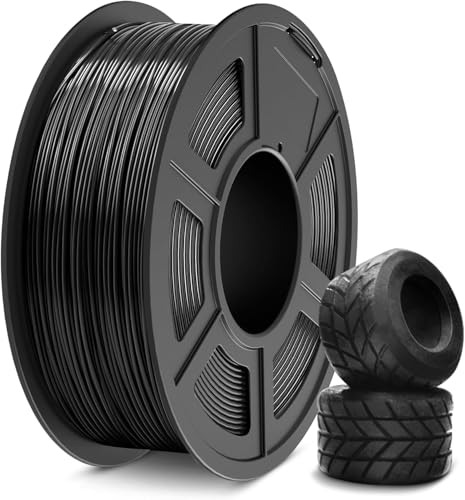
SUNLU TPU 95A (Black, 1.75 mm, 1 kg)
- Best for
- Budget 95A TPU for everyday flexible parts on a direct-drive printer.
- Skip this if
- You need clear manufacturer guidance on AMS or Bowden feeding.
Specs, strengths, and limitations
- Material
- TPU
- Diameter
- 1.75 mm
- Net filament
- 1000 g (filament only, not packaged weight)
- Hardness
- 95A
- Format
- other
- Maker's nozzle range
- 190–230 °C
- Manufacturer lists elongation at break above 900% for TPU 95A.
- Manufacturer states printing speeds of 80–120 mm/s at 210–230 °C.
- Manufacturer states the filament is vacuum-sealed with ±0.02 mm diameter tolerance.
- SUNLU claims compatibility with most FDM printers, including Bambu Lab, but says nothing about AMS or other automatic material systems, or about Bowden extruders.
- No drying time is given, only a 50–60 °C temperature.
- Bed needs 50–60 °C with glue, which is warmer than several other TPUs here.
Skip it if you need the maker's own guidance for Bowden or AMS feeding.
eSUN eTPU-95A (Black, 1.75 mm, 1 kg)
eSUN's TDS (V4.0) lists elongation at break of 800% or more, measured on injection-molded test bars rather than printed parts, and a slow 20–50 mm/s recommended speed. It recommends a short-path extruder with two-wheel reduction built for flexibles, and says the filament is usually difficult on a remote (Bowden) extruder, where it suggests trying 20 mm/s or slower. We don't treat it as a Bowden pick. eSUN lists a 220–250 °C nozzle and a 45–60 °C bed, drying at 55 °C for more than 4 hours, or 60 °C for more than 8 hours after long storage. It also recommends running cleaning filament, as residue can build up in the nozzle on long runs.

eSUN eTPU-95A (Black, 1.75 mm, 1 kg)
- Best for
- Flexible insoles, shoe parts, and wear parts on a direct-drive printer run at modest speeds.
- Skip this if
- Your printer uses a Bowden extruder or you need fast TPU printing.
Specs, strengths, and limitations
- Material
- TPU
- Diameter
- 1.75 mm
- Net filament
- 1000 g (filament only, not packaged weight)
- Hardness
- 95A
- Format
- other
- Maker's nozzle range
- 220–250 °C
- TDS lists 95A hardness and elongation at break of 800% or more (injection-molded test bars).
- Manufacturer states it has good tear, wear, and cut resistance.
- Manufacturer states printed parts are elastic and not easy to deform.
- eSUN's TDS recommends a short-path, two-wheel reduction extruder built for flexibles, and says it is usually difficult on remote (Bowden) extruders, where it suggests trying 20 mm/s or slower. The product page recommends direct-drive printers.
- TDS recommends a slow 20–50 mm/s.
- eSUN recommends cleaning filament because residue may build up in the nozzle during long runs.
Skip it if your printer is Bowden, or you want fast flexible printing.
ELEGOO TPU 95A (Black, 1.75 mm, 1 kg)
ELEGOO's product page lists 95A, a 220–240 °C nozzle, a 30–45 °C bed with glue recommended, printing below 60 mm/s, and a nozzle of 0.4 mm or larger. It says drying before use is required, at 70 ± 5 °C for 8 hours, and that printing and storage should stay at or below 20% RH. ELEGOO states the filament stays flexible in freezing conditions, which suits outdoor seals and covers, although that is the maker's claim.
ELEGOO says nothing about extruder type, Bowden feeding, or automatic material systems on this page. Plan on direct drive and an external spool.

ELEGOO TPU 95A (Black, 1.75 mm, 1 kg)
- Best for
- Outdoor and cold-weather flexible parts such as seals and gaskets.
- Skip this if
- You need documented support for multi-material feeding systems.
Specs, strengths, and limitations
- Material
- TPU
- Diameter
- 1.75 mm
- Net filament
- 1000 g (filament only, not packaged weight)
- Hardness
- 95A
- Format
- other
- Maker's nozzle range
- 220–240 °C
- Manufacturer states a Shore hardness of 95A and ±0.02 mm dimensional accuracy.
- Manufacturer states it is fully dried and vacuum-sealed with desiccant before shipping.
- Manufacturer states it holds up to water and cold, staying flexible in freezing conditions.
- ELEGOO's product page says nothing about extruder type, Bowden feeding, or automatic material systems (such as its CANVAS or Bambu Lab's AMS).
- Manufacturer recommends printing below 60 mm/s with a nozzle of 0.4 mm or larger.
- Manufacturer says drying before use is required (70 ± 5 °C for 8 h).
Skip it if you need documented support for a multi-material feeder.
Bambu Lab TPU 95A HF (Black 51100, 1.75 mm, 1 kg, with spool)
TPU 95A HF is Bambu Lab's high-flow 95A. Bambu states it prints three times faster than its standard TPU 95A. Its store page compares 12 mm³/s maximum volumetric speed with 3.6 mm³/s for the standard grade, and the TDS gives printing speeds below 200 mm/s. The TDS lists a 220–240 °C nozzle and a narrow 30–35 °C bed with glue. It isn't compatible with Cool Plate SuperTack or a 0.2 mm stainless steel nozzle.
Despite the Bambu name, it is not for the AMS. Bambu's store page marks it not compatible with all AMS series, so it suits Bambu Lab owners printing single-color flexible parts from the external spool holder. Drying is 70 °C for 8 hours in a blast drying oven, or 80–90 °C for 12 hours on an X1 Series heatbed. The spool is PC + ABS, rated to 90 °C.

Bambu Lab TPU 95A HF (Black (51100), 1.75 mm, 1 kg, filament with spool)
- Best for
- Fast single-color flexible parts such as bumpers, grips, and cases, fed from an external spool on a Bambu Lab printer.
- Skip this if
- You want to run flexible filament through an AMS or AMS lite for multicolor prints.
Specs, strengths, and limitations
- Material
- TPU (high-flow)
- Diameter
- 1.75 mm
- Net filament
- 1000 g (filament only, not packaged weight)
- Hardness
- 95A
- Format
- plastic spool
- Maker's nozzle range
- 220–240 °C
- Manufacturer states it prints 3 times faster than standard Bambu TPU 95A.
- TDS lists breaking elongation above 650% (X-Y) and impact strength of 123.2 kJ/m² (X-Y).
- Manufacturer states it comes on a high-temperature reusable spool (PC + ABS, rated 90 °C).
- Not fed by any AMS: Bambu's store page lists all AMS series NOT compatible. Bambu's TPU and X/A2L guides allow the AMS HT only as a sealed drying chamber, fed via its TPU outlet.
- Manufacturer calls it highly sensitive to humidity and says to dry it before use and after storage.
- Bed temperature window is narrow, 30–35 °C, and the TDS calls for glue on the plate.
- Color per the listing's selected variant; check the color before buying.
Skip it if you want flexible filament in multicolor AMS prints.
Bambu Lab TPU for AMS (Gray 53102, 1.75 mm, 1 kg, with spool)
TPU for AMS is the exception on this page. Bambu Lab's store page marks it compatible with all AMS series, including the AMS lite, and says its RFID tag carries the print settings. The trade-off is hardness. At 68D it is much stiffer than every 95A grade here, so parts are tough rather than soft and squishy. Bambu's TDS also lists breaking elongation above 650% in X-Y but only 31% in Z, so orient parts with that in mind.
Bambu states it prints up to 60% faster than TPU 95A HF, with up to 238 mm/s and 18 mm³/s on the store page. It isn't compatible with a 0.2 mm stainless steel nozzle. The listing is gray because no Amazon listing for the black version was found. Bambu says it must be dried before use and kept dry while printing, at 70 °C for 8 hours in a blast drying oven.

Bambu Lab TPU for AMS (Gray (53102), 1.75 mm, 1 kg, filament with spool)
- Best for
- Multicolor prints on a Bambu Lab printer with AMS where you need tough, impact-resistant TPU parts.
- Skip this if
- You need a soft, highly flexible part (85A–95A) rather than a firm 68D one.
Specs, strengths, and limitations
- Material
- TPU (AMS-compatible)
- Diameter
- 1.75 mm
- Net filament
- 1000 g (filament only, not packaged weight)
- Hardness
- 68D
- Format
- plastic spool
- Maker's nozzle range
- 220–240 °C
- Manufacturer states it is optimized for the AMS, and its store page marks it compatible with all AMS series, including the AMS lite.
- Manufacturer states it prints up to 60% faster than Bambu TPU 95A HF and greatly reduces stringing.
- Manufacturer states its RFID tag carries the print settings, which the AMS reads.
- At 68D it is much stiffer than typical 95A TPU, so parts are tough rather than soft and squishy.
- Manufacturer says it must be dried before use and kept moisture-free during printing to prevent stringing.
- Not compatible with a 0.2 mm stainless steel nozzle, per Bambu Lab's store page.
Skip it if you need a soft, highly flexible part in the 85A to 95A range.
What should you check before buying TPU?
- Hardness, including the letter. 85A and 90A are the hardest to feed. 68D is a different, much firmer class. Our TPU compatibility guide explains the scales.
- Extruder type. Know whether your printer is direct drive or Bowden, and whether its maker documents flexible filament for your exact model and revision. Polymaker and eSUN warn against Bowden for their grades. Siraya Tech and NinjaTek (for NinjaFlex) point to direct drive.
- Automatic material systems. Only Bambu Lab TPU for AMS is listed by its maker as AMS-compatible. Overture and Bambu Lab (TPU 95A HF) say their 95A grades are not. Feed everything else from an external spool.
- Nozzle. Bambu rules out a 0.2 mm stainless steel nozzle for both of its TPUs, and ELEGOO asks for 0.4 mm or larger. Polymaker says small nozzles make TPU90 very difficult.
- Spool size and format. Polymaker's spools are 0.75 kg cardboard, the Cheetah listing is 0.5 kg, and the two Bambu products ship on PC + ABS spools rated to 90 °C. Several makers don't publish spool material.
- Build plate. Bed ranges run from 20–50 °C (Siraya Tech) to 50–60 °C (SUNLU). Several makers recommend glue, and TPU can bond too strongly to some sheets. See textured vs smooth build surfaces, and how to clean a build plate for removing glue residue.
Alternatives, and when you don't need to buy anything
- Your parts don't need to flex. PETG is tougher than PLA without the feeding trouble of TPU. See the PETG filament shortlist or the PLA filament shortlist.
- Your current TPU strings or prints badly. Dry it first, using the maker's own settings, before buying a different spool. Our stringing troubleshooting guide covers the other causes one change at a time.
- Your extruder struggles with soft filament. A firmer grade from the same maker may solve it without new hardware. Read the TPU compatibility guide before buying an extruder upgrade.
- Not sure TPU is the right material? Try the filament finder.
Drying, storage, and safety
TPU makers disagree on drying. Polymaker and Bambu Lab give 70 °C for 8 hours, Overture 70 °C for 7 hours, ELEGOO 70 ± 5 °C for 8 hours, Siraya Tech 50–65 °C for 4–6 hours, and eSUN 55 °C for more than 4 hours. NinjaTek publishes no drying setting on the pages we checked. Check your dryer's maximum temperature and the spool's own rating before drying on the spool, and use a dryer made for filament rather than a kitchen oven. See filament dryer vs dry box and filament storage.
How this page was checked
This is a research-based shortlist. We have not printed with these spools for this page, so there are no test results, scores, or "we found" claims. Every hardness grade, temperature, speed, drying setting, and feed-path statement above comes from the manufacturer documents listed in the sources section or on each product's catalog record, retrieved on 2026-10-06. Polymaker's flexible TPU FAQ was retrieved on 2026-10-14. Makers' own pages sometimes disagree, as noted for Overture and Polymaker. Values vary by exact product, color, and revision, so check the current data sheet for your spool. Read more in our editorial standards and affiliate disclosure.
TPU: what to check before you buy a spool ↗Head-to-head comparisons
Deciding between two products on this page? Each comparison puts both makers’ specs side by side and says who should choose which.
Sources
- NinjaFlex Technical Data Sheet, NinjaTek
- Printing Guidelines, NinjaTek
- Fused Deposition Modeling, NinjaTek
- Flex TPU 85A Technical Data Sheet, Siraya Tech
- PolyFlex TPU90 product page, Polymaker
- Flexible TPU (Polymaker Wiki), Polymaker
- PolyFlex TPU95 Technical Data Sheet V5.4, Polymaker
- Overture TPU 95A 3D Printer Filament 1.75mm, Overture
- TPU 90A/95A 3D Printer Filament 1KG, SUNLU
- eTPU-95A Technical Data Sheet V4.0, eSUN
- TPU 95A Filament 1.75mm Colored 1KG, ELEGOO
- TPU 95A HF, Bambu Lab
- TPU for AMS, Bambu Lab
- Filament guide material table, Bambu Lab
- CFS Filament Compatibility Description, Creality
This page is research-based: we have not tested the products or methods ourselves. It draws on the manufacturer documentation and sources listed. Exact settings and fit always defer to your printer and filament makers.
Keep reading

TPU Compatibility: Extruder Path, Hardness, and Feeding Systems
Whether a TPU will feed in your printer depends on its Shore hardness, your extruder path, and whether it goes through an automatic material system.

Filament dryer vs dry box: drying and storage explained
A dry box keeps dry filament dry; a dryer removes moisture that is already in it. How to tell which problem you have, and what to do safely.

Textured vs Smooth Build Surfaces: Compatibility and Release Considerations
How smooth and textured PEI differ in finish, adhesion, release, and cleaning, and why plate fit depends on your exact printer model.