Polymaker Fiberon PET-CF17 vs Siraya Tech PET-CF
Two carbon-fiber PETs on maker data: hotend heat, nozzles, drying, annealing, AMS. Pick Polymaker for 300 °C hotends, Siraya Tech to skip annealing.
On this page (13 sections)
Pick Polymaker Fiberon PET-CF17 if your hotend tops out at 300 °C, you print in an enclosed printer, and you can anneal finished parts in an oven to reach the heat resistance Polymaker describes. Pick Siraya Tech Fibreheart PET-CF if your hotend runs up to 320 °C and you'd rather print parts without an annealing step, from a spool the maker ships dried and sealed. Both are carbon-fiber-filled PET, not PETG, and both are abrasive, so both makers call for a hardened nozzle. Polymaker states a higher carbon fiber content than Siraya Tech and says annealing is required for higher heat resistance. Siraya Tech says it doesn't recommend its PET-CF for the AMS, and Bambu advises against third-party PET-CF in the AMS too. The two data sheets use different test standards and specimen treatments, so we list their figures separately.
Who this comparison is for
This page is for anyone choosing between two specific spools: Polymaker Fiberon PET-CF17 in Black (1.75 mm, 1 kg, SKU FL01003) and Siraya Tech Fibreheart PET-CF in Black (1 kg, US SKU ST3003). These are engineering filaments for stiff, heat-resistant parts, a step up from PLA-CF and PETG-CF in hotend temperature and post-processing, so the real question is whether your hotend, nozzle, and oven can meet each maker's conditions. If you haven't printed abrasive filament before, start with our abrasive filament nozzle guide. For more options, see the carbon fiber filament shortlist. For Polymaker's carbon-fiber nylon, see Fiberon PA6-CF20 vs ELEGOO PAHT-CF.
| Product | Best for | Skip if | Link |
|---|---|---|---|
| Polymaker Fiberon PET-CF17 (Black, 1.75 mm, 1 kg) | Stiff, heat-resistant jigs and tooling on an enclosed printer, when you want nylon-like performance with less moisture fuss. | Your hotend tops out below 270 °C, or you can't anneal parts at 120 °C. | View on Amazon (opens Amazon in a new tab) |
| Siraya Tech Fibreheart PET-CF (Black, 1.75 mm, 1 kg) | Stiff, heat-resistant parts that need to hold dimensions in humid conditions, on a direct-feed printer with a 320 °C hardened hotend. | Your hotend can't reach 280 °C, or you print through an AMS or similar multi-material feeder. | View on Amazon (opens Amazon in a new tab) |


How we compared them
This is a research-based comparison. Every figure below comes from Polymaker's product page and data sheet, Siraya Tech's product page, data sheet page, user manual, and one blog post, and Bambu Lab's AMS notes, all listed in the sources. We haven't tested either filament, so nothing here is a measured result of ours. Where a maker describes its own product, such as Polymaker's "Moisture Insensitivity" or Siraya Tech's "No Warping, Shrinkage," we label it as the maker's claim.
Print settings are each maker's guidance, so they sit together in the table below. Test figures are another matter. The two makers use different test standards and specimen treatment, as explained below, so we list each maker's test figures on its own rather than set them head to head.
Side-by-side specs
| Polymaker Fiberon PET-CF17 | Siraya Tech Fibreheart PET-CF | |
|---|---|---|
| Variant | Black, 1.75 mm, 1 kg (FL01003) | Black, 1 kg (ST3003, US); 1.75 ± 0.02 mm (TDS page) |
| Base material | PET with 17% carbon fiber (product page) | "Polyethylene terephthalate + 15% carbon fiber" (TDS page) |
| Nozzle requirement | "0.4mm+ hardened nozzle required"; all-metal hotend 270 °C+ (product page) | 0.4–1.0 mm, "hardened steel or higher grade" (TDS page and manual) |
| Nozzle temperature | 270–300 °C (TDS and product page) | 280–320 °C (TDS page and manual) |
| Bed temperature | 70–80 °C (TDS and product page) | 60–80 °C in the print settings; the TDS page's preparation text recommends 70–90 °C |
| Build surface | Not stated | "PEI or coat with PVP glue stick" (TDS page and manual) |
| Enclosure and chamber | Chamber at room temperature (TDS); "Enclosure Recommended," keep the chamber door closed (product page) | Not mentioned on the product page, TDS page, or manual; a Siraya Tech blog says PET-CF "requires heated chamber and drying" |
| Cooling fan | Off (TDS and product page) | Off (TDS page and manual) |
| Maker's speed figure | "Up to 300mm/s" (TDS and product page) | 30–120 mm/s; maximum volumetric speed 20 mm³/s at 320 °C (TDS page and manual) |
| Retraction | Direct drive 3 mm at 40 mm/s; Bowden ("Indirect Drive") 6 mm at 60 mm/s (product page) | 1–3 mm at 1800–3600 mm/min (TDS page and manual) |
| Drying | 100 °C for 10 h; PolyDryer level 3 for 18 h (product page and TDS) | 90 °C for 4–6 h (all three pages); see below for when |
| Annealing | 120 °C for 10 h; 100 °C for 14 h for parts with large overhangs or thin sections (product page) | Optional, 90–100 °C for 4–6 h "if you need to enhance its hardness" (TDS page and manual) |
| Packaging and spool | Spool material not stated on the product page; FAQ says fiber filaments are wound on a larger core | Ships dried and sealed in an aluminum bag; spool material not stated |
| Published data format | One-page data sheet (V1.0) with ISO and GB/T methods | Data sheet web page with ASTM and ISO methods, unannealed and annealed columns |
Hotend and nozzle come first
Both filaments are abrasive. Polymaker's printing tips say to "Use an all-metal hotend within 270-300°C and a wear-resistant nozzle because the carbon-fiber reinforcement is abrasive," and its specification panel says "0.4mm+ hardened nozzle required." Siraya Tech's FAQ says that because its PET-CF "contains 15% carbon fiber, it is highly abrasive and can wear out standard brass nozzles quickly," and it "strongly" recommends "Hardened steel nozzles with 0.4mm or larger," "Rubidium or tungsten carbide nozzles for extended lifespan," and "Nozzles with at least 0.6mm diameter if printing at high speeds to avoid clogging."
Hotend temperature is where they split. Siraya Tech's window is 280–320 °C, and its maximum volumetric speed figure, 20 mm³/s, is quoted at 320 °C, so the two overlap at 280–300 °C. If your hotend's documented maximum is 300 °C, you can stay inside Polymaker's whole range but only the lower half of Siraya Tech's, and you won't reach the temperature behind Siraya Tech's flow figure. Check your hotend's rating, including any PTFE-lined parts, before buying either. Our replacement nozzle guide covers choosing a hardened nozzle.
Bed, enclosure, and speed
Both makers say to print with the cooling fan off. Polymaker gives a 70–80 °C bed and a room-temperature chamber in its data sheet, and its product page lists "Enclosure Recommended" and says "An enclosed printer is recommended; keep the chamber door closed during printing." Polymaker doesn't name a build surface or glue on the pages we checked.
Siraya Tech's print settings give a 60–80 °C bed on "PEI or coat with PVP glue stick." Its data sheet page also says "Recommended bed temperatures range from 70°C to 90°C to help the first layer adhere better," so its own figures run from 60 to 90 °C depending on the section. None of the three Siraya Tech pages for this filament mentions an enclosure or chamber temperature. A Siraya Tech blog comparing PET-CF with PETG-CF, which isn't specific to Fibreheart, rates PET-CF's printing difficulty "Higher, requires heated chamber and drying." Siraya Tech claims prints have "no warpage thanks to internal stress release," which is the maker's claim. Our enclosure planning guide covers what an enclosure does and doesn't do.
On speed, Polymaker says "up to 300mm/s" and Siraya Tech gives 30–120 mm/s. Neither names the nozzle size or layer height behind its figure, so treat either as a ceiling rather than a target, especially on a 0.4 mm hardened nozzle.
Drying and moisture
Both makers describe their PET-CF as low in moisture uptake, but each one's own pages disagree about when to dry.
| Maker and source | What it says about drying |
|---|---|
| Polymaker | PET-CF17 is "less sensitive to moisture, ensuring consistent print quality and reducing the need for pre-drying" |
| Polymaker print settings | 100 °C for 10 hours in a regular oven, or level 3 for 18 hours in its PolyDryer, "(Only if the material has absorbed moisture)" |
| Polymaker printing tips | "Dry at 100°C for 10 hours and keep the filament dry during use" |
| Polymaker FAQ | A dryer may be needed "either entire time while printing, or at least between prints" in a humid climate |
| Product-page answer labelled Polymaker | 85 °C for 10 hours "would be fine" if your dryer has good airflow, with 100 °C for a convection oven |
| Siraya Tech | The filament is "dried before being sealed in an aluminum bag" and "can be used directly without drying" |
| Siraya Tech data sheet page and manual | 90 °C for 4–6 hours; "Only dry if filament shows signs of moisture" |
| Siraya Tech product page | "Please dry at 90°C for 4-6 hours before printing." |
| Siraya Tech data sheet troubleshooting | A third setting, "an oven set at 100-120°C for 4-6 hours," for filament that has absorbed moisture |
Both publish a water absorption figure, measured differently. Polymaker's data sheet chart, at 70% RH and 23 °C, gives an equilibrium water absorption of 0.53%. Siraya Tech's data sheet gives a water absorption rate of 0.5% by ISO 62. Polymaker's chart doesn't name a standard, so these aren't a like-for-like pair.
Check your dryer's top temperature, and whether the spool can take it, before you buy. Neither maker publishes a temperature rating for its spool. Our filament dryer vs dry box guide covers the options.
Annealing: built in or optional
This is the clearest difference in how the two makers present their filaments.
Polymaker treats annealing as part of the process. Its printing requirements list "Annealing post printing," its description says "Annealing is required for higher heat resistance," and its data sheet says "We strongly recommend 120°C, 10h annealing to achieve the best performance of the material." Its FAQ says annealing raises the heat deflection temperature "from around 70°C to over 100°C," but "mainly increases the stiffness (modulus) of the material but does not enhance impact resistance or layer adhesion." Before annealing, Polymaker says to "allow the print to rest for more than 24 hours or place it at 80°C for 2 hours." For parts with large overhangs or thin sections, it gives 100 °C for 14 hours instead, and says 100 °C "would be the bare minimum to anneal PET-CF at." The data sheet also shows shrinkage: a 40 mm X-Y dimension measured 39.94 mm after printing and 39.40 mm after annealing.
Siraya Tech treats it as optional. Its data sheet page and manual say the filament "can be used right off the spool without annealing," and suggest 90–100 °C for 4–6 hours "if you need to enhance its hardness," adding "Be mindful of potential shrinkage during the annealing process." Its data sheet lists an annealed column, but doesn't say how those test bars were annealed.
So the two schedules aren't interchangeable. Polymaker says that at 80–100 degrees "the crystallization rate of PET-CF is very slow," and calls 100 °C the bare minimum, while Siraya Tech's own range is 90–100 °C. Each maker is describing its own filament, so follow the maker of the spool you buy. Our annealing guide covers ovens, supports, and shrinkage.
Strength and heat figures: listed separately
Polymaker's data sheet uses ISO test methods and states its specimen settings: printed at 300 °C on a 70 °C bed, 100% infill, two shells, three top and bottom layers, fan off. Directly under its mechanical table, a note reads "All specimens were annealed at 120°C for 10h." The sheet doesn't say whether the specimens in its thermal table, including heat deflection, were annealed. Siraya Tech's data sheet uses ASTM D638 for tensile figures and ISO methods for bending, impact, and Vicat, names its heat deflection loads only as "Method A" and "Method B," and doesn't give specimen print settings or annealing conditions. With different standards and specimen treatment, we don't put these numbers side by side.
Polymaker Fiberon PET-CF17 (TDS V1.0)
- Heat deflection temperature: 105 °C at 1.8 MPa and 147.5 °C at 0.45 MPa (ISO 75); annealing not stated for these specimens
- Vicat softening temperature: 238.4 °C (ISO 306, GB/T 1633)
- Glass transition: 79.3 °C; melting temperature: 241.3 °C (DSC, 10 °C/min)
- Tensile strength: 65.9 ± 1.0 MPa X-Y, 27.9 ± 1.3 MPa Z (ISO 527, GB/T 1040; annealed specimens)
- Young's modulus: 5481.0 ± 223.7 MPa X-Y, 3558.8 ± 260.4 MPa Z (annealed specimens)
- Elongation at break: 2.4 ± 0.5% X-Y, 0.8 ± 0.1% Z (annealed specimens)
- Bending strength: 109.3 ± 2.0 MPa X-Y, 43.4 ± 8.8 MPa Z; bending modulus 4744.4 ± 136.3 MPa X-Y, 2768.2 ± 422.6 MPa Z (annealed specimens; the sheet lists ISO 178 for modulus and ISO 306 for strength)
- Charpy impact: 5.1 ± 0.2 kJ/m² X-Y notched, 25.1 ± 2.8 kJ/m² X-Y unnotched, 3.1 ± 0.7 kJ/m² Z unnotched (ISO 179, GB/T 1043; annealed specimens)
- Density: 1.34 g/cm³ at 23 °C (ISO 1183, GB/T 1033)
Siraya Tech Fibreheart PET-CF (TDS page; unannealed, then annealed where given)
- Heat deflection temperature: 76.6 °C, then 118 °C, at 1.80 MPa ("Method A"); 86.7 °C, then 176 °C, at 0.45 MPa ("Method B")
- Vicat softening temperature: 220 °C unannealed (ISO 306)
- Glass transition: 80 °C; melting point: 250 °C (ASTM D3418)
- Tensile stress at break: 74, then 73 MPa X-Y; 35 MPa Z unannealed (ASTM D638)
- Young's modulus: 5950, then 6700 MPa X-Y; 3400 MPa Z unannealed (ASTM D638)
- Elongation at break: 2.5, then 1.5% X-Y; 1.15% Z unannealed (ASTM D638)
- Bending strength: 116, then 115 MPa; bending modulus 5600, then 5900 MPa (ISO 178; direction not stated)
- Charpy impact: 9, then 4.8 kJ/m² (ISO 179; notch and direction not stated)
- Notched Izod impact at 72 °F: 36, in units the sheet gives as kJ/m (ASTM D256)
- Filament density: 1.3 g/cm³ (no method named)
Siraya Tech's user manual gives a different heat pair: "HDT is 78.4C for method A and 90.2C for method B," without saying whether those parts were annealed.
Two things hold across both makers' own figures. First, the Z direction, between layers, is far weaker than X-Y, so orient parts so the main load runs along the layers. Second, annealing trades toughness for heat resistance and stiffness. Polymaker says annealing doesn't make the material tougher, and Siraya Tech's own columns show its Charpy figure falling from 9 to 4.8 kJ/m² after annealing while its heat deflection figures rise.
Bambu's AMS and third-party PET-CF
If you own a Bambu Lab printer with an AMS, this matters more than any spec. Bambu's Notes for AMS say to avoid "third-party fiber reinforcement materials (PA-CF/GF, PET-CF/GF, PLA-CF /GF, etc.)" because "they may wear AMS PTFE tubes during the printing process, brittle breaks, and other problems," while its own "PLA-CF, PETG-CF, PAHT-CF and other official filaments are specially optimized."
Neither filament here is Bambu's, so Bambu's guidance points both to the external spool holder. The makers' own statements agree:
- Siraya Tech answers "Can I use PET-CF filament with AMS?" with "We don't recommend it," because "Carbon fiber makes the filament more brittle, and it can break inside the AMS feed path, leading to jams or failed prints." It suggests "a direct-drive extruder or load the filament manually."
- Polymaker answers "Will the spools work in an AMS?" with "Yes! We have redesigned the edges of our spools so all Polymaker products will now spin great in the AMS," then adds "you will need to be careful when using any abrasive materials in the AMS." That answer is about the spool, not the abrasive filament.
Our AMS filament compatibility guide covers Bambu's rules and the external spool route.
What each maker says it's for
- Polymaker Fiberon PET-CF17. Polymaker calls it "the preferred choice for engineering 3D printing composite materials, featuring high modulus, heat resistance, moisture insensitivity, and ease of printing," and pitches it for "automotive, aerospace, robotics, and industrial parts."
- Siraya Tech Fibreheart PET-CF. Siraya Tech pitches it for automotive parts, drones, industrial machinery, robot parts, sports equipment, and electronics casings. It claims "low creep and better mechanical properties compared to PA and PC," and "Good dimensional stability during printing with no warping, shrinkage or odor."
Those are each maker's claims, without a published test against the other filament.

Polymaker Fiberon PET-CF17 (Black, 1.75 mm, 1 kg)
- Best for
- Stiff, heat-resistant jigs and tooling on an enclosed printer, when you want nylon-like performance with less moisture fuss.
- Skip this if
- Your hotend tops out below 270 °C, or you can't anneal parts at 120 °C.
Specs, strengths, and limitations
- Material
- PET (17% carbon-fiber filled)
- Diameter
- 1.75 mm
- Net filament
- 1000 g (filament only, not packaged weight)
- Format
- other
- Maker's nozzle range
- 270–300 °C
- Nozzle
- Abrasive: the maker recommends a wear-resistant nozzle
- Manufacturer states 17% carbon fiber for a high modulus, stiffness and dimensional stability.
- TDS lists a heat deflection temperature of 105 °C at 1.8 MPa.
- Manufacturer states that, unlike many engineering filaments, it is less sensitive to moisture, reducing the need for pre-drying.
- Abrasive: Polymaker requires a hardened nozzle of 0.4 mm or larger and an all-metal hotend.
- Needs a 270–300 °C hotend and annealing at 120 °C for 10 h for the stated heat resistance.
- Polymaker recommends an enclosure; its pages give a long 100 °C / 10 h drying cycle.
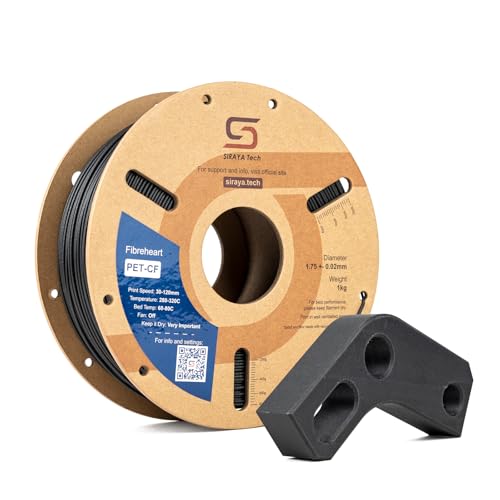
Siraya Tech Fibreheart PET-CF (Black, 1.75 mm, 1 kg)
- Best for
- Stiff, heat-resistant parts that need to hold dimensions in humid conditions, on a direct-feed printer with a 320 °C hardened hotend.
- Skip this if
- Your hotend can't reach 280 °C, or you print through an AMS or similar multi-material feeder.
Specs, strengths, and limitations
- Material
- PET (15% chopped carbon-fiber filled)
- Diameter
- 1.75 mm
- Net filament
- 1000 g (filament only, not packaged weight)
- Format
- other
- Maker's nozzle range
- 280–320 °C
- Nozzle
- Abrasive: the maker recommends a wear-resistant nozzle
- TDS lists a heat deflection temperature of 118 °C at 1.8 MPa for annealed test bars (annealing conditions not stated).
- Manufacturer states very low moisture absorption in prints (0.5% water absorption in the TDS) and no warping.
- Shipped dried in a sealed aluminum bag; the TDS says it can be used directly without drying (the product page still says to dry before printing).
- Abrasive: Siraya Tech requires a hardened steel (or harder) nozzle of 0.4 mm or larger.
- Runs hot: needs a hotend that reaches 280–320 °C.
- Not recommended for AMS-style feeders, and the bed range differs between sections of the TDS.
Verdict: which should you buy?
Choose Polymaker Fiberon PET-CF17 if…
- Your all-metal hotend and hardened nozzle (0.4 mm or larger) run at 270–300 °C, and your hotend doesn't go past 300 °C.
- You print in an enclosed printer, as Polymaker recommends, on a 70–80 °C bed with the fan off.
- You can anneal finished parts at 120 °C for 10 hours, or 100 °C for 14 hours for thin or overhanging parts, to reach the heat resistance Polymaker describes.
- You want a maker that publishes ISO test methods and its specimen print settings.
Choose Siraya Tech Fibreheart PET-CF if…
- Your hotend and hardened nozzle (0.4 mm or larger, 0.6 mm or larger for high speeds) run at 280–320 °C.
- You'd rather print parts without an annealing step, with annealing at 90–100 °C as an option.
- You feed the spool directly to the extruder rather than through an AMS, as Siraya Tech advises.
- You want a filament the maker ships dried and sealed, and says can be used straight from the bag.
Safety and limits
How this page was checked
Every temperature, speed, drying setting, annealing schedule, nozzle requirement, AMS statement, and test figure above comes from the manufacturer documents in the sources section, retrieved on 2026-10-13. We haven't printed with either filament for this page, so nothing here is a measured result of ours. Polymaker's FAQ says "we are not offering 1KG Fiberon™ options," but its store lists a 1 kg PET-CF17 spool (FL01003), and a product-page answer labelled Polymaker says "we do have 1KG of PET-CF now," so we cover the 1 kg spool. Polymaker's data sheet places its annealing note under the mechanical table only, so we don't describe its heat deflection figures as annealed. The same sheet lists ISO 306, a Vicat method, against its bending strength rows, which looks like an error, so we report that as printed. Siraya Tech's three pages differ on drying and bed temperature, as described above, and its data sheet page and user manual give different heat deflection figures. We used the data sheet web page rather than the PDF version it links to on a third-party file host. Values vary by color and revision, so check the current documents for your spool. Read more in our editorial standards and affiliate disclosure.
Specialty materials: what to check before you buy a spool ↗Sources
- Fiberon PET-CF17 product page, Polymaker
- Fiberon PET-CF17 Technical Data Sheet V1.0, Polymaker
- Siraya Tech Fibreheart PET-CF Filament, Siraya Tech
- Siraya Tech Fibreheart PET-CF TDS, Siraya Tech
- Siraya Tech Fibreheart PET-CF User Manual, Siraya Tech
- PET-CF vs PETG-CF: Differences in Performance and Applications, Siraya Tech
- Notes for AMS, Bambu Lab
This page is research-based: we have not tested the products or methods ourselves. It draws on the manufacturer documentation and sources listed. Exact settings and fit always defer to your printer and filament makers.
Keep reading

Best Carbon Fiber Filament (2026): Spools by Base Material
The best carbon fiber filament by base material: fifteen spools from PLA-CF to nylon and PC, with each maker's nozzle, heat, enclosure and drying needs.

Annealing 3D Prints: What Filament Makers Actually Say
Which filaments makers say to anneal, their temperatures and times, what it changes, the shrinkage and warping it costs, and how they say to run the oven.
Nozzles for Abrasive Filaments: Carbon Fiber, Glass Fiber, and Glow
Which filaments wear out nozzles, how brass, stainless, hardened, coated, and ruby-tipped nozzles differ, and how to find the right part for your exact hotend.