Best Carbon Fiber Filament (2026): Spools by Base Material
The best carbon fiber filament by base material: fifteen spools from PLA-CF to nylon and PC, with each maker's nozzle, heat, enclosure and drying needs.
On this page (27 sections)
For a first carbon-fiber spool, start with Polymaker PolyLite PLA-CF: Polymaker says that apart from a hardened nozzle it will print on any stock printer, with no enclosure needed. The trade-off is heat, with an HDT of 50 °C at 1.8 MPa. Check your nozzle before anything else, because every filament here is abrasive and every maker calls for a hardened steel or other wear-resistant nozzle. PETG-CF prints at PETG-like settings with a little more heat resistance, while PET-CF runs hotter and, after annealing, holds more heat. Nylon (PA) CF grades include the highest heat figures here, but they need a hot hotend, careful drying, and often annealing. ELEGOO ASA-CF covers outdoor parts and needs an enclosure, while Prusament PC Blend Carbon Fiber covers heat-stressed parts and doesn't. The fit rule: choose by base material, then confirm your hotend, bed and enclosure meet that maker's range.
Quick picks
| Need | Pick | Why |
|---|---|---|
| Default first carbon-fiber spool | Polymaker PolyLite PLA-CF | PLA temperatures (190–230 °C) and no enclosure needed; Polymaker says it prints on any stock printer apart from the hardened nozzle |
| More heat at PETG-like settings | ELEGOO PETG-CF | Enclosed printing not required, with an HDT of 74 °C at 0.45 MPa |
| AMS-type feeders | Siraya Tech Fibreheart PETG-CF Pro HF | Siraya Tech says it is rigid enough for smooth loading in systems like the AMS |
| Heat without an enclosure | Prusament PC Blend Carbon Fiber | Prusa says no enclosure is needed; HDT of 106 °C at 1.8 MPa |
| Outdoor parts | ELEGOO ASA-CF | ASA's outdoor durability with carbon fiber; ELEGOO requires an enclosed printer |
Picks are matched to documented needs, not scored.
Who is this carbon fiber shortlist for?
This page is for readers who want stiffer, matte, more dimensionally stable parts than unfilled filament gives, and who are ready to set up their printer for abrasive material. It suits jigs, fixtures, brackets, drone and robot parts, and functional prototypes. It doesn't suit decorative prints where a matte PLA would do, or printers that only have a brass nozzle.
If you haven't fitted a wear-resistant nozzle yet, start with our abrasive filament nozzle guide, then our replacement nozzle shortlist to find a part listed for your exact printer and hotend.
| Product | Best for | Skip if | Link |
|---|---|---|---|
| Polymaker PolyLite PLA-CF (Black, 1.75 mm, 1 kg) | Stiff, matte-finish PLA parts and prototypes on a printer fitted with a hardened nozzle. | Your printer only has a brass nozzle, or the part will see heat. | View on Amazon (opens Amazon in a new tab) |
| ELEGOO PLA-CF (Carbon Fiber Black, 1.75 mm, 1 kg) | Stiff, textured-finish PLA parts and assembly prototypes on an open or enclosed printer fitted with a hardened steel nozzle. | Your printer only has a brass nozzle, or the part will sit somewhere warm such as a car interior. | View on Amazon (opens Amazon in a new tab) |
| ELEGOO PETG-CF (Carbon Fiber Black, 1.75 mm, 1 kg) | Stiff matte functional parts on a printer with a 0.4 mm or larger hardened steel nozzle. | Your printer only has a brass nozzle, or the part will see temperatures near the listed 74 °C (0.45 MPa) heat deflection temperature. | View on Amazon (opens Amazon in a new tab) |
| Polymaker Fiberon PETG-rCF08 (Black, 1.75 mm, 0.5 kg) | An easy first carbon-fiber PETG for matte functional parts and fixtures on a printer with a hardened nozzle. | You need parts that hold up above about 65 °C, or you want a 1 kg spool. | View on Amazon (opens Amazon in a new tab) |
| Siraya Tech Fibreheart PETG-CF Pro HF (High Flow Black, 1.75 mm, 1 kg) | Fast, matte carbon-fiber PETG parts such as drone frames and fixtures on high-flow printers with a hardened nozzle. | Your printer has a brass nozzle, or the part must survive temperatures above about 70 °C. | View on Amazon (opens Amazon in a new tab) |
| Polymaker Fiberon PET-CF17 (Black, 1.75 mm, 1 kg) | Stiff, heat-resistant jigs and tooling on an enclosed printer, when you want nylon-like performance with less moisture fuss. | Your hotend tops out below 270 °C, or you can't anneal parts at 120 °C. | View on Amazon (opens Amazon in a new tab) |
| Siraya Tech Fibreheart PET-CF (Black, 1.75 mm, 1 kg) | Stiff, heat-resistant parts that need to hold dimensions in humid conditions, on a direct-feed printer with a 320 °C hardened hotend. | Your hotend can't reach 280 °C, or you print through an AMS or similar multi-material feeder. | View on Amazon (opens Amazon in a new tab) |
| Polymaker Fiberon PA612-CF15 (Black, 1.75 mm, 1 kg) | Stiff, heat-resistant engineering parts such as jigs and fixtures, on a printer with a hardened nozzle and a dry box. | Your printer has a brass nozzle or a hotend that can't reach 250 °C, or you can't keep filament below 20% RH. | View on Amazon (opens Amazon in a new tab) |
| Polymaker Fiberon PA12-CF10 (Black, 1.75 mm, 0.5 kg) | Dimensionally stable nylon parts in humid environments, on an open or enclosed printer with a hardened nozzle. | Your hotend can't reach 280 °C, or you want the strongest, highest-temperature carbon nylon (PA6-CF20 is stiffer). | View on Amazon (opens Amazon in a new tab) |
| Polymaker Fiberon PA6-CF20 (Black, 1.75 mm, 1 kg) | Stiff, heat-resistant jigs, fixtures and tooling on a printer with a 300 °C hardened hotend and a dry box. | Your hotend tops out below 280 °C, you can't anneal parts, or you can't keep filament below 20% RH. | View on Amazon (opens Amazon in a new tab) |
| SUNLU PA12-CF (Black, 1.75 mm, 1 kg) | Low-moisture carbon nylon parts such as gears and brackets, on a printer with a hardened nozzle and a filament dryer. | You can't dry filament at 80 °C or higher, or you need a 1.8 MPa heat-deflection figure. | View on Amazon (opens Amazon in a new tab) |
| SUNLU PA6-CF (Black, 1.75 mm, 1 kg) | Budget carbon-fiber PA6 for stiff, heat-resistant functional parts, if you can dry it thoroughly. | You want fully consistent specs, or you can't dry filament at 80 °C for 24 h (or 110 °C for 4 h). | View on Amazon (opens Amazon in a new tab) |
| ELEGOO PAHT-CF (Carbon Fiber Black, 1.75 mm, 1 kg) | Heat-resistant nylon parts such as motor mounts and under-hood brackets on an enclosed printer with a hardened nozzle and a dryer. | Your printer is open-frame, can't reach 260 °C, or you have no way to dry filament at 80 °C. | View on Amazon (opens Amazon in a new tab) |
| ELEGOO ASA-CF (Carbon Fiber Black, 1.75 mm, 1 kg) | Stiff outdoor and automotive parts printed on an enclosed printer with a hardened steel nozzle. | Your printer is open-frame or brass-nozzled, or it sits in an unventilated room. | View on Amazon (opens Amazon in a new tab) |
| Prusa Research Prusament PC Blend Carbon Fiber (Black, 1.75 mm, 800 g) | Heat-stressed functional parts such as fan shrouds, on a printer with a hardened nozzle and a 120 °C-capable bed. | Your printer has a brass nozzle or can't reach about 285 °C at the nozzle. | View on Amazon (opens Amazon in a new tab) |




How we chose these
A spool made the list only if it met all of these criteria:
- Manufacturer documentation we could read. Polymaker, Siraya Tech, and Prusa publish data sheets. ELEGOO publishes a specification table on each product page. SUNLU publishes specs on its store and product pages, plus a data sheet linked from its product page.
- An exact variant we could verify. Each catalog record ties one listing to one manufacturer product, color, diameter (1.75 mm), and net mass. Three aren't 1 kg spools: two Polymaker Fiberon spools hold 500 g and the Prusament spool holds 800 g.
- A stated nozzle requirement. Every maker here says its filament needs a hardened or wear-resistant nozzle, and we quote what each one says.
Don't compare heat figures across makers unless the test load matches. A heat deflection temperature (HDT) measured at 0.45 MPa always reads higher than one measured at 1.8 MPa on the same material, and annealed test bars read higher than unannealed ones. We give the load and conditions for every figure, as each maker states them. Our strongest filament guide explains why cross-brand comparisons mislead.
Why does carbon fiber wear out brass nozzles?
Prusa's composites guide says "carbon, glass and kevlar fibers are highly abrasive" and that you need a hardened nozzle to print them. Polymaker's nozzle guide describes brass as having "low wear resistance" and being "unsuitable for abrasives (carbon fiber, metal-filled filaments)". The chopped fibers act on the inside of the nozzle like an abrasive, so the bore gets larger and print quality drifts. Our worn nozzle guide covers the signs of wear.
Polymaker puts a number on it. Its Fiberon PETG-rCF08, PA612-CF15, PA12-CF10, and PA6-CF20 data sheets each say brass nozzle abrasion "happens frequently" with that filament and estimates brass nozzle life at "approximately 9h". Polymaker's nozzle guide also notes that hardened steel conducts heat less well than brass and may need a higher nozzle temperature, so start from the filament maker's range and adjust gradually. The extruder gears and feed path wear too, which our abrasive filament nozzle guide covers.
Carbon-fiber PLA: stiff, matte, low heat
PLA-CF prints at PLA temperatures with no enclosure, so it's the easiest way into carbon-fiber printing. The trade-off is heat. Both data sets here put HDT in the 50s °C.
Polymaker PolyLite PLA-CF (Black, 1.75 mm, 1 kg)

Polymaker PolyLite PLA-CF (Black, 1.75 mm, 1 kg)
- Best for
- Stiff, matte-finish PLA parts and prototypes on a printer fitted with a hardened nozzle.
- Skip this if
- Your printer only has a brass nozzle, or the part will see heat.
Specs, strengths, and limitations
- Material
- PLA (carbon-fiber filled (8 wt% chopped carbon fiber))
- Diameter
- 1.75 mm
- Net filament
- 1000 g (filament only, not packaged weight)
- Format
- cardboard spool
- Maker's nozzle range
- 190–230 °C
- Nozzle
- Abrasive: the maker recommends a wear-resistant nozzle
- Manufacturer states 8% chopped carbon fiber gives exceptional rigidity and strength.
- Manufacturer states a matte black finish with virtually invisible layer lines and low shrinkage.
- Manufacturer states it prints with standard PLA settings; the TDS lists no enclosure needed.
- Abrasive: Polymaker strongly recommends a hardened nozzle.
- Not suited to heat: the TDS lists a heat deflection temperature of 50 °C (1.8 MPa).
- Cardboard spool: Bambu Lab strongly advises a spool adapter or adapter ring for cardboard spools in the AMS.
- The Amazon listing's bullet points describe plain PolyLite PLA, though its title and model number (PA10001) are the carbon-fiber version. Check that the title says Carbon Fiber PLA before you buy.
Polymaker says this PLA contains 8% chopped carbon fiber by weight, which gives "exceptional rigidity and strength", a matte black finish, and low shrinkage. Its product page says the material "is abrasive so you will need a hardened nozzle, but it will print on any stock printer aside from that", and the data sheet (V5.4) lists no enclosure needed, a 190–230 °C nozzle, a 25–60 °C bed, and drying at 55 °C for 6 hours.
The data sheet lists an HDT of 50 °C at 1.8 MPa and 54 °C at 0.45 MPa (ISO 75). It suits stiff, good-looking prototypes and fixtures that stay at room temperature. It comes on Polymaker's cardboard spool, and our catalog notes that the Amazon listing's bullet points describe plain PolyLite PLA even though its title and model number (PA10001) match PLA-CF, so check the listing title before you buy.
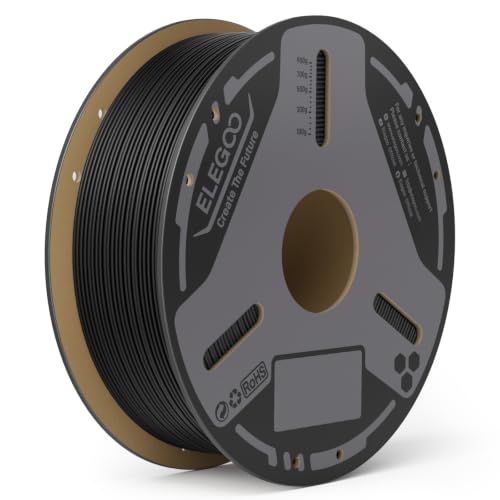
ELEGOO PLA-CF (Carbon Fiber Black, 1.75 mm, 1 kg)
ELEGOO PLA-CF (Carbon Fiber Black, 1.75 mm, 1 kg)
- Best for
- Stiff, textured-finish PLA parts and assembly prototypes on an open or enclosed printer fitted with a hardened steel nozzle.
- Skip this if
- Your printer only has a brass nozzle, or the part will sit somewhere warm such as a car interior.
Specs, strengths, and limitations
- Material
- PLA (carbon-fiber reinforced)
- Diameter
- 1.75 mm
- Net filament
- 1000 g (filament only, not packaged weight)
- Format
- other
- Maker's nozzle range
- 210–240 °C
- Nozzle
- Abrasive: the maker recommends a wear-resistant nozzle
- Manufacturer states carbon fiber reinforcement gives 'higher strength and stiffness'.
- Manufacturer states minimal shrinkage and warping for dimensionally accurate assembly parts.
- Manufacturer states a textured finish that hides layer lines, and it prints at PLA temperatures (210–240 °C) with no enclosure.
- Abrasive: ELEGOO recommends a hardened steel nozzle of 0.4 mm or larger.
- Low heat resistance: the product page lists a heat deflection temperature of 56 °C (0.45 MPa).
- Drying is listed as required (50 °C for 8 h), and no TDS PDF or fiber percentage is published.
ELEGOO says carbon fiber gives this PLA higher strength and rigidity, minimal warping and shrinkage, and a texture that hides layer lines. Its specification table recommends a "Hardened Steel Nozzle, ≥ 0.4 mm", says enclosed printing is not required, and lists a 210–240 °C nozzle and a 35–65 °C bed.
The table lists drying as required, at 50 ± 5 °C for 8 hours, and printing and storage at or below 20% RH, sealed with desiccant. That's stricter than most makers' advice for plain PLA, so plan for a dryer or dry box. The table gives an HDT of 56 °C at 0.45 MPa. ELEGOO publishes no 1.8 MPa figure and no fiber percentage.
Carbon-fiber PETG and PET: more heat, still approachable
PETG-CF prints close to plain PETG. PET-CF is a different base polymer. It runs hotter and, according to its makers, holds more heat, especially after annealing. Check which one you're buying, because the two names are easy to confuse. Our PLA-CF vs PETG-CF guide compares the PLA and PETG grades.
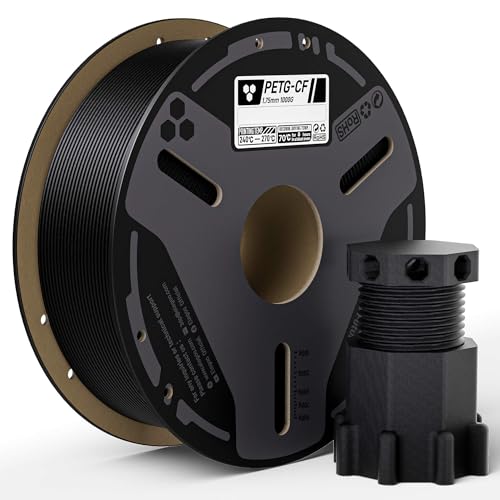
ELEGOO PETG-CF (Carbon Fiber Black, 1.75 mm, 1 kg)
ELEGOO PETG-CF (Carbon Fiber Black, 1.75 mm, 1 kg)
- Best for
- Stiff matte functional parts on a printer with a 0.4 mm or larger hardened steel nozzle.
- Skip this if
- Your printer only has a brass nozzle, or the part will see temperatures near the listed 74 °C (0.45 MPa) heat deflection temperature.
Specs, strengths, and limitations
- Material
- PETG (carbon-fiber filled)
- Diameter
- 1.75 mm
- Net filament
- 1000 g (filament only, not packaged weight)
- Format
- other
- Maker's nozzle range
- 240–270 °C
- Nozzle
- Abrasive: the maker recommends a wear-resistant nozzle
- Manufacturer states carbon fiber adds strength and rigidity, with abrasion resistance and dimensional stability.
- Manufacturer states that, compared with PLA-CF, it has superior toughness and is less prone to fracture under stress and impact.
- Manufacturer states a premium matte finish that reduces visible layer lines.
- Abrasive: ELEGOO recommends a 0.4/0.6/0.8 mm hardened steel nozzle and says 0.2 mm nozzles are not compatible.
- Needs drying before use (60 ± 5 °C for 8 h per the spec table; the page's 'Important Notes' say 70 °C) and storage at ≤ 20% RH.
- Modest heat resistance: the spec table lists a heat deflection temperature of 74 °C at 0.45 MPa; no 1.8 MPa figure or TDS PDF is published.
ELEGOO's product page says "0.2 mm Nozzle Not Compatible" and "0.4 mm/0.6 mm/0.8 mm Hardened Steel Nozzle Recommended". Its specification table lists a 240–270 °C nozzle and a 65–75 °C bed, says enclosed printing is not required, and gives an HDT of 74 °C at 0.45 MPa. ELEGOO says the carbon fiber adds strength, rigidity, and dimensional stability, with a matte finish.
ELEGOO's own page gives two drying temperatures. The specification table and the note at the top of the page say 60 °C for 8 hours, while the "Important Notes" list says 70 °C for 8 hours. The specification table also calls for printing and storage at or below 20% RH. ELEGOO doesn't publish the fiber percentage.
Polymaker Fiberon PETG-rCF08 (Black, 1.75 mm, 500 g)

Polymaker Fiberon PETG-rCF08 (Black, 1.75 mm, 0.5 kg)
- Best for
- An easy first carbon-fiber PETG for matte functional parts and fixtures on a printer with a hardened nozzle.
- Skip this if
- You need parts that hold up above about 65 °C, or you want a 1 kg spool.
Specs, strengths, and limitations
- Material
- PETG (8% recycled carbon-fiber filled)
- Diameter
- 1.75 mm
- Net filament
- 500 g (filament only, not packaged weight)
- Format
- other
- Maker's nozzle range
- 240–270 °C
- Nozzle
- Abrasive: the maker recommends a wear-resistant nozzle
- Manufacturer states 8% recycled carbon fiber for added stiffness over standard PETG.
- Manufacturer states a matte finish that hides layer lines and PETG-level low warping.
- Prints at ordinary PETG temperatures (240–270 °C nozzle, 60–70 °C bed) per the TDS, with only a short 65 °C / 3 h dry.
- Abrasive: Polymaker requires a hardened (or ruby) nozzle of 0.4 mm or larger; brass lasts about 9 h.
- Modest heat resistance: TDS heat deflection temperature is 65.7 °C at 1.8 MPa.
- Only sold in 0.5 kg and 3 kg spools, and Polymaker's enclosure guidance is inconsistent between page sections.
Polymaker says this PETG holds 8% recycled carbon fiber for extra stiffness and a matte finish. The data sheet (V1.0) lists a 240–270 °C nozzle, a 60–70 °C bed, a room-temperature chamber, and drying at 65 °C for 3 hours, the shortest drying cycle on this page. It lists an HDT of 65.7 °C at 1.8 MPa and 68.6 °C at 0.45 MPa (ISO 75), with no annealing step. The product page says "0.4mm+ hardened nozzle required".
Polymaker's guidance on enclosures conflicts. The specification block says "Enclosure Not needed", but the printing tips say "An enclosed printer is recommended" and point open-frame users to Polymaker's presets. It's sold only in 500 g and 3 kg spools.
Siraya Tech Fibreheart PETG-CF Pro HF (High Flow Black, 1.75 mm, 1 kg)

Siraya Tech Fibreheart PETG-CF Pro HF (High Flow Black, 1.75 mm, 1 kg)
- Best for
- Fast, matte carbon-fiber PETG parts such as drone frames and fixtures on high-flow printers with a hardened nozzle.
- Skip this if
- Your printer has a brass nozzle, or the part must survive temperatures above about 70 °C.
Specs, strengths, and limitations
- Material
- PETG (high-flow, 10% short-cut carbon-fiber reinforced)
- Diameter
- 1.75 mm
- Net filament
- 1000 g (filament only, not packaged weight)
- Format
- other
- Maker's nozzle range
- 250–270 °C
- Nozzle
- Abrasive: the maker recommends a wear-resistant nozzle
- Manufacturer states a high-flow formula good for up to 25 mm³/s, which it says cuts production time by half.
- Manufacturer states chopped (not powdered) carbon fiber for stiffness; TDS lists a 3450 MPa bending modulus.
- Product page FAQ says it is rigid enough to load smoothly in AMS-type systems.
- Abrasive: Siraya Tech requires a hardened steel or ruby nozzle of 0.4 mm or larger.
- Modest heat resistance: TDS heat deflection temperature is 69 °C at 1.8 MPa.
- Siraya Tech recommends an enclosure: the TDS says 'Not mandatory, but it is recommended', and the product page FAQ calls one 'highly recommended'.
Siraya Tech describes this as a high-flow PETG with short chopped carbon fiber, and its data sheet gives the fiber content as 10%. Its product page lists "Hardened steel (0.4 mm or larger)" and says a brass nozzle is not recommended, because "a hardened steel or ruby nozzle is required to prevent rapid wear." The data sheet lists a 250–270 °C nozzle, a 70–80 °C bed, and drying at 70–80 °C for 4–6 hours.
Heat figures differ by section. The data sheet gives 69 °C at 1.8 MPa (Method A) and 75 °C at 0.45 MPa (Method B), while the product page headline says 76 °C without a test load. On enclosures, the data sheet says one is "not mandatory, but it is recommended", and the product page FAQ calls one "highly recommended", warning that large or complex parts can warp in cold or drafty air. Siraya Tech's FAQ also says it is "rigid enough for smooth loading in systems like the AMS". Our catalog notes that the product page prints the diameter tolerance as "1.75±0.2 mm", while the data sheet gives ±0.02 mm.
Polymaker Fiberon PET-CF17 (Black, 1.75 mm, 1 kg)

Polymaker Fiberon PET-CF17 (Black, 1.75 mm, 1 kg)
- Best for
- Stiff, heat-resistant jigs and tooling on an enclosed printer, when you want nylon-like performance with less moisture fuss.
- Skip this if
- Your hotend tops out below 270 °C, or you can't anneal parts at 120 °C.
Specs, strengths, and limitations
- Material
- PET (17% carbon-fiber filled)
- Diameter
- 1.75 mm
- Net filament
- 1000 g (filament only, not packaged weight)
- Format
- other
- Maker's nozzle range
- 270–300 °C
- Nozzle
- Abrasive: the maker recommends a wear-resistant nozzle
- Manufacturer states 17% carbon fiber for a high modulus, stiffness and dimensional stability.
- TDS lists a heat deflection temperature of 105 °C at 1.8 MPa.
- Manufacturer states that, unlike many engineering filaments, it is less sensitive to moisture, reducing the need for pre-drying.
- Abrasive: Polymaker requires a hardened nozzle of 0.4 mm or larger and an all-metal hotend.
- Needs a 270–300 °C hotend and annealing at 120 °C for 10 h for the stated heat resistance.
- Polymaker recommends an enclosure; its pages give a long 100 °C / 10 h drying cycle.
This is PET, not PETG, with 17% carbon fiber. Polymaker's product page says "0.4mm+ hardened nozzle required", calls for an all-metal hotend within 270–300 °C, and lists "Enclosure Recommended", with the chamber door kept closed while printing. The data sheet (V1.0) lists a 70–80 °C bed, a room-temperature chamber, and the cooling fan off.
The data sheet lists an HDT of 105 °C at 1.8 MPa and 147.5 °C at 0.45 MPa (ISO 75). Its note that specimens were annealed at 120 °C for 10 hours sits under the mechanical table, so the sheet doesn't say whether the HDT bars were annealed. Polymaker "strongly recommend[s] 120°C, 10h annealing to achieve the best performance of the material," and its FAQ says annealing raises HDT "from around 70°C to over 100°C." Its print settings say to dry at 100 °C for 10 hours "Only if the material has absorbed moisture," while its printing tips say "Dry at 100°C for 10 hours and keep the filament dry during use." Polymaker describes PET-CF17 as less sensitive to moisture than many engineering filaments.
Siraya Tech Fibreheart PET-CF (Black, 1.75 mm, 1 kg)
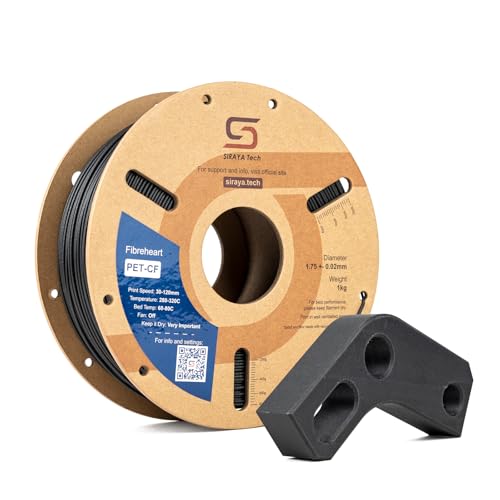
Siraya Tech Fibreheart PET-CF (Black, 1.75 mm, 1 kg)
- Best for
- Stiff, heat-resistant parts that need to hold dimensions in humid conditions, on a direct-feed printer with a 320 °C hardened hotend.
- Skip this if
- Your hotend can't reach 280 °C, or you print through an AMS or similar multi-material feeder.
Specs, strengths, and limitations
- Material
- PET (15% chopped carbon-fiber filled)
- Diameter
- 1.75 mm
- Net filament
- 1000 g (filament only, not packaged weight)
- Format
- other
- Maker's nozzle range
- 280–320 °C
- Nozzle
- Abrasive: the maker recommends a wear-resistant nozzle
- TDS lists a heat deflection temperature of 118 °C at 1.8 MPa for annealed test bars (annealing conditions not stated).
- Manufacturer states very low moisture absorption in prints (0.5% water absorption in the TDS) and no warping.
- Shipped dried in a sealed aluminum bag; the TDS says it can be used directly without drying (the product page still says to dry before printing).
- Abrasive: Siraya Tech requires a hardened steel (or harder) nozzle of 0.4 mm or larger.
- Runs hot: needs a hotend that reaches 280–320 °C.
- Not recommended for AMS-style feeders, and the bed range differs between sections of the TDS.
Siraya Tech says this PET holds 15% carbon fiber and is "highly abrasive". It recommends hardened steel nozzles of 0.4 mm or larger, tungsten carbide nozzles for longer life, and at least 0.6 mm for high-speed printing. It runs the hottest of the PET grades here, at 280–320 °C on a 60–80 °C bed per the data sheet, which also recommends 70–90 °C in its preparation text.
Heat figures depend on annealing. The data sheet lists 76.6 °C at 1.8 MPa (Method A) and 86.7 °C at 0.45 MPa (Method B) unannealed, and 118 °C and 176 °C annealed. The data sheet doesn't state the annealing conditions for those test bars; its annealing section suggests 90–100 °C for 4–6 hours. The user manual gives different values, 78.4 °C (Method A) and 90.2 °C (Method B), without saying whether they're annealed. Siraya Tech's data sheet and manual say it ships the filament dried and sealed in an aluminum bag, and to dry it at 90 °C for 4–6 hours only if it shows signs of moisture, while the product page says to dry it at 90 °C for 4–6 hours before printing. The data sheet's troubleshooting section suggests 100–120 °C instead. Siraya Tech does not recommend this filament for the AMS, because it is brittle and "can break inside the AMS feed path". Its product page, data sheet, and user manual don't mention an enclosure, though a Siraya Tech blog comparing PET-CF with PETG-CF lists PET-CF as "Higher, requires heated chamber and drying" for printing difficulty.
Carbon-fiber nylon (PA): highest heat figures, most demanding
Nylon CF grades have the highest heat figures on this page, but they ask the most of your setup. All six nylon spools come with drying instructions, and most makers call for keeping the spool at or below 20% RH while printing. Polymaker also recommends annealing printed parts, and its data sheets note that the mechanical test specimens were annealed. PA12 and PA612 absorb less moisture than PA6, according to Polymaker and SUNLU, but none of these nylons is moisture-proof. Read our dryer vs dry box guide first.
Polymaker Fiberon PA612-CF15 (Black, 1.75 mm, 1 kg)

Polymaker Fiberon PA612-CF15 (Black, 1.75 mm, 1 kg)
- Best for
- Stiff, heat-resistant engineering parts such as jigs and fixtures, on a printer with a hardened nozzle and a dry box.
- Skip this if
- Your printer has a brass nozzle or a hotend that can't reach 250 °C, or you can't keep filament below 20% RH.
Specs, strengths, and limitations
- Material
- PA (PA612, 15% carbon-fiber filled)
- Diameter
- 1.75 mm
- Net filament
- 1000 g (filament only, not packaged weight)
- Format
- other
- Maker's nozzle range
- 250–300 °C
- Nozzle
- Abrasive: the maker recommends a wear-resistant nozzle
- Manufacturer states significantly lower moisture sensitivity than PA6/66 and PA6-based nylons.
- TDS lists 91.9 MPa X-Y tensile strength dry and 83.1 MPa after moisture conditioning (annealed specimens).
- Manufacturer states Warp-Free technology for print size stability.
- Abrasive: the TDS highly recommends a hardened steel or ruby nozzle (brass lasts about 9 h).
- Needs a 250–300 °C hotend; Polymaker's product page recommends an enclosure, and the TDS recommends annealing at 100 °C for 16 h for full properties.
- Still hygroscopic: the TDS says to store and print below 20% RH and dry at 100 °C for 10 h.
Polymaker states PA612-CF15 has significantly lower moisture sensitivity than "traditional PA6/66 and PA6-based nylons". The data sheet (V1.1) lists a 250–300 °C nozzle, a 40–50 °C bed, a room-temperature chamber, the fan off, and an HDT of 114 °C at 1.8 MPa and 175 °C at 0.45 MPa (ISO 75). Its note that specimens were annealed at 100 °C for 16 hours sits under the mechanical property tables, not the thermal table. The data sheet highly recommends "a wear-resistance nozzle, such as hardened steel and ruby nozzle", and the product page says "0.4mm+ hardened nozzle required".
Polymaker's enclosure guidance is mixed. The product page specification block says "Enclosure Recommended", while its FAQ says its Warp-Free technology needs the build plate and ambient air both below 50 °C. Dry it at 100 °C for 10 hours and keep it below 20% RH. It was formerly sold as PolyMide PA612-CF.
Polymaker Fiberon PA12-CF10 (Black, 1.75 mm, 500 g)

Polymaker Fiberon PA12-CF10 (Black, 1.75 mm, 0.5 kg)
- Best for
- Dimensionally stable nylon parts in humid environments, on an open or enclosed printer with a hardened nozzle.
- Skip this if
- Your hotend can't reach 280 °C, or you want the strongest, highest-temperature carbon nylon (PA6-CF20 is stiffer).
Specs, strengths, and limitations
- Material
- PA (PA12 (long-chain copolyamide), 10% carbon-fiber filled)
- Diameter
- 1.75 mm
- Net filament
- 500 g (filament only, not packaged weight)
- Format
- other
- Maker's nozzle range
- 280–300 °C
- Nozzle
- Abrasive: the maker recommends a wear-resistant nozzle
- Manufacturer states it absorbs significantly less moisture than PA6/66 and PA6-based nylons.
- Manufacturer states Warp-free technology; the product page says no enclosure is needed.
- TDS lists a heat deflection temperature of 105 °C at 1.8 MPa.
- Abrasive: Polymaker requires a hardened (or ruby) nozzle of 0.4 mm or larger; brass lasts about 9 h.
- Only sold in 0.5 kg and 3 kg spools, and needs a hotend that reaches 280–300 °C per the TDS.
- Still needs drying at 100 °C for 10 h and storage below 20% RH.
Polymaker says this PA12 grade absorbs significantly less moisture than PA6/66 and PA6-based nylons. The data sheet (V1.1) lists an HDT of 105 °C at 1.8 MPa and 131 °C at 0.45 MPa (ISO 75), and recommends annealing at 100 °C for 16 hours. It's sold only in 500 g and 3 kg spools.
Polymaker's documents conflict on temperatures and enclosure. The data sheet lists a 280–300 °C nozzle, a 40–50 °C bed, and a room-temperature chamber. The product page's specification block lists a 260–300 °C nozzle, a 25–50 °C bed, and "Enclosure Not needed", but the same page's print settings give 280–300 °C and 40–50 °C, and its printing requirements list an "All-metal hotend 280˚C+". Plan for 280 °C. It needs a hardened nozzle of 0.4 mm or larger, drying at 100 °C for 10 hours, and storage below 20% RH.
Polymaker Fiberon PA6-CF20 (Black, 1.75 mm, 1 kg)

Polymaker Fiberon PA6-CF20 (Black, 1.75 mm, 1 kg)
- Best for
- Stiff, heat-resistant jigs, fixtures and tooling on a printer with a 300 °C hardened hotend and a dry box.
- Skip this if
- Your hotend tops out below 280 °C, you can't anneal parts, or you can't keep filament below 20% RH.
Specs, strengths, and limitations
- Material
- PA (PA6, 20% carbon-fiber filled)
- Diameter
- 1.75 mm
- Net filament
- 1000 g (filament only, not packaged weight)
- Format
- other
- Maker's nozzle range
- 280–300 °C
- Nozzle
- Abrasive: the maker recommends a wear-resistant nozzle
- TDS lists 109.3 MPa X-Y tensile strength and 8636 MPa X-Y Young's modulus (dry, annealed).
- TDS lists a heat deflection temperature of 173 °C at 1.8 MPa.
- Manufacturer states minimal warping and chemical resistance; the TDS calls for a room-temperature chamber, not a heated one.
- Abrasive: Polymaker requires a hardened (or ruby) nozzle of 0.4 mm or larger; brass lasts about 9 h.
- Needs a 280–300 °C all-metal hotend, plus annealing at 100 °C for 16 h for the stated properties.
- PA6 is moisture-sensitive: TDS wet-state tensile strength drops to 54.7 MPa, and it must be dried at 100 °C for 10 h and kept below 20% RH.
PA6-CF20 has the highest Polymaker heat figure here. The data sheet (V1.1) lists an HDT of 173 °C at 1.8 MPa and 215 °C at 0.45 MPa. Its note that specimens were annealed at 100 °C for 16 hours sits under the mechanical property tables, so the sheet doesn't say clearly whether the heat figures are annealed. The product page says "0.4mm+ hardened nozzle required" and an all-metal hotend rated 280 °C or higher, and the data sheet lists a 280–300 °C nozzle and a 40–50 °C bed.
PA6 is the most moisture-sensitive nylon here. Polymaker's data sheet shows X-Y tensile strength dropping from 109.3 MPa dry to 54.7 MPa after moisture conditioning, both on annealed specimens. Dry it at 100 °C for 10 hours and keep it below 20% RH. The product page lists "Enclosure Recommended", while the data sheet calls for a room-temperature chamber.
SUNLU PA12-CF (Black, 1.75 mm, 1 kg)

SUNLU PA12-CF (Black, 1.75 mm, 1 kg)
- Best for
- Low-moisture carbon nylon parts such as gears and brackets, on a printer with a hardened nozzle and a filament dryer.
- Skip this if
- You can't dry filament at 80 °C or higher, or you need a 1.8 MPa heat-deflection figure.
Specs, strengths, and limitations
- Material
- PA (PA12, 20% carbon-fiber filled)
- Diameter
- 1.75 mm
- Net filament
- 1000 g (filament only, not packaged weight)
- Format
- other
- Maker's nozzle range
- 260–280 °C
- Nozzle
- Abrasive: the maker recommends a wear-resistant nozzle
- Manufacturer states PA12 has the lowest water absorption of the nylons, for stable dimensions.
- SUNLU's TDS lists a heat deflection temperature of 175 ± 3 °C at 0.45 MPa (ISO 75) and 86 MPa tensile strength.
- Prints at a comparatively low 260–280 °C on a 50–70 °C bed per SUNLU.
- Abrasive: SUNLU recommends a hardened steel (wear-resistant) nozzle.
- Needs drying (80 °C for 12 h or 110 °C for 4 h) after the bag has been open 6 h, and storage below 20% RH.
- SUNLU's PA12-CF pages give no enclosure advice (its general wiki strongly recommends one for nylon), and its TDS lists only a 0.45 MPa heat deflection temperature.
SUNLU says this PA12 holds 20% carbon fiber and calls PA12 the nylon with the lowest water absorption. Its store page warns that "printing PA12-CF with copper nozzles is susceptible to wear and tear" and recommends "wear-resistant nozzles, e.g. hardened steel nozzles." It prints at 260–280 °C on a 50–70 °C bed with glue, per the store page, whose specification table gives 60–70 °C.
SUNLU's store page says to dry it once the bag has been open for 6 hours, at 80 °C for 12 hours or 110 °C for 4 hours, and to store it below 20% RH. SUNLU's product and store pages list an HDT of 175 ± 3 °C without a test load. The data sheet linked from its product page places that value in an ISO 75 row at 0.45 MPa and doesn't mention annealing. SUNLU's PA12-CF pages and data sheet don't mention an enclosure, but SUNLU's general enclosure wiki lists nylon (PA) as "Strongly recommended."
SUNLU PA6-CF (Black, 1.75 mm, 1 kg)
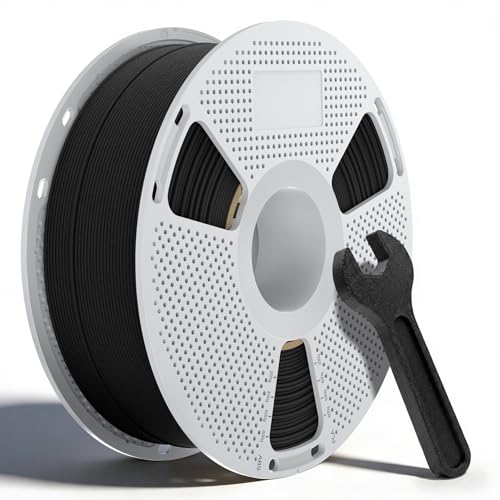
SUNLU PA6-CF (Black, 1.75 mm, 1 kg)
- Best for
- Budget carbon-fiber PA6 for stiff, heat-resistant functional parts, if you can dry it thoroughly.
- Skip this if
- You want fully consistent specs, or you can't dry filament at 80 °C for 24 h (or 110 °C for 4 h).
Specs, strengths, and limitations
- Material
- PA (PA6, 20% carbon-fiber filled)
- Diameter
- 1.75 mm
- Net filament
- 1000 g (filament only, not packaged weight)
- Format
- other
- Maker's nozzle range
- 270–290 °C
- Nozzle
- Abrasive: the maker recommends a wear-resistant nozzle
- Manufacturer states 20% carbon fiber in PA6 for high stiffness, with 112 MPa tensile strength in its spec table.
- SUNLU's TDS lists a heat deflection temperature of 203 ± 3 °C at 0.45 MPa (ISO 75); its product copy says up to 209 °C.
- Recommended for high-load parts such as gears, fan blades and chassis parts.
- Abrasive: SUNLU recommends a hardened steel (abrasion-resistant) nozzle.
- Needs long drying before use: 80 °C for 24 h or 110 °C for 4 h, per the store page.
- SUNLU's heat figure varies between pages (203 ± 3 °C on the store page and TDS vs. 'up to 209°C' on its www.sunlu.com product page), and its PA6-CF pages give no enclosure advice, though its general wiki strongly recommends one for nylon.
SUNLU says this is PA6 with 20% carbon fiber, aimed at high-load parts. Its store page says to "use an abrasion-resistant nozzle (e.g., hardened steel)" and to dry the filament before use at 80 °C for 24 hours or 110 °C for 4 hours. Its settings table, product page, and data sheet list a 270–290 °C nozzle and a 50–70 °C bed with glue.
SUNLU's pages disagree with each other. The store page and SUNLU's tables give the heat figure as 203 ± 3 °C, while the descriptive text on its www.sunlu.com product page says "up to 209°C". The data sheet places 203 ± 3 °C in an ISO 75 row at 0.45 MPa and doesn't mention annealing. SUNLU's PA6-CF pages and data sheet don't mention an enclosure, but SUNLU's general enclosure wiki lists nylon (PA) as "Strongly recommended." If you need settled numbers, ask SUNLU before relying on any of them.
ELEGOO PAHT-CF (Carbon Fiber Black, 1.75 mm, 1 kg)

ELEGOO PAHT-CF (Carbon Fiber Black, 1.75 mm, 1 kg)
- Best for
- Heat-resistant nylon parts such as motor mounts and under-hood brackets on an enclosed printer with a hardened nozzle and a dryer.
- Skip this if
- Your printer is open-frame, can't reach 260 °C, or you have no way to dry filament at 80 °C.
Specs, strengths, and limitations
- Material
- PA (PAHT (high-temperature nylon), carbon-fiber reinforced)
- Diameter
- 1.75 mm
- Net filament
- 1000 g (filament only, not packaged weight)
- Format
- other
- Maker's nozzle range
- 260–290 °C
- Nozzle
- Abrasive: the maker recommends a wear-resistant nozzle
- Product page lists a heat deflection temperature of 194 °C (0.45 MPa), for parts near motors or engines.
- Specification table lists 87 MPa X-Y tensile strength and 5089 MPa X-Y bending modulus.
- Manufacturer states carbon fiber reduces shrinkage and warping and improves wear resistance.
- Abrasive: ELEGOO recommends a 0.4/0.6/0.8 mm hardened steel nozzle and says 0.2 mm nozzles are not compatible.
- Needs an enclosed printer (45–60 °C chamber), a 260–290 °C hotend, a 90–110 °C bed and bed glue.
- Must be dried at 80 °C for 8 h and kept at ≤ 20% RH; slow at under 100 mm/s.
PAHT-CF is ELEGOO's high-temperature nylon, and it's the only nylon here whose maker requires an enclosure. The product page says "0.2 mm Nozzle Not Compatible", "0.4 mm/0.6 mm/0.8 mm Hardened Steel Nozzle Recommended", and "Enclosure Printer Required". Its specification table lists a 45–60 °C chamber, a 260–290 °C nozzle, a 90–110 °C bed with glue, printing below 100 mm/s, and an HDT of 194 °C at 0.45 MPa. ELEGOO publishes no 1.8 MPa figure or fiber percentage.
The specification table and page notes give drying at 80 ± 5 °C for 8 hours, required before printing, with printing and storage at or below 20% RH. This is one of the most demanding spools on this page.
Carbon-fiber ASA: outdoor parts
ELEGOO ASA-CF (Carbon Fiber Black, 1.75 mm, 1 kg)
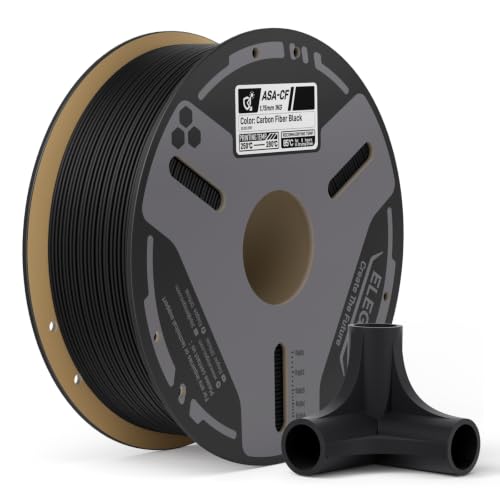
ELEGOO ASA-CF (Carbon Fiber Black, 1.75 mm, 1 kg)
- Best for
- Stiff outdoor and automotive parts printed on an enclosed printer with a hardened steel nozzle.
- Skip this if
- Your printer is open-frame or brass-nozzled, or it sits in an unventilated room.
Specs, strengths, and limitations
- Material
- ASA (carbon-fiber reinforced)
- Diameter
- 1.75 mm
- Net filament
- 1000 g (filament only, not packaged weight)
- Format
- other
- Maker's nozzle range
- 250–280 °C
- Nozzle
- Abrasive: the maker recommends a wear-resistant nozzle
- Manufacturer states ASA's UV and weather resistance for outdoor parts.
- Product page lists a heat deflection temperature of 108 °C (0.45 MPa).
- Manufacturer states lower warping and better dimensional control than standard ASA for large prints.
- Abrasive: ELEGOO recommends a hardened steel nozzle of 0.4 mm or larger.
- Needs an enclosed printer (45–60 °C chamber), a 90–100 °C bed with glue, and ventilation for odor.
- ELEGOO gives two drying temperatures (80 °C in the table, 85 °C in the note), and no TDS PDF is published.
ELEGOO says ASA-CF combines ASA's outdoor durability with carbon-fiber reinforcement, and claims lower warping and better dimensional control than standard ASA for large prints. Its specification table recommends a "Hardened Steel Nozzle, ≥ 0.4 mm", says enclosed printing is required, and lists a 45–60 °C chamber, a 250–280 °C nozzle, a 90–100 °C bed with glue, and an HDT of 108 °C at 0.45 MPa.
ELEGOO says to "use an enclosed printer in a well-ventilated area", because ASA-CF may produce a more noticeable odor than standard filaments. Its drying advice conflicts. The specification table says 80 ± 5 °C for 8 hours, while the page note says 85 °C for 8 hours. The specification table also calls for printing and storage at or below 20% RH. Our ABS vs ASA guide covers ASA emissions and ventilation.
Carbon-fiber polycarbonate: heat without an enclosure
Prusament PC Blend Carbon Fiber (Black, 1.75 mm, 800 g)

Prusa Research Prusament PC Blend Carbon Fiber (Black, 1.75 mm, 800 g)
- Best for
- Heat-stressed functional parts such as fan shrouds, on a printer with a hardened nozzle and a 120 °C-capable bed.
- Skip this if
- Your printer has a brass nozzle or can't reach about 285 °C at the nozzle.
Specs, strengths, and limitations
- Material
- PC (PC blend, carbon-fiber filled)
- Diameter
- 1.75 mm
- Net filament
- 800 g (filament only, not packaged weight)
- Format
- plastic spool
- Maker's nozzle range
- 275–295 °C
- Nozzle
- Abrasive: the maker recommends a wear-resistant nozzle
- Manufacturer states excellent temperature resistance (114 °C), up to 130 °C with annealing.
- Manufacturer states an enclosure is not needed, with good UV stability and resistance to common chemicals.
- Manufacturer states a professional-looking matte finish and lighter weight than unmodified PC Blend.
- Abrasive: Prusa states a hardened steel nozzle is needed.
- Needs a hotend reaching 285 ± 10 °C and a heated bed at 110 ± 10 °C per the TDS.
- Spool holds 800 g, and diameter tolerance is ±0.04 mm, looser than Prusa's unfilled filaments.
- The data sheet's 285 ± 10 °C nozzle range tops out above the 290 °C maximum Prusa lists for the MK4S, CORE One, and XL hotends; stay at or below your printer's limit.
Prusa's material page lists "Enclosure not needed", "Heated Bed is necessary", and "A hardened steel nozzle is needed", and rates abrasivity as "High". The data sheet lists a 285 ± 10 °C nozzle and a 110 ± 10 °C bed. The top of that nozzle range is above the 290 °C maximum Prusa lists for its own MK4S, CORE One, and XL, so on those printers stay at or below 290 °C. It also lists an HDT of 114 °C at 0.45 MPa and 106 °C at 1.8 MPa (ISO 75). Prusa says annealing raises its temperature resistance to 130 °C, by putting the part in an oven preheated to 140 °C for 120 minutes. Prusa also says there's "no need for drying prior to printing".
The spool holds 800 g, not 1 kg. Prusa lists a looser diameter tolerance (±0.04 mm) caused by the fibers, and a filament that breaks more easily than unfilled PC Blend. Prusa doesn't recommend printing it on a smooth PEI sheet without a layer of glue stick, because it can bond to and damage the surface.
What should you check before buying carbon fiber filament?
- Hardened nozzle. Every maker here requires or strongly recommends a hardened steel or wear-resistant nozzle. Find one listed for your exact printer and hotend in our replacement nozzle shortlist. Unknown fit is not fit.
- Nozzle size. ELEGOO says its PETG-CF and PAHT-CF are not compatible with 0.2 mm nozzles. ELEGOO, Polymaker, and Siraya Tech call for 0.4 mm or larger, and Siraya Tech suggests 0.6 mm or larger for high-speed PET-CF.
- Hotend temperature. The ranges run from 190 °C (PolyLite PLA-CF) to 320 °C (Fibreheart PET-CF). Six spools start at 270 °C or higher. Check your hotend's documented maximum, including any PTFE-lined parts, and never exceed it.
- Bed temperature. PLA-CF and the Polymaker nylons run at 50–65 °C or below. PAHT-CF, ASA-CF, and Prusament PC Blend Carbon Fiber need 100–120 °C at the top of their ranges.
- Enclosure. ELEGOO requires one for PAHT-CF and ASA-CF. Polymaker recommends one for PET-CF17 and lists one as recommended for PA6-CF20 and PA612-CF15, while its data sheets call for a room-temperature chamber. Prusa says PC Blend Carbon Fiber doesn't need one. SUNLU's product pages and data sheets don't mention one, but its general enclosure wiki lists nylon (PA) as "Strongly recommended." Siraya Tech's PET-CF product page, data sheet, and user manual don't mention one, though a Siraya Tech blog says PET-CF "requires heated chamber and drying."
- Drying. Settings here run from 50 °C (ELEGOO PLA-CF) to 110 °C (SUNLU's faster option), and Siraya Tech's PET-CF troubleshooting mentions up to 120 °C. Check your dryer's maximum temperature and the spool's rating before drying on the spool. See our filament dryer shortlist.
- AMS and other feeders. Siraya Tech doesn't recommend its PET-CF for the AMS. Siraya Tech says its PETG-CF Pro HF loads smoothly in AMS-type systems. Polymaker says its spools fit the AMS but to "be careful when using any abrasive materials in the AMS", and in a product-page answer warns that CF filament is more brittle and "can wear out the AMS tubes and gears faster". Other makers here don't address it. Read our AMS compatibility guide before loading any carbon-fiber spool into a feeder.
- Spool size. Fiberon PETG-rCF08 and PA12-CF10 come in 500 g (or 3 kg), and Prusament PC Blend Carbon Fiber comes in 800 g. Polymaker's FAQ says it spools brittle carbon-fiber filament on a larger core to reduce snapping, and says it doesn't offer 1 kg Fiberon spools, although its store now lists 1 kg versions of PA6-CF20, PA612-CF15, and PET-CF17.
Alternatives, and when you don't need to buy anything
- Only want a matte look? An unfilled matte PLA avoids the nozzle question entirely. See our PLA filament shortlist.
- Need more toughness than PLA, but not stiffness? Plain PETG is easier on your hardware. See our PETG filament shortlist.
- Need outdoor or heat resistance without fibers? Unfilled ASA and PC grades are in our specialty filament shortlist.
- No hardened nozzle yet? Price one in before buying a spool. Check fit in our abrasive filament nozzle guide.
- Already printing CF and seeing clogs? Work through our clog diagnosis guide before replacing parts. Wet filament, a worn nozzle, and too small a nozzle can all look alike.
How this page was checked
This is a research-based shortlist. We haven't printed with these spools for this page, so there are no test results, scores, or "we found" claims here. Every nozzle requirement, temperature, heat figure, drying setting, enclosure statement, and AMS note above comes from the manufacturer pages and data sheets listed in the sources section. We retrieved them on 2026-10-07. Where a maker's own pages disagree, we report both values rather than picking one. Values vary by exact product, color, and revision, and makers do reformulate, so check the current page or data sheet for your spool before relying on a number. Read more about our process in our editorial standards and affiliate disclosure.
Specialty materials: what to check before you buy a spool ↗Head-to-head comparisons
Deciding between two products on this page? Each comparison puts both makers’ specs side by side and says who should choose which.
Sources
- PolyLite PLA-CF product page, Polymaker
- PolyLite PLA-CF Technical Data Sheet V5.4, Polymaker
- ELEGOO PLA-CF Filament 1.75mm 1kg, ELEGOO
- ELEGOO PETG-CF Filament 1.75mm 1kg, ELEGOO
- Fiberon PETG-rCF08 product page, Polymaker
- Fiberon PETG-rCF08 Technical Data Sheet V1.0, Polymaker
- Fibreheart PETG-CF Pro HF product page, Siraya Tech
- Fibreheart PETG-CF Pro TDS, Siraya Tech
- Fiberon PET-CF17 product page, Polymaker
- Fiberon PET-CF17 Technical Data Sheet V1.0, Polymaker
- Fibreheart PET-CF product page, Siraya Tech
- Fibreheart PET-CF TDS, Siraya Tech
- Fibreheart PET-CF User Manual, Siraya Tech
- PET-CF vs PETG-CF: Differences in Performance and Applications, Siraya Tech
- Fiberon PA612-CF15 product page, Polymaker
- Fiberon PA612-CF15 Technical Data Sheet V1.1, Polymaker
- Fiberon PA12-CF10 product page, Polymaker
- Fiberon PA12-CF10 Technical Data Sheet V1.1, Polymaker
- Fiberon PA6-CF20 product page, Polymaker
- Fiberon PA6-CF20 Technical Data Sheet V1.1, Polymaker
- Nylon-12 Carbon Fiber (PA12-CF) 3D Printer Filament 1KG, SUNLU
- PA12-CF product page and technical data sheet, SUNLU
- Nylon-6 Carbon Fiber (PA6-CF) 3D Printer Filament, SUNLU
- PA6-CF product page and technical data sheet, SUNLU
- Printer Enclosure (SUNLU Wiki), SUNLU
- ELEGOO PAHT-CF Filament 1.75mm 1kg, ELEGOO
- ELEGOO ASA-CF 3D Printer Filament, ELEGOO
- Prusament PC Blend Carbon Fiber material page, Prusa Polymers
- Prusament PC Blend Carbon Fiber Technical Data Sheet, Prusa Polymers
- Composite materials filled with carbon, kevlar or glass, Prusa Research
- Nozzles, Polymaker
- Polymaker transitions all filaments onto 100% recycled cardboard spools, Polymaker
- 3D Printing (Additive Manufacturing), CDC / NIOSH
This page is research-based: we have not tested the products or methods ourselves. It draws on the manufacturer documentation and sources listed. Exact settings and fit always defer to your printer and filament makers.
Keep reading

Nozzles for Abrasive Filaments: Carbon Fiber, Glass Fiber, and Glow
Which filaments wear out nozzles, how brass, stainless, hardened, coated, and ruby-tipped nozzles differ, and how to find the right part for your exact hotend.
Best Replacement Nozzles and Hotends (2026), Matched to Your Printer
The best replacement nozzles and hotends for Bambu Lab, Creality and Prusa printers, matched to each maker's named models. Fit first, then flow and wear.

Which Filaments Work in Bambu's AMS and AMS lite
Bambu's own rules for the AMS and AMS lite: unsupported materials, TPU, damp or brittle filament, cardboard spools, spool sizes, and the external spool route.