SUNLU FilaDryer E2 vs S2
SUNLU's FilaDryer E2 and S2 compared on maker data: heat range, spool fit, annealing, power, and size. Pick the E2 above 70 °C, the S2 for one small spool.
On this page (15 sections)
Pick the SUNLU FilaDryer E2 if your filament maker calls for more than 70 °C, you want to anneal printed parts, or you dry two spools at once. Pick the FilaDryer S2 if you dry one spool of everyday filament at a time and want a small box beside the printer. The E2 is a large two-spool box for engineering filaments, with a 35–110 °C working range, a long timer, and silicone seals. SUNLU's pages give its capacity, weight, and power in different ways. The S2 is a small single-spool dryer with a 35–70 °C range and a humidity readout on its screen. SUNLU's own blog says the S2 is "Not suitable for high-temp engineering filaments," even though its product page calls it suitable for PA and PC.
Who this comparison is for
This page is for anyone choosing between SUNLU's two dryers at opposite ends of its range: the FilaDryer E2 in Black, and the FilaDryer S2 in Black. Both come from the same maker, so the question isn't brand but scale. Do you need more than 70 °C, more than one spool, or an annealing box, and do you have the space for a larger unit? If you're still deciding whether you need a heated dryer at all, start with our filament dryer vs dry box guide. For the S2 against a different single-spool design, see our SUNLU FilaDryer S2 vs Polymaker PolyDryer comparison. For the S2 against SUNLU's own storage-box design, see our SUNLU FilaDryer SP2 vs S2 comparison, and for another small dryer, our eSUN eBOX Lite vs SUNLU FilaDryer S2 comparison. For more dryers, see the filament dryer shortlist.
| Product | Best for | Skip if | Link |
|---|---|---|---|
| SUNLU FilaDryer E2 (Black, drying and annealing box) | Drying engineering filaments such as nylon and PC, or annealing printed parts, above the 70 °C limit of typical dryers. | You only print PLA and PETG and don't need temperatures above 70 °C. | View on Amazon (opens Amazon in a new tab) |
| SUNLU FilaDryer S2 (Black, single-spool dryer) | Drying and feeding one standard 1 kg spool of PLA, PETG, or TPU at a time. | You need to dry several spools at once or need temperatures above 70 °C. | View on Amazon (opens Amazon in a new tab) |

How we compared them
This is a research-based comparison. Every figure below comes from SUNLU's own store pages, product pages, wiki, and comparison blog, listed in the sources, plus Overture's filament drying table for the materials. We haven't tested either dryer, so nothing here is a measured result of ours. Where SUNLU describes its own product, such as "Excellent Airtightness," we label it as the maker's claim.
SUNLU publishes each dryer on several pages, and they don't always agree. Where they differ, we give each figure with where it appears. Neither dryer has a user manual we could read as text. The E2's manual is an image-only PDF, and the S2's "User Manual" link opens a one-page S2 quick guide with no text we could extract.
Side-by-side specs
| SUNLU FilaDryer E2 | SUNLU FilaDryer S2 | |
|---|---|---|
| Variant | Black | Black |
| Spools | Two 1 kg, two 2 kg, or one 3 kg (store page); two 1 kg or one 2 kg (product page and wiki) | "one standard 1 kg spool" (blog) |
| Maximum spool size | Φ250 × 153 mm, measured with SUNLU spools (store page) | φ210 × 85 mm (wiki) |
| Temperature range | 35–110 °C (store page) | 35–70 °C (wiki) |
| Heat-up time | 50 °C in 20 minutes and 70 °C in 30 minutes from room temperature (store page) | Not stated |
| Heater | "500W PTC" (store page); 325 W rated power (product page and wiki) | Upper and lower heating plates with a bottom fan; 48 W maximum working power (product page and wiki) |
| Annealing | Yes, "80–90°C annealing for 2–3 hours" (product page and wiki) | Not listed |
| Timer | 0–99 hours (store page) | Countdown shown on the screen; range not stated |
| Humidity display | 10–90%, accuracy ±10% (store page) | Real-time humidity on the screen; range not stated |
| Display | Screen size not stated | 4.6-inch LCD (product page, wiki, and a store-page feature panel); 3.42 × 2.87 inches and 2 inches in the store description |
| Presets | "Built-in preset filament settings" (store page) | One-touch presets for different filaments (wiki and store page) |
| Sealing | Silicone plug over the filament hole and silicone strips on the cover (store page) | Not described |
| PTFE tube included | Φ4 × Φ3 mm, two 8 cm and two 1 m lengths (store page) | Not stated |
| Filament diameters | 1.75 and 2.85 mm (store description, product page, and wiki); 1.75, 2.85, and 3.0 mm (store spec table) | 1.75, 2.85, and 3.00 mm (store page); 3.01 mm in the wiki |
| Product size, L × W × H | 400 × 220 × 307 mm (store page) | 265 × 274 × 118 mm (product page and wiki) |
| Internal size, L × W × H | 372 × 192 × 255 mm (store page); "Max Capacity" 372 × 192 × 186 mm (wiki) | Not stated |
| Net weight | 6.1 kg (store page and blog); 7.6 kg (product page and wiki) | 1109 g (product page and wiki); 1.19 kg (blog) |
| Power input | AC 110 V/60 Hz or 220 V/50 Hz (wiki); 2.2 A at 230 V or 4.2 A at 120 V maximum, standby 1 W or less (store page) | 24 V DC adapter, 2 A; standby 0.05 W (wiki) |
| Operating environment | 10–35 °C, up to 95% RH (store page) | 20–35 °C, up to 90% RH (wiki) |
Temperature: 110 °C vs 70 °C
This is the main difference. The E2's store page lists a "Working Temperature Range: 35℃-110℃," and its product page describes "rapid heating up to 70°C for standard filaments" with support for "90°C for specialty filaments like PA/PC." SUNLU says it reaches 50 °C in 20 minutes and 70 °C in 30 minutes from room temperature. The S2's wiki lists a "Temperature Setting Range" of 35–70 °C, and SUNLU doesn't publish a heat-up time for it.
SUNLU is inconsistent about whether 70 °C is enough for engineering materials. The S2's product page says it "Supports heating up to 70°C, suitable for specialty filaments such as PA and PC," but SUNLU's comparison blog lists "Not suitable for high-temp engineering filaments" as an S2 con and points nylon and PC users to the E2.
Filament makers' own drying tables show where 70 °C runs short. Overture's drying guide gives these settings for its filaments:
| Material | Overture drying setting | Within the S2's 70 °C? | Within the E2's 110 °C? |
|---|---|---|---|
| PLA | 50 °C for 7 h | Yes | Yes |
| PETG | 60 °C for 5 h | Yes | Yes |
| TPU | 70 °C for 7 h | At the limit | Yes |
| ABS and ASA | 75 °C for 7 h | No | Yes |
| PC | 75 °C for 7 h | No | Yes |
| Nylon | 95 °C for 7 h | No | Yes |
Those are Overture's figures for its own filaments. Other brands give different settings, so follow the drying guidance for your exact spool. The E2's range only helps if the spool can take it, which we cover below.
Spool fit and capacity
SUNLU's pages disagree about the E2's capacity.
- SUNLU FilaDryer E2. The store page says it "can hold 2 reels of regular 1KG spools, 2 reel of regular 2KG spools or 1 reel of regular 3KG spools," with a maximum spool of Φ250 × 153 mm. It adds that "the test spools are SUNLU spools, other brands of spools will have slight differences." The wiki says it "Holds 2 rolls of 1kg filament or 1 roll of 2kg filament," and the product page describes it the same way. Plan around the smaller claim unless your spools match SUNLU's.
- SUNLU FilaDryer S2. The wiki gives a maximum of φ210 × 85 mm, and SUNLU's blog says it holds "one standard 1 kg spool."
So the E2 takes spools up to 40 mm larger across and 68 mm wider, which matters for 2–3 kg spools. Spool sizes vary by brand, so measure yours before you buy either.
Annealing
Only the E2 anneals. SUNLU's product page and wiki say it "provides 80–90°C annealing for 2–3 hours," and the store page lists ABS, ABS-CF, ASA, PC, PC-ABS, PC-PBT, CoPA, PA6-GF, PA6-CF, PA12-CF, PA612-CF, and PA12 among materials it suits. The store page also claims it "can anneal 99.99% of engineering materials on the market." That's SUNLU's claim, with no test published.
SUNLU's own FAQ is more careful. It says that although the manual gives some annealing temperatures and times, "it is recommended to use the filament manufacturer's recommended temperatures and times for annealing." Annealed parts can shrink, and SUNLU's tips say to "Allow for shrinkage, and adjust your design accordingly." Our annealing guide covers what filament makers recommend for annealing.
Controls, humidity, and sealing
- SUNLU FilaDryer E2. The store page lists a 0–99 hour timer, built-in presets, and a humidity display of 10–90% at ±10%. It notes that at 80 °C or above, the humidity sensor goes into a protection mode and shows under 10%, and takes about 20 hours to recover its accuracy after the temperature drops to 70 °C. So the humidity reading isn't useful during high-heat runs. For sealing, SUNLU lists a one-piece silicone plug over the filament hole and silicone strips and a magnetic block on the cover. Its FAQ suggests opening the plug during drying to let moisture out, then plugging it "tightly" afterwards.
- SUNLU FilaDryer S2. The product page and wiki list a 4.6-inch LCD that shows "temperature, time, humidity, filament type, and countdown," and the wiki and store page add one-touch presets and an LED ring for status. The store page's feature panel also says 4.6 inches, but its description text calls the screen "3.42*2.87 inches" in one place and a "2 inch large LCD screen" in another. SUNLU doesn't publish the S2's timer range or humidity range, or describe any seal.
Feeding the printer
SUNLU's blog says both dryers "support PTFE tube feed-through for active drying during printing." The S2's store page says it "Allows you to print while drying," and that its feed-out coil lets filament "continue to dry in the dryer as it's being fed to the printer." The E2 comes with PTFE tubing, and its store page lists the tube sizes, but it doesn't describe printing from the box. Neither product page names a printer or multi-material feeder SUNLU has tested with, so we make no compatibility claim.
Spool temperature limits
SUNLU warns about this on the E2's store page itself. The E2's temperature "can reach up to 110℃ ( high temperature drying needs to take into account the temperature resistance of the filament spool )." Its FAQ adds that if you set 70 °C or more, the spool should be rated for at least that temperature "to avoid deformation of the spool." SUNLU doesn't publish a rating for its own spools on these pages. Many spools aren't rated for the E2's upper range, so check yours before going above 70 °C. At its 70 °C maximum, the S2 is at the same threshold.
Size, power, and weight
The E2 is a big appliance. SUNLU lists it at 400 × 220 × 307 mm and between 6.1 kg and 7.6 kg, depending on the page, with a maximum current of 4.2 A at 120 V. Its store page credits it with "500W PTC ultra-high heating power," while its product page and wiki list 325 W rated power. SUNLU doesn't explain the difference.
The S2 is 265 × 274 × 118 mm, wide and low, and weighs 1109 g by SUNLU's product page. It runs from a 24 V DC adapter with a 48 W maximum working power. SUNLU's store page claims it runs at "less than 10db while operating." Neither maker page gives drying-time or energy-use figures we could compare.
Safety features SUNLU lists
- SUNLU FilaDryer E2. The store page lists a "two-level temperature control switch" that cuts power when it overheats and restores it when it cools, an alarm that sounds "if the temperature exceeds the preset value by 10°C or the machine continues to work improperly," double-layer insulation, and "fireproof grade materials." SUNLU says that when the inside is above 100 °C, the outside touch temperature is under 60 °C. Its FAQ also warns that the outer surface reaches 55 °C or more when set to 80 °C or above, and says not to touch or handle it while running, or to wear insulated gloves.
- SUNLU FilaDryer S2. The product page says its temperature control "Precisely monitors chamber temperature to ensure safe and stable operation, preventing overheating." SUNLU doesn't list a separate cut-out or alarm for the S2 on the pages we checked.
What SUNLU says each is for
- SUNLU FilaDryer E2. SUNLU says it's "built for engineering-grade consumables," with "dual drying-and-annealing functions," and its blog suggests it for anyone "working with Nylon, PC, CF-filled filaments, or who wants to anneal prints."
- SUNLU FilaDryer S2. SUNLU calls it "designed as a drying and storage box for 3D printer filaments," and its blog suggests it for "Beginners, students, or anyone with a single printer and limited space."
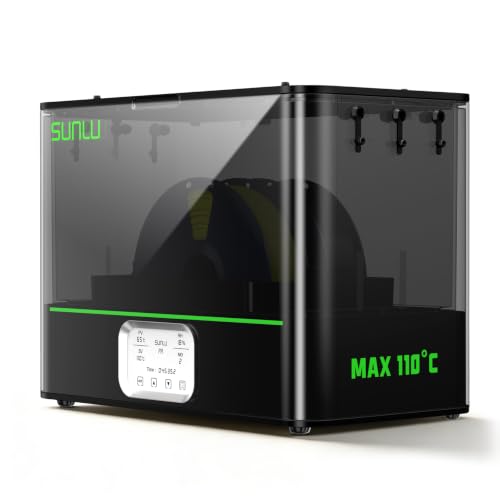
SUNLU FilaDryer E2 (Black, drying and annealing box)
- Best for
- Drying engineering filaments such as nylon and PC, or annealing printed parts, above the 70 °C limit of typical dryers.
- Skip this if
- You only print PLA and PETG and don't need temperatures above 70 °C.
Specs, strengths, and limitations
- Capacity
- Two 1 kg, two 2 kg, or one 3 kg spool, max Φ250 × 153 mm (SUNLU store page, tested with SUNLU spools); SUNLU product page and wiki list two 1 kg or one 2 kg spool
- Outer size
- 400 × 220 × 307 mm
- Part rated to
- 110 °C (your printer's own hotend limit may be lower)
- Maker notes
- SUNLU store page: 'Temperature can reach up to 110℃ (high temperature drying needs to take into account the temperature resistance of the filament spool)'. Heater: the store page states '500W PTC ultra-high heating power'; the SUNLU wiki lists rated power 325 W. SUNLU states 20 minutes to 50 °C and 30 minutes to 70 °C from room temperature. Outer-surface figures differ across SUNLU's pages: the store page says the outside touch temperature is 'only <60℃' when the inside is >100 °C; the wiki says 'exterior surface ≤ 60°C at 110°C operation'; the store FAQ says the outer surface 'will be ≥55℃' when the set temperature is ≥80 °C. Filament diameters Φ1.75 / Φ2.85 mm (store description, product page, wiki); the store spec table also lists Φ3.0 mm. Includes Φ4×Φ3 mm PTFE tubing (2 × 8 cm, 2 × 1 m). SUNLU lists ABS, ABS-CF, ASA, PC, PC-ABS, PC-PBT, CoPA, PA6-GF, PA6-CF, PA12-CF, PA612-CF and PA12 among materials it can anneal. Spool fit was tested with SUNLU spools; SUNLU says other brands' spools may differ slightly. Product size 400 × 220 × 307 mm (L×W×H) per SUNLU wiki.
- Manufacturer states temperatures up to 110 °C for drying and annealing engineering filaments.
- Store page states a maximum spool of Φ250 × 153 mm, including one 3 kg spool; SUNLU's wiki lists two 1 kg or one 2 kg.
- Manufacturer states the outside stays below 60 °C when the inside is above 100 °C.
- SUNLU warns that high-temperature drying must account for the temperature resistance of the filament spool; check that third-party plastic spools are rated for the temperature you set.
- SUNLU's own figures for heater power differ (500 W PTC vs 325 W rated).
- Larger and heavier than single-spool dryers: SUNLU lists 400 × 220 × 307 mm.
- SUNLU's store FAQ says the outer surface reaches 55 °C or more at settings of 80 °C and above; don't touch the enclosure while it runs.

SUNLU FilaDryer S2 (Black, single-spool dryer)
- Best for
- Drying and feeding one standard 1 kg spool of PLA, PETG, or TPU at a time.
- Skip this if
- You need to dry several spools at once or need temperatures above 70 °C.
Specs, strengths, and limitations
- Capacity
- One spool up to 210 mm diameter × 85 mm wide (SUNLU wiki: max capacity φ210×85(H) mm; SUNLU comparison: one standard 1 kg spool)
- Outer size
- 265 × 274 × 118 mm
- Part rated to
- 70 °C (your printer's own hotend limit may be lower)
- Maker notes
- Temperature setting range 35–70 °C (SUNLU wiki). Max working power 48 W (SUNLU product page and wiki). SUNLU describes dual upper and lower heating plates with a bottom fan ('360° Enclosed Heating') and a real-time humidity readout. Filament diameters 1.75 / 2.85 / 3.00 mm (SUNLU store page); SUNLU wiki lists 1.75 / 2.85 / 3.01 mm. SUNLU dimensions are 265(L) × 274(W) × 118(H) mm; recorded here as width = L, depth = W. SUNLU pages give different screen sizes (4.6-inch on sunlu.com, other figures on the store page), so screen size is not recorded. Timer range is not stated on SUNLU's product pages.
- Manufacturer states a 35–70 °C setting range with heating plates above and below the spool and a bottom fan.
- Manufacturer states filament can keep drying while it feeds to the printer.
- Manufacturer lists a low 48 W maximum working power.
- Holds a single spool, and SUNLU lists a maximum spool size of 210 mm diameter × 85 mm width, so wide or 2–3 kg spools will not fit.
- 70 °C maximum is below the drying temperature some engineering filaments call for; check the filament maker's drying guidance.
Verdict: which should you buy?
Choose the SUNLU FilaDryer E2 if…
- Your filament makers call for drying above 70 °C, and your spools are rated for the heat you'll set.
- You want to anneal printed parts in the same box, following your filament maker's settings.
- You dry two spools at once or use 2–3 kg spools, and you have room for a 400 mm wide box.
Choose the SUNLU FilaDryer S2 if…
- You dry one spool at a time, mostly materials whose makers give 70 °C or less.
- You want a small, low box that sits beside the printer and feeds while it dries.
- Your spools are no more than 210 mm across and 85 mm wide.
Safety and limits
How this page was checked
Every specification, temperature, and claim above comes from SUNLU's pages in the sources section, plus Overture's drying table, retrieved on 2026-10-13. We haven't used either dryer for this page, so nothing here is a measured result of ours. SUNLU's pages disagree on the E2's capacity, net weight, heater power, and internal size, and on the S2's screen size, weight, and largest filament diameter (3.00 mm on the store page, 3.01 mm in the wiki), so we've reported each figure with where it appears. Neither manual had text we could extract (the E2's user manual is an image-only PDF, and the S2's "User Manual" link opens a one-page S2 quick guide made of images and outlined text), so we used neither. The S2 store page's FAQ section answers questions about SUNLU's AMS Heater rather than the S2, so we didn't use it. SUNLU's blog FAQ says "Many users pair the S4 or E2 with AMS/AMS HT systems," but that's a description of users, not a tested fit, so we haven't treated it as a compatibility claim. Customer reviews weren't used. Read more in our editorial standards and affiliate disclosure.
Dryers & dry boxes: what to check before you buy ↗Sources
- SUNLU FilaDryer E2 (SUNLU store), SUNLU
- FilaDryer E2 product page, SUNLU
- SUNLU S2 Filament Dryer (SUNLU store), SUNLU
- FilaDryer S2 product page, SUNLU
- Filament Dryer wiki, SUNLU
- SUNLU Filament Dryer Comparison: S2 vs S4 vs E2, SUNLU
- Filament Drying Guide (Overture 3D Wiki), Overture
This page is research-based: we have not tested the products or methods ourselves. It draws on the manufacturer documentation and sources listed. Exact settings and fit always defer to your printer and filament makers.
Keep reading

Best Filament Dryers (2026), by Spool Count and Max Temp
The best filament dryers by need: ten units with published maker specs for one spool, several spools, engineering materials, or drying plus sealed storage.
SUNLU FilaDryer S2 vs Polymaker PolyDryer
SUNLU FilaDryer S2 vs Polymaker PolyDryer on maker data: heat, spool fit, power, feeding. Pick the S2 to set a temperature, the PolyDryer for sealed storage.

Annealing 3D Prints: What Filament Makers Actually Say
Which filaments makers say to anneal, their temperatures and times, what it changes, the shrinkage and warping it costs, and how they say to run the oven.