Best ABS Filament (2026): Spools for Enclosed Printers
The best ABS filament for enclosed printers: twelve 1.75 mm spools matched to the printer each suits, with their makers' enclosure, ventilation and heat data.
On this page (20 sections)
For most enclosed printers, start with Polymaker PolyLite ABS: it has the most complete data sheet of the standard grades here, with a heat deflection temperature of 98 °C at 1.8 MPa, and suits printers whose bed reaches 90–100 °C. Bambu ABS suits Bambu Lab owners who already have a reusable spool, and Anycubic ABS suits Anycubic owners with an ACE Pro. eSUN ABS+, Overture ABS, ELEGOO ABS, SUNLU ABS and Kexcelled K5 ABS are widely stocked general-purpose options, each with its own documentation gaps or quirks. Flashforge ABS Pro and Creality Hyper ABS suit owners of those brands' printers, though their makers publish less on enclosures and ventilation. For a sparkle or metallic look, PolyLite Galaxy ABS and PolyLite Metallic ABS use the PolyLite ABS resin. The fit rule for every spool: plan on an enclosed printer and real ventilation first. Creality says Hyper ABS "supports open printing," but the same guide recommends an enclosed printer or a heated chamber for ABS.
Quick picks
| Need | Pick | Why |
|---|---|---|
| Default for most enclosed printers | Polymaker PolyLite ABS | The most complete data sheet of the standard grades here, with mechanical, thermal and drying data |
| Bambu Lab printers with a spare spool | Bambu ABS refill | A spool-free refill for owners who already have an empty Bambu spool |
| Settings without opening a PDF | ELEGOO ABS | Print, drying and mechanical settings are published on the product page |
| Anycubic ACE Pro | Anycubic ABS | Anycubic lists it as ACE compatible, with RFID chips the ACE Pro reads |
| Sparkle finish | PolyLite Galaxy ABS | The same low-volatile resin as PolyLite ABS, in a sparkle black |
Picks are matched to documented needs, not scored.
Who is this ABS shortlist for?
This page is for anyone buying ABS for heat-resistant indoor parts: printer upgrades, enclosures for electronics, car-interior trim, jigs, and prototypes. It assumes a 1.75 mm printer, a 1 kg spool, and an enclosed printer, or one you are about to enclose. If the part will live outdoors or in sunlight, read our ABS vs ASA guide first, because ASA is usually the better fit there. If you don't have an enclosure yet, start with our enclosure planning guide. An enclosure helps ABS print without warping, but it is not a ventilation solution.
| Product | Best for | Skip if | Link |
|---|---|---|---|
| Polymaker PolyLite ABS (Black, 1.75 mm, 1 kg) | Heat-resistant functional parts, enclosures, and prototypes printed on an enclosed printer. | Your printer is open-frame or its bed can't reach 90 °C. | View on Amazon (opens Amazon in a new tab) |
| Bambu Lab Bambu ABS (Black (40101), 1.75 mm, 1 kg refill (no spool)) | Bambu Lab enclosed-printer owners who want ABS with Bambu's tuned profiles and a reusable spool. | You don't have a reusable Bambu spool or an enclosed printer. | View on Amazon (opens Amazon in a new tab) |
| eSUN ABS+ (Black, 1.75 mm, 1 kg) | General-purpose ABS parts from a widely stocked brand, printed in an enclosure. | You need documented heat resistance above about 75 °C or published drying settings. | View on Amazon (opens Amazon in a new tab) |
| Overture ABS (Black, 1.75 mm, 1 kg) | Budget-friendly ABS for functional parts on an enclosed printer. | You want high-speed printing or don't have an enclosure. | View on Amazon (opens Amazon in a new tab) |
| ELEGOO ABS (Black, 1.75 mm, 1 kg) | ELEGOO and other enclosed-printer owners who want a well-documented ABS. | Your printer is open-frame. | View on Amazon (opens Amazon in a new tab) |
| SUNLU ABS (Black, 1.75 mm, 1 kg) | Budget general-purpose ABS for functional parts on an enclosed printer. | You need documented heat resistance at 1.8 MPa or full drying instructions. | View on Amazon (opens Amazon in a new tab) |
| Kexcelled THE K5 ABS (Black, 1.75 mm, 1 kg) | General-purpose ABS in a wide range of colors. | You want maker-published drying and enclosure guidance or heat resistance above 85 °C. | View on Amazon (opens Amazon in a new tab) |
| Anycubic ABS (Black, 1.75 mm, 1 kg) | Anycubic Kobra owners with an ACE Pro who want RFID-recognized ABS. | You need product-specific enclosure guidance or heat resistance above 85 °C. | View on Amazon (opens Amazon in a new tab) |
| Flashforge ABS Pro (Black, 1.75 mm, 1 kg) | Flashforge owners and anyone who wants a lower-odor ABS with a wide speed range. | You want a published TDS with heat deflection data. | View on Amazon (opens Amazon in a new tab) |
| Creality Hyper ABS (Black, 1.75 mm, 1 kg) | Creality K1/K2-series owners who want Creality's high-speed ABS with matching slicer profiles. | You want published TDS data before buying. | View on Amazon (opens Amazon in a new tab) |
| Polymaker PolyLite Galaxy ABS (Galaxy Black, 1.75 mm, 1 kg) | Heat-resistant functional or display parts where a sparkle black finish hides layer lines, printed in an enclosure. | You print open-frame or only use a 0.4 mm nozzle for fine detail. | View on Amazon (opens Amazon in a new tab) |
| Polymaker PolyLite Metallic ABS (Metallic Blue, 1.75 mm, 1 kg) | Heat-resistant parts that need a metallic look, printed on an enclosed printer. | You print open-frame or need a nozzle smaller than 0.4 mm. | View on Amazon (opens Amazon in a new tab) |


How we chose these twelve
A product made the list only if it met these criteria:
- Manufacturer documentation we could read. Ten of the twelve have a technical data sheet or a full spec table on the maker's own site. Creality and Flashforge publish less, and we say so in their sections.
- An exact variant we could verify. Each catalog record ties one Amazon listing to one manufacturer product at 1.75 mm, with 1 kg of filament, in black (or, for the two decorative PolyLite spools, Galaxy Black and Metallic Blue). Where the listing's model number or product name doesn't match the maker's, we flag it.
- Unfilled ABS. None of these is fiber-filled, so none is listed by its maker as abrasive.
They are different grades with different heat ratings and printing windows, so the right one depends on your printer.
Polymaker PolyLite ABS (Black, 1.75 mm, 1 kg)
Polymaker's data sheet (V5.5) is the most complete of the standard ABS grades here, with mechanical, thermal, and drying data. Polymaker says PolyLite ABS uses a bulk-polymerized resin with significantly lower volatile content than traditional ABS, for minimal odor. Lower odor is not the same as no emissions, so you still need ventilation. The data sheet lists a heat deflection temperature of 98 °C at 1.8 MPa, a closed chamber as "Needed", and the cooling fan off. It suits most enclosed printers whose bed reaches 90–100 °C.
The caveat is the spool. Polymaker moved its filaments to recycled cardboard spools, which can behave differently from plastic in some automatic material systems and dryers.

Polymaker PolyLite ABS (Black, 1.75 mm, 1 kg)
- Best for
- Heat-resistant functional parts, enclosures, and prototypes printed on an enclosed printer.
- Skip this if
- Your printer is open-frame or its bed can't reach 90 °C.
Specs, strengths, and limitations
- Material
- ABS
- Diameter
- 1.75 mm
- Net filament
- 1000 g (filament only, not packaged weight)
- Format
- cardboard spool
- Maker's nozzle range
- 245–265 °C
- Manufacturer states PolyLite ABS uses a bulk-polymerized ABS resin with significantly lower volatile content than traditional ABS, for minimal odor.
- TDS lists a heat deflection temperature of 98 °C at 1.8 MPa.
- Manufacturer publishes a full TDS with mechanical, thermal, and drying data.
- TDS lists a closed chamber as 'Needed'. Polymaker's product page says a non-enclosed printer with a 90 °C bed and 260 °C nozzle can handle models smaller than fist size, larger prints need an enclosed printer (about 40–50 °C), and models over about 15–20 cm need a heated chamber (about 70 °C or more).
- Needs a 90–100 °C bed (TDS), so printers with low-temperature beds aren't suitable.
- Cardboard spool: Bambu Lab strongly advises a spool adapter or adapter ring for cardboard spools in the AMS.
Skip it if your printer is open-frame, its bed can't reach 90 °C, or your feeder can't take cardboard spools.
Bambu ABS (Black 40101, 1.75 mm, 1 kg refill)
Bambu Lab says its ABS is designed to reduce warping and cracking while keeping strong impact resistance. Its store page says an enclosed printer is required and recommends a well-ventilated area or air filtration, warning that ABS may release styrene at printing temperatures. The data sheet (V3.0) lists a chamber temperature of 45–60 °C, print speeds under 300 mm/s, glue on the build plate, and storage below 20% RH.
This is the refill, with no spool, so it suits owners who already have an empty Bambu spool. The Amazon listing reports a model number (47948-R) that doesn't match Bambu's color code, so confirm the color and refill format on the listing before you buy.

Bambu Lab Bambu ABS (Black (40101), 1.75 mm, 1 kg refill (no spool))
- Best for
- Bambu Lab enclosed-printer owners who want ABS with Bambu's tuned profiles and a reusable spool.
- Skip this if
- You don't have a reusable Bambu spool or an enclosed printer.
Specs, strengths, and limitations
- Material
- ABS
- Diameter
- 1.75 mm
- Net filament
- 1000 g (filament only, not packaged weight)
- Format
- refill
- Maker's nozzle range
- 240–270 °C
- Manufacturer states Bambu ABS is designed to reduce warping and cracking while keeping strong impact resistance.
- TDS lists print speeds under 300 mm/s and nozzle sizes from 0.2 to 0.8 mm.
- Manufacturer publishes a full TDS with drying, annealing, and mechanical data.
- Bambu Lab's store page says enclosed printers are required and recommends a well-ventilated area or air filtration, warning that it may release styrene at printing temperatures.
- Refill only: it needs a reusable spool to load in an AMS or on a spool holder.
- TDS calls for glue on the build plate.
Skip it if you don't have a reusable spool or an enclosed printer.
eSUN ABS+ (Black, 1.75 mm, 1 kg)
eSUN ABS+ is eSUN's own modified grade. Its data sheet (V4.0) says it has higher mechanical properties, lower odor, and lower shrinkage than conventional ABS. "ABS+" from another brand is a different recipe, and our ABS vs ABS+ guide explains what the label does and doesn't mean. eSUN says to print it in an enclosed chamber with a stable temperature and to keep the printing area well ventilated. It needs a hot bed, at 95–110 °C.
Its documentation has gaps and conflicts. The data sheet lists a heat distortion temperature of 73 °C (method GB/T 1634, with no test load stated), while eSUN's product page claims up to 89 °C, so plan around the lower figure. The data sheet recommends 100% fan speed, while the product page says to reduce or turn off cooling. eSUN publishes no drying settings for it.

eSUN ABS+ (Black, 1.75 mm, 1 kg)
- Best for
- General-purpose ABS parts from a widely stocked brand, printed in an enclosure.
- Skip this if
- You need documented heat resistance above about 75 °C or published drying settings.
Specs, strengths, and limitations
- Material
- ABS (ABS+ (modified ABS))
- Diameter
- 1.75 mm
- Net filament
- 1000 g (filament only, not packaged weight)
- Format
- other
- Maker's nozzle range
- 230–270 °C
- TDS states ABS+ has higher mechanical properties, lower odor, and lower shrinkage than conventional ABS.
- Manufacturer states ABS+ is not easy to warp or crack during printing.
- TDS lists Izod impact strength of 42 kJ/m² (GB/T 1843, injection-molded bars; notched or unnotched not stated).
- eSUN says to print in an enclosed chamber with a stable temperature and to keep the printing area well ventilated.
- TDS heat distortion temperature is 73 °C (GB/T 1634, test load not stated), lower than the product page's 89 °C claim.
- Needs a 95–110 °C bed (product page and TDS).
Skip it if you need documented heat resistance above about 75 °C, or published drying settings.
Overture ABS (Black, 1.75 mm, 1 kg)
Overture says its ABS uses a specialty resin with significantly lower volatile content than traditional ABS, and states a diameter tolerance of ±0.02 mm, measured with a CCD system. Its product page lists "Enclosed Printer Required" and recommends a well-ventilated space because ABS may emit fumes. It gives drying at 75 °C for 7 hours and warns against extended drying.
Overture's temperatures don't agree with each other. The product page description gives a 230–250 °C nozzle and a 90–110 °C bed, while its spec table and data sheet give 245–265 °C and 80–100 °C. We used the data sheet values. Its data sheet speed range of 30–70 mm/s is slower than the high-speed grades here.

Overture ABS (Black, 1.75 mm, 1 kg)
- Best for
- Budget-friendly ABS for functional parts on an enclosed printer.
- Skip this if
- You want high-speed printing or don't have an enclosure.
Specs, strengths, and limitations
- Material
- ABS
- Diameter
- 1.75 mm
- Net filament
- 1000 g (filament only, not packaged weight)
- Format
- cardboard spool
- Maker's nozzle range
- 245–265 °C
- TDS states Overture ABS uses a specialty ABS resin with significantly lower volatile content than traditional ABS, for minimal odor.
- Manufacturer states diameter tolerance of ±0.02 mm, measured with a CCD system.
- Manufacturer publishes drying guidance and a TDS.
- Overture's product page lists 'Enclosed Printer Required' and recommends a well-ventilated space because ABS may emit fumes.
- TDS print speed is 30–70 mm/s, slower than high-speed ABS options.
- Overture's product page text and TDS disagree on temperatures (see notes).
Skip it if you print at high speed, or don't have an enclosure.
ELEGOO ABS (Black, 1.75 mm, 1 kg)
ELEGOO publishes its print, drying, and mechanical settings directly on the product page. It lists enclosed printing as "Required", a chamber of 45–60 °C, build-plate glue as required, and storage at or below 20% RH. ELEGOO says it withstands up to 85 °C without deforming, and the page gives a heat deflection temperature of 85 °C at 0.45 MPa. It suits ELEGOO owners and anyone with an enclosed printer who wants a documented spec sheet without opening a PDF.
ELEGOO ships it on a recycled cardboard spool, and states an empty spool weight of 154 ± 10 g. Check your material system's documentation if it needs plastic spools.

ELEGOO ABS (Black, 1.75 mm, 1 kg)
- Best for
- ELEGOO and other enclosed-printer owners who want a well-documented ABS.
- Skip this if
- Your printer is open-frame.
Specs, strengths, and limitations
- Material
- ABS
- Diameter
- 1.75 mm
- Net filament
- 1000 g (filament only, not packaged weight)
- Format
- cardboard spool
- Maker's nozzle range
- 240–280 °C
- Manufacturer states ELEGOO ABS withstands temperatures up to 85 °C without deforming.
- Product page lists an impact strength of 54.9 kJ/m² (X-Y) and tensile strength of 35 MPa (X-Y).
- Manufacturer publishes full print, drying, and mechanical settings on the product page.
- ELEGOO lists enclosed printing as 'Required' with a 45–60 °C chamber.
- Product page says build plate glue is required.
- Cardboard spool: Bambu Lab strongly advises a spool adapter or adapter ring for cardboard spools in the AMS.
Skip it if your printer is open-frame, or your feeder can't take cardboard spools.
SUNLU ABS (Black, 1.75 mm, 1 kg)
SUNLU recommends this ABS for enclosed printers, to keep the printing temperature consistent and limit warping. Both of its data sheets (the US store and UK store link different ones) say the print area should be well ventilated and call for glue on the plate and an 80–100 °C bed. They list a heat distortion temperature at 0.45 MPa (ISO 75) of 95 °C (US-linked sheet) or 95 ± 5 °C (UK-linked sheet). SUNLU gives no figure at 1.8 MPa, so the number isn't directly comparable with Polymaker's or Bambu Lab's. It suits anyone with an enclosed printer who wants a widely stocked general-purpose ABS.
SUNLU's own documents disagree on temperatures. The US store and the data sheet it links give 250–260 °C at 50–100 mm/s and 260–280 °C at 100–200 mm/s, while the UK store and the data sheet it links give 250–270 °C at 50–100 mm/s and 270–290 °C at 100–200 mm/s. Start with the range that matches your print speed. Drying differs the same way: 50 °C from the US store and its data sheet, 80 °C from the UK store and its data sheet. Both stores specify a blast drying oven, and none of SUNLU's documents give a drying time.

SUNLU ABS (Black, 1.75 mm, 1 kg)
- Best for
- Budget general-purpose ABS for functional parts on an enclosed printer.
- Skip this if
- You need documented heat resistance at 1.8 MPa or full drying instructions.
Specs, strengths, and limitations
- Material
- ABS
- Diameter
- 1.75 mm
- Net filament
- 1000 g (filament only, not packaged weight)
- Format
- other
- Maker's nozzle range
- 250–260 °C
- SUNLU's data sheets list a heat distortion temperature of 95 °C (US-linked) or 95 ± 5 °C (UK-linked) at 0.45 MPa.
- Sold in many colors from a widely stocked brand.
- SUNLU recommends it for enclosed printers to keep the temperature consistent and limit warping.
- Drying temperature is published but no drying time.
- SUNLU's US and UK stores and their linked data sheets give different nozzle ranges and drying temperatures (see notes).
Skip it if you need heat resistance documented at 1.8 MPa, or complete drying instructions.
Kexcelled K5 ABS (Black, 1.75 mm, 1 kg)
Kexcelled says THE K5 ABS is formulated for reduced shrinkage and improved layer adhesion to prevent edge warping and cracking, with lower printing temperatures and low odor. Its product page and data sheet (KT012, rev. 05) give a 240–280 °C nozzle, an 80–100 °C bed with tape or glue, the cooling fan at 0–50%, and speeds up to 200 mm/s, based on a 0.4 mm nozzle. The data sheet lists a heat deflection temperature of 85 °C at 0.45 MPa (ISO 75) and a Vicat softening temperature of 98 °C. It suits anyone who wants a documented general-purpose ABS in a wide range of colors.
Kexcelled publishes no drying instructions and no enclosure or ventilation guidance for K5 ABS. That's a documentation gap, so plan for an enclosure and ventilation as you would for any ABS. The Amazon listing doesn't use the K5 name, so confirm it matches before you buy.

Kexcelled THE K5 ABS (Black, 1.75 mm, 1 kg)
- Best for
- General-purpose ABS in a wide range of colors.
- Skip this if
- You want maker-published drying and enclosure guidance or heat resistance above 85 °C.
Specs, strengths, and limitations
- Material
- ABS
- Diameter
- 1.75 mm
- Net filament
- 1000 g (filament only, not packaged weight)
- Format
- other
- Maker's nozzle range
- 240–280 °C
- Manufacturer states it is formulated for reduced shrinkage and improved layer adhesion to cut warping and cracking.
- TDS rates print speeds up to 200 mm/s.
- Manufacturer publishes a TDS with heat and mechanical data, plus nearly 50 colors.
- TDS heat deflection is 85 °C at 0.45 MPa, lower than several other ABS options here.
- No drying or enclosure guidance from Kexcelled.
- Amazon listing doesn't name the K5 product line.
Skip it if you want maker-published drying and enclosure guidance, or heat resistance above 85 °C.
Anycubic ABS (Black, 1.75 mm, 1 kg)
Anycubic says its ABS has enhanced anti-warping properties that help prevent corner lifting even on 220 × 220 mm prints. Anycubic lists it as ACE compatible and says the filament has intelligent identification (RFID) chips that work with its ACE Pro for automatic identification of printing information, a feature Anycubic says needs an internet connection. Its data sheet (V3.0) gives a 240–280 °C nozzle, an 80–100 °C bed, 50–150 mm/s, and the fan at 80%, and both the data sheet and product page say to dry it at 70–80 °C for 8–12 hours before use. It suits Anycubic owners with an ACE Pro.
Anycubic's product page and data sheet both give a heat deflection temperature of 85 °C at 0.45 MPa, with no figure at 1.8 MPa, so the number isn't directly comparable with Polymaker's or Bambu Lab's. Anycubic's product page and data sheet give no enclosure or ventilation guidance, but Anycubic's general ABS Printing Guide on its wiki, which isn't specific to this filament, says to "Use an enclosed printer or hot air system," and that ABS emits trace amounts of harmful gases such as styrene, so "ensure good ventilation or use a filtered printing environment." The product page also lists "Reusable Filament Spool" as not supported.

Anycubic ABS (Black, 1.75 mm, 1 kg)
- Best for
- Anycubic Kobra owners with an ACE Pro who want RFID-recognized ABS.
- Skip this if
- You need product-specific enclosure guidance or heat resistance above 85 °C.
Specs, strengths, and limitations
- Material
- ABS
- Diameter
- 1.75 mm
- Net filament
- 1000 g (filament only, not packaged weight)
- Format
- other
- Maker's nozzle range
- 240–280 °C
- Manufacturer states enhanced anti-warping properties that help prevent corner lifting even on 220 × 220 mm prints.
- RFID intelligent identification with Anycubic's ACE Pro (manufacturer; needs an internet connection).
- Manufacturer publishes a TDS with drying, flow, and mechanical data.
- The product page and TDS give no enclosure or ventilation guidance; only Anycubic's general wiki ABS guide covers them.
- Heat deflection is given only at 0.45 MPa (85 °C), with no 1.8 MPa figure, so it isn't directly comparable with makers that publish 1.8 MPa values.
- Long drying cycle (8–12 h) recommended before use.
Skip it if you want enclosure guidance on the product page or data sheet itself, or heat resistance above 85 °C.
Flashforge ABS Pro (Black, 1.75 mm, 1 kg)
Flashforge says ABS Pro has lower shrinkage, less odor, milder printing conditions, and better mechanical properties than traditional ABS. Its product page lists speeds of 40–250 mm/s, drying at 80 °C for 5 hours in a convection oven, and sealed storage at or below 20% RH with desiccant. It suits Flashforge owners who want the maker's own material.
The documentation is thin. Flashforge's US ABS page now offers both "ABS Basic" and "ABS Pro," but its one spec block lists a 100–110 °C build plate with either type selected, while the UK ABS Pro page lists 80–100 °C. Flashforge gives no enclosure or ventilation guidance and no heat deflection figure. Its lack of enclosure guidance doesn't mean you can skip one, so treat it like any other ABS.
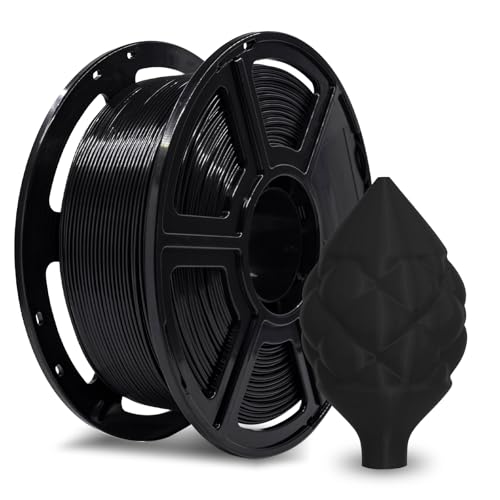
Flashforge ABS Pro (Black, 1.75 mm, 1 kg)
- Best for
- Flashforge owners and anyone who wants a lower-odor ABS with a wide speed range.
- Skip this if
- You want a published TDS with heat deflection data.
Specs, strengths, and limitations
- Material
- ABS
- Diameter
- 1.75 mm
- Net filament
- 1000 g (filament only, not packaged weight)
- Format
- other
- Maker's nozzle range
- 220–260 °C
- Manufacturer states ABS Pro has lower shrinkage, less odor, milder printing conditions, and better mechanical properties than traditional ABS.
- Manufacturer lists print speeds of 40–250 mm/s.
- Manufacturer publishes drying and storage settings.
- Flashforge's product page gives no enclosure or ventilation guidance, so those needs are unconfirmed by the maker.
- Flashforge's UK and US pages give different bed ranges (80–100 °C vs 100–110 °C), and the US page doesn't separate ABS Pro settings from ABS Basic.
Skip it if you want a published data sheet with heat deflection data.
Creality Hyper ABS (Black, 1.75 mm, 1 kg)
Creality's store page calls Hyper ABS "Five Times Faster, More Efficient" without naming a baseline, and lists "High Impact Resistance," but its text gives no speed or impact figure. It suits owners of Creality's high-speed printers who want to use the matching Creality material profiles.
This is the least documented ABS here. Creality's product page text publishes no nozzle, bed, drying, enclosure, or ventilation guidance, and no data sheet is linked. Creality's materials buying guide says Hyper ABS "supports open printing" and releases "fewer volatile substances," but it gives no settings for printing open, and the same guide recommends an enclosed printer or a heated chamber for ABS. Until Creality publishes more, plan for an enclosure and ventilation as you would for any ABS, and get temperatures from your slicer's Creality profile.

Creality Hyper ABS (Black, 1.75 mm, 1 kg)
- Best for
- Creality K1/K2-series owners who want Creality's high-speed ABS with matching slicer profiles.
- Skip this if
- You want published TDS data before buying.
Specs, strengths, and limitations
- Material
- ABS (high-speed)
- Diameter
- 1.75 mm
- Net filament
- 1000 g (filament only, not packaged weight)
- Format
- other
- Manufacturer states it is 'Five Times Faster, More Efficient' (no baseline given).
- Manufacturer lists high impact resistance and high-temperature resistance.
- Creality's product page text gives no enclosure, ventilation, temperature or drying guidance. Its materials buying guide says Hyper ABS 'supports open printing', but recommends an enclosed printer or heated chamber for ABS.
- Documentation is thin compared with the other picks: no TDS is linked from the product page.
Skip it if you want published data sheet values before buying.
Decorative finishes
Polymaker sells its PolyLite ABS resin in sparkle and metallic finishes. Both product pages list the same print settings as standard PolyLite ABS: a 245–265 °C nozzle, a 90–100 °C bed, 30–50 mm/s, the fan off, and drying at 70 °C for 6 hours only if the filament has absorbed moisture. The heat figures come from the general PolyLite ABS data sheet (V5.5), which each product page links. That sheet covers PolyLite ABS in general, not these finishes specifically. Polymaker also gives nozzle-size advice for each finish, covered in its section.
Polymaker PolyLite Galaxy ABS (Galaxy Black, 1.75 mm, 1 kg)
PolyLite Galaxy ABS is the sparkle-finish version of PolyLite ABS, on the same bulk-polymerized, low-volatile resin. Polymaker says to print it on an enclosed printer, and the PolyLite ABS data sheet lists a closed chamber as "Needed" and a heat deflection temperature of 98 °C at 1.8 MPa. It suits heat-resistant functional or display parts where you want a sparkle black finish. The Amazon listing reports Polymaker's own SKU, PE01055.
Polymaker's product page says a 0.4 mm nozzle is possible, but suggests 0.6 mm or larger to avoid any chance of a clog. Polymaker doesn't call for a hardened nozzle. Like other Polymaker filaments, it ships on a recycled cardboard spool.

Polymaker PolyLite Galaxy ABS (Galaxy Black, 1.75 mm, 1 kg)
- Best for
- Heat-resistant functional or display parts where a sparkle black finish hides layer lines, printed in an enclosure.
- Skip this if
- You print open-frame or only use a 0.4 mm nozzle for fine detail.
Specs, strengths, and limitations
- Material
- ABS
- Diameter
- 1.75 mm
- Net filament
- 1000 g (filament only, not packaged weight)
- Format
- cardboard spool
- Maker's nozzle range
- 245–265 °C
- Sparkle finish on the same low-odor, bulk-polymerized ABS resin as standard PolyLite ABS (manufacturer).
- TDS lists a heat deflection temperature of 98 °C at 1.8 MPa.
- Amazon model number matches Polymaker's SKU exactly.
- Polymaker says to print it on an enclosed printer; the TDS lists a closed chamber as 'Needed'.
- Polymaker suggests a 0.6 mm or larger nozzle to avoid clogs, so fine-detail 0.4 mm printing carries some risk.
- Cardboard spool: Bambu Lab strongly advises a spool adapter or adapter ring for cardboard spools in the AMS.
Skip it if you print open-frame, or only use a 0.4 mm nozzle for fine detail.
Polymaker PolyLite Metallic ABS (Metallic Blue, 1.75 mm, 1 kg)
PolyLite Metallic ABS is the metallic-finish version of PolyLite ABS, on the same low-volatile resin. Polymaker says to print it on an enclosed printer, and the PolyLite ABS data sheet lists a closed chamber as "Needed" and a heat deflection temperature of 98 °C at 1.8 MPa. Polymaker's store offers it in Metallic Blue and Metallic Green. It suits heat-resistant parts that need a metallic look.
The product page says a nozzle of 0.4 mm or larger is required. Polymaker doesn't call for a hardened nozzle. It ships on a recycled cardboard spool, and the Amazon listing reports no model number, so check the color and weight on the listing.

Polymaker PolyLite Metallic ABS (Metallic Blue, 1.75 mm, 1 kg)
- Best for
- Heat-resistant parts that need a metallic look, printed on an enclosed printer.
- Skip this if
- You print open-frame or need a nozzle smaller than 0.4 mm.
Specs, strengths, and limitations
- Material
- ABS
- Diameter
- 1.75 mm
- Net filament
- 1000 g (filament only, not packaged weight)
- Format
- cardboard spool
- Maker's nozzle range
- 245–265 °C
- Metallic finish on the same low-odor, bulk-polymerized ABS resin as standard PolyLite ABS (manufacturer).
- TDS lists a heat deflection temperature of 98 °C at 1.8 MPa.
- Manufacturer publishes print and drying settings on the product page.
- Polymaker says to print it on an enclosed printer; the TDS lists a closed chamber as 'Needed'.
- Requires a nozzle of 0.4 mm or larger (product page).
- Only two colors (Metallic Blue, Metallic Green) on Polymaker's store.
Skip it if you print open-frame, or need a nozzle smaller than 0.4 mm.
What should you check before buying ABS?
- Enclosure. Every maker that gives guidance says ABS needs, or is best printed on, an enclosed printer. Flashforge and Kexcelled give none, which is a documentation gap, not permission to print open. Anycubic's product page and data sheet give none either, but its general ABS guide on its wiki says to use an enclosed printer or hot air system. Creality's buying guide says Hyper ABS "supports open printing" but still recommends an enclosed printer or heated chamber for ABS. See our enclosure planning guide if you're adding one.
- Nozzle temperature. The published ranges run from 220 °C (Flashforge's lower bound) to 280 °C (the upper bound for ELEGOO, Anycubic, and Kexcelled), and SUNLU's UK store and the data sheet it links go up to 290 °C for the fastest speeds. Check your hotend's documented maximum, including any PTFE-lined parts, against the range for the exact spool.
- Bed temperature. These grades want 80–110 °C, depending on the maker. A bed that tops out near 80 °C limits you to the lower-temperature options.
- Nozzle size. Polymaker suggests 0.6 mm or larger for PolyLite Galaxy ABS and requires 0.4 mm or larger for PolyLite Metallic ABS. Anycubic recommends 0.4 mm or larger.
- Build surface. Bambu Lab, ELEGOO, and SUNLU call for glue on the build plate, and Kexcelled for tape or glue. Follow your plate maker's guidance as well. Our build surfaces guide covers the trade-offs, and how to clean a build plate covers removing glue residue.
- Spool format. The Bambu listing is a refill with no spool. The three PolyLite spools and ELEGOO ship on cardboard. Anycubic says its ABS has RFID identification chips for its ACE Pro. The other makers, Anycubic included, don't state spool material. Check your material system and dryer documentation.
- Diameter. All twelve are 1.75 mm. None fits a 2.85 mm or 3 mm printer.
- The exact listing. Model numbers on several Amazon listings differ from the maker's SKU. Confirm the color, weight, and spool format on the listing before you buy.
Alternatives, and when you don't need to buy anything
- Outdoor or sun-exposed parts? ASA is usually the better fit. Our ABS vs ASA guide explains why, and the specialty materials hub covers ASA.
- No enclosure and no plan for ventilation? Don't buy ABS yet. For moderate warmth and weather resistance, PETG may be enough. See our PETG filament shortlist and PLA vs PETG guide.
- Already printing ABS but it warps or cracks? That's usually drafts, chamber temperature, or bed adhesion, not the brand. Work through our warping troubleshooting before switching spools.
- Spool seems damp? Dry it at its maker's setting before replacing it. Our dryer vs dry box guide explains the options.
- Not sure ABS is the right material? Try the filament finder or the ABS hub.
Ventilation, enclosure heat, and safety
ABS is one of the higher-emitting common filaments. Bambu Lab warns that its ABS may release styrene at printing temperatures, Overture, eSUN, and SUNLU all tell you to print in a well-ventilated space, and Anycubic's general ABS guide names styrene and says to ensure good ventilation or use a filtered printing environment. "Low odor" claims from Polymaker, eSUN, Overture, Flashforge, and Kexcelled describe their own resins compared with traditional ABS. They don't make any ABS safe to print in a closed, occupied room.
- Electronics heat. Bambu Lab and ELEGOO list chamber temperatures of 45–60 °C. Check that your printer's electronics, power supply, and any add-on enclosure are rated for that heat. Our enclosure planning guide covers electronics heat and fire safety.
- Rated temperatures. Never exceed your hotend's or bed's rated maximum to reach a filament's range, and never bypass thermal protection.
- Drying and spool limits. Drying settings here run from 70 °C to 80 °C (SUNLU's US store and the data sheet it links list 50 °C), and Bambu Lab lists a 90–100 °C heatbed method for its X1 Series. Check your dryer's maximum and the spool's rating before drying a cardboard or plastic spool at those temperatures. Don't use a kitchen food oven as your default dryer.
- Finished parts. Don't treat a printed ABS part as food-safe, child-safe, or fit for safety-critical loads.
How this page was checked
This is a research-based shortlist. We have not printed with these spools for this page, so there are no test results, scores, or "we found" claims here. Every temperature, heat figure, drying setting, and enclosure statement above comes from the manufacturer documents listed in the sources section, and from the product pages and data sheets recorded in our catalog for each spool, retrieved on 2026-10-06 for the original seven and on 2026-10-07 for the five spools added on 2026-10-08. SUNLU's US-linked data sheet and Anycubic's wiki ABS guide were checked on 2026-10-14. Values vary by exact product, color, and revision, and makers do reformulate. Check the current data sheet for your spool before relying on a number. Read more about our process in our editorial standards and affiliate disclosure.
ABS: what to check before you buy a spool ↗Head-to-head comparisons
Deciding between two products on this page? Each comparison puts both makers’ specs side by side and says who should choose which.
Sources
- ABS 3D Printer Filament | Flashforge, Flashforge
- PolyLite ABS Technical Data Sheet V5.5, Polymaker
- Bambu ABS Technical Data Sheet V3.0, Bambu Lab
- eSUN ABS+ Technical Data Sheet V4.0, eSUN
- Overture ABS 3D Printer Filament 1.75mm, Overture
- ABS filament 1.75mm 1kg product page, ELEGOO
- Flashforge ABS Pro Filament, Flashforge
- Hyper Series ABS 3D Printing Filament 1kg, Creality
- The Buying Guide for Creality 3D Printing Materials, Creality
- PolyLite Galaxy ABS product page, Polymaker
- PolyLite Metallic ABS product page, Polymaker
- Polymaker transitions all filaments onto 100% recycled cardboard spools, Polymaker
- SUNLU ABS 3D Printer Filament 1KG (US store), SUNLU
- ABS Filament 1KG (UK store), SUNLU
- SUNLU ABS Technical Data Sheet, SL-TE-WI-068 A/2 (linked from the UK store), SUNLU
- SUNLU ABS Technical Data Sheet, Version 1.0 2024-6 (linked from the US store), SUNLU
- Anycubic ABS Filament product page, Anycubic
- Anycubic ABS Technical Data Sheet V3.0, Anycubic
- FDM 3D Printing: ABS Printing Guide (Anycubic Wiki), Anycubic
- THE K5 ABS product page, Kexcelled
- THE K5 ABS Technical Data Sheet (KT012, rev. 05), Kexcelled
This page is research-based: we have not tested the products or methods ourselves. It draws on the manufacturer documentation and sources listed. Exact settings and fit always defer to your printer and filament makers.
Keep reading

ABS vs ASA: Heat, UV, Warping, and Ventilation
How ABS and ASA compare for heat-resistant and outdoor parts: UV behavior, warping, enclosure needs, emissions and ventilation, and when PETG is enough.
Planning a 3D Printer Enclosure: Temperature, Electronics, and Air
What an enclosure does and doesn't do, when to skip it, and how to plan for electronics heat, fire safety, ventilation, and access.

Warping and lifted corners: diagnose before you buy anything
Why corners lift and tall parts split, and how to check material, surface, drafts, cooling, and brims one at a time before buying an enclosure or plate.