How to clean a build plate: PEI, cool plates, CryoGrip and glass
How Prusa, Bambu Lab, Creality, BIQU and Magigoo say to clean each build surface, what to avoid, how to remove glue residue, and when a plate is worn out.
On this page (15 sections)
Clean a build plate the way its maker says, because makers disagree. For textured PEI, Bambu Lab (for its Textured PEI Plate) and Creality (for the SPARKX i7 plate) say to scrub with dish detergent and warm water, while Prusa says to wipe with about 90% isopropyl alcohol (IPA) and use dish soap only as a last resort. For smooth PEI, Prusa says IPA, with acetone allowed once or twice a month, while Bambu Lab says warm water and soap. Bambu Lab's Cool Plate SuperTack takes water and detergent; BIQU says CryoGrip Pro Frostbite takes soapy water and Glacier takes alcohol or soapy water, and Creality says glass can take acetone sparingly. Prusa, Bambu Lab and Creality all say no acetone on textured PEI and no cleaners with oils or moisturizers, and most glue residue comes off with water. A plate is worn out when it's damaged or won't grip after a proper clean; some PEI plates can first be revived by light sanding.
Who this guide is for
This guide is for anyone who wants to clean a build plate without damaging it, whether it's a textured or smooth PEI sheet, a low-temperature coated plate like Bambu Lab's Cool Plate SuperTack or BIQU's CryoGrip Pro, an epoxy plate, or glass. It covers what each maker says to clean with, what to avoid, how often, how to get glue off, and when a plate is past saving. Each maker's instructions apply to that maker's plates. If you have a specific problem, these guides go deeper:
| What's happening | Guide |
|---|---|
| Prints won't stick to a textured PEI plate | Textured PEI not sticking |
| A print is stuck and you need it off safely | Print stuck to the bed |
| The plate is torn, gouged or worn | Damaged or worn PEI sheet |
| Deciding whether to use glue at all | Bed adhesives explained |
| Prints won't stick and you're not sure the plate is to blame | First layer adhesion |
Three points several makers share
- Clean it cold. Prusa says to clean its sheets "when cold" and to spray alcohol "on the cold print surface." Magigoo says to clean "the cool printing bed." Creality's bed cleaning guide says to let the bed cool down first if you've just finished a print. The exception is Creality's glue stick guide, which says to heat the bed slightly to make glue residue easier to remove. Bambu Lab's and BIQU's cleaning instructions don't mention bed temperature.
- Keep skin oils off it. Prusa says grease stains such as fingerprints "often cause poor surface adhesion," and Bambu Lab says skin oils "reduce the plate's adhesion to filament." Bambu Lab and Creality both say to hold the plate by its sides.
- Nothing made for skin, and no oily detergent. Prusa says "Do not use anything made for skin! It can contain oils that ruin adhesion!" Bambu Lab and Creality say to use a detergent that doesn't contain oils or moisturizers, because those can stay on the plate. Prusa specifies liquid dish soap, "not hand soap."
How often should you clean a build plate?
Makers give different intervals, and some tie cleaning to the adhesive you use.
- Prusa: cleaning is a step "you should perform before (almost) every print."
- Creality: its bed cleaning guide says a basic clean "before each print or after a handful of prints" is good practice, with a quick IPA wipe after each print. It also says to clean when the first layer doesn't stick, when there are visible stains or residue, or when you change materials.
- Bambu Lab: says to clean its plates "regularly" and its textured plate "periodically." For the Cool Plate SuperTack, Bambu says it "provides good adhesion without adhesive or frequent cleaning," and to clean it with water and detergent "if heavy dirt appears."
- Glue users: Bambu Lab says that if there is "a lot of glue residue," clean the plate before the next print. Magigoo recommends applying Magigoo before every print and wiping the bed with a damp cloth once prints have popped off.
Textured PEI
Textured (powder-coated) PEI is where makers disagree most.
Bambu Lab Textured PEI Plate: detergent and a sponge
Bambu Lab's cleaning guide, which uses its Gold PEI Textured Plate as the example, gives four steps:
- Wet the plate with water.
- Apply dishwashing detergent evenly.
- Scrub with a basic sponge until the detergent foams. Bambu says "a scouring pad or a plastic brush" works better because it can "reach into the grooves of textures."
- Rinse with clean water and dry the plate. Bambu suggests a regular paper towel.
Bambu explains why it prefers detergent over alcohol on this plate: "Alcohol might just spread the oils on the print surface instead of removing it," while detergent "acts as a degreaser" and the scrubbing gets it into the texture. Bambu says not to clean the Textured PEI Plate with acetone, "as it will damage the PEI surface."
Creality SPARKX i7 plate: the same method
Creality's wiki covers the dual-texture gold PEI plate that comes with the SPARKX i7. It says to wet the plate (warm water is recommended), scrub the whole surface with dishwashing liquid and a scouring pad or brush until it foams, rinse thoroughly, and dry with paper towels. Creality says not to use "ketone-based organic solvents (such as acetone)," and to use a detergent without oils or moisturizing agents.
Prusa textured sheet: alcohol first, soap as a last resort
Prusa says to clean its textured sheet "with ~90% IPA or denatured alcohol when cold." If prints still won't stick after that, Prusa suggests washing it "in warm water (not hot!) with a few drops of liquid dish soap (not hand soap)," which it says can remove oils and sugars that rubbing alcohol doesn't. But Prusa warns that "the textured sheet is not waterproof," so washing is "a last resort, which should not be done often," and you shouldn't submerge the sheet completely in hot water. Prusa also says: "Never clean the sheet with acetone! It will deteriorate the surface!"
For more on getting prints to stick to textured PEI, see textured PEI not sticking.
Smooth PEI
Prusa smooth sheet: IPA, with occasional acetone
Prusa says to clean its smooth sheet "with ~90% IPA (isopropyl alcohol) or denatured alcohol when cold," applied on an unscented paper towel and rubbed over the sheet. If IPA isn't enough, Prusa says "1-2 times a month, it can be cleaned the same way with acetone." Its product article adds "do not overuse it."
Bambu Lab Smooth PEI Plate: warm water and soap
Bambu Lab's troubleshooting page for its High Temperature and Smooth PEI plates says to clean them periodically to remove "debris, old glue stick, or fingerprints." It suggests "warm water and regular soap," using a basic sponge and dishwashing detergent, then drying with a paper towel. That page doesn't mention IPA or acetone.
So on smooth PEI, Prusa's routine method is alcohol and Bambu Lab's is soap and water. Follow the maker of your sheet.
Low-temperature coated plates ("cool" plates)
These plates use a softer coating than PEI, and the makers say so.
Bambu Lab Cool Plate SuperTack
Bambu says to clean the SuperTack "with water and detergent if heavy dirt appears," and: "Do not use organic solvents (especially acetone) to clean the build plate, as it will damage the SuperTack surface." Bambu's plate guide adds that most residue or marks "can be removed with alcohol wipes or detergent and water," and that "a few persistent stains or first-layer marks are normal and do not affect long-term use or performance."
Bambu says the surface "is soft," so be careful with a scraper, and that minor scratches from normal use "will not significantly affect adhesion performance." To loosen a stuck print, Bambu suggests moistening the area where the model meets the plate with alcohol before using a scraper.
BIQU CryoGrip Pro Glacier and Frostbite
The BIGTREETECH Wiki, which documents BIQU's plates, gives a different method for each surface: "For Frostbite - Clean with soapy water. For Glacier - Clean with alcohol or soapy water." It adds that "most residue can be removed with alcohol or soapy water," and that "minor discoloration or first-layer imprints that cannot be fully removed do not affect long-term performance."
BIQU's own store page for its Bambu-size plates, whose description is written for Glacier, says "a simple wipe with water, soap, or alcohol restores full adhesion." For Frostbite, the wiki's cleaning line names only soapy water, though its residue note, which covers CryoGrip Pro without splitting the two surfaces, mentions alcohol or soapy water. Neither page says not to use alcohol on Frostbite, but soapy water is the one method the wiki names for it specifically. For the differences between the two surfaces, see CryoGrip Pro Glacier vs Frostbite.
Bambu Lab Engineering Plate
Bambu says faint print marks or color changes on the Engineering Plate "are normal" and that most can be removed by "cleaning with detergent and water" or "wiping with alcohol." Bambu says its coating withstands "hundreds of cleaning and part removal cycles." Because this plate needs glue for every filament, also see the glue residue section below.
Epoxy resin plates
Creality sells epoxy resin coated plates, but its store pages for the K1 Max epoxy plate and its 235 × 235 mm epoxy plate give no cleaning or care instructions, and we found no Creality wiki page for them. Creality's general bed cleaning guide doesn't mention epoxy surfaces either. Until Creality publishes guidance for the plate you own, we can't tell you which cleaners it tolerates, so ask Creality support before trying anything stronger than a gentle wash.
Glass
Of the makers we checked, only Creality and Magigoo cover glass. Prusa's and Bambu Lab's sheet care pages are about their steel sheets.
- Creality: its bed cleaning guide says "Glass beds are durable and can handle scrapers, blades, and chemicals like acetone more robustly than other surfaces," but to "avoid using abrasive materials that could scratch the glass." For stubborn residue on "glass or garolite," it says "acetone can be used sparingly." Its general cleaning steps, which aren't specific to glass, are an IPA wipe, then a wash with dish soap and warm water for a deeper clean, then drying completely.
- Magigoo: says Magigoo Original was "designed and extensively tested on glass build plates." To clean it off, Magigoo says to wipe the cool bed "with a damp cloth. Use just water."
Where makers disagree
| Cleaner or tool | What the makers say |
|---|---|
| IPA (isopropyl alcohol) | Prusa: the routine cleaner for its smooth and textured sheets, ~90%. Creality's general guide: IPA, 70% or higher, for routine cleaning. Bambu Lab: on its Textured PEI Plate, alcohol "might just spread the oils," but it lists alcohol wipes for marks on the Cool Plate SuperTack and Engineering Plate. BIQU: alcohol or soapy water for Glacier; Frostbite's cleaning line names only soapy water, while the wiki's residue note mentions alcohol or soapy water for CryoGrip Pro generally. |
| Dish soap and water | Bambu Lab: the main method for its Textured PEI and Smooth PEI plates. Creality: the main method for the SPARKX i7 plate, and the "deeper clean" in its general guide. Prusa: a last resort for its textured sheet, which "is not waterproof." BIQU: soapy water for both CryoGrip Pro surfaces. |
| Acetone | Prusa: allowed on its smooth sheet "1-2 times a month," never on its textured sheet. Bambu Lab: not on the Textured PEI Plate or Cool Plate SuperTack. Creality: not on the SPARKX i7 plate or PEI in general, but "sparingly" on glass. BIQU's pages don't mention it. |
| Scouring pads and abrasives | Bambu Lab (Textured PEI Plate) and Creality (SPARKX i7 plate) recommend a scouring pad or brush. Creality says avoid abrasives on glass. Prusa and Bambu Lab describe sanding only as a way to restore a worn surface (see below). |
| Metal scrapers | Prusa: fine on its smooth sheet, though "cosmetic scratches may appear"; never on its textured sheet, which is "Not scratch-resistant." Bambu Lab and BIQU: be careful with a scraper on their soft coatings. Creality's general guide mentions a scraper or putty knife but warns not to gouge PEI or glass, and its glue stick guide says to use a plastic scraper. |
| Soaking in water | Bambu Lab: soak a plate with dried glue stick in water for about 30 seconds. Prusa: don't submerge its textured sheet completely in hot water. |
The pattern is that each maker's method fits its own coating. A cleaner that's fine on one plate can damage another, so look up the instructions for the exact plate you own.
How do you remove glue residue from a build plate?
The adhesive maker and the plate maker both have a say. If they conflict, the plate maker's limits come first, because the cleaner touches their coating.
- Bambu Lab glue stick: "Glue stick can be cleaned with water and soap. If the glue is dry, let the plate soak in water for about 30 seconds before washing it away."
- Bambu Lab liquid glue: "Rinse with water and scrub with a non-woven cloth to remove it completely."
- Prusa PVA glue stick: Prusa says marks left in the glue layer after removing a print are only in the glue, "not on the print sheet surface," and "disappear with the glue after washing." For glue left behind by tape, Prusa says it can usually be washed off "with IPA or with water and dishwasher soap," but to "double-check the steel sheet maintenance articles before washing them."
- Creality glue stick: Creality's glue stick guide says to heat the bed slightly, "use a plastic scraper or spatula to gently scrape off the residue," then wipe with a damp cloth, using "a mild solvent such as isopropyl alcohol" if the residue is stubborn, and to make sure the bed is "completely dry" before printing.
- Magigoo: "Clean with a damp cloth. No chemicals or scraping needed." Its FAQ says "Water is all you need — no chemicals or solvents required."
Bambu Lab also says white marks on the bottom of a print are "usually caused by the solidification of glue or glue stick residue during heating," and can be wiped off the print with a cleaning agent or alcohol.
If you use glue regularly, these two adhesives come with the maker cleanup instructions quoted above. Check your plate maker's glue guidance first: Bambu Lab says "third-party glues are strongly discouraged and may damage the plate," and neither of these is a Bambu Lab glue. Our bed adhesives guide covers when each maker says to use glue at all.

Magigoo (Thought3D) Magigoo Original 3D Printing Adhesive (50 mL pen applicator (Amazon model MO2016))
- Best for
- Glass or smooth beds where PETG sticks too hard or ABS warps at the corners.
- Skip this if
- Your plate maker advises against adhesives, or you print nylon, PC, or PP.
Specs, strengths, and limitations
- Maker notes
- Magigoo datasheet v1.5: water-based ('Solvent: water'); intended 'on FDM/FFF 3D printers with a heated bed on aluminium, glass surfaces. Also works when applied on sheets e.g. Kapton, PEI and similar', for PLA, ABS, HIPS, PETG, and TPU. Datasheet bed temperatures: ABS 90–110 °C, PLA 40–70 °C, PETG 80–100 °C, HIPS 90–115 °C, TPU 30–60 °C. The current product page lists slightly different 'optimised' ranges (for example PLA 50–70 °C, PETG 70–90 °C), so follow your filament maker's settings. The product page also lists ASA as 'Compatible' (90–110 °C): 'Works with some ASA filament brands. Better suited for glass build plates.' Magigoo's printed instructions give a third set of bed temperatures (PLA 40–60 °C, ABS 90–110 °C, PETG 60–85 °C, HIPS 90–110 °C). Magigoo states prints release once the bed cools by about 30–40 °C, and that it cleans with water. This is a liquid adhesive in a valved pen applicator, not a solid glue stick. The 50 mL volume comes from the Amazon title. The Magigoo page doesn't state a volume.
- Manufacturer states it holds parts while the bed is hot and releases them as it cools.
- Manufacturer datasheet lists PLA, ABS, PETG, HIPS, and TPU, on glass and aluminium beds and on PEI or Kapton sheets.
- Manufacturer states it is water-based and cleans off with water.
- Magigoo's current product page says it was 'designed and extensively tested on glass build plates'. The datasheet says it 'also works' on PEI. Check your build plate maker's guidance before using any adhesive on PEI.
- Not for nylon, PC, or PP. Magigoo makes separate formulas for those.
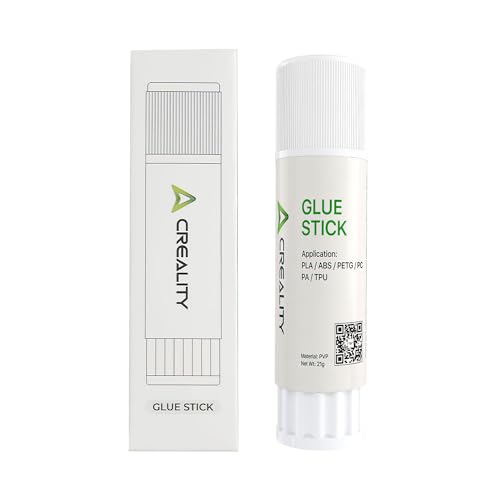
Creality Glue Stick for Build Plate (1 stick, 21 g)
- Best for
- A cheap release layer or adhesion aid on glass or smooth plates, or for PETG release on PEI where the plate maker allows it.
- Skip this if
- Your plate maker says not to use glue on it.
Specs, strengths, and limitations
- Maker notes
- Creality store: 'Capacity: 21g'; 'Application: PLA/ABS/PETG/PC/PA/TPU'. Creality's blog describes this glue stick as 'Made from high-quality PVP material.' The Amazon listing (1 Pack) adds that it cleans off with water once the plate cools. 21 g comes from Creality's store page. A 4-pack is a separate ASIN (B0D3XLHVLZ).
- Manufacturer states it keeps steady adhesion so models don't come loose or warp.
- Manufacturer lists PLA, ABS, PETG, PC, PA, and TPU as applications.
- Creality's page gives no build-surface guidance. Check your build plate maker's advice before using glue on textured or smooth PEI.
- Small 21 g stick, per Creality.
Restoring a worn surface
Some makers say a dull plate can be brought back before you replace it. Use these only on the plates they were written for.
- Prusa smooth sheet: after 1 to 2 years, "the surface can smooth out further, which affects adhesion." Prusa says light sanding with 600 to 1000 grit paper revives the PEI, "bringing fresh PEI to the surface," and leaves "a very light texture."
- Bambu Lab Textured PEI Plate: "Grinding the surface of the Textured PEI plate with fine sandpaper or steel wool will create a new, clean surface and enhance the build plate's adhesion." Bambu says to clean off all the sanding debris afterwards.
Prusa's textured sheet article and BIQU's and Creality's plate pages don't describe sanding.
When is a build plate worn out?
Prusa calls its print sheets consumables. The plate makers describe the end of a plate's life differently, and not all of them describe it at all.
- Prusa: print sheets "are not covered by warranty as the coatings will diminish over time," and cosmetic damage such as "scratches, dents, cracks" isn't covered either. Prusa says the PEI film on its smooth sheet "can be replaced in case of extensive damage."
- Bambu Lab Smooth PEI and High Temperature plates: if the surface is broken by scratches or peeling, Bambu says the fix is a new sheet, but that spare sheets are no longer sold, so "a new plate must be purchased if the damage warrants" it. Bambu notes the High Temperature Plate itself has been discontinued.
- Bambu Lab Cool Plate SuperTack: Bambu doesn't describe an end point. It says the coating retains its sticky properties "even after extensive use," quoting "less than 20% adhesion loss after 300 prints" from its own test with PLA Basic on an A1.
- Creality SPARKX i7: "After extended use, PEI print plates may experience irreversible adhesion degradation. In this case, adhesive can be applied, or the print plate can be replaced."
Not every mark means a worn plate. Bambu Lab, Creality and BIQU all describe some wear in the nozzle wipe area or persistent faint marks as normal. Our PEI sheet damage guide lists which marks the makers call harmless and which are real damage.
If you do need a new plate, it has to match your exact printer model. Our build plates shortlist lists plates by printer, using only the compatibility records we hold, and textured vs smooth build surfaces explains how the surfaces differ.
Checklist
- Find your plate maker's cleaning instructions for the exact plate.
- Let the plate cool before cleaning, unless the maker's glue removal steps say otherwise.
- Use the maker's cleaner: IPA, dish soap and water, or both, depending on the plate.
- Use a detergent without oils or moisturizers, and nothing made for skin.
- No acetone unless your plate's maker allows it.
- Scrape gently, and never with metal on a plate whose maker forbids it.
- Wash off glue the way the glue maker says, within the plate maker's limits.
- Dry the plate fully and handle it by the edges.
- Sand or replace only where the maker documents it.
How this guide was checked
This is a research-based guide. We haven't cleaned or worn out plates for it. Every cleaning method, warning, interval and replacement rule comes from the Prusa Research, Bambu Lab, Creality, BIGTREETECH (BIQU) and Magigoo pages listed in the sources, retrieved on 2026-10-14, and applies only to the plates or adhesives each page names. We used only the visible text on each page. Plate fit comes only from our compatibility records. Read more in our editorial standards and affiliate disclosure.
Build plates: what to check before you buy ↗Sources
- Print surface preparation, Prusa Research
- Smooth Steel Sheet, Prusa Research
- Textured steel sheet, Prusa Research
- Flexible steel sheets (guidepost), Prusa Research
- Bambu Lab Textured PEI Plate Cleaning Guide, Bambu Lab
- Introduction to Bambu Lab Build Plates, Bambu Lab
- High Temperature Plate / Smooth PEI Plate troubleshooting, Bambu Lab
- Bambu Cool Plate SuperTack, Bambu Lab
- How to Use Bambu Lab Glue, Bambu Lab
- i7 Print Plate Cleaning and Maintenance Guide, Creality (Creality Wiki)
- Easy 3D Printer Bed Cleaning Guide - Quick Tutorial, Creality
- Glue Stick for 3D Printing: What, Why and How, Creality
- CryoGrip Pro Low-Temp Plates, BIGTREETECH (BIQU)
- BIQU Panda Build Plate CryoGrip Pro, BIQU
- Magigoo Original, Magigoo (Thought3D)
- Magigoo support and FAQs, Magigoo (Thought3D)
- Magigoo Original instructions, Magigoo (Thought3D)
This page is research-based: we have not tested the products or methods ourselves. It draws on the manufacturer documentation and sources listed. Exact settings and fit always defer to your printer and filament makers.
Keep reading

Prints not sticking to a textured PEI plate
Why prints won't stick to textured PEI: how makers say to clean it, how much first-layer squish it needs, bed temperatures per filament, glue rules and wear.
Damaged or worn PEI sheet: causes, care and replacement
What tears, gouges and wears out PEI build plates, how Prusa, Bambu Lab, Creality and BIQU say to clean and restore them, and when to replace the sheet.
Print stuck to the bed or tearing the build plate
Why PETG and TPU can bond too hard to smooth PEI, which plate and filament pairings makers warn against, and how to free a stuck print without ruining a plate.