ELEGOO PETG-CF vs Siraya Tech PETG-CF Pro HF
Two carbon-fiber PETGs on maker data: nozzles, temperatures, drying, enclosure, AMS, heat. Pick ELEGOO for open-frame printers, Siraya Tech for high flow.
On this page (13 sections)
Pick ELEGOO PETG-CF if you print on an open-frame printer at moderate speeds and want a maker that says enclosed printing isn't required. Pick Siraya Tech Fibreheart PETG-CF Pro HF if you print fast on a high-flow setup, have an enclosure, and want stated fiber content and named test methods. Both are abrasive carbon-fiber PETG, and both makers call for a hardened nozzle of 0.4 mm or larger, so check your nozzle first. Their nozzle windows sit close together: 240–270 °C for ELEGOO and 250–270 °C on Siraya Tech's data sheet. ELEGOO makes drying "Required" before use and publishes its figures without test methods. Siraya Tech sells this as a high-flow grade "up to 25 mm³/s" and says it is rigid enough for smooth loading in the AMS, while ELEGOO makes no AMS claim for the filament itself.
Who this comparison is for
This page is for anyone choosing between two specific spools: ELEGOO PETG-CF in Carbon Fiber Black (1 kg, SKU SPUS-EL-GCF-001) and Siraya Tech Fibreheart PETG-CF Pro HF in High Flow Black (1 kg, US SKU ST3031). Siraya Tech's data sheet gives the diameter as 1.75 ± 0.02 mm. ELEGOO's page text doesn't state a diameter, though its product address says 1.75 mm. Both makers pitch carbon fiber for stiffness and a matte finish. The real question is whether your nozzle, dryer, and printer setup meet each maker's conditions. If you haven't printed abrasive filament before, start with our abrasive filament nozzle guide. For more options, see the carbon fiber filament shortlist.
| Product | Best for | Skip if | Link |
|---|---|---|---|
| ELEGOO PETG-CF (Carbon Fiber Black, 1.75 mm, 1 kg) | Stiff matte functional parts on a printer with a 0.4 mm or larger hardened steel nozzle. | Your printer only has a brass nozzle, or the part will see temperatures near the listed 74 °C (0.45 MPa) heat deflection temperature. | View on Amazon (opens Amazon in a new tab) |
| Siraya Tech Fibreheart PETG-CF Pro HF (High Flow Black, 1.75 mm, 1 kg) | Fast, matte carbon-fiber PETG parts such as drone frames and fixtures on high-flow printers with a hardened nozzle. | Your printer has a brass nozzle, or the part must survive temperatures above about 70 °C. | View on Amazon (opens Amazon in a new tab) |


How we compared them
This is a research-based comparison. Every figure below comes from ELEGOO's product page, Siraya Tech's product page, data sheet page, and user guide, and Bambu Lab's AMS and filament documentation, all listed in the sources. We haven't tested either filament, so nothing here is a measured result of ours. Where a maker describes its own product, such as ELEGOO's "No Warping" or Siraya Tech's "2X Faster Printing," we label it as the maker's claim.
Print settings are each maker's guidance, so they sit together in the table below. Test figures are another matter. ELEGOO's specification table names no test method or specimen settings, and only its heat deflection row gives a load. Siraya Tech names ASTM and ISO methods, and its user guide describes its specimens. Because only one side states how its numbers were made, we list each maker's test figures on its own rather than set them head to head.
Side-by-side specs
| ELEGOO PETG-CF | Siraya Tech Fibreheart PETG-CF Pro HF | |
|---|---|---|
| Variant | Carbon Fiber Black, 1 kg (SPUS-EL-GCF-001) | High Flow Black, 1 kg (ST3031, US); 1.75 ± 0.02 mm (TDS) |
| Base material | PETG with carbon fiber; fiber content not stated | "Glycol-modified Polyethylene Terephthalate + 10% short cut carbon fiber" (TDS) |
| Nozzle requirement | "Hardened Steel Nozzle, ≥ 0.4 mm"; 0.2 mm "Not Compatible" | "Hardened steel (0.4 mm or larger)" (product page); 0.4–1.0 mm (TDS) |
| Nozzle temperature | 240–270 °C | 250–270 °C (TDS and user guide quick start); the guide's detailed settings say 250–280 °C |
| Bed temperature | 65–75 °C, depending on printer and plate | 70–80 °C (TDS and user guide) |
| Build surface | Textured or smooth PEI or other plates; glue "Recommended" | Glass, PEI film, or PVP glue stick (TDS) |
| Enclosure and chamber | Enclosed printing "Not Required"; chamber 25–50 °C | "Not mandatory, but it is recommended" (TDS); "highly recommended" (product page FAQ) |
| Cooling fan | Not stated | "Off or run very low (10-20%)" (TDS); the guide's quick start says below 50% |
| Maker's speed figure | Below 220 mm/s | "Capable of 30 mm/s up to 300 mm/s" (TDS); flow "up to 25 mm³/s" (product page) |
| Retraction | Not stated | 1–3 mm at 1800–2400 mm/min (TDS and user guide) |
| Drying | Required: 60 ± 5 °C for 8 h (spec table); the "Important Notes" say 70 °C for 8 h | 70–80 °C for 4–6 h (TDS) |
| Storage | Print and store at or below 20% RH, sealed with desiccant | Sealed aluminum foil bag with desiccant (TDS); print from a dry box (user guide) |
| Spool | Material not stated; empty spool 154 ± 10 g, and ELEGOO's Filament Ring note refers to a "paper tray" | Not stated |
| Published data format | Specification table on the product page, no methods | Data sheet web page with ASTM and ISO methods |
The nozzle comes first
Carbon fiber wears brass nozzles, and both makers say so.
| Source | What it says |
|---|---|
| ELEGOO "Important Notes" | "0.2 mm Nozzle Not Compatible" and "0.4 mm/0.6 mm/0.8 mm Hardened Steel Nozzle Recommended" |
| ELEGOO specification table | "Hardened Steel Nozzle, ≥ 0.4 mm" |
| Siraya Tech product page | "Hardened steel (0.4 mm or larger)" |
| Siraya Tech FAQ, answering "Can I use a brass nozzle?" | "Not recommended. Carbon fiber is abrasive. A hardened steel or ruby nozzle is required to prevent rapid wear." |
| Siraya Tech data sheet | A 0.4 mm to 1.0 mm range and "Carbon hardened, hardened steel or higher grade nozzles" |
So both rule out brass and a 0.2 mm nozzle.
On a Bambu Lab printer, Bambu's filament guide says to always use a hardened steel nozzle for fiber-filled filament, never a 0.2 mm one, and names a 0.6 mm hardened steel nozzle as first choice for fiber filament other than its own specially designed grades. A 0.4 mm hardened nozzle is its second choice, at a maximum speed of about 100 mm/s. Our replacement nozzle guide covers choosing one.
Temperatures, speed, and flow
The two windows overlap almost entirely. ELEGOO lists 240–270 °C, and Siraya Tech's data sheet lists 250–270 °C. Siraya Tech's user guide adds detail: "Start at 255°C for standard speeds. Increase temperature for high-speed printing (>150mm/s) to ensure proper melting," with a detailed range of 250–280 °C that runs past its own data sheet. The beds differ by 5 °C at each end: 65–75 °C for ELEGOO and 70–80 °C for Siraya Tech.
Speed is where Siraya Tech leans in. It calls this a "High-Flow (HF) formula" that "enables speeds up to 25 mm³/s, cutting production time by half," and its data sheet says the filament is "Capable of 30 mm/s up to 300 mm/s." Its user guide's quick start gives 50–250 mm/s. ELEGOO gives one figure, below 220 mm/s. Neither maker names the nozzle size or layer height behind its figure, and Bambu's 100 mm/s figure for a 0.4 mm hardened nozzle is far lower than either. Treat any top speed as a ceiling, not a target. Our high-speed filament guide explains what flow figures mean.
On cooling, Siraya Tech's data sheet says "Off or run very low (10-20%)," and its user guide says to keep the fan "below 50%" because "Excessive cooling can reduce layer adhesion, making the part brittle." ELEGOO doesn't give a fan setting on its page.
Enclosure and bed
This is the clearest difference in printer setup.
| Source | What it says about an enclosure |
|---|---|
| ELEGOO specification table | Enclosed printing "Not Required"; a chamber range of 25–50 °C for printers that have one |
| Siraya Tech data sheet | "Not mandatory, but it is recommended" |
| Siraya Tech product page FAQ | Goes further: "an enclosure is highly recommended for PETG-CF Pro HF," because "Large or complex parts are prone to warping if the ambient temperature is too low or if there are sudden drafts" |
| Bambu filament guide, for its own printers | PETG-CF is "Not prone to warping" and works on open-frame or enclosed printers, but "For PETG and PETG-CF/GF, an enclosed printer is recommended to prevent low ambient temperatures from reducing the model's interlayer strength" |
On the bed, ELEGOO recommends glue on textured or smooth PEI and claims "Low Shrinkage & No Warping," which is the maker's claim. Siraya Tech's data sheet lists glass, PEI film, or PVP glue stick, and warns: "Avoid "squishing" the first layer too tightly, as this can cause nozzle clogs." Its troubleshooting fix for warping is to raise the bed to 80 °C and add a brim.
Our enclosure planning guide covers what an enclosure does and doesn't do.
Drying and moisture
Both makers treat moisture seriously, and ELEGOO's own page gives two drying temperatures.
- ELEGOO marks drying before use as "Required" in its specification table, at 60 ± 5 °C for 8 hours. A note near the price and another under "Compatibility" say "Dry at 60°C for 8 Hours before Use for Optimal Print Quality," but the "Important Notes" list says "Dry at 70 °C for 8 Hours before Use for Optimal Print Quality." ELEGOO also says to print and store at or below 20% RH, sealed with desiccant.
- Siraya Tech gives 70–80 °C for 4–6 hours in its data sheet. Its user guide calls the filament "hygroscopic (absorbs moisture)" and moisture "the #1 cause of printing issues like stringing and rough surfaces," and says "It is highly recommended to feed the filament directly from a dry box during the printing process."
Neither maker publishes a water absorption figure or a temperature rating for its spool. Check your dryer's top temperature, and whether the spool can take it, before you buy. Our filament dryer vs dry box guide covers the options.
Strength and heat figures: listed separately
ELEGOO's specification table gives figures labelled X-Y and Z, but names no test method, specimen type, or print settings, and only its heat deflection row names a load. Siraya Tech's data sheet uses ASTM D638 for tensile figures, ISO 178 for bending, ISO 179 for Charpy impact, ISO 306 for Vicat, and names its heat deflection methods only as "Method A" and "Method B," though its user guide lists the 0.45 MPa figure under "ISO 75 Method B." The guide says its data is "based on printed specimens (0.4mm nozzle, 100% infill, ±45° angle)." Neither maker mentions annealing. With only one side describing its method, we don't set these numbers against each other.
ELEGOO PETG-CF (product page specification table, no methods named)
- Heat deflection temperature: 74 °C at 0.45 MPa; no 1.8 MPa figure
- Vicat softening temperature: 83 °C
- Melting temperature: 226 °C
- Tensile strength: 51 ± 8 MPa X-Y, 38 ± 5 MPa Z
- Elongation at break: 9.6% ± 1.0% X-Y, 7.5% ± 1.0% Z
- Bending strength: 75 ± 2 MPa X-Y, 53 ± 4 MPa Z
- Bending modulus: 3040 ± 21 MPa X-Y, 2222 ± 33 MPa Z
- Impact strength: 70.7 ± 6.2 kJ/m² X-Y, 14.6 ± 2.1 kJ/m² Z, test type not stated
- Density: 1.29 g/cm³; melt index 10.3 ± 3.2 g/10 min
Siraya Tech Fibreheart PETG-CF Pro HF (TDS page)
- Heat deflection temperature: 69 °C at 1.80 MPa ("Method A"); 75 °C at 0.45 MPa ("Method B")
- Vicat softening temperature: 85 °C (ISO 306)
- Glass transition: 68 °C; melting point: 220 °C (ASTM D3418)
- Tensile stress at break: 44 MPa X-Y (ASTM D638)
- Young's modulus: 3400 MPa X-Y (ASTM D638)
- Elongation at break: 7.5% X-Y (ASTM D638)
- Bending strength: 85 MPa; bending modulus 3450 MPa (ISO 178; direction not stated on the TDS)
- Charpy impact: 4.5 kJ/m² (ISO 179; notch and direction not stated)
- Notched Izod impact at 72 °F: 15 J/m (ASTM D256)
- Density: 1.3 g/cm³ (ISO 1183)
Siraya Tech's product page headline gives a "76°C HDT" without a load, one degree above the data sheet's 0.45 MPa figure. Whatever the method, both makers' heat figures sit in the 70s °C at 0.45 MPa, so check them against the temperatures your part will see. ELEGOO's Z figures, between layers, are lower than its X-Y figures, so orient parts so the main load runs along the layers. Siraya Tech doesn't publish Z figures.
Bambu's AMS and third-party PETG-CF
If you own a Bambu Lab printer with an AMS, read this before you load either spool.
- Siraya Tech answers "Is it AMS compatible?" with "Yes, it is rigid enough for smooth loading in systems like the AMS."
- ELEGOO makes no AMS statement for the filament. It offers a printable "Filament Ring" that it says helps the spool "adapt to AMS (because AMS will rub the bottom paper tray, causing the paper tray to easily delaminate)," and suggests printing the ring in PETG. That's about the spool, not the filament.
Bambu's own documents point two ways. Its filament guide table lists PETG-CF as "AMS: Compatible" and "AMS lite: Not Recommended," but its table notes say that rating covers loading and unloading only, and that you "should also check whether the roughness of the filament may wear down the internal feed channel." The same guide warns that carbon fiber "can eventually grind down the internal PTFE feed channels." Bambu's Notes for AMS go further, advising against "third-party fiber reinforcement materials (PA-CF/GF, PET-CF/GF, PLA-CF /GF, etc.)" because they "may wear AMS PTFE tubes," while its own "PLA-CF, PETG-CF, PAHT-CF and other official filaments are specially optimized." Neither filament here is Bambu's. Siraya Tech's statement is the filament maker's claim, and Bambu's notes are the printer maker's advice, so weigh both, and use the external spool holder if you want to avoid wear on the AMS feed path. Our AMS filament compatibility guide covers Bambu's rules and the external spool route.
What each maker says it's for
- ELEGOO PETG-CF. ELEGOO pitches it for "robust industrial jigs, lightweight brackets, durable bike components and drone parts," and for "gears, bearings, and structural parts." It says "Compared to PLA-CF, Elegoo PETG-CF provides superior toughness and is less prone to fracture under external stress and impact," and that carbon fiber gives "a distinct, fine matte texture that reduces visible layer lines." It also says it is "Compatible with most FDM 3D printers on the market."
- Siraya Tech Fibreheart PETG-CF Pro HF. Siraya Tech pitches it for "jigs, fixtures, drone parts, and high-performance prototyping." It says "Unlike carbon fiber powder PETG-CF, we use short chopped carbon fibers," claims "Significantly higher impact resistance and HDT (76°C)" with "minimal warping," and its FAQ says that, compared with standard PETG-CF, "The Pro version is tougher, more heat-resistant, and prints significantly faster."
Those are each maker's claims, without a published test against the other filament.
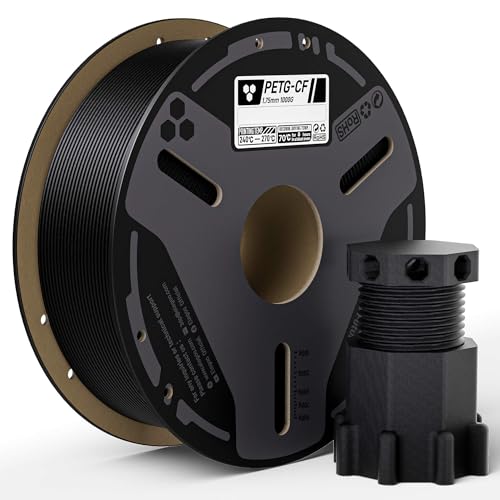
ELEGOO PETG-CF (Carbon Fiber Black, 1.75 mm, 1 kg)
- Best for
- Stiff matte functional parts on a printer with a 0.4 mm or larger hardened steel nozzle.
- Skip this if
- Your printer only has a brass nozzle, or the part will see temperatures near the listed 74 °C (0.45 MPa) heat deflection temperature.
Specs, strengths, and limitations
- Material
- PETG (carbon-fiber filled)
- Diameter
- 1.75 mm
- Net filament
- 1000 g (filament only, not packaged weight)
- Format
- other
- Maker's nozzle range
- 240–270 °C
- Nozzle
- Abrasive: the maker recommends a wear-resistant nozzle
- Manufacturer states carbon fiber adds strength and rigidity, with abrasion resistance and dimensional stability.
- Manufacturer states that, compared with PLA-CF, it has superior toughness and is less prone to fracture under stress and impact.
- Manufacturer states a premium matte finish that reduces visible layer lines.
- Abrasive: ELEGOO recommends a 0.4/0.6/0.8 mm hardened steel nozzle and says 0.2 mm nozzles are not compatible.
- Needs drying before use (60 ± 5 °C for 8 h per the spec table; the page's 'Important Notes' say 70 °C) and storage at ≤ 20% RH.
- Modest heat resistance: the spec table lists a heat deflection temperature of 74 °C at 0.45 MPa; no 1.8 MPa figure or TDS PDF is published.

Siraya Tech Fibreheart PETG-CF Pro HF (High Flow Black, 1.75 mm, 1 kg)
- Best for
- Fast, matte carbon-fiber PETG parts such as drone frames and fixtures on high-flow printers with a hardened nozzle.
- Skip this if
- Your printer has a brass nozzle, or the part must survive temperatures above about 70 °C.
Specs, strengths, and limitations
- Material
- PETG (high-flow, 10% short-cut carbon-fiber reinforced)
- Diameter
- 1.75 mm
- Net filament
- 1000 g (filament only, not packaged weight)
- Format
- other
- Maker's nozzle range
- 250–270 °C
- Nozzle
- Abrasive: the maker recommends a wear-resistant nozzle
- Manufacturer states a high-flow formula good for up to 25 mm³/s, which it says cuts production time by half.
- Manufacturer states chopped (not powdered) carbon fiber for stiffness; TDS lists a 3450 MPa bending modulus.
- Product page FAQ says it is rigid enough to load smoothly in AMS-type systems.
- Abrasive: Siraya Tech requires a hardened steel or ruby nozzle of 0.4 mm or larger.
- Modest heat resistance: TDS heat deflection temperature is 69 °C at 1.8 MPa.
- Siraya Tech recommends an enclosure: the TDS says 'Not mandatory, but it is recommended', and the product page FAQ calls one 'highly recommended'.
Verdict: which should you buy?
Choose ELEGOO PETG-CF if…
- Your hardened steel nozzle (0.4, 0.6, or 0.8 mm) runs at 240–270 °C, and your bed reaches 65–75 °C.
- You print on an open-frame printer and want a maker that says enclosed printing isn't required.
- You already dry and store filament sealed, since ELEGOO lists drying as required and storage at or below 20% RH.
- You print at moderate speeds, below ELEGOO's 220 mm/s figure.
Choose Siraya Tech Fibreheart PETG-CF Pro HF if…
- Your hardened steel or ruby nozzle (0.4 mm or larger) runs at 250–270 °C, or up to 280 °C for fast printing, on a 70–80 °C bed.
- You print fast on a high-flow setup and want a maker that publishes a flow figure, up to 25 mm³/s.
- You have an enclosure, or can keep drafts and cold air away from large parts, as Siraya Tech recommends.
- You want a maker that states the fiber content (10%) and publishes named test methods.
Safety and limits
How this page was checked
Every temperature, speed, drying setting, spool detail, nozzle requirement, AMS statement, and test figure above comes from the manufacturer documents in the sources section, retrieved on 2026-10-13. We haven't printed with either filament for this page, so nothing here is a measured result of ours. ELEGOO's specifications are on its product page rather than in a separate data sheet, and a search of ELEGOO's US store found no data sheet for PETG-CF. ELEGOO's page gives 60 °C for drying in three places and 70 °C in its "Important Notes." Replies in the product page's Q&A section are labelled "Customer" rather than ELEGOO, so we didn't use them. Siraya Tech's product page prints the diameter as "1.75±0.2 mm," while its data sheet says 1.75 ± 0.02 mm. We use the data sheet. Its user guide gives a 250–280 °C nozzle range in one section and 250–270 °C in another, a fan setting that differs from the data sheet's, and calls the 44 MPa figure "Tensile Yield Strength" where the data sheet says "Tensile Stress at Break." Values vary by color and revision, so check the current documents for your spool. Read more in our editorial standards and affiliate disclosure.
Specialty materials: what to check before you buy a spool ↗Sources
- ELEGOO PETG-CF Filament 1.75mm 1kg (ELEGOO US Store), ELEGOO
- Fibreheart PETG-CF Pro Filament, Siraya Tech
- Fibreheart PETG-CF Pro TDS, Siraya Tech
- Siraya Tech PETG-CF Pro User Guide, Siraya Tech
- Notes for AMS, Bambu Lab
- Filament guide: printer, nozzle, AMS, build plate and glue compatibility, Bambu Lab
This page is research-based: we have not tested the products or methods ourselves. It draws on the manufacturer documentation and sources listed. Exact settings and fit always defer to your printer and filament makers.
Keep reading

Best Carbon Fiber Filament (2026): Spools by Base Material
The best carbon fiber filament by base material: fifteen spools from PLA-CF to nylon and PC, with each maker's nozzle, heat, enclosure and drying needs.
Nozzles for Abrasive Filaments: Carbon Fiber, Glass Fiber, and Glow
Which filaments wear out nozzles, how brass, stainless, hardened, coated, and ruby-tipped nozzles differ, and how to find the right part for your exact hotend.

Which Filaments Work in Bambu's AMS and AMS lite
Bambu's own rules for the AMS and AMS lite: unsupported materials, TPU, damp or brittle filament, cardboard spools, spool sizes, and the external spool route.