NinjaTek Cheetah 95A vs Bambu Lab TPU 95A HF
Two fast 95A TPUs compared on maker data: temperatures, speed, Bowden and AMS rules, drying, and spools. Pick Bambu for Bambu printers, Cheetah for Bowden.
On this page (14 sections)
Pick Bambu Lab TPU 95A HF if you print on a Bambu Lab printer and want the printer maker's own settings, drying figures, and AMS HT instructions. Pick NinjaTek Cheetah 95A if you print on another brand, especially a Bowden printer, since NinjaTek says Cheetah is known to feed well on that setup. Both are 95A TPUs that their makers sell as faster than ordinary flexible filament, and neither feeds through a standard AMS or AMS lite. Bambu gives a narrow bed range with glue, retraction figures, and drying settings. NinjaTek gives a wider bed range and no drying setting. Bambu ships 1 kg on a plastic spool, while this Cheetah listing is 0.5 kg. Their test figures come from different standards and specimens, so they don't line up.
Who this comparison is for
This page is for anyone choosing between these two specific 1.75 mm spools: NinjaTek Cheetah 95A in Midnight Black (0.5 kg) and Bambu Lab TPU 95A HF in Black (51100, 1 kg, with spool). Both are 95A, the firmer end of common TPU, and both are pitched at faster flexible printing. So the questions are mostly about your printer: how it feeds filament, whether you have a Bambu Lab AMS, and how you'll keep the spool dry. If you're new to flexible filament, start with our TPU compatibility guide. For other brands and hardness grades, see the TPU filament shortlist, and for another 95A pair, PolyFlex TPU95 vs Bambu TPU 95A HF. If you're choosing between Bambu's own TPUs, see Bambu TPU for AMS vs TPU 95A HF, and for a softer NinjaTek grade, Siraya Tech Flex 85A vs NinjaFlex 85A.
| Product | Best for | Skip if | Link |
|---|---|---|---|
| NinjaTek Cheetah 95A (Midnight Black, 1.75 mm, 0.5 kg) | Tough 95A parts such as shock-absorbing mounts and washers when you want faster flexible printing. | You want a 1 kg spool at this listing, or a softer TPU than 95A. | View on Amazon (opens Amazon in a new tab) |
| Bambu Lab TPU 95A HF (Black (51100), 1.75 mm, 1 kg, filament with spool) | Fast single-color flexible parts such as bumpers, grips, and cases, fed from an external spool on a Bambu Lab printer. | You want to run flexible filament through an AMS or AMS lite for multicolor prints. | View on Amazon (opens Amazon in a new tab) |


How we compared them
This is a research-based comparison. Every figure below comes from the makers' own data sheets, product pages, and guides, listed in the sources. We haven't tested either filament, so nothing here is a measured result of ours. Where a maker describes its own product, such as "the fastest and easiest-to-print flexible TPU filament available" or "3 times faster," we label it as the maker's claim.
We only put numbers side by side where both makers publish the same kind of value under the same conditions. Print settings line up as each maker's guidance. The test figures don't qualify: NinjaTek tested Cheetah to ASTM standards and Bambu tested TPU 95A HF to ISO and GB/T standards, on specimens printed and treated differently, so we list each maker's figures separately.
Side-by-side specs
| NinjaTek Cheetah 95A | Bambu Lab TPU 95A HF | |
|---|---|---|
| Variant | Midnight Black, 1.75 mm | Black (51100), 1.75 mm, with spool |
| Net filament | 0.5 kg; also 1 kg and 2 kg (product page) | 1 kg (TDS) |
| Hardness | 95 Shore A, ASTM D2240 (TDS) | 95A (product name; the TDS lists no Shore value) |
| Nozzle temperature | 225–250 °C (product page and printing guidelines) | 220–240 °C (TDS) |
| Bed temperature | Room temperature to 50 °C, glue suggested (product page) | 30–35 °C with glue (TDS) |
| Build surface | Glue and/or blue painter's tape if not using a heated bed (printing guidelines) | Cool Plate, Engineering Plate, High Temperature Plate, or Textured PEI Plate (TDS); not Cool Plate SuperTack (store page) |
| Chamber | Not stated | 25–45 °C (TDS) |
| Cooling fan | From layer 2, if available (product page) | On (TDS) |
| Maker's speed figure | Top and bottom layers 25–45 mm/s, infill 50–80 mm/s (product page) | Below 200 mm/s (TDS); 147 mm/s at 12 mm³/s on a store-page test model |
| Retraction | Not stated | 0.8–1.4 mm at 20–40 mm/s (TDS) |
| Nozzle sizes | Not stated | 0.4, 0.6, 0.8 mm (TDS); not a 0.2 mm stainless steel nozzle (store page) |
| Bowden | "Known to feed well" on Bowden printers (NinjaTek's FDM guide) | No Bowden guidance |
| Drying | Not published on the pages we checked | 70 °C for 8 h in a blast drying oven, or 80–90 °C for 12 h on an X1 Series heatbed (TDS) |
| Storage | Not stated | Below 20% RH, sealed with desiccant (TDS) |
| Diameter tolerance | Not stated; "Consistent diameter" (product page) | ±0.03 mm (store page) |
| Spool | Material and dimensions not published | PC + ABS, rated to 90 °C, 200 mm diameter, 67 mm high (TDS) |
0.5 kg against 1 kg
This Cheetah listing holds 0.5 kg, and Bambu's TPU 95A HF holds 1 kg. So one spool of this Cheetah gives you half the filament of one spool of TPU 95A HF. NinjaTek also sells Midnight Black Cheetah in 1.75 mm as 1 kg and 2 kg spools, but those are different listings. Check the net weight on the listing, and compare cost per kilogram rather than per spool if price is part of your decision.
Speed: two fast grades, measured differently
Both makers sell their 95A as faster than other flexible filament, and they back that in different ways.
NinjaTek calls Cheetah "the fastest and easiest-to-print flexible TPU filament available," and says it "Prints at speeds greater than 60 mm/ sec with standard ABS settings." Its data sheet says Cheetah is printable "at ABS and PLA speeds, many times twice the speed of other flexible materials on the market." Its print guidelines give 25–45 mm/s for top and bottom layers and 50–80 mm/s for infill and shells. Those are NinjaTek's claims, with no test method named.
Bambu says TPU 95A HF has "a print speed that's 3 times faster than standard TPU 95A." Its store page tests both on the same model specimen, 50 mm in diameter and 100 mm tall at 40% infill, printed at 230 °C: 12 mm³/s and 147 mm/s for TPU 95A HF, against 3.6 mm³/s and 44 mm/s for TPU 95A. Its data sheet gives a print speed below 200 mm/s.
NinjaTek gives speeds per feature, and Bambu gives a maximum plus one test-model result. Read them as each maker's starting advice for its own filament, not as a measured race.
Feeding: direct drive and Bowden
Soft TPU is hard to push through a long tube, and 95A is the firmer end of the common grades. NinjaTek's guide to FDM printing says direct drive "allows for better, more stable material control, especially when using flexible and specialty filaments," and adds, "While some TPUs can be tricky to print on a Bowden, Cheetah ® and Armadillo ® are known to feed well on this type of printer." Its data sheet says Cheetah is "printable across all types of desktop 3D printers." It gives no Bowden-specific settings.
Bambu's TPU 95A HF documentation is written for Bambu Lab printers. Its TPU printing guide marks TPU 95A HF as compatible with the H2, X1, P series, A1 series, and A2L printers, and recommends feeding TPU from an AMS HT or a sealed filament dry box, raised so the filament feeds smoothly. Its A2L TPU guide warns that "an overly long PTFE tube" can lead to extruder gear slipping, filament wear, or feeding interruptions. Our TPU compatibility guide covers direct drive and Bowden in more detail.
AMS and multi-material systems
Neither filament feeds automatically from any AMS.
- Bambu Lab TPU 95A HF. The store page marks it "All AMS Series NOT Compatible." Bambu's TPU printing guide says "Among the AMS series, only the AMS HT supports printing with TPU filament," and that when printing TPU "the AMS HT functions solely as a sealed enclosure — its standard outlet and automatic feeding functionality cannot be used." You feed the filament through the dedicated TPU outlet on the back of the unit. The AMS HT's store page says it "cannot use the automatic feed and return function" with TPU, and can't run drying while it feeds a print through the bypass port. So there's no automatic color switching with TPU 95A HF.
- NinjaTek Cheetah. NinjaTek doesn't mention the AMS on the pages we checked, so Bambu's own rules are the guide. Bambu's TPU guide says the AMS, AMS lite, and AMS 2 Pro "are not compatible with TPU filament." Its filament guide lists TPU 95A among filament that is "too soft" and "cannot pass smoothly through the AMS / AMS lite channel," and its notes for the AMS say to avoid "flexible materials, including TPU, TPE." The AMS HT's store page lists "generic TPU" for its bypass outlet, which means the same manual feeding with no color switching. It also lists spools of 197–202 mm diameter and 50–68 mm width, and NinjaTek doesn't publish Cheetah's spool size, so check it before relying on that route. Otherwise, feed it from an external spool holder.
On drying TPU in the AMS HT, Bambu's documents don't line up:
| Bambu source | What it says |
|---|---|
| TPU printing guide | Lists the AMS HT's drying function as one way to dry TPU |
| Filament guide | 75 °C for 12 h for TPU in the AMS HT |
| AMS HT store page | Names only Bambu's TPU for AMS in its drying list, and says the unit can't dry while feeding a print through the bypass port |
NinjaTek doesn't publish a spool temperature rating for Cheetah, so check the spool before heating it. Our AMS filament compatibility guide collects Bambu's rules for TPU.
Temperatures and build plates
The nozzle windows overlap at 225–240 °C. TPU 95A HF starts 5 °C lower, and Cheetah's range runs 10 °C higher at the top. NinjaTek adds that "temperatures can be affected by filament diameter, nozzle diameter and layer height settings."
The beds are very different in width. NinjaTek gives room temperature to 50 °C with glue suggested, and glue or blue painter's tape if you don't have a heated bed. Bambu gives a narrow 30–35 °C with glue, on its Cool Plate, Engineering Plate, High Temperature Plate, or Textured PEI Plate, and its store page says TPU 95A HF isn't compatible with the Cool Plate SuperTack. Both makers say to use the cooling fan, NinjaTek from layer 2.
Bambu also gives retraction, 0.8–1.4 mm at 20–40 mm/s, and a 25–45 °C chamber range. NinjaTek gives neither for Cheetah, though its troubleshooting guide suggests keeping Cheetah's minimum infill at 10%.
Strength and heat figures: listed separately
These can't be set side by side. NinjaTek tested to ASTM methods and Bambu to ISO and GB/T methods, and the specimens were made differently. NinjaTek printed its specimens on a TAZ 5 printer with a 0.75 mm nozzle. The tensile bars were Style IV dogbones at 100% fill with diagonal line fill and a 1.05 extrusion multiplier, and the impact bars were printed un-notched, with the notch added afterwards by the testing facility. Bambu printed at 230 °C on a 35 °C bed at 140 mm/s with 100% infill, and a note under its specimen conditions says "All the specimens were annealed and dried at 70 °C for 12 h before testing."
NinjaTek Cheetah (data sheet, document 2016_04_NF_MSPEC)
- Specific gravity: 1.22 (ASTM D792)
- Tensile strength: 9 MPa at yield, 39 MPa ultimate (ASTM D638)
- Tensile modulus: 26 MPa (ASTM D638)
- Elongation: 55% at yield, 580% at break (ASTM D638)
- Notched Izod impact: 19.1 kJ/m² at 23 °C (ASTM D256)
- Abrasion: 0.06 g mass loss over 10,000 cycles (ASTM D4060)
- Heat deflection: 74 °C at 0.07 MPa, 49 °C at 0.45 MPa (ASTM D648)
- Melting point 220 °C, glass transition −24 °C (DSC)
- Moisture absorption: 0.18% after 24 hours (ASTM D570)
Bambu Lab TPU 95A HF (TDS V1.0)
- Density: 1.22 g/cm³ (ISO 1183)
- Tensile strength: 27.3 ± 0.8 MPa X-Y, 22.3 ± 0.6 MPa Z (ISO 527, GB/T 1040)
- Young's modulus: 9.8 ± 0.7 MPa X-Y, 7.4 ± 0.6 MPa Z (ISO 527, GB/T 1040)
- Elongation at break: above 650% X-Y, above 480% Z (ISO 527, GB/T 1040)
- Impact strength: 123.2 kJ/m² X-Y, 86.3 kJ/m² Z (ISO 179, GB/T 1043), without saying whether the bar was notched
- Heat deflection and Vicat: listed as N/A
- Melting temperature: 183 °C (DSC)
- Saturated water absorption: 1.08% at 25 °C and 55% RH
Both list 1.22 for density, but under different standards. NinjaTek also claims Cheetah's impact strength is "84% greater than ABS" and its abrasion resistance "40% better than ABS and 76% better than PLA." Those are NinjaTek's comparisons, and Bambu makes no equivalent claim.
Drying and storage
Bambu calls TPU 95A HF "highly sensitive to humidity" and recommends drying it before use and after storage. Its data sheet gives 70 °C for 8 hours in a blast drying oven, or 80–90 °C for 12 hours on an X1 Series heatbed, and printing and storage below 20% RH with desiccant. The spool is rated to 90 °C. Bambu says "a micro-wave oven or kitchen oven is not compatible."
NinjaTek publishes no drying temperature or storage humidity for Cheetah on its product page, data sheet, or support pages, and a search of its site for "dry" returns nothing. Its data sheet does give 0.18% moisture absorption after 24 hours, but that's a material property, not a drying instruction. NinjaTek doesn't publish a spool temperature rating either, so check your dryer's documentation and the spool before heating Cheetah. Our filament dryer vs dry box guide covers the options.
What each maker says it's for
- NinjaTek Cheetah. NinjaTek calls Cheetah "the perfect blend of speed and toughness," for applications that need "strength, flexibility and plenty of impact strength." Its examples include a shock-absorbing sensor mount, replacement washers for gymnastics equipment, and sports, healthcare, and industrial parts. Its product page lists REACH and RoHS 3 compliance.
- Bambu Lab TPU 95A HF. Bambu describes "an exceptionally soft and flexible filament with extraordinary impact resistance," for parts that need to withstand impact, collision, and falling, printed faster than standard TPU.
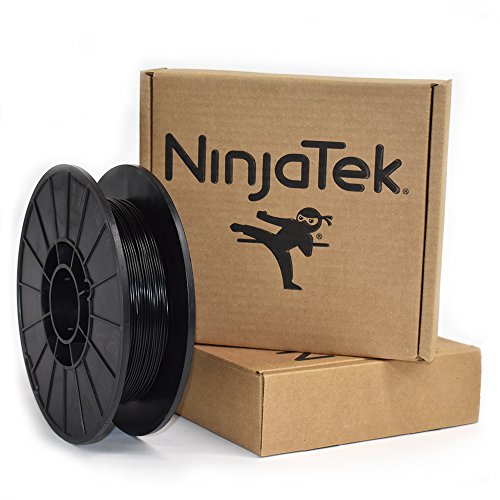
NinjaTek Cheetah 95A (Midnight Black, 1.75 mm, 0.5 kg)
- Best for
- Tough 95A parts such as shock-absorbing mounts and washers when you want faster flexible printing.
- Skip this if
- You want a 1 kg spool at this listing, or a softer TPU than 95A.
Specs, strengths, and limitations
- Material
- TPU
- Diameter
- 1.75 mm
- Net filament
- 500 g (filament only, not packaged weight)
- Hardness
- 95A
- Format
- other
- Maker's nozzle range
- 225–250 °C
- Manufacturer states it prints at speeds greater than 60 mm/s with standard ABS settings.
- Manufacturer states impact strength is 84% greater than ABS, and abrasion resistance is 40% better than ABS.
- TDS lists 95 Shore A hardness and 580% elongation at break.
- Spool holds only 0.5 kg.
- NinjaTek says it prints on all types of desktop 3D printers, but gives no guidance for automatic material systems such as the AMS.
- No drying instructions are published on the product page or TDS.

Bambu Lab TPU 95A HF (Black (51100), 1.75 mm, 1 kg, filament with spool)
- Best for
- Fast single-color flexible parts such as bumpers, grips, and cases, fed from an external spool on a Bambu Lab printer.
- Skip this if
- You want to run flexible filament through an AMS or AMS lite for multicolor prints.
Specs, strengths, and limitations
- Material
- TPU (high-flow)
- Diameter
- 1.75 mm
- Net filament
- 1000 g (filament only, not packaged weight)
- Hardness
- 95A
- Format
- plastic spool
- Maker's nozzle range
- 220–240 °C
- Manufacturer states it prints 3 times faster than standard Bambu TPU 95A.
- TDS lists breaking elongation above 650% (X-Y) and impact strength of 123.2 kJ/m² (X-Y).
- Manufacturer states it comes on a high-temperature reusable spool (PC + ABS, rated 90 °C).
- Not fed by any AMS: Bambu's store page lists all AMS series NOT compatible. Bambu's TPU and X/A2L guides allow the AMS HT only as a sealed drying chamber, fed via its TPU outlet.
- Manufacturer calls it highly sensitive to humidity and says to dry it before use and after storage.
- Bed temperature window is narrow, 30–35 °C, and the TDS calls for glue on the plate.
- Color per the listing's selected variant; check the color before buying.
Verdict: which should you buy?
Choose NinjaTek Cheetah 95A if…
- You print on a Bowden printer, and want a 95A TPU its maker says is known to feed well on that setup.
- You want a bed range from room temperature to 50 °C, without relying on a narrow window.
- You're fine with a 0.5 kg spool and no maker drying figures.
Choose Bambu Lab TPU 95A HF if…
- You print on a Bambu Lab printer and want a 95A TPU with the printer maker's own data sheet settings.
- You want 1 kg on a plastic spool rated to 90 °C, with drying and storage figures from the maker.
- You have an AMS HT and accept manual feeding through its TPU outlet, or you're happy with an external spool holder.
Safety and limits
How this page was checked
Every temperature, speed, feeding rule, drying setting, spool detail, and test figure above comes from the manufacturer documents in the sources section, retrieved on 2026-10-13. We haven't printed with either filament for this page, so nothing here is a measured result of ours. NinjaTek's data sheet columns don't extract in line with their row labels in every mode, so we matched each value to its row, test method, and unit, and checked them against a second extraction and NinjaTek's technical specs table. NinjaTek's product page lists "Infill speeds" of 50–80 mm/s, while its printing guidelines label the same figures "Infill & Shell Speeds." Bambu's TPU guide and A2L guide are written for Bambu Lab printers. Values vary by color and revision, so check the current data sheet for your spool. Read more in our editorial standards and affiliate disclosure.
TPU: what to check before you buy a spool ↗Sources
- Cheetah 3D Printer Filament (95A), NinjaTek
- Cheetah Technical Specifications, NinjaTek
- Printing Guidelines, NinjaTek
- Troubleshooting Guide, NinjaTek
- Fused Deposition Modeling, NinjaTek
- TPU 95A HF Technical Data Sheet V1.0, Bambu Lab
- TPU 95A HF (Bambu Lab US Store), Bambu Lab
- TPU Printing Guide, Bambu Lab
- TPU Printing Guide for A2L, Bambu Lab
- AMS HT (Bambu Lab US Store), Bambu Lab
- Filament guide: printer, nozzle, AMS, build plate and glue compatibility, Bambu Lab
- Notes for AMS, Bambu Lab
This page is research-based: we have not tested the products or methods ourselves. It draws on the manufacturer documentation and sources listed. Exact settings and fit always defer to your printer and filament makers.
Keep reading

Best TPU Filament (2026): Flexible Spools by Hardness and Feed Path
The best TPU filament for your printer: eleven flexible spools from 85A to 68D, matched by hardness and feed path (direct drive, Bowden or Bambu Lab's AMS).
TPU Compatibility: Extruder Path, Hardness, and Feeding Systems
Whether a TPU will feed in your printer depends on its Shore hardness, your extruder path, and whether it goes through an automatic material system.
TPU Hardness Explained: 85A, 95A, and 68D
What Shore A and Shore D numbers measure, why 68D TPU is far firmer than 95A, and how hardness changes feeding, AMS use, and the parts you print.