Best Filament for the Prusa CORE One, CORE One L and MK4S (2026)
PLA, PETG, TPU, ASA and carbon-fiber spools that suit the enclosed CORE One and CORE One L and the open MK4S, checked against Prusa's own limits.

On this page (15 sections)
For a CORE One, CORE One L or MK4S, start with Prusament PLA and Prusament PETG, Prusa's own filament and natural fits on all three. Polymaker and eSUN are documented alternatives, and Polymaker PolyFlex TPU95 covers flexible parts. ASA, such as Prusament ASA, belongs on the CORE One, the CORE One L or an enclosed MK4S. Carbon-fiber spools need a wear-resistant nozzle first, such as E3D's ObXidian Nextruder nozzle. The fit rule is the enclosure. The CORE One and MK4S share the Nextruder, a 290 °C hotend, a 120 °C heatbed and a brass stock nozzle. Prusa says the MK4S handles PLA, PETG and flexible filament in the open, but ASA and ABS need its optional enclosure. The CORE One is enclosed and, per Prusa, prints PLA with the door closed. The larger CORE One L+ has the same nozzle and bed limits, a chamber that reaches 60 °C, and lists ASA and ABS "with Advanced Filtration."
Quick picks
| Need | Pick | Why |
|---|---|---|
| Everyday PLA | Prusament PLA | Prusa's own PLA; its material page says "Enclosure not required" |
| PETG for functional parts | Prusament PETG | Prusa's own PETG, with sheet guidance for Prusa's satin, powder-coated and smooth PEI |
| TPU | Polymaker PolyFlex TPU95 | 95A, the firmer end of common TPU, which Prusa says is easier to print than softer grades |
| Outdoor parts (enclosed) | Prusament ASA | Prusa calls it "UV stable"; for the CORE One, CORE One L or an enclosed MK4S |
| Carbon fiber | E3D ObXidian nozzle, then Polymaker PolyLite PLA-CF | E3D names all three printers; the stock brass nozzle wears too quickly |
These are defaults by need, not a ranking.
Who this page is for
This page is for owners of a Prusa CORE One, CORE One L or Original Prusa MK4S who want to know which spools suit their printer before buying. All three printers take 1.75 mm filament, and every spool here is 1.75 mm. For nozzles and build sheets that fit the CORE One and MK4S, see the CORE One and MK4S printer page. For nozzles that fit the L, see the CORE One L printer page. What changes on the L is covered in its own section.
| Product | Best for | Skip if | Link |
|---|---|---|---|
| Prusa Research Prusament PLA (Jet Black, 1.75 mm, 1 kg) | Precise everyday PLA prints, especially on Prusa printers with stock profiles. | The part needs heat, UV, or mechanical-stress resistance. | View on Amazon (opens Amazon in a new tab) |
| Polymaker PolyLite PLA (Black, 1.75 mm, 1 kg) | Everyday PLA prints, prototypes, and display models where a documented, easy-printing PLA is wanted. | The part will sit in a hot car, near heat sources, or needs toughness beyond standard PLA. | View on Amazon (opens Amazon in a new tab) |
| Polymaker PolyLite PLA Pro (Black, 1.75 mm, 1 kg) | Functional PLA parts, props, and prototypes that need more drop resistance than standard PLA. | The part will see heat above about 55 °C (TDS HDT 58 °C at 1.8 MPa) or needs to flex. | View on Amazon (opens Amazon in a new tab) |
| Prusa Research Prusament PETG (Jet Black, 1.75 mm, 1 kg) | Functional parts, brackets, and larger prints that need more toughness than PLA. | The part needs heat resistance above about 68 °C (TDS HDT at 0.45 and 1.8 MPa), or you want a matte finish that hides layer lines. | View on Amazon (opens Amazon in a new tab) |
| Polymaker PETG (Black, 1.75 mm, 1 kg (new formula)) | Functional brackets and fixtures, indoors or in shade, that need more toughness than PLA. | You can't keep filament dry, or the part needs heat resistance well above 65 °C (TDS HDT at 1.8 MPa). | View on Amazon (opens Amazon in a new tab) |
| eSUN PETG (Solid Black, 1.75 mm, 1 kg) | Everyday PETG for outdoor and functional parts from a long-established brand. | Your bed can't reach 75 °C or the part needs heat resistance above about 60 °C (TDS heat distortion temperature 64 °C at 0.45 MPa). | View on Amazon (opens Amazon in a new tab) |
| Polymaker PolyFlex TPU95 (Black, 1.75 mm, 0.75 kg) | Flexible covers, grips, bumpers, and seals on printers that handle 95A TPU. | You need a softer TPU than 95A, or fast print times, or your printer is set up as Bowden and you can't print very slowly (Polymaker highly recommends direct drive and says Bowden is possible only at very slow speeds). | View on Amazon (opens Amazon in a new tab) |
| Overture TPU 95A (Black, 1.75 mm, 1 kg) | General-purpose 95A flexible parts such as gaskets, seals, and protective cases. | You plan to feed it through a Bambu Lab AMS or AMS lite, or you want a TPU whose maker recommends it for Bowden printers. | View on Amazon (opens Amazon in a new tab) |
| Prusament ASA (Natural, 1.75 mm, 800 g) | Prusa owners and anyone who wants a thoroughly documented, UV-stable ASA for outdoor parts. | Your bed can't reach 110 °C or you print in an unventilated room. | View on Amazon (opens Amazon in a new tab) |
| Polymaker ASA (Black, 1.75 mm, 1 kg) | Outdoor and sun-exposed functional parts printed on an enclosed machine. | Your printer is open-frame or can't reach a 95 °C bed and 260 °C nozzle. | View on Amazon (opens Amazon in a new tab) |
| OVERTURE ASA (Black, 1.75 mm, 1 kg) | Outdoor, sun-exposed functional parts printed on an enclosed printer. | Your printer is open-frame, you want fast printing (the TDS lists 30–50 mm/s), or you need a published heat deflection temperature. | View on Amazon (opens Amazon in a new tab) |
| E3D ObXidian Prusa Nextruder Nozzle (0.4 mm, single nozzle (PRUSA-MK4-NOZZLE-OBX-AS-0400)) | Nextruder owners (MK4, MK4S, XL, CORE One, CORE One L) who print carbon-fiber, glass-fiber or glow filaments regularly. | You print only plain PLA and PETG, where a brass Nextruder nozzle does the job. | View on Amazon (opens Amazon in a new tab) |
| Polymaker PolyLite PLA-CF (Black, 1.75 mm, 1 kg) | Stiff, matte-finish PLA parts and prototypes on a printer fitted with a hardened nozzle. | Your printer only has a brass nozzle, or the part will see heat. | View on Amazon (opens Amazon in a new tab) |
| Polymaker Fiberon PETG-rCF08 (Black, 1.75 mm, 0.5 kg) | An easy first carbon-fiber PETG for matte functional parts and fixtures on a printer with a hardened nozzle. | You need parts that hold up above about 65 °C, or you want a 1 kg spool. | View on Amazon (opens Amazon in a new tab) |


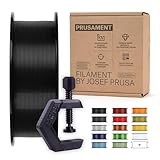


The table is grouped by job, not ranked.
What can the CORE One and MK4S print, per Prusa?
Same toolhead, same limits. Prusa's specifications list a maximum nozzle temperature of 290 °C and a maximum heatbed temperature of 120 °C for both the CORE One+ (Gen 2) and the MK4S. Both ship with a "High-flow Prusa Nozzle brass CHT - 0.4 mm." Prusa's comparison table lists 400 °C for the CORE One+ (Gen 2) with its optional HT hotend, but this page assumes the stock 290 °C hotend. Every spool here has a published nozzle range that tops out at 290 °C or lower, and a bed range at or below 120 °C.
The MK4S is open. Prusa's comparison table lists the MK4S enclosed chamber as "No (optional add-on)." Its specifications list "PLA, PETG, Flex, PVA, PC, PP, CPE, PVB and when using the Original Prusa Enclosure with filtration add-on ABS, ASA, HIPS, PA." The same page says most common materials, "such as PLA, PETG, and even some advanced ones (like PCCF) do not require an enclosure. However, once you need to print with more advanced materials, such as ASA, ABS, PC and similar, the Enclosure is the best option." Our enclosure planning guide covers what an enclosure does and doesn't do.
The CORE One is enclosed. Prusa lists PLA, PETG, Flex, PVA, PC, PP, CPE and PVB, with ABS, ASA, HIPS and PA as "Advanced" in its spec table; its filament cards rate "ASA and ABS" as "Moderate." The CORE One+ (Gen 2) has active chamber heating up to 55 °C.
PLA in a closed CORE One. You don't need to open the door for PLA. Prusa's help page for the door-open error says the CORE One can't print with the door open, and that PLA and other low-temperature filaments can be printed with the enclosure closed thanks to active cooling. Turning off the door sensor is possible, but Prusa warns it "may lead to injury or printer damage." What matters for PLA is the vent. Prusa lists automatic top vent operation among the CORE One+ improvements: the printer "automatically opens the vent for low-temperature materials (PLA, PETG) and closes it for high-temp materials." Prusa says an original CORE One can get the "+" improvements with an upgrade kit or self-printed parts. On a CORE One with a manually operated grille, the printer reminds you to open it when you start a low-temperature print right after one that needed the grille closed. Prusa says an open grille matters because these filaments "might clog the nozzle and cause stringing," and that the reminder doesn't detect whether the grille is actually open. So check it yourself.
Heat in use. Prusa's PLA guide says PLA "gets soft and deforms at temperatures over 60 °C." Its PETG guide calls PETG suitable for interior and most exterior use "with temperatures below 80 °C." For parts that will sit somewhere hot or outdoors, ASA is the better fit, on a printer that can enclose it. Our PLA vs ASA guide covers that trade-off.
CORE One L: what is the same and what differs
Prusa calls the CORE One L "the larger sibling" of the CORE One. The figures below come from Prusa's CORE One L+ product page and its technical specifications, set against the CORE One+ (Gen 2) specifications. Prusa sells the L+ today. The original CORE One L may differ in details we couldn't check.
| CORE One L+ | CORE One+ (Gen 2) | |
|---|---|---|
| Build volume | 300 × 300 × 330 mm (29.7 liters) | 250 × 220 × 270 mm |
| Extruder | Nextruder direct drive | Nextruder direct drive |
| Max nozzle (stock hotend) | 290 °C | 290 °C |
| Max heatbed | 120 °C | 120 °C |
| Max chamber | 60 °C, "Active Convection Chamber" | 55 °C (see note below the table) |
| Heatbed | All-aluminum, dual-loop heating (AC) | Prusa MK52 24V heatbed (DC), per Prusa's L+ comparison |
| Nozzles supplied | Brass High-Flow CHT 0.4 mm fitted, plus an abrasive-resistant 0.4 mm in the box | High-flow brass CHT 0.4 mm |
| Supported materials | PLA, PETG, Flex, PVA, PC, PP, CPE, PVB, "and with Advanced Filtration: ABS, ASA, HIPS, PA" | PLA, PETG, Flex, PVA, PC, PP, CPE, PVB, "Advanced: ABS, ASA, HIPS, PA" |
Prusa's own wording for the CORE One+ chamber isn't consistent. The comparison table on the L+ page calls it "Passive (up to 55°C)," while the CORE One+ (Gen 2) page calls it "Active Chamber Temperature Control" and lists active chamber heating up to 55 °C. Both agree on the 55 °C figure, which is what matters for the spools here.
What is the same. Prusa's CORE One L/+ glossary describes the same Nextruder and 1.75 mm filament, and the L+ specifications list the same 290 °C nozzle and 120 °C heatbed maximums. Every spool on this page fits inside those limits on the L too. Like the CORE One+, the L lists 400 °C only with the optional HT Hotend upgrade, which this page doesn't cover. The door rule is the same. Prusa's door-open help page covers the CORE One L (error #35110) and gives the same advice: keep the door closed, including for PLA.
Spool and filament path. Prusa's CORE One L/+ glossary says you insert filament "into the PTFE tube on the side of the printer (next to the spoolholder)," where it feeds into the Nextruder. Prusa's USS Drybox guide says the CORE One+ and CORE One L "use the same spool mounting system and filament routing interface," with the PTFE tube running to the side filament sensor. The side sensor's flex-loading switch described in the TPU section below applies to the L as well.
Chamber and vent. The L's chamber is bigger and warmer. Prusa says two fans under the heatbed "bring cold air in and blast it across the massive heated surface" to take the chamber up to 60 °C, against 55 °C on the CORE One+ (Gen 2). The top vent is automatic. Prusa's L+ page says that for a low-temperature material "(e.g., PLA or PETG), the printer will automatically open the top vent using a lever on the extruder," and closes it for high-temperature materials. The CORE One L/+ glossary, which covers both the original L and the L+, lists a "Nextruder lever" that "automatically opens and closes the ventilation grille." Prusa's help page for the manual-grille reminder described above lists warning codes for the CORE One and CORE One INDX only, not the L.
Material guidance specific to the L. The L+ spec table lists ABS, ASA, HIPS and PA "with Advanced Filtration," where the CORE One+ table labels the same four "Advanced." Prusa's L+ page also says its 60 °C chamber lets you "easily print advanced materials like ASA, ABS, PC, PA," and calls the optional Advanced Filtration System "useful when you print materials such as ASA." So on an L+, plan ASA and ABS together with Prusa's Advanced Filtration, which is how the spec table lists them. Prusa also says the L+ can be hooked up to an HVAC system instead. PLA, PETG and flexible filament are listed without any add-on.
Nozzles. Per Prusa's L+ specifications, the L+ comes with a 0.4 mm abrasive-resistant nozzle in the box ("0.4mm Prusa Hardened Nozzle (Nickle-plated)" in the box list) alongside the fitted brass one. An L+ owner can fit that before trying the carbon-fiber spools below, instead of buying the E3D nozzle. We haven't confirmed whether the original CORE One L shipped with the same extra nozzle. E3D names the CORE One L as compatible with its ObXidian Nextruder nozzle.
Not covered for the L. The MMU3 notes below come from Prusa's MMU3 pages for the MK4S and the CORE One. We haven't checked MMU3 support on the L, so don't read those notes as covering it. The L's build area is larger, so don't assume a CORE One or MK4S build sheet fits it. Our CORE One L printer page currently lists nozzles only.
Can the CORE One print carbon fiber on the stock nozzle?
Prusa's Nextruder nozzle guide says a brass nozzle "tends to wear too quickly" with abrasive filaments, and that most abrasive materials are composites and plastics with additives. Its nozzle-size table marks wood- or metal-infused filaments and CF- or Kevlar-infused ABS as needing a hardened nozzle at 0.4 mm. E3D adds glass-fiber fills to that list, and warns that glow-in-the-dark filaments contain a very hard additive. The CORE One and MK4S ship with brass, so don't buy the carbon-fiber spools below until you've fitted a wear-resistant nozzle. Our worn nozzle guide covers the signs of a worn one. The CORE One L+ ships with a brass nozzle fitted and a hardened one in the box, so swap that in first. Prusa lists its own ObXidian and hardened nozzles and E3D's High Flow ObXidian and DiamondBack Nextruder nozzles. Our replacement nozzle shortlist covers the options.
MMU3 notes
Prusa's MMU3 product page for the MK4S says the MMU3 "delivers the best performance, the same speed and the highest efficiency (lowest waste)" with the standard nozzle rather than the high-flow one, and a standalone MMU3 for the MK4S comes with the standard nozzle. Prusa's CORE One MMU3 page "strongly recommend[s] a standard 0.4mm nozzle for MMU printing" and says the full kit includes one. On materials, the same page says the MMU3 "is designed to offer the best performance with PLA and PETG," and that with more advanced materials "the results may vary." So check Prusa's MMU3 documentation before loading flexible or filled filament. This page doesn't cover Prusa's INDX toolchanger.
Everyday PLA
Prusament PLA (Jet Black, 1 kg)
Prusament is Prusa's own filament brand, which makes it a straightforward choice on a Prusa printer. Prusa's material page lists a 210 ± 10 °C nozzle, a 40–60 °C bed, "Enclosure not required," and a temperature resistance of 55 °C. It also lists low UV resistance and says it's "not ideal for outdoor use." Prusa lists "Low warping" among its pros and "Brittle" among its cons.

Prusa Research Prusament PLA (Jet Black, 1.75 mm, 1 kg)
- Best for
- Precise everyday PLA prints, especially on Prusa printers with stock profiles.
- Skip this if
- The part needs heat, UV, or mechanical-stress resistance.
Specs, strengths, and limitations
- Material
- PLA
- Diameter
- 1.75 mm
- Net filament
- 1000 g (filament only, not packaged weight)
- Format
- plastic spool
- Maker's nozzle range
- 200–220 °C
- Manufacturer states diameter precision of ±0.02 mm and publishes measured data for every spool.
- Manufacturer states low warping, suitable for large prints.
- Manufacturer states guaranteed color consistency between batches.
- Not suited to heat or outdoor use: Prusa lists 55 °C temperature resistance and low UV resistance.
- Prusa suggests PETG or PC Blend for mechanically stressed parts, and lists PLA as difficult to sand.
Skip it if the part will see heat, sun or repeated bending.
Polymaker PolyLite PLA (Black, 1 kg)
PolyLite PLA is a non-Prusament alternative that works the same way on all three printers. Its TDS (V5.4) lists a 190–230 °C nozzle, a 25–60 °C bed, "Closure Chamber: No Needed," and a heat deflection temperature of 58 °C at 1.8 MPa. It ships on a cardboard spool.

Polymaker PolyLite PLA (Black, 1.75 mm, 1 kg)
- Best for
- Everyday PLA prints, prototypes, and display models where a documented, easy-printing PLA is wanted.
- Skip this if
- The part will sit in a hot car, near heat sources, or needs toughness beyond standard PLA.
Specs, strengths, and limitations
- Material
- PLA
- Diameter
- 1.75 mm
- Net filament
- 1000 g (filament only, not packaged weight)
- Format
- cardboard spool
- Maker's nozzle range
- 190–230 °C
- Manufacturer states PolyLite PLA is designed for reliability and ease of printing.
- Manufacturer TDS lists no enclosure needed and a wide 190–230 °C nozzle window.
- Manufacturer publishes a full TDS with mechanical, thermal, and drying data.
- Not suited to parts exposed to heat: the TDS lists a heat deflection temperature of 58 °C (1.8 MPa).
- Cardboard spool: Polymaker says its spools have hardened edges that work in the AMS, but Bambu Lab's general AMS guidance recommends an adapter or ring for cardboard spools. Check your unit.
Skip it if the part will see heat, or you'd rather stay with Prusa's own filament.
Polymaker PolyLite PLA Pro (Black, 1 kg)
PolyLite PLA Pro is Polymaker's toughened PLA, for household parts and prototypes that may get dropped. Its TDS lists the same 190–230 °C nozzle range, a 30–60 °C bed, no closed chamber needed, and a heat deflection temperature of 58 °C at 1.8 MPa. So it still has PLA's heat limit.

Polymaker PolyLite PLA Pro (Black, 1.75 mm, 1 kg)
- Best for
- Functional PLA parts, props, and prototypes that need more drop resistance than standard PLA.
- Skip this if
- The part will see heat above about 55 °C (TDS HDT 58 °C at 1.8 MPa) or needs to flex.
Specs, strengths, and limitations
- Material
- PLA (PLA Pro (toughened PLA))
- Diameter
- 1.75 mm
- Net filament
- 1000 g (filament only, not packaged weight)
- Format
- cardboard spool
- Maker's nozzle range
- 190–230 °C
- Manufacturer states it combines high toughness and high rigidity with the ease of printing of regular PLA.
- TDS lists notched Charpy impact strength of 17.1 kJ/m² (X-Y).
- Manufacturer publishes a full TDS with mechanical, thermal, and drying data.
- Not for heat: the TDS lists a heat deflection temperature of 58 °C (1.8 MPa), and Polymaker says it is not for projects needing high heat resistance or flexibility.
- Cardboard spool: Bambu Lab strongly advises a spool adapter or adapter ring for cardboard spools in the AMS.
- Polymaker now calls this the 'Old Formula' and sells a separate 'New Formula' Polymaker PLA Pro; check which version an Amazon listing ships.
Skip it if the part will sit somewhere warm or needs to flex.
PETG for functional parts
Prusa's PETG guide warns, "Do not print on the smooth PEI sheet as the adhesion may be too strong!" It recommends the powder-coated or satin sheet, or glue stick if you must use smooth PEI. That applies to every PETG below.
Prusament PETG (Jet Black, 1 kg)
Prusament PETG is Prusa's own PETG. Its TDS lists a 250 ± 10 °C nozzle and an 80 ± 10 °C heatbed, with satin, powder-coated or smooth PEI (with glue stick) sheets. It gives a heat deflection temperature of 68 °C. Prusa's material page warns of "Strong adhesion to the bed - be careful when you're removing the print," and lists possible stringing as a con.

Prusa Research Prusament PETG (Jet Black, 1.75 mm, 1 kg)
- Best for
- Functional parts, brackets, and larger prints that need more toughness than PLA.
- Skip this if
- The part needs heat resistance above about 68 °C (TDS HDT at 0.45 and 1.8 MPa), or you want a matte finish that hides layer lines.
Specs, strengths, and limitations
- Material
- PETG
- Diameter
- 1.75 mm
- Net filament
- 1000 g (filament only, not packaged weight)
- Format
- plastic spool
- Maker's nozzle range
- 240–260 °C
- Manufacturer states high strength and durability with low shrinking and warping.
- Manufacturer states diameter precision of ±0.02 mm and publishes measured data for every spool.
- Manufacturer states it is easier to sand than PLA.
- Prusa lists possible stringing that may require occasional drying, and poor bridging.
- Strong bed adhesion: Prusa warns to take care removing prints, recommends textured, satin or PP sheets, and says to avoid smooth PEI (glue stick if used).
- Heat resistance tops out around 68 °C: the TDS gives HDT 68 °C at both 0.45 and 1.8 MPa.
Skip it if the part needs more heat resistance than PETG offers.
Polymaker PETG (Black, 1 kg)
Polymaker's current PETG is a high-flow formula. Its TDS (V3.0) lists a 240–260 °C nozzle, a 60–70 °C bed, speeds up to 300 mm/s, and "Closure chamber: Not Needed." It recommends drying at 60 °C for 6 hours. It ships on a cardboard spool.

Polymaker PETG (Black, 1.75 mm, 1 kg (new formula))
- Best for
- Functional brackets and fixtures, indoors or in shade, that need more toughness than PLA.
- Skip this if
- You can't keep filament dry, or the part needs heat resistance well above 65 °C (TDS HDT at 1.8 MPa).
Specs, strengths, and limitations
- Material
- PETG (high-flow)
- Diameter
- 1.75 mm
- Net filament
- 1000 g (filament only, not packaged weight)
- Format
- cardboard spool
- Maker's nozzle range
- 240–260 °C
- Manufacturer states it is less brittle and more impact-resistant than PLA.
- Manufacturer states it prints without an enclosure and works with AMS and multi-material systems.
- Manufacturer states a high-flow formulation for speeds up to 300 mm/s with a 0.4 mm nozzle.
- Moisture-sensitive: the TDS recommends drying at 60 °C for 6 h and printing from a dry box.
- Heat resistance is limited: the TDS lists HDT 65 °C at 1.8 MPa (69 °C at 0.45 MPa).
- Cardboard spool: Polymaker says its spools have hardened edges that work in the AMS, but Bambu Lab's general AMS guidance recommends an adapter or ring for cardboard spools. Check your unit.
Skip it if you can't keep filament dry.
eSUN PETG (Solid Black, 1 kg)
eSUN PETG is a PETG from a maker that publishes a dated data sheet. Its TDS (V2.0) lists a 230–260 °C nozzle, a 75–90 °C build platform and UV resistance. It recommends drying at 60 °C for more than 8 hours. eSUN's TDS gives a heat distortion temperature of 64 °C at 0.45 MPa.

eSUN PETG (Solid Black, 1.75 mm, 1 kg)
- Best for
- Everyday PETG for outdoor and functional parts from a long-established brand.
- Skip this if
- Your bed can't reach 75 °C or the part needs heat resistance above about 60 °C (TDS heat distortion temperature 64 °C at 0.45 MPa).
Specs, strengths, and limitations
- Material
- PETG
- Diameter
- 1.75 mm
- Net filament
- 1000 g (filament only, not packaged weight)
- Format
- other
- Maker's nozzle range
- 230–260 °C
- Manufacturer states it combines PLA's easy printing with ABS's toughness.
- Manufacturer TDS lists UV resistance, and the product page states it withstands sun and rain outdoors.
- Manufacturer publishes a dated TDS with print and drying settings.
- Needs a hot bed: the TDS lists 75–90 °C build platform temperature.
- Heat resistance is limited: the TDS lists a heat distortion temperature of 64 °C (0.45 MPa).
- eSUN's own guidance varies between its TDS and product page (nozzle 230 vs 240 °C start).
Skip it if the part will run hot, or your bed can't comfortably hold 75 °C or more.
TPU for flexible parts
Prusa's flexible materials guide says "the softer the filament is, the harder it is to print," and recommends keeping flexible filament dry. On the CORE One+ and CORE One L, Prusa says a hardware switch on the side filament sensor case loosens the lever for easier flex loading. Both spools below are 95A, the firmer end of common TPU. Our TPU compatibility guide explains hardness grades.
Polymaker PolyFlex TPU95 (Black, 0.75 kg)
PolyFlex TPU95's TDS (V5.4) lists Shore 95A, a 210–230 °C nozzle, a 25–60 °C bed, no closed chamber needed, and drying at 70 °C for 8 hours. The spool holds 0.75 kg on cardboard.

Polymaker PolyFlex TPU95 (Black, 1.75 mm, 0.75 kg)
- Best for
- Flexible covers, grips, bumpers, and seals on printers that handle 95A TPU.
- Skip this if
- You need a softer TPU than 95A, or fast print times, or your printer is set up as Bowden and you can't print very slowly (Polymaker highly recommends direct drive and says Bowden is possible only at very slow speeds).
Specs, strengths, and limitations
- Material
- TPU
- Diameter
- 1.75 mm
- Net filament
- 750 g (filament only, not packaged weight)
- Hardness
- 95A
- Format
- cardboard spool
- Maker's nozzle range
- 210–230 °C
- Manufacturer states it is engineered to work on most desktop 3D printers without specialized hardware.
- Manufacturer states it can stretch over three times its original length.
- Manufacturer TDS lists shore hardness 95A and no enclosure needed.
- Slow printing: the TDS recommends 30–50 mm/s.
- Spool holds 0.75 kg, not 1 kg.
- Cardboard spool: Polymaker says it redesigned its spool edges to spin well in the AMS, but its Flexible TPU FAQ says TPU is often too soft to feed through the AMS and suggests avoiding it. Bambu Lab also advises against TPU in the AMS and recommends an adapter or ring for cardboard spools.
Skip it if you want a 1 kg spool or a softer TPU.
Overture TPU 95A (Black, 1 kg)
Overture's product page lists 95A hardness, a 210–240 °C nozzle and a 35–50 °C bed. It recommends drying at 70 °C for 7 hours, and warns that drying too long can make it brittle. Overture's TDS gives a wider 25–60 °C bed range and 8 hours of drying, so its own documents differ.

Overture TPU 95A (Black, 1.75 mm, 1 kg)
- Best for
- General-purpose 95A flexible parts such as gaskets, seals, and protective cases.
- Skip this if
- You plan to feed it through a Bambu Lab AMS or AMS lite, or you want a TPU whose maker recommends it for Bowden printers.
Specs, strengths, and limitations
- Material
- TPU
- Diameter
- 1.75 mm
- Net filament
- 1000 g (filament only, not packaged weight)
- Hardness
- 95A
- Format
- cardboard spool
- Maker's nozzle range
- 210–240 °C
- Manufacturer states its 95A Shore hardness balances softness and toughness for impact absorption and rebound.
- Manufacturer states it resists oil and recovers its shape after repeated stress.
- Manufacturer states unopened spools have a 1-year shelf life with proper storage.
- The TPU printing tips on Overture's product page say 'Not compatible with AMS or other multi-material systems.'
- Overture marks it 'AMS & AMS lite NOT Compatible', and its FAQ says TPU is too soft for the AMS and can jam or extrude inconsistently.
- Overture's own documents disagree on bed temperature, drying time, and elongation (see notes).
- Manufacturer says to keep it dry before use.
- Overture's TPU wiki says to use a direct-drive system or an external extruder attachment, and its extruder wiki rates Bowden support for flexible filament as 'Limited'; the product page doesn't mention Bowden.
Skip it if you want one consistent set of maker settings.
Which of these Prusa printers can print ASA?
Prusa's ASA guide says "the bed should be heated to at least 100°C, and the printer should be inside an enclosure to keep a higher ambient temperature." It also warns that ASA "releases fumes and substances that could pose a potential health risk." On the MK4S, Prusa lists ASA only with the Original Prusa Enclosure and its filtration add-on. On the CORE One L+, Prusa's spec table lists ASA "with Advanced Filtration." All three spools below fit within the 290 °C nozzle and 120 °C bed limits. For the wider ASA picture, see the ASA filament shortlist.
Prusament ASA (Natural, 800 g)
Prusa's material page lists a 260 ± 5 °C nozzle, a 110 ± 5 °C bed and "Skirt or Enclosure Recommended." It calls the material "UV stable" and says it shows "no signs of deformation up to temperatures near 93 °C." The spool holds 800 g, and it's sold in Natural rather than black.

Prusament ASA (Natural, 1.75 mm, 800 g)
- Best for
- Prusa owners and anyone who wants a thoroughly documented, UV-stable ASA for outdoor parts.
- Skip this if
- Your bed can't reach 110 °C or you print in an unventilated room.
Specs, strengths, and limitations
- Material
- ASA
- Diameter
- 1.75 mm
- Net filament
- 800 g (filament only, not packaged weight)
- Format
- other
- Maker's nozzle range
- 250–270 °C
- Manufacturer states ASA is UV stable and shows no deformation up to about 93 °C.
- Prusa publishes a full TDS and measures diameter along every spool.
- Manufacturer states it can be smoothed with acetone vapor and sanded wet or dry.
- Spool holds 800 g, less than the 1 kg spools here.
- Needs a 110 °C bed, and Prusa recommends an enclosure or tall skirt to control warping.
- Prusa warns of styrene fumes and recommends ventilation or an enclosure with active filtration.
Skip it if you print on an open MK4S, or want a 1 kg spool.
Polymaker ASA (Black, 1 kg)
Polymaker's ASA TDS lists a 230–260 °C nozzle, a 75–95 °C bed, "Closure chamber: Needed," and a heat deflection temperature of 100 °C at 1.8 MPa. It recommends drying at 70 °C for 7 hours. It ships on a cardboard spool.

Polymaker ASA (Black, 1.75 mm, 1 kg)
- Best for
- Outdoor and sun-exposed functional parts printed on an enclosed machine.
- Skip this if
- Your printer is open-frame or can't reach a 95 °C bed and 260 °C nozzle.
Specs, strengths, and limitations
- Material
- ASA
- Diameter
- 1.75 mm
- Net filament
- 1000 g (filament only, not packaged weight)
- Format
- cardboard spool
- Maker's nozzle range
- 230–260 °C
- Manufacturer states it is an alternative to ABS with improved weather and UV resistance.
- Manufacturer TDS lists a heat deflection temperature of 100 °C (1.8 MPa).
- Manufacturer states it prints with settings very similar to ABS.
- Needs an enclosed printer per the TDS.
- Requires higher nozzle and bed temperatures (230–260 °C, 75–95 °C) than PLA or PETG.
- Cardboard spool: Bambu Lab strongly advises a spool adapter or adapter ring for cardboard spools in the AMS.
Skip it if your MK4S isn't enclosed.
Overture ASA (Black, 1 kg)
Overture's product page lists a 240–270 °C nozzle, a 70–95 °C bed, 30–50 mm/s printing and "Enclosed Printer Required." It recommends drying at 75 °C for 7 hours. Overture advises good ventilation and considering air filtration.

OVERTURE ASA (Black, 1.75 mm, 1 kg)
- Best for
- Outdoor, sun-exposed functional parts printed on an enclosed printer.
- Skip this if
- Your printer is open-frame, you want fast printing (the TDS lists 30–50 mm/s), or you need a published heat deflection temperature.
Specs, strengths, and limitations
- Material
- ASA
- Diameter
- 1.75 mm
- Net filament
- 1000 g (filament only, not packaged weight)
- Format
- other
- Maker's nozzle range
- 240–270 °C
- Manufacturer states it is formulated for maximum UV protection, for outdoor use.
- Manufacturer states each spool is dried for 24 hours and vacuum-sealed in a resealable foil bag.
- Manufacturer states a dimensional accuracy of ±0.02 mm.
- Needs an enclosed printer: the product page lists 'Enclosed Printer Required'.
- Needs a 240–270 °C nozzle and a 70–95 °C bed per the product page; dry at 75 °C for 7 h when needed.
- Slow and fussy to print: Overture's TDS V5.1 lists 30–50 mm/s and PVA glue on the build surface, and it gives a Vicat softening point (106.2 °C) but no heat deflection temperature.
Skip it if you want fast printing, or your MK4S isn't enclosed.
Carbon fiber: fit a wear-resistant nozzle first
E3D ObXidian Prusa Nextruder Nozzle (0.4 mm)
E3D's product page names the MK4S and CORE One among compatible printers, along with the MK3.9, MK3.9S, MK4, XL and CORE One L. E3D lists a 300 °C maximum. That's above the printers' 290 °C hotend limit, so the hotend is the real cap. E3D says the coating gives "orders-of-magnitude higher durability for abrasive filaments like carbon fiber, glass fiber filled materials." It also warns that aggressive fillers, such as Polymaker's Fiberon PA612-CF, PA6-CF, PA6-GF and PA12-CF, can still cause significant wear. And some filled materials can jam 0.4 mm and smaller nozzles, so check the filament maker's minimum nozzle size. E3D also sells a 0.6 mm size. Follow Prusa's procedure when you change a Nextruder nozzle.

E3D ObXidian Prusa Nextruder Nozzle (0.4 mm, single nozzle (PRUSA-MK4-NOZZLE-OBX-AS-0400))
- Best for
- Nextruder owners (MK4, MK4S, XL, CORE One, CORE One L) who print carbon-fiber, glass-fiber or glow filaments regularly.
- Skip this if
- You print only plain PLA and PETG, where a brass Nextruder nozzle does the job.
- Verified fit
- Prusa Research MK4S; Prusa Research CORE One; Prusa Research CORE One L; Prusa Research XL; Prusa Research MK4 (stock configuration, per the manufacturer)
Specs, strengths, and limitations
- Interface
- Prusa Nextruder nozzle with all-metal filament guide
- Hotend design
- Tool steel insert with E3DLC coating
- Part rated to
- 300 °C (your printer's own hotend limit may be lower)
- Wear-resistant
- Yes, per the manufacturer
- Maker notes
- E3D product page: compatible with Prusa MK3.9, MK3.9S, MK4, MK4S, XL, CORE One & CORE One L. MK3.9/MK3.9S are not in printers.json. Amazon listing says MK4 and XL only; E3D's current page (manufacturer) also names MK4S, CORE One and CORE One L. Prusa Knowledge Base: every MK4S, MK3.9S, MK4, MK3.9, XL, CORE One/+, CORE One L/+ and Signature Oak printer has a Nextruder hotend. Each nozzle has its size engraved (E3D).
- Manufacturer states wear resistance orders of magnitude higher than any other E3D nozzle, for abrasive/filled polymers.
- Manufacturer states the E3DLC coating adds non-stick properties for less plastic build-up.
- Manufacturer names the MK4, MK4S, XL, CORE One and CORE One L as compatible.
- E3D lists a 300 °C maximum recommended printing temperature.
- E3D warns aggressive fillers (e.g. Polymaker Fiberon PA612-CF, PA6-CF, PA6-GF, PA12-CF) can still cause significant wear, and some filled materials can jam nozzles of 0.4 mm and smaller.
Skip it if you print only plain PLA, PETG, TPU and ASA, where the stock brass nozzle does the job.
Polymaker PolyLite PLA-CF (Black, 1 kg)
PolyLite PLA-CF is PLA with 8% chopped carbon fiber, for stiff, matte parts. Polymaker's product page says a hardened nozzle is strongly recommended. The TDS (V5.4) lists a 190–230 °C nozzle, a 25–60 °C bed and no closed chamber needed, while the product page's print settings give 210–230 °C and 30–70 °C. Either range fits these printers. The TDS lists a heat deflection temperature of 50 °C at 1.8 MPa, lower than plain PLA.

Polymaker PolyLite PLA-CF (Black, 1.75 mm, 1 kg)
- Best for
- Stiff, matte-finish PLA parts and prototypes on a printer fitted with a hardened nozzle.
- Skip this if
- Your printer only has a brass nozzle, or the part will see heat.
Specs, strengths, and limitations
- Material
- PLA (carbon-fiber filled (8 wt% chopped carbon fiber))
- Diameter
- 1.75 mm
- Net filament
- 1000 g (filament only, not packaged weight)
- Format
- cardboard spool
- Maker's nozzle range
- 190–230 °C
- Nozzle
- Abrasive: the maker recommends a wear-resistant nozzle
- Manufacturer states 8% chopped carbon fiber gives exceptional rigidity and strength.
- Manufacturer states a matte black finish with virtually invisible layer lines and low shrinkage.
- Manufacturer states it prints with standard PLA settings; the TDS lists no enclosure needed.
- Abrasive: Polymaker strongly recommends a hardened nozzle.
- Not suited to heat: the TDS lists a heat deflection temperature of 50 °C (1.8 MPa).
- Cardboard spool: Bambu Lab strongly advises a spool adapter or adapter ring for cardboard spools in the AMS.
- The Amazon listing's bullet points describe plain PolyLite PLA, though its title and model number (PA10001) are the carbon-fiber version. Check that the title says Carbon Fiber PLA before you buy.
Skip it if you still have the brass nozzle fitted, or the part will see heat.
Polymaker Fiberon PETG-rCF08 (Black, 0.5 kg)
Fiberon PETG-rCF08 is PETG with 8% recycled carbon fiber. Its TDS (V1.0) lists a 240–270 °C nozzle, a 60–70 °C build plate and a room-temperature chamber. It says brass nozzle wear "happens frequently," with a brass nozzle lasting "approximately 9h," and highly recommends a wear-resistant nozzle such as hardened steel or ruby. It recommends drying at 65 °C for 3 hours. The spool holds 0.5 kg. For more filled options, see the carbon fiber filament shortlist.

Polymaker Fiberon PETG-rCF08 (Black, 1.75 mm, 0.5 kg)
- Best for
- An easy first carbon-fiber PETG for matte functional parts and fixtures on a printer with a hardened nozzle.
- Skip this if
- You need parts that hold up above about 65 °C, or you want a 1 kg spool.
Specs, strengths, and limitations
- Material
- PETG (8% recycled carbon-fiber filled)
- Diameter
- 1.75 mm
- Net filament
- 500 g (filament only, not packaged weight)
- Format
- other
- Maker's nozzle range
- 240–270 °C
- Nozzle
- Abrasive: the maker recommends a wear-resistant nozzle
- Manufacturer states 8% recycled carbon fiber for added stiffness over standard PETG.
- Manufacturer states a matte finish that hides layer lines and PETG-level low warping.
- Prints at ordinary PETG temperatures (240–270 °C nozzle, 60–70 °C bed) per the TDS, with only a short 65 °C / 3 h dry.
- Abrasive: Polymaker requires a hardened (or ruby) nozzle of 0.4 mm or larger; brass lasts about 9 h.
- Modest heat resistance: TDS heat deflection temperature is 65.7 °C at 1.8 MPa.
- Only sold in 0.5 kg and 3 kg spools, and Polymaker's enclosure guidance is inconsistent between page sections.
Skip it if you still have the brass nozzle fitted, or want a 1 kg spool.
What we left out
- PC. Prusa lists PC for the CORE One+ (Gen 2), the CORE One L+ and the MK4S, but the only PC spool in our catalog, Polymaker PolyLite PC, lists "Closure Chamber: Needed (70-100°C)" in its TDS. That's above the CORE One+ (Gen 2)'s listed 55 °C chamber maximum and the CORE One L+'s 60 °C, so we haven't included it.
- Prusament PC Blend Carbon Fiber. Prusa's material page gives a nozzle temperature of 285 ± 10 °C, a range that goes beyond the stock 290 °C hotend.
- Nylon carbon-fiber grades. Several in our catalog list nozzle ranges up to 300 °C, and E3D names Polymaker's Fiberon nylons among the fillers that can still wear ObXidian.
Checklist before you buy for a CORE One, CORE One L or MK4S
- Material vs. enclosure. PLA, PETG and TPU work on all three. ASA and ABS need the CORE One, the CORE One L (Prusa's L+ spec table lists them with Advanced Filtration) or an MK4S with Prusa's enclosure.
- Temperatures. The stock hotend reaches 290 °C and the bed 120 °C. Check the spool's published range.
- PLA on the CORE One or CORE One L. Keep the door closed and make sure the vent or grille is open. The L opens its top vent automatically.
- PETG on smooth PEI. Use glue stick, or switch to the powder-coated or satin sheet.
- Abrasive fills. Carbon fiber, Kevlar, glass, wood and metal fills need a wear-resistant Nextruder nozzle, not the stock brass. E3D also warns about glow-in-the-dark filaments.
- Spool weight. Prusament ASA is 800 g, PolyFlex TPU95 is 0.75 kg and Fiberon PETG-rCF08 is 0.5 kg. Everything else here is 1 kg.
Drying, storage and safety
PETG, TPU and ASA are the most moisture-sensitive materials here. Each maker's drying setting is on its product card above. Use the setting for your exact spool, and check the spool's own temperature rating before drying it on the spool. Our filament dryer vs dry box guide covers the options.
How this page was checked
This is a research-based page. We have not printed these spools on a CORE One, CORE One L or MK4S for it, so it contains no test results or scores. The printer limits come from Prusa's CORE One+ (Gen 2) and MK4S product pages, the Prusa Knowledge Base material guides, the CORE One door and ventilation help pages, the Nextruder nozzle guide, and the MK4S and CORE One MMU3 product pages. The spool and nozzle statements come from each maker's own pages and data sheets, listed in the sources section. All were retrieved on 2026-10-07. The CORE One L section comes from Prusa's CORE One L+ product page, the CORE One L/+ glossary and the USS Drybox installation guide for the CORE One L and CORE One+, retrieved on 2026-10-14, along with a recheck of the door-open, open-chamber-ventilation and flexible-materials help pages, the CORE One+ (Gen 2) specifications and E3D's ObXidian page on the same date. Makers update their pages, so check the current version before relying on a number. Read more in our editorial standards and affiliate disclosure.
PLA: what to check before you buy a spool ↗Head-to-head comparisons
Deciding between two products on this page? Each comparison puts both makers’ specs side by side and says who should choose which.
Sources
- Prusa CORE One+ (Gen 2) product page and specifications, Prusa Research
- Prusa CORE One L+ product page and technical specifications, Prusa Research
- CORE One L/+ glossary, Prusa Research
- Prusa USS Drybox - Installation on CORE One L / CORE One+, Prusa Research
- Original Prusa MK4S 3D Printer product page and specifications, Prusa Research
- Door open (#31110 CORE One), Prusa Research
- Open chamber ventilation (#31837 CORE One), Prusa Research
- Prusa nozzle types for Nextruder printers, Prusa Research
- PLA material guide, Prusa Research
- PETG material guide, Prusa Research
- ASA material guide, Prusa Research
- Flexible materials guide, Prusa Research
- Original Prusa MMU3 (for MK4S/MK3.9S) product page, Prusa Research
- Original Prusa MMU3 Enclosed (for CORE One) - Full Kit product page, Prusa Research
- Prusament PLA material page, Prusa Polymers
- Prusament PETG material page, Prusa Polymers
- Prusament PETG Technical Data Sheet, Prusa Polymers
- Prusament ASA material page, Prusa Polymers
- Prusament PC Blend Carbon Fiber material page, Prusa Polymers
- PolyLite PLA Technical Data Sheet V5.4, Polymaker
- PolyLite PLA Pro Technical Data Sheet, Polymaker
- Polymaker PETG Technical Data Sheet V3.0, Polymaker
- PolyFlex TPU95 Technical Data Sheet V5.4, Polymaker
- Polymaker ASA Technical Data Sheet, Polymaker
- PolyLite PLA-CF product page, Polymaker
- PolyLite PLA-CF Technical Data Sheet V5.4, Polymaker
- Fiberon PETG-rCF08 Technical Data Sheet V1.0, Polymaker
- PolyLite PC Technical Data Sheet V5.4, Polymaker
- eSUN PETG Filament Technical Data Sheet V2.0, eSUN
- Overture TPU 95A product page, Overture 3D
- OVERTURE TPU 2.0 Technical Data Sheet, Overture 3D
- Overture ASA product page, Overture 3D
- ObXidian Prusa Nextruder Nozzles, E3D
This page is research-based: we have not tested the products or methods ourselves. It draws on the manufacturer documentation and sources listed. Exact settings and fit always defer to your printer and filament makers.
Keep reading

Best ASA Filament (2026): Outdoor-Part Spools by Printer
The best ASA filament for outdoor parts: seven 1.75 mm spools matched to the printers they suit, with each maker's UV, enclosure, heat and drying guidance.

Best Carbon Fiber Filament (2026): Spools by Base Material
The best carbon fiber filament by base material: fifteen spools from PLA-CF to nylon and PC, with each maker's nozzle, heat, enclosure and drying needs.
Best Replacement Nozzles and Hotends (2026), Matched to Your Printer
The best replacement nozzles and hotends for Bambu Lab, Creality and Prusa printers, matched to each maker's named models. Fit first, then flow and wear.