Best ASA Filament (2026): Outdoor-Part Spools by Printer
The best ASA filament for outdoor parts: seven 1.75 mm spools matched to the printers they suit, with each maker's UV, enclosure, heat and drying guidance.
On this page (17 sections)
For outdoor and sun-exposed parts on most enclosed printers, start with Polymaker ASA: its data sheet lists a 230–260 °C nozzle and a 75–95 °C bed, and Polymaker is the only maker here that publishes how long its outdoor parts held up. Prusament ASA has the most complete data of any ASA here and suits Prusa owners, but it wants a 110 °C bed. Overture ASA and ERYONE ASA High-Speed also run at moderate temperatures, and ERYONE suits fast printers without a very hot bed. SUNLU ASA and Anycubic ASA need a hotter nozzle, and eSUN ASA+ wants a bed of 100 °C or more. The fit rule: check your printer before the spool. Most of these makers call for an enclosure, every one needs a nozzle of at least 250 °C at the top of its range, and all of them need real ventilation.
Quick picks
| Need | Pick | Why |
|---|---|---|
| Default for most enclosed printers | Polymaker ASA | Full data sheet at moderate temperatures (230–260 °C nozzle, 75–95 °C bed), and the only maker here that states how long its outdoor parts lasted |
| Prusa printers and the fullest data | Prusament ASA | Prusa publishes the most complete data for any ASA here; it needs a 110 ± 5 °C bed |
| Fast printers without a very hot bed | ERYONE ASA High-Speed | 30–200 mm/s and a 75–90 °C bed, the lowest bed ceiling here |
| Anycubic ACE | Anycubic ASA | Anycubic says it is compatible with its ACE material system |
Picks are matched to documented needs, not scored.
Who is this ASA shortlist for?
This page is for anyone buying ASA for parts that will see sun, rain, or outdoor temperature swings: garden fittings, fence and wall mounts, car-exterior trim pieces that aren't safety-related, camera and sensor housings, and outdoor signage. It assumes a 1.75 mm printer that is enclosed, or one you are about to enclose, and a room you can ventilate. If you're still deciding between ABS and ASA, start with our ABS vs ASA guide. If you're moving up from PLA, our PLA vs ASA guide compares the two. If your parts stay indoors, our ABS filament shortlist covers the indoor option.
| Product | Best for | Skip if | Link |
|---|---|---|---|
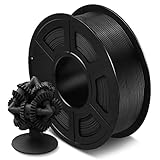
| Polymaker ASA (Black, 1.75 mm, 1 kg) | Outdoor and sun-exposed functional parts printed on an enclosed machine. | Your printer is open-frame or can't reach a 95 °C bed and 260 °C nozzle. | View on Amazon (opens Amazon in a new tab) |
| OVERTURE ASA (Black, 1.75 mm, 1 kg) | Outdoor, sun-exposed functional parts printed on an enclosed printer. | Your printer is open-frame, you want fast printing (the TDS lists 30–50 mm/s), or you need a published heat deflection temperature. | View on Amazon (opens Amazon in a new tab) |
| ERYONE ASA High-Speed (Black, 1.75 mm, 1 kg) | Fast printers that need ASA for outdoor parts without a very hot bed. | Your printer is open-frame, or you want unambiguous heat-deflection data (the TDS gives no clear test load) or can't dry at 90–100 °C. | View on Amazon (opens Amazon in a new tab) |
| SUNLU ASA (Black, 1.75 mm, 1 kg) | Budget outdoor parts on a printer that can hold an 80–100 °C bed. | Your printer is open-frame, your hotend tops out below 260 °C, or you want a stated drying time. | View on Amazon (opens Amazon in a new tab) |
| Anycubic ASA (Black, 1.75 mm, 1 kg) | Anycubic and other printers with a 275 °C-capable hotend making outdoor or garden parts. | You want high-speed printing, or you need to know in advance whether you'll get Anycubic's reusable spool. | View on Amazon (opens Amazon in a new tab) |
| Prusament ASA (Natural, 1.75 mm, 800 g) | Prusa owners and anyone who wants a thoroughly documented, UV-stable ASA for outdoor parts. | Your bed can't reach 110 °C or you print in an unventilated room. | View on Amazon (opens Amazon in a new tab) |
| eSUN ASA+ (Black, 1.75 mm, 1 kg) | Outdoor functional parts on an enclosed printer that can reach a 110 °C bed. | Your printer is open-frame or its bed tops out below 100 °C. | View on Amazon (opens Amazon in a new tab) |




How we chose these
A product made the list only if it met these criteria:
- Manufacturer documentation we could read. All seven makers publish a technical data sheet alongside their product page. Overture's and ERYONE's are the shortest, and we say what's missing.
- An exact variant we could verify. Each catalog record ties one Amazon listing to one manufacturer product, color, diameter (1.75 mm), and filament mass. Six hold 1 kg. Prusament ASA holds 800 g, and is sold in Natural rather than black.
- Unfilled ASA. None of these contains carbon or glass fiber, and none is flagged by its maker as abrasive. Filled ASA grades need a hardened nozzle, so they're not covered here. Our worn nozzle guide covers which filaments wear nozzles.
We've grouped them by how hot they ask your printer to run, because that is usually what rules a spool in or out.
Moderate temperatures: bed up to 95 °C
These three ask the least of your printer: a nozzle of 260–270 °C at the top of their ranges and a bed that tops out at 90–95 °C. They're the place to start if your bed can't hold 100 °C.
Polymaker ASA (Black, 1.75 mm, 1 kg)
Polymaker describes its ASA as an alternative to ABS with improved weather resistance and UV stability, printed with settings very similar to ABS. Its data sheet lists a 230–260 °C nozzle, a 75–95 °C bed, the cooling fan off, a closed chamber as "Needed", and drying at 70 °C for 7 hours. Heat deflection is 100 °C at 1.8 MPa and 103 °C at 0.45 MPa (ISO 75). It's the only maker here that states how long its outdoor parts lasted: Polymaker's wiki says that in its own experiments, components exposed to outdoor weather "maintain integrity for a minimum of two years." That's Polymaker's finding for its own material, not a lifespan for your part or for other brands.
Polymaker is also the most specific about enclosures. Its wiki says a non-enclosed printer with a 90 °C bed and 260 °C nozzle can handle models smaller than a fist, larger prints need an enclosed printer at about 40–50 °C, and models bigger than about 15–20 cm in any direction need an actively heated chamber of about 70 °C or more. It recommends proper ventilation and filtration whatever you print. It was formerly sold as PolyLite ASA, and it ships on a cardboard spool.

Polymaker ASA (Black, 1.75 mm, 1 kg)
- Best for
- Outdoor and sun-exposed functional parts printed on an enclosed machine.
- Skip this if
- Your printer is open-frame or can't reach a 95 °C bed and 260 °C nozzle.
Specs, strengths, and limitations
- Material
- ASA
- Diameter
- 1.75 mm
- Net filament
- 1000 g (filament only, not packaged weight)
- Format
- cardboard spool
- Maker's nozzle range
- 230–260 °C
- Manufacturer states it is an alternative to ABS with improved weather and UV resistance.
- Manufacturer TDS lists a heat deflection temperature of 100 °C (1.8 MPa).
- Manufacturer states it prints with settings very similar to ABS.
- Needs an enclosed printer per the TDS.
- Requires higher nozzle and bed temperatures (230–260 °C, 75–95 °C) than PLA or PETG.
- Cardboard spool: Bambu Lab strongly advises a spool adapter or adapter ring for cardboard spools in the AMS.
Skip it if your feeder or dryer can't take cardboard spools, or you plan large parts on an open-frame printer.
Overture ASA (Black, 1.75 mm, 1 kg)
Overture says its ASA is "specially formulated for maximum UV protection" for outdoor use. Its product page lists a 240–270 °C nozzle, a 70–95 °C bed, and "Enclosed Printer Required", and recommends good ventilation and considering air filtration. Overture says every spool is dried for 24 hours before being vacuum-sealed in a resealable foil bag, and gives drying at 75 °C for 7 hours if needed, warning that longer drying can make the filament brittle. It states a ±0.02 mm tolerance. Its product page and data sheet (V5.1) list a 30–50 mm/s print speed, the slowest here, and the data sheet calls for PVA glue on the build surface.
Overture's data sheet doesn't give a heat deflection figure. It and the product page give a Vicat softening temperature of 106.2 °C (ISO 306), measured on printed specimens, which isn't comparable to the heat deflection numbers elsewhere on this page. Overture also says ASA's emissions are generally less harmful than ABS's, but it publishes no emissions data, so plan ventilation as you would for any ASA.

OVERTURE ASA (Black, 1.75 mm, 1 kg)
- Best for
- Outdoor, sun-exposed functional parts printed on an enclosed printer.
- Skip this if
- Your printer is open-frame, you want fast printing (the TDS lists 30–50 mm/s), or you need a published heat deflection temperature.
Specs, strengths, and limitations
- Material
- ASA
- Diameter
- 1.75 mm
- Net filament
- 1000 g (filament only, not packaged weight)
- Format
- other
- Maker's nozzle range
- 240–270 °C
- Manufacturer states it is formulated for maximum UV protection, for outdoor use.
- Manufacturer states each spool is dried for 24 hours and vacuum-sealed in a resealable foil bag.
- Manufacturer states a dimensional accuracy of ±0.02 mm.
- Needs an enclosed printer: the product page lists 'Enclosed Printer Required'.
- Needs a 240–270 °C nozzle and a 70–95 °C bed per the product page; dry at 75 °C for 7 h when needed.
- Slow and fussy to print: Overture's TDS V5.1 lists 30–50 mm/s and PVA glue on the build surface, and it gives a Vicat softening point (106.2 °C) but no heat deflection temperature.
Skip it if your printer is open-frame, you want to print fast, or you want a heat deflection figure.
ERYONE ASA High-Speed (Black, 1.75 mm, 1 kg)
ERYONE sells this as a high-speed grade, with a 30–200 mm/s speed range, a 230–260 °C nozzle, and a 75–90 °C bed, the lowest bed ceiling here. ERYONE states "excellent weather and UV resistance", minimal shrinkage, and very little warping. It suits fast printers that need ASA for outdoor parts without a very hot bed.
Its documentation is among the thinnest here. ERYONE's data sheet (version 1.0) lists "enclosed printing", a Vicat softening temperature of 106 °C, and a heat distortion temperature of 82 °C, but doesn't make clear whether that figure is at 1.8 or 0.45 MPa. Its drying entry reads "90-100℃,12H", which we read as 90–100 °C for 12 hours. That's hotter than any other maker here, so check that your dryer and the spool can take it, and confirm with ERYONE before drying. ERYONE gives no ventilation guidance. The product page says the material is strongly hygroscopic, to make sure it's dry before use, and to avoid strong wind and temperature fluctuations while printing to reduce warping. "High-speed" is ERYONE's own formulation, so its settings don't transfer to other ASA spools.

ERYONE ASA High-Speed (Black, 1.75 mm, 1 kg)
- Best for
- Fast printers that need ASA for outdoor parts without a very hot bed.
- Skip this if
- Your printer is open-frame, or you want unambiguous heat-deflection data (the TDS gives no clear test load) or can't dry at 90–100 °C.
Specs, strengths, and limitations
- Material
- ASA (high-speed)
- Diameter
- 1.75 mm
- Net filament
- 1000 g (filament only, not packaged weight)
- Format
- other
- Maker's nozzle range
- 230–260 °C
- Manufacturer states a formulation for high-speed printing, up to 200 mm/s.
- Manufacturer states net weight (1000 g) and a lower bed temperature (75–90 °C) than most ASA here.
- Manufacturer states minimal shrinkage and very little warping.
- ERYONE's TDS asks for 90–100 °C drying for 12 h, hotter than other ASA makers, and its 82 °C heat distortion figure doesn't make clear which test load applies.
- Needs an enclosure: ERYONE's TDS lists 'enclosed printing', and the product page warns that drafts and temperature swings cause warping.
- UV resistance is a marketing claim without a published test.
Skip it if you want heat and drying figures with clearly stated test loads and units before you buy.
Hotter nozzle: up to 275–280 °C
SUNLU and Anycubic both publish data sheets, but both want a nozzle in the 255–280 °C band. Check your hotend's documented maximum first. For example, our printer record for the Creality Ender-3 V3 SE lists a 260 °C hotend maximum, which leaves only SUNLU's slower 250–260 °C band and the bottom of Anycubic's range.
SUNLU ASA (Black, 1.75 mm, 1 kg)
SUNLU's data sheet splits its nozzle range by speed: 250–260 °C at 50–100 mm/s, and 260–280 °C at 100–200 mm/s. It lists an 80–100 °C bed with PEI and glue, and drying at 80 °C with no time given. SUNLU lists a heat deflection temperature of 101 ± 2 °C, at 0.45 MPa (ISO 75) on its data sheet. Its store page states net (1 kg) and gross (1.3 kg) weight, and markets the filament as "UV / Rain / Heat resistant" for outdoor functional parts. SUNLU publishes no weathering test.
There are two documentation conflicts. SUNLU's store page also gives a 90–110 °C bed in one tip and an 80–120 °C bed in another, so we used the spec table and data sheet value of 80–100 °C. And the handling section of SUNLU's data sheet says the product "may yellow under the action of ultraviolet light", advising storage away from direct sunlight. That reads like general resin-handling text, but it sits awkwardly beside the UV marketing, so don't assume color stability outdoors. SUNLU's data sheet, in Chinese only, says to print enclosed ("封箱打印"); its English store page doesn't mention an enclosure. The same data sheet says the print area should be well ventilated, with local extraction when necessary.

SUNLU ASA (Black, 1.75 mm, 1 kg)
- Best for
- Budget outdoor parts on a printer that can hold an 80–100 °C bed.
- Skip this if
- Your printer is open-frame, your hotend tops out below 260 °C, or you want a stated drying time.
Specs, strengths, and limitations
- Material
- ASA
- Diameter
- 1.75 mm
- Net filament
- 1000 g (filament only, not packaged weight)
- Format
- other
- Maker's nozzle range
- 250–280 °C
- Manufacturer states net (1 kg) and gross (1.3 kg) weight on the product page.
- Manufacturer states UV, rain, and heat resistance for outdoor functional parts.
- Manufacturer publishes separate temperature bands for normal (50–100 mm/s) and fast (100–200 mm/s) printing.
- Needs a hot nozzle (up to 280 °C at high speed) and an 80–100 °C bed.
- SUNLU's only enclosure note is Chinese-only on the TDS, and it gives no drying time, only 80 °C.
- Amazon listing settings differ from SUNLU's current page; follow the maker's page.
Skip it if your hotend tops out below 260 °C, or you want a documented enclosure and drying procedure.
Anycubic ASA (Black, 1.75 mm, 1 kg)
Anycubic's product page and data sheet (V3.0) list a 255–275 °C nozzle, an 80–100 °C bed, 50–100 mm/s, and a 0.4 mm or larger nozzle. Anycubic gives the most specific drying routine of the newer brands here, 70–80 °C for 8–12 hours, and says its ASA is compatible with its ACE material system. It describes "a high-grade anti-UV and anti-oxidation formula" and says the material has lower odor than ABS. It publishes no weathering test.
Its heat figures are inconsistent. The data sheet lists a heat deflection temperature of 90 °C at 0.45 MPa and leaves the 1.8 MPa row blank. The product page's spec table lists 90 °C at 0.45 MPa, while its feature text claims a heat deflection temperature of 106 °C at 0.45 MPa. Plan around the lower 90 °C figure. Anycubic gives no enclosure or ventilation guidance, and a "reduced emissions" claim isn't a reason to skip ventilation. Its 50–100 mm/s recommended speed is among the slowest here.

Anycubic ASA (Black, 1.75 mm, 1 kg)
- Best for
- Anycubic and other printers with a 275 °C-capable hotend making outdoor or garden parts.
- Skip this if
- You want high-speed printing, or you need to know in advance whether you'll get Anycubic's reusable spool.
Specs, strengths, and limitations
- Material
- ASA
- Diameter
- 1.75 mm
- Net filament
- 1000 g (filament only, not packaged weight)
- Format
- other
- Maker's nozzle range
- 255–275 °C
- Manufacturer publishes a TDS and a safety data sheet and ships 1 kg rolls.
- TDS V3.0 lists a heat deflection temperature of 90 °C at 0.45 MPa, and Anycubic states lower odor than ABS.
- Manufacturer gives a specific drying routine (70–80 °C, 8–12 h).
- Runs hot: 255–275 °C nozzle and an 80–100 °C bed.
- Slow recommended speed (50–100 mm/s).
- Anycubic gives no enclosure guidance, and its product page contradicts itself: it gives both 90 °C and 106 °C as the 0.45 MPa HDT, and both describes and denies a reusable spool.
Skip it if you print at high speed, or your hotend can't reach 275 °C.
Hot bed: 100 °C and above
Prusament ASA and eSUN ASA+ want the hottest beds here. Check your printer maker's bed specification before buying either.
Prusament ASA (Natural, 1.75 mm, 800 g)
Prusa publishes the most complete data for any ASA here. Its data sheet (v1.1) lists a 260 ± 10 °C nozzle, a 110 ± 5 °C bed, 30% cooling (0–50% depending on geometry), speeds up to 200 mm/s, and a satin, smooth PEI, or powder-coated sheet with glue stick. Heat deflection is 86 °C at 1.8 MPa and 93 °C at 0.45 MPa (ISO 75). Prusa's material page says it is "Great for outside use – UV stable" and that it can be smoothed with acetone vapors. It suits Prusa owners and anyone who wants a thoroughly documented ASA.
Prusa lists "Skirt or Enclosure Recommended", and says warping can be eliminated by printing inside an enclosure or adding a tall skirt around the object. It warns that ASA contains styrene, with potentially harmful fumes, and recommends a well-ventilated area or an enclosure with active filtration. Prusa calls it hygroscopic and says it may need occasional drying if stored improperly. Its drying article gives 80 °C for 4 hours for ASA, and rates the black Prusament spool used from October 2025 to 90 °C, but older black spools only to 45 °C unless you add a screw with a thread of at least 65 mm to hold the sides together. The spool holds 800 g, and earlier spools were 850 g, so check the weight on the listing.

Prusament ASA (Natural, 1.75 mm, 800 g)
- Best for
- Prusa owners and anyone who wants a thoroughly documented, UV-stable ASA for outdoor parts.
- Skip this if
- Your bed can't reach 110 °C or you print in an unventilated room.
Specs, strengths, and limitations
- Material
- ASA
- Diameter
- 1.75 mm
- Net filament
- 800 g (filament only, not packaged weight)
- Format
- other
- Maker's nozzle range
- 250–270 °C
- Manufacturer states ASA is UV stable and shows no deformation up to about 93 °C.
- Prusa publishes a full TDS and measures diameter along every spool.
- Manufacturer states it can be smoothed with acetone vapor and sanded wet or dry.
- Spool holds 800 g, less than the 1 kg spools here.
- Needs a 110 °C bed, and Prusa recommends an enclosure or tall skirt to control warping.
- Prusa warns of styrene fumes and recommends ventilation or an enclosure with active filtration.
Skip it if your bed can't reach 110 °C, or you want black or a 1 kg spool.
eSUN ASA+ (Black, 1.75 mm, 1 kg)
eSUN ASA+ is eSUN's own modified grade. "ASA+" from another brand is a different recipe. eSUN says it "effectively resists UV radiation, preventing fading, yellowing, or brittleness" under long-term sunlight. Its product page recommends enclosed-chamber printing. The data sheet lists a 250–280 °C nozzle, a 100–110 °C bed, and 10–50% fan, based on eSUN's settings for a Bambu Lab P1S with a 0.4 mm nozzle. The product page gives a 90–110 °C bed and 0–30% fan instead.
The data sheet gives a heat distortion temperature of 95.5 °C at 0.45 MPa, and the product page says 96.4 °C. eSUN states its data sheet properties come from injection-molded specimens, not printed parts. It lists drying recommendations as "N/A" and gives no ventilation guidance.

eSUN ASA+ (Black, 1.75 mm, 1 kg)
- Best for
- Outdoor functional parts on an enclosed printer that can reach a 110 °C bed.
- Skip this if
- Your printer is open-frame or its bed tops out below 100 °C.
Specs, strengths, and limitations
- Material
- ASA (ASA+ (eSUN modified ASA))
- Diameter
- 1.75 mm
- Net filament
- 1000 g (filament only, not packaged weight)
- Format
- other
- Maker's nozzle range
- 250–280 °C
- Manufacturer states outstanding weatherability, with UV resistance against fading and yellowing.
- TDS lists a heat distortion temperature of 95.5 °C (0.45 MPa).
- Needs enclosed-chamber printing per eSUN's product page.
- Runs hot: the TDS lists a 250–280 °C nozzle and a 100–110 °C bed.
- eSUN publishes no drying settings, and its TDS values are from injection-molded, not printed, specimens.
Skip it if your printer is open-frame, its bed tops out below 100 °C, or you want published drying settings.
What should you check before buying ASA?
- Enclosure. Polymaker says "Needed" (with a size-based exception for small parts), Overture says "Required", ERYONE's data sheet lists "enclosed printing", eSUN recommends one, and Prusa recommends an enclosure or a tall skirt. SUNLU's data sheet says to print enclosed ("封箱打印"), but only in Chinese; its English store page doesn't mention an enclosure. Anycubic doesn't say. That's a documentation gap, not permission to print open. Bambu Lab's filament guide groups ASA with materials that need higher bed and chamber temperatures and recommends an enclosed printer. See our enclosure planning guide.
- Bambu Lab A1 and A1 mini. These are open-frame printers, and Bambu's FAQs say "We don't recommend enclosing the A1," with the same answer for the A1 mini. Don't plan to make either one ASA-ready with a box. Our A1 filament shortlist and the A1 and A1 mini printer pages cover what they're suited to. For other models, check the printer pages.
- Nozzle temperature. Upper limits run from 260 °C (Polymaker, ERYONE) to 280 °C (SUNLU's high-speed band, eSUN). Check your hotend's documented maximum, including any PTFE-lined parts, and never exceed it.
- Bed temperature. Upper limits run from 90 °C (ERYONE) to 115 °C (Prusament, at 110 ± 5 °C). A bed that can't hold 100 °C rules out Prusament and eSUN.
- Build surface. SUNLU and Overture call for glue on the plate, Prusa calls for glue stick on its powder-coated sheet, and Polymaker lists PC or textured PEI, with glue when needed. Follow your plate maker's guidance too. Our build surfaces guide covers the trade-offs, and how to clean a build plate covers removing glue residue.
- Spool and material system. Polymaker ships on cardboard. Prusa says its spools from October 2025 are made from recycled polycarbonate. Anycubic says its ASA works with its ACE system. The others don't state spool material or dimensions for these listings. Check your material system and dryer documentation before you buy.
- Diameter and weight. All seven are 1.75 mm. Prusament holds 800 g, and the others 1 kg.
- The exact listing. Confirm the color, weight, and grade on the listing before you buy, especially for Prusament, where older 850 g stock may still be listed.
Alternatives, and when you don't need to buy anything
- Part stays indoors? ABS is the usual alternative for heat-resistant indoor parts. See our ABS filament shortlist and the ABS vs ASA guide.
- Only moderate warmth or weather? PETG may be enough, and it doesn't need an enclosure on most printers. See our PETG filament shortlist and PLA vs PETG guide.
- Need stiffer parts or other specialty materials? Our specialty filament shortlist covers polycarbonate and carbon-fiber blends, and the specialty materials hub collects related guides.
- No enclosure and no way to ventilate? Don't buy ASA yet. Plan the space first with our enclosure planning guide.
- Already printing ASA, but it warps or splits? That's usually drafts, chamber temperature, or bed adhesion, not the brand. Work through our warping troubleshooting before switching spools.
- Spool seems damp? Dry it at its maker's setting before replacing it. Our dryer vs dry box guide explains the options.
Ventilation, enclosure heat, and safety
ASA is not a low-emission material. UL researchers name ASA, alongside ABS, as a high-emitting filament, as our ABS vs ASA guide explains. Prusa warns that ASA contains styrene, with potentially harmful fumes. Polymaker, Overture, SUNLU, and Prusa all call for ventilation, and Polymaker, Overture, and Prusa mention filtration. eSUN, ERYONE, and Anycubic give no ventilation guidance. Anycubic's and Overture's claims of lower odor or less harmful emissions than ABS describe their own products and aren't backed by published data. None of them makes ASA safe to print in a closed, occupied room.
- Enclosure heat. Polymaker suggests a chamber of about 40–50 °C for larger prints, and an actively heated chamber of about 70 °C or more for parts over about 15–20 cm. Check that your printer's electronics, power supply, and any add-on enclosure are rated for that heat. Our enclosure planning guide covers electronics heat and fire safety.
- Rated temperatures. Never exceed your hotend's or bed's rated maximum to reach a filament's range, and never bypass thermal protection.
- Drying. Published settings run from 70 °C (Polymaker, Anycubic's lower bound) to 80 °C (SUNLU, Prusa, Anycubic's upper bound). ERYONE's data sheet gives 90–100 °C for 12 hours ("90-100℃,12H"), well above everyone else, so confirm it with ERYONE. eSUN publishes no drying temperature for ASA+. Check your dryer's maximum and the spool's temperature rating first, and don't use a kitchen food oven as your default dryer.
- Acetone. Prusa says Prusament ASA can be smoothed with acetone vapors. Acetone is highly flammable. Read the safety notes in our ABS vs ASA guide and follow the manufacturer's procedure.
- Finished parts. UV and heat figures describe each maker's own material or test specimens, not your printed part. Don't treat an ASA part as food-safe, child-safe, electrically safe, or fit for safety-critical loads, including automotive safety parts.
How this page was checked
This is a research-based shortlist. We have not printed with these spools for this page, so there are no test results, scores, or "we found" claims here. Every temperature, heat figure, UV statement, drying setting, and enclosure or ventilation statement above comes from the manufacturer documents listed in the sources section and recorded in our catalog for each spool, retrieved and rechecked on 2026-10-07, with Prusa's drying and spool details added on 2026-10-13. Where a maker's documents disagree, we said so and used the data sheet or spec table. Values vary by exact product, color, and revision, and makers do reformulate. Check the current data sheet for your spool before relying on a number. Read more about our process in our editorial standards and affiliate disclosure.
Specialty materials: what to check before you buy a spool ↗Head-to-head comparisons
Deciding between two products on this page? Each comparison puts both makers’ specs side by side and says who should choose which.
Sources
- Polymaker ASA Technical Data Sheet, Polymaker
- Polymaker ASA (Polymaker Wiki), Polymaker
- Polymaker transitions all filaments onto 100% recycled cardboard spools, Polymaker
- Overture ASA 3D Printer Filament 1.75mm, Overture
- OVERTURE ASA Technical Data Sheet V5.1, Overture
- ASA High-Speed Filament, ERYONE
- ERYONE Hyper-Speed ASA Technical Data Sheet, ERYONE
- SUNLU ASA 3D Printer Filament 1KG, SUNLU
- SUNLU ASA Technical Data Sheet, SUNLU
- Anycubic ASA Filament, Anycubic
- Anycubic ASA Technical Data Sheet V3.0, Anycubic
- Prusament ASA Natural 800g, Prusa Research
- Prusament ASA material page, Prusa Polymers
- Prusament ASA Technical Datasheet v1.1, Prusa Polymers
- Drying filament (Prusa Knowledge Base), Prusa Research
- The OpenPrintTag is here: a new NFC tag standard shipped with a redesigned Prusament spool, Prusa Research
- eSUN ASA+ product page, eSUN
- eSUN ASA+ Technical Data Sheet, eSUN
- Filament guide: printer, nozzle, AMS, build plate, glue compatibility and required parameters, Bambu Lab
- A1 FAQ, Bambu Lab
- A1 mini FAQ, Bambu Lab
This page is research-based: we have not tested the products or methods ourselves. It draws on the manufacturer documentation and sources listed. Exact settings and fit always defer to your printer and filament makers.
Keep reading

ABS vs ASA: Heat, UV, Warping, and Ventilation
How ABS and ASA compare for heat-resistant and outdoor parts: UV behavior, warping, enclosure needs, emissions and ventilation, and when PETG is enough.
Planning a 3D Printer Enclosure: Temperature, Electronics, and Air
What an enclosure does and doesn't do, when to skip it, and how to plan for electronics heat, fire safety, ventilation, and access.
Best ABS Filament (2026): Spools for Enclosed Printers
The best ABS filament for enclosed printers: twelve 1.75 mm spools matched to the printer each suits, with their makers' enclosure, ventilation and heat data.