Prusament PETG vs Polymaker PETG
Prusament PETG and Polymaker PETG compared on maker data: temperatures, sheets, speed, drying, and spools. Pick Prusament on a Prusa, Polymaker for speed.
On this page (13 sections)
Pick Prusament PETG if you print on a Prusa machine and want Prusa's own profiles and sheet advice, plus measured diameter data for every spool. Pick Polymaker PETG if you want a PETG its maker sells as high-flow, up to 300 mm/s on a 0.4 mm nozzle, or your bed tops out around 70 °C. Both are standard 1.75 mm PETG for functional parts with nearly matching nozzle windows, and both makers say no enclosure is needed. The beds differ, with Prusa's range running hotter than Polymaker's. The drying settings are close. Prusament ships on a plastic spool, with an NFC tag on spools made from October 2025. Polymaker ships on cardboard and says its spools work in the AMS.
Who this comparison is for
This page is for anyone choosing between these two specific spools: Prusament PETG in Jet Black, 1.75 mm, 1 kg, and Polymaker PETG in Black (SKU PB05001, the new formula), 1.75 mm, 1 kg. Polymaker says its older PolyLite PETG "will be discontinued and replaced" by Polymaker PETG, so check the listing names the new formula. If you're still deciding whether PETG is the right material, start with PLA vs PETG. For more PETG brands, see the PETG filament shortlist, and for Polymaker against Bambu's PETG, Bambu Lab PETG Basic vs Polymaker PETG.
| Product | Best for | Skip if | Link |
|---|---|---|---|
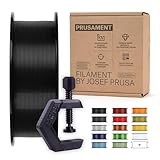
| Prusa Research Prusament PETG (Jet Black, 1.75 mm, 1 kg) | Functional parts, brackets, and larger prints that need more toughness than PLA. | The part needs heat resistance above about 68 °C (TDS HDT at 0.45 and 1.8 MPa), or you want a matte finish that hides layer lines. | View on Amazon (opens Amazon in a new tab) |
| Polymaker PETG (Black, 1.75 mm, 1 kg (new formula)) | Functional brackets and fixtures, indoors or in shade, that need more toughness than PLA. | You can't keep filament dry, or the part needs heat resistance well above 65 °C (TDS HDT at 1.8 MPa). | View on Amazon (opens Amazon in a new tab) |

How we compared them
This is a research-based comparison. Every figure below comes from the makers' own data sheets, product pages, knowledge base, wiki, and blog, listed in the sources. We haven't tested either filament, so nothing here is a measured result of ours. Where a maker describes its own product, such as Prusa's "low shrinking and warping" or Polymaker's "excellent layer adhesion," we label it as the maker's claim.
We only put numbers side by side where both makers publish the same kind of value under the same conditions. Print settings line up as each maker's guidance. Most test figures don't qualify. The two makers printed their test bars with different settings, Prusa reports tensile yield strength where Polymaker reports tensile strength, and neither data sheet says how the specimens behind its heat figures were made, so we list each maker's test figures separately.
Side-by-side specs
| Prusament PETG | Polymaker PETG | |
|---|---|---|
| Variant | Jet Black, 1.75 mm, 1 kg | Black (PB05001, new formula), 1.75 mm, 1 kg |
| Nozzle temperature | 250 ± 10 °C (TDS, material and store pages) | 240–260 °C (TDS and product page) |
| Bed temperature | 80 ± 10 °C (TDS, material and store pages) | 60–70 °C (TDS and product page) |
| Build surface | Satin, powder-coated, or smooth PEI sheet, with a glue stick on smooth PEI (TDS); textured, satin, or PP sheet recommended (store page) | PC and textured PEI (TDS); glue stick as a release layer on smooth PEI or glass (product page) |
| Enclosure | "Enclosure not required" (material page) | Closure chamber "Not Needed" (TDS) |
| Part cooling fan | 50% (TDS) | 20–60% (TDS) |
| Maker's speed figure | Up to 200 mm/s (TDS) | Up to 300 mm/s on a 0.4 mm nozzle (TDS); over 500 mm/s with high-flow nozzles (product page) |
| Nozzle | "0.4 mm brass nozzle" recommended (store page); abrasivity "None" (material page) | Settings based on a 0.4 mm nozzle (TDS) |
| Drying | 55 °C for 6 h (knowledge base) | 60 °C for 6 h (TDS); the product page also shows 65 °C for 4 h (see below) |
| Diameter tolerance | ±0.02 mm (TDS and store page) | Not stated on the product page or TDS |
| Density, ISO 1183 | 1.27 g/cm³ (TDS) | 1.30 g/cm³ at 23 °C (TDS) |
| Spool | From October 2025, recycled polycarbonate with a plastic core and an NFC tag (Prusa blog); dimensions not published | Cardboard, 200 ± 1 mm diameter, 65.6 ± 2 mm wide, 55 ± 1 mm hole (Polymaker FAQ) |
Temperatures, bed, and cooling
The nozzle settings overlap almost completely. Prusa's 250 ± 10 °C works out to 240–260 °C, the same window Polymaker gives. The bed is the real difference. Prusa's 80 ± 10 °C, or 70–90 °C, only meets Polymaker's 60–70 °C at 70 °C. If your printer's PETG profile was written for one of these, expect to change the bed setting before switching to the other.
Prusa's knowledge base article on PETG gives lower figures: 230 °C for the first layer and 240 °C after that, with the bed at 85 °C and then 90 °C. That article covers PETG in general rather than Prusament specifically, so we've used the Prusament data sheet in the table.
Both makers want some cooling, with a trade-off. Prusa's data sheet sets the fan at 50%, and its material page says "If you need the strongest possible print, print with no fan," recommending the first few layers without the fan "and half fan power on after that." Polymaker's range is 20–60%, and the FAQ on its product page says to run at least 20% at a 30-second layer time and up to 60% at a 10-second layer time. For weak layer bonding, Polymaker suggests less cooling within that range, a slightly hotter nozzle, and slower printing.
Neither maker calls for an enclosure. Prusa's material page says "Enclosure not required," and that PETG "rarely lifts from the bed and warps" even on big objects. Polymaker's data sheet lists the closure chamber as "Not Needed," and its printing tips add that on an enclosed printer, closing the enclosure "may also help improve layer adhesion."
Build plate: Prusa's smooth PEI warning
PETG sticks hard to PEI, and both makers say so. This is the setup detail most likely to cost you a sheet.
- Prusament PETG. The data sheet lists satin, powder-coated, and smooth PEI sheets, with a footnote that smooth PEI is used "with a glue stick." The store page says "Use a glue stick when printing on smooth PEI sheet" and recommends the textured, satin, or PP sheet. Prusa's PETG knowledge base article goes further: "Do not print on the smooth PEI sheet as the adhesion may be too strong!" It says printing on smooth PEI "might damage the sheet," and that if you use it anyway, you should apply a glue stick first. The material page lists "Strong adhesion to the bed - be careful when you're removing the print" among the cons. It also says isopropyl alcohol isn't recommended for cleaning before PETG "because the adhesion may be too strong," and suggests window cleaner instead.
- Polymaker PETG. The data sheet lists PC and textured PEI. The product page says textured PEI gives the best results, and on smooth PEI or glass you should "apply a thin layer of glue stick as a release layer to prevent the print from bonding too strongly." The FAQ on its product page says that on textured PEI you should let the print and sheet cool to room temperature before removing the part.
Whichever spool you buy, glue on smooth PEI is the one point both makers agree on. Our PEI sheet damage guide covers what happens when PETG bonds too hard.
Speed: different claims, not a measured race
Polymaker calls its PETG a "high-flow formulation." Here is each maker's speed figure:
| Source | What it says |
|---|---|
| Polymaker data sheet (settings based on a 0.4 mm nozzle) and product page print settings | Up to 300 mm/s |
| Polymaker product page | "over 500 mm/s with high-flow nozzles" |
| FAQ on Polymaker's product page | "up to 500mm/s or greater" with a high-flow nozzle |
| Prusa data sheet | "up to 200" mm/s |
| Prusa material page | Print speed "Fast," without a number |
Prusa's 200 mm/s is also the speed it used to print its own test bars.
Neither maker defines its figure the same way, as a volumetric flow or a tested part, so read these as each maker's ceiling, not as a measured comparison. In practice, your printer's PETG profile and hotend set the real limit.
Heat and strength figures: listed separately
Both makers test heat deflection to ISO 75 at the same two loads, but neither data sheet says how its heat-test specimens were made. Prusa's printed-specimen footnote sits under its mechanical table, not under the "Typical material properties" table that holds the heat figures. Polymaker draws only its tensile, bending, and impact bars. So the heat figures sit below in each maker's list rather than in a head-to-head table.
The mechanical figures differ in kind and in setup. Prusa printed its bars on an Original Prusa i3 MK3 with Slic3r Prusa Edition 1.40.0, at 0.20 mm layers, with no solid top or bottom layers, two perimeters, 100% rectilinear infill, 200 mm/s, a 250 °C nozzle, and an 80 °C bed. Polymaker printed at 240 °C on an 80 °C bed at ambient temperature, with 100% infill, two shells, three top and bottom layers, and the fan off, and doesn't state a speed. Prusa reports tensile yield strength and modulus in GPa. Polymaker reports tensile strength and modulus in MPa.
Prusament PETG (TDS v1.1)
- Heat deflection temperature: 68 °C at 0.45 MPa and 68 °C at 1.80 MPa (ISO 75)
- Density: 1.27 g/cm³ (ISO 1183)
- Moisture absorption: 0.07% in 24 hours and 0.10% in 7 days, at 24 °C and 22% humidity (Prusa Polymers' own method)
- Tensile yield strength of the filament itself: 46 ± 1 MPa (ISO 527)
- Interlayer adhesion: 18 ± 4 MPa (Prusa Polymers' own method)
- Hardness: Shore D 74 (Prusa Polymers' own method)
- Printed specimens, horizontal / "Vertical xz": tensile yield strength 47 ± 2 / 50 ± 1 MPa, tensile modulus 1.5 ± 0.1 / 1.6 ± 0.1 GPa, elongation at yield 5.1 ± 0.1 / 5.1 ± 0.1% (ISO 527-1)
- Flexural strength 66 ± 2 / 70 ± 1 MPa, flexural modulus 1.7 ± 0.1 / 1.6 ± 0.1 GPa, deflection at flexural strength 9.0 ± 0.1 / 9.3 ± 0.2 mm (ISO 178)
- Charpy impact, edgewise, 4 J pendulum: unnotched "NB" (no break) in both directions, notched 6 ± 1 / 3 ± 1 kJ/m² (ISO 179-1)
Prusa doesn't say whether its "Vertical xz" column is the same as a Z-direction (between-layers) test, and it lists interlayer adhesion as a separate figure, so don't read the vertical column as layer strength.
Polymaker PETG (TDS V3.0)
- Heat deflection temperature: 69 °C at 0.45 MPa, 65 °C at 1.8 MPa (ISO 75)
- Vicat softening temperature: 75 °C (ISO 306, GB/T 1633)
- Glass transition: 71.24 °C (DSC, 10 °C/min)
- Density: 1.30 g/cm³ at 23 °C (ISO 1183, GB/T 1033)
- Melt index: 16.3 g/10 min at 230 °C and 2.16 kg (no standard named)
- Maximum water absorption: 0.51%, at 70% RH and 23 °C
- Tensile strength: 47.96 ± 4.88 MPa X-Y, 45.71 ± 1.76 MPa Z (ISO 527, GB/T 1040)
- Young's modulus: 2311.11 ± 92.41 MPa X-Y, 2202.91 ± 52.34 MPa Z (ISO 527, GB/T 1040)
- Elongation at break: 9.33 ± 6.57% X-Y, 3.54 ± 2.35% Z (ISO 527, GB/T 1040)
- Bending strength: 80.08 ± 3.53 MPa X-Y, 57.65 ± 5.63 MPa Z (ISO 178, GB/T 9341)
- Bending modulus: 2277.34 ± 198.09 MPa X-Y, 1958.74 ± 126.39 MPa Z (ISO 178, GB/T 9341)
- Charpy impact, unnotched: 20.24 ± 3.95 kJ/m² X-Y, 15.74 ± 3.91 kJ/m² Z; notched: 4.95 ± 0.55 kJ/m² X-Y (ISO 179, GB/T 1043)
Polymaker's product page gives "approximately 70 °C HDT," which is higher than the 65 °C at 1.8 MPa in its own data sheet, so use the data sheet figure with its load. Prusa's material page lists "Temperature resistance 68 °C," matching its data sheet.
Two things hold whatever the caveats. Both PETGs sit in the mid-60s to about 70 °C for heat deflection, so neither suits parts near engines, heaters, or a hot car dashboard. And the gaps of a few degrees or a few MPa between them come from different test setups, so they don't show which spool is stronger or more heat resistant. Our parts deforming in heat guide covers what to try when PETG isn't enough.
Drying and storage
Both makers expect PETG to need drying at some point, and their settings are close.
- Prusament PETG. The store page lists "Possibility of stringing (may require occasional drying)" and says "Drying may improve the print quality, especially when stored in wet conditions." The material page lists "Low water absorption" as a pro. Prusa's drying article gives 55 °C for 6 hours for "PETG (all versions)," and warns not to exceed its temperatures "or the filament will soften and stick together," and to keep to the times "to prevent overdrying."
- Polymaker PETG. The data sheet and print settings give 60 °C for 6 hours, the print settings adding "Only if the material has absorbed moisture." The printing tips repeat 60 °C for 6 hours and suggest a longer cycle after long exposure in hot, humid conditions. The product page's Technical Specifications panel shows 65 °C for 4 hours instead. We list the data sheet value. Polymaker calls the material "very hygroscopic," says it ships pre-dried in resealable vacuum barrier bags, and "highly" recommends printing and storing from a PolyBox or PolyDryer box.
Check the Prusament spool before you heat it. Prusa says the black spool used since October 2025 "resists drying temperatures as high as 90 °C." Older black spools have plastic sides pressed onto a cardboard core, and Prusa says they "can be heated up safely up to 45 ºC" unless you add a screw with a thread of at least 65 mm to hold the sides together. That's below Prusa's 55 °C PETG setting, and Prusa says "a significant number of old spools" are still on the market. Polymaker doesn't publish a temperature rating for its cardboard spool. Check your dryer's documentation too. Our filament dryer vs dry box guide and filament storage guide cover the options.
Spools, refills, and multi-material systems
- Prusament PETG. Prusa says that starting in October 2025, all Prusament filaments ship on a redesigned spool made "from recycled polycarbonate" with a plastic core and an OpenPrintTag NFC tag that the Prusa mobile app can read. Its blog says the new spool is "3 mm slimmer" for "compatibility with a wide range of multi-color and multi-material printing systems," without naming one, and Prusa doesn't publish the spool's dimensions. The store page says every spool comes with "the actual measured data from manufacturing: diameter readings along the entire length, weight, and ovality." The blog says new refills are 900 g, wound without a paper core, and that old refills don't fit the new spools.
- Polymaker PETG. Polymaker moved all its filaments to recycled cardboard spools in 2021, with 4 mm pressed cardboard faces. Its wiki FAQ lists the 1 kg spool at 200 ± 1 mm across, 65.6 ± 2 mm wide, with a 55 ± 1 mm hole, and says it offers refills for select Panchroma PLA spools, "with more options coming." The product page says the PETG "works seamlessly with AMS and multi-material systems," and the FAQ on that page answers the AMS question with "Yes! All Polymaker spools now have hardened edges that roll great in the AMS." Its wiki FAQ says it redesigned the spool edges so all its products "will now spin great in the AMS."
Bambu Lab's AMS notes list a supported spool range of 50–68 mm wide and 197–202 mm across, "highly recommend" plastic spools that fit correctly, and "strongly advise" a spool adapter for cardboard spools. Neither Prusa nor Bambu documents Prusament on an AMS, so we make no fit claim for it. Our AMS filament compatibility guide covers spool sizes and adapters.
What each maker says it's for
- Prusament PETG. Prusa calls PETG "the easiest technical material to print with" and lists high strength and durability, low shrinking and warping, and easier sanding than PLA. Its cons include possible stringing, poor bridging, a glossy surface that "highlights imperfections," supports that are harder to remove, and being "Prone to scratches (more than PLA)." Prusa suggests it for mechanical parts, holders, clamps, and waterproof prints, and says it uses PETG for parts of its own printers. Its store page lists supported print profiles for "All Prusa FDM 3D printers."
- Polymaker PETG. Polymaker describes a "cost-effective, high-flow filament" for prototypes and end-use parts, and says it is "less brittle and more impact-resistant than PLA." Its examples include gears, brackets, fixtures, outdoor tools, sports accessories, and cosplay props, and it says the material is "Compatible with most FDM printers."

Prusa Research Prusament PETG (Jet Black, 1.75 mm, 1 kg)
- Best for
- Functional parts, brackets, and larger prints that need more toughness than PLA.
- Skip this if
- The part needs heat resistance above about 68 °C (TDS HDT at 0.45 and 1.8 MPa), or you want a matte finish that hides layer lines.
Specs, strengths, and limitations
- Material
- PETG
- Diameter
- 1.75 mm
- Net filament
- 1000 g (filament only, not packaged weight)
- Format
- plastic spool
- Maker's nozzle range
- 240–260 °C
- Manufacturer states high strength and durability with low shrinking and warping.
- Manufacturer states diameter precision of ±0.02 mm and publishes measured data for every spool.
- Manufacturer states it is easier to sand than PLA.
- Prusa lists possible stringing that may require occasional drying, and poor bridging.
- Strong bed adhesion: Prusa warns to take care removing prints, recommends textured, satin or PP sheets, and says to avoid smooth PEI (glue stick if used).
- Heat resistance tops out around 68 °C: the TDS gives HDT 68 °C at both 0.45 and 1.8 MPa.

Polymaker PETG (Black, 1.75 mm, 1 kg (new formula))
- Best for
- Functional brackets and fixtures, indoors or in shade, that need more toughness than PLA.
- Skip this if
- You can't keep filament dry, or the part needs heat resistance well above 65 °C (TDS HDT at 1.8 MPa).
Specs, strengths, and limitations
- Material
- PETG (high-flow)
- Diameter
- 1.75 mm
- Net filament
- 1000 g (filament only, not packaged weight)
- Format
- cardboard spool
- Maker's nozzle range
- 240–260 °C
- Manufacturer states it is less brittle and more impact-resistant than PLA.
- Manufacturer states it prints without an enclosure and works with AMS and multi-material systems.
- Manufacturer states a high-flow formulation for speeds up to 300 mm/s with a 0.4 mm nozzle.
- Moisture-sensitive: the TDS recommends drying at 60 °C for 6 h and printing from a dry box.
- Heat resistance is limited: the TDS lists HDT 65 °C at 1.8 MPa (69 °C at 0.45 MPa).
- Cardboard spool: Polymaker says its spools have hardened edges that work in the AMS, but Bambu Lab's general AMS guidance recommends an adapter or ring for cardboard spools. Check your unit.
Verdict: which should you buy?
These are both standard PETGs with near-identical nozzle windows, no enclosure requirement, and heat deflection in the same band. The choice comes down to your printer. On a Prusa, Prusament is the documented fit: Prusa publishes the profiles, the sheet guidance, and, on spools made from October 2025, a spool rated above its own PETG drying setting. Polymaker PETG makes more sense when speed matters or your bed runs cooler, since its maker documents both. If you're on a Prusa and print on smooth PEI, either spool needs glue.
Choose Prusament PETG if…
- You print on a Prusa machine and want Prusa's own profiles and sheet advice, and you'll use a textured or satin sheet, or glue on smooth PEI.
- You want a stated ±0.02 mm diameter tolerance and measured data for your spool.
- You want a plastic spool rated for drying, and you can check whether you've received the new spool or an older one.
Choose Polymaker PETG if…
- You want a PETG its maker sells as high-flow, with up to 300 mm/s on a standard 0.4 mm nozzle.
- Your bed tops out around 70 °C, or your printer's PETG profile runs a cooler bed.
- You're fine with a cardboard spool, and you'll check its fit in your feeder or add an adapter if your multi-material system's maker recommends one.
Safety and limits
How this page was checked
Every temperature, speed, drying setting, spool detail, and test figure above comes from the manufacturer documents in the sources section, retrieved on 2026-10-14. We haven't printed with either filament for this page, so nothing here is a measured result of ours. Prusa's data sheet columns don't extract in line with their row labels in every mode, and neither do Polymaker's impact rows, so we matched each value to its row and its test method and checked them against a second extraction and, for Polymaker, its product page. Prusa's own pages differ on temperatures and on the smooth PEI sheet, as described above. We've used the data sheet for settings and given both sheet warnings. Prusa's drying article rates the new spool to 90 °C, while its blog says the spool is reliable "up to 100 °C," so we've used the lower figure. Polymaker's product page disagrees with its data sheet on drying and heat deflection, and we've said which figures we followed. Values vary by color and revision, and older Prusament stock may still arrive on the old spool, so check the current data sheet and the spool you receive. Read more in our editorial standards and affiliate disclosure.
PETG: what to check before you buy a spool ↗Sources
- Prusament PETG Jet Black 1kg, Prusa Research
- Prusament PETG material page, Prusa Polymers
- Prusament PETG Technical Datasheet v1.1, Prusa Polymers
- PETG (Prusa Knowledge Base), Prusa Research
- Drying filament (Prusa Knowledge Base), Prusa Research
- The OpenPrintTag is here: a new NFC tag standard shipped with a redesigned Prusament spool, Prusa Research
- Polymaker PETG Technical Data Sheet V3.0, Polymaker
- Polymaker PETG product page, Polymaker
- Polymaker FAQ (Spool Questions), Polymaker
- Polymaker transitions all filaments onto 100% recycled cardboard spools, Polymaker
- Notes for AMS, Bambu Lab
This page is research-based: we have not tested the products or methods ourselves. It draws on the manufacturer documentation and sources listed. Exact settings and fit always defer to your printer and filament makers.
Keep reading

Best PETG Filament (2026): Functional-Part Spools by Printer
The best PETG filament for functional parts: standard and high-speed 1.75 mm spools matched on maker data for temperatures, drying, spools and build plates.
Bambu Lab PETG Basic vs Polymaker PETG
Bambu Lab PETG Basic vs Polymaker PETG on maker data: speed, temperatures, drying, spools, AMS fit. Pick Bambu for an AMS, Polymaker for high-flow printing.
Prusament PLA vs Polymaker PolyLite PLA
Prusament PLA and Polymaker PolyLite PLA compared on maker data: temperatures, speed, tolerance, spools, AMS notes, drying, and test figures.