ELEGOO PLA-CF vs Polymaker PolyLite PLA-CF
ELEGOO PLA-CF vs PolyLite PLA-CF on maker data: nozzles, temperatures, drying, AMS rules, heat. Pick ELEGOO for glue-free PEI, Polymaker for a data sheet.
On this page (12 sections)
Pick ELEGOO PLA-CF if your hardened nozzle runs comfortably at 210–240 °C, you already dry and store filament sealed, and you want a maker that says glue isn't required. Pick Polymaker PolyLite PLA-CF if you want stated fiber content, a data sheet with named test methods, and a lower published nozzle window. Both are abrasive carbon-fiber PLA, and both makers say you need a hardened nozzle, so check your nozzle before anything else. ELEGOO says drying is required before use and publishes its figures without test methods. Polymaker says to dry only if the spool has absorbed moisture, and states 8% carbon fiber by weight. Neither is a Bambu filament, and Bambu advises against third-party fiber-filled filament in its AMS, so plan on the external spool holder there.
Who this comparison is for
This page is for anyone choosing between these two specific spools: ELEGOO PLA-CF in Carbon Fiber Black and Polymaker PolyLite PLA-CF in Black (SKU PA10001), both 1 kg. Polymaker's listing is 1.75 mm. ELEGOO's page text doesn't state a diameter, though its product address and images say 1.75 mm. If you haven't printed abrasive filament before, read our abrasive filament nozzle guide first. For more options, see the carbon fiber filament shortlist, and if you're weighing a carbon-fiber PETG instead, see ELEGOO PETG-CF vs Siraya Tech PETG-CF Pro HF.
| Product | Best for | Skip if | Link |
|---|---|---|---|
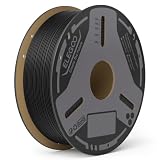
| ELEGOO PLA-CF (Carbon Fiber Black, 1.75 mm, 1 kg) | Stiff, textured-finish PLA parts and assembly prototypes on an open or enclosed printer fitted with a hardened steel nozzle. | Your printer only has a brass nozzle, or the part will sit somewhere warm such as a car interior. | View on Amazon (opens Amazon in a new tab) |
| Polymaker PolyLite PLA-CF (Black, 1.75 mm, 1 kg) | Stiff, matte-finish PLA parts and prototypes on a printer fitted with a hardened nozzle. | Your printer only has a brass nozzle, or the part will see heat. | View on Amazon (opens Amazon in a new tab) |

How we compared them
This is a research-based comparison. Every figure below comes from the makers' own product pages and data sheet, plus Bambu Lab's AMS documentation, listed in the sources. We haven't tested either filament, so nothing here is a measured result of ours. Where a maker states something about its own product, such as hiding layer lines or printing without clogs, we label it as the maker's claim.
We only put numbers side by side where both makers publish the same kind of value. ELEGOO doesn't name test methods or specimen settings for its strength and heat figures, so we don't put those in a head-to-head table.
Side-by-side specs
| ELEGOO PLA-CF | Polymaker PolyLite PLA-CF | |
|---|---|---|
| Variant | Carbon Fiber Black, 1 kg | Black (PA10001), 1.75 mm, 1 kg |
| Fiber content | Not published | 8% chopped carbon fiber by weight |
| Nozzle requirement | "Hardened Steel Nozzle, ≥ 0.4 mm" | "0.4mm+ hardened nozzle required" (product page) |
| Nozzle temperature | 210–240 °C | 190–230 °C (TDS; see below for a conflicting block) |
| Bed temperature | 35–65 °C, depending on printer and plate | 25–60 °C (TDS) |
| Build surface | Textured or smooth PEI or other plates; glue not required | PC and textured PEI, glue when needed (TDS) |
| Chamber or enclosure | Enclosed printing "Not Required"; chamber 20–45 °C | Enclosure "No Needed" (TDS) |
| Maker's speed figure | Below 300 mm/s | 50–300 mm/s (TDS); the product page also gives 70 and 25–60 mm/s |
| Drying | Required: 50 ± 5 °C for 8 h | 55 °C for 6 h, only if the material has absorbed moisture |
| Storage | Print and store at or below 20% RH, sealed with desiccant | Not stated on the pages we checked |
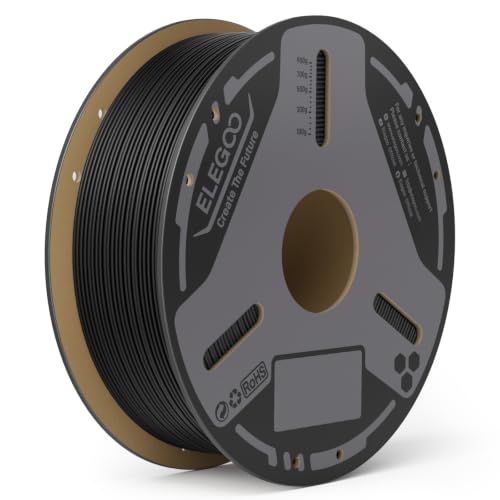
| Spool | Material not stated in the specs; empty spool weighs 154 ± 10 g, and ELEGOO's Filament Ring note refers to a "paper tray" | Cardboard. The product page doesn't list dimensions, but Polymaker's FAQ gives its 1 kg cardboard spool as a 55 ± 1 mm hole, 200 ± 1 mm diameter, 65.6 ± 2 mm width and 140 ± 7 g. The FAQ doesn't say which spool PolyLite PLA-CF uses, and its answer on Fiberon spools says carbon fiber filament is wound on a larger core |
| Published data format | Specification table on the product page, no methods | Data sheet (V5.4) with ISO and GB/T methods |
The nozzle comes first
Carbon fiber wears brass nozzles, and both makers say so plainly. ELEGOO's specification table recommends a "Hardened Steel Nozzle, ≥ 0.4 mm." Polymaker's product page says the material "is abrasive so you will need a hardened nozzle, but it will print on any stock printer aside from that," and its specification panel says "0.4mm+ hardened nozzle required." So both rule out a 0.2 mm nozzle and a brass one.
If you print on a Bambu Lab printer, Bambu's filament guide adds its own advice for fiber-filled filament. It says to always use a hardened steel nozzle, never a 0.2 mm nozzle, and never stainless steel or brass. For fiber filament other than its own specially designed grades, it names a 0.6 mm hardened steel nozzle as the first choice and a 0.4 mm one as the second, with a layer height of 0.15–0.3 mm and a maximum speed of about 100 mm/s on the 0.4 mm nozzle. That speed is far below ELEGOO's figure of below 300 mm/s and Polymaker's data sheet range of 50–300 mm/s, so treat those top speeds with caution on a small nozzle. Our replacement nozzle guide covers choosing one.
Temperatures and speed
ELEGOO's nozzle window, 210–240 °C, runs higher than Polymaker's data sheet window of 190–230 °C, and the two overlap at 210–230 °C. Start in the middle of your spool's range and adjust in small steps.
Polymaker's own pages disagree with each other here:
| Polymaker source | What it says |
|---|---|
| Data sheet | 190–230 °C nozzle, 25–60 °C bed, 50–300 mm/s |
| Product page printing tips | 50–300 mm/s, repeating the data sheet |
| Product page specification panel | The same temperatures as the data sheet, but a maximum speed of 70 mm/s |
| Separate Print Settings block on the same page | 210–230 °C nozzle, 30–70 °C bed, 25–60 mm/s |
We list the data sheet values, but the spread shows how loosely speed figures are defined. ELEGOO gives one figure, below 300 mm/s, and doesn't say what nozzle or layer height it assumes.
Both say no enclosure is needed. ELEGOO also lists a 20–45 °C chamber range for enclosed printers and says no glue is needed. Polymaker suggests glue on PC or textured PEI only when needed.
Strength and heat figures: not a head-to-head
Polymaker publishes a full data sheet. It uses ISO 527 for tensile, ISO 178 for bending, ISO 179 for impact, and ISO 75 and ISO 306 for heat, on specimens printed at 230 °C on a 50 °C bed with 100% infill, the fan on, and no stated print speed or annealing. ELEGOO's table gives tensile, bending, impact, and heat figures, labeled X-Y and Z, but names no test method, specimen type, or print settings. Without that, we don't set their numbers against each other in a table.
What we can say:
- Heat. Polymaker gives a heat deflection temperature of 50 °C at 1.8 MPa and 54 °C at 0.45 MPa (ISO 75). ELEGOO gives 56 °C at 0.45 MPa and no 1.8 MPa figure. Both list a Vicat softening point of 64 °C. Whatever the method, both sit in the 50s °C at 0.45 MPa, so neither suits a hot car, a sunny windowsill, or parts near heat.
- Layer bonding. Both publish separate X-Y and Z figures, and both show the Z direction, between layers, as clearly weaker. Polymaker's data sheet gives 31.2 ± 0.7 MPa X-Y and 15.1 ± 0.7 MPa Z tensile strength. ELEGOO's table gives 39 ± 3 MPa X-Y and 23 ± 4 MPa Z. With no method behind ELEGOO's numbers, the gap between the two makers' figures isn't a measured difference. Orient parts so the main load runs along the layers.
- Claims. ELEGOO says carbon fiber gives "superior strength and rigidity" and that the filament is "as easy to print as regular PLA without clogs or bubbles." Polymaker says 8% carbon fiber gives "exceptional rigidity and strength." Neither claim is a published test against the other filament.
Polymaker's product page also lists a glass transition of 52.83 °C and a melting point of 155.43 °C, while its data sheet gives 62 °C and 162 °C. We use the data sheet.
Bambu's AMS and third-party carbon fiber
If you own a Bambu Lab printer with an AMS, this matters more than any spec. Bambu's documents point the same way:
| Bambu source | What it says |
|---|---|
| Notes for AMS | Avoid "third-party fiber reinforcement materials (PA-CF/GF, PET-CF/GF, PLA-CF /GF, etc.)" because they "may wear AMS PTFE tubes" and cause "brittle breaks, and other problems." Bambu says its own PLA-CF and other fiber filaments are "specially optimized" to avoid this. |
| Filament guide | Lists "certain brands of" PLA-CF/GF as "too hard and rough," saying they "can easily wear down the internal feed channel." Its compatibility entry for PLA-CF names only Bambu PLA-CF. |
| AMS lite store page | Lists "other brand filament that contains carbon fiber or glass fiber" as unsupported. |
Neither filament here is Bambu's, so Bambu's guidance points both to the external spool holder. The makers' own statements don't change that:
- Polymaker answers "Will the spools work in an AMS?" with "Yes! We have redesigned the edges of our spools so all Polymaker products will now spin great in the AMS," then adds "you will need to be careful when using any abrasive materials in the AMS." That answer is about the cardboard spool, not the abrasive filament.
- ELEGOO offers a printable "Filament Ring" for its spool that it says helps it "adapt to AMS (because AMS will rub the bottom paper tray, causing the paper tray to easily delaminate)," and suggests printing the ring in PETG. That too is about the spool, and ELEGOO doesn't say this filament is AMS compatible.
Bambu also recommends plastic spools that fit correctly, and "strongly" advises an adapter for cardboard spools. Our AMS filament compatibility guide covers Bambu's rules and the external spool route in full.
Drying and storage
The makers frame drying differently. ELEGOO's table marks drying before use as "Required," at 50 ± 5 °C for 8 hours, and says to print and store at or below 20% RH, sealed with desiccant. That's stricter than most makers' advice for PLA, so plan for a dryer or dry box. Polymaker gives 55 °C for 6 hours, and its product page says to dry only if the material has absorbed moisture. Neither maker publishes a temperature rating for its spool, so check your dryer's documentation before heating either one. Our filament dryer vs dry box guide and filament storage guide cover the options.
What each maker says it's for
- ELEGOO PLA-CF. ELEGOO pitches it for structural and engineering parts, high-precision assemblies, and display pieces, saying carbon fiber "minimizes warping and shrinkage," with a texture that "effectively hides layer lines," and the option to combine it with regular PLA in multicolor prints. It says it is compatible with "most FDM 3D printers on the market."
- Polymaker PolyLite PLA-CF. Polymaker describes "a high-quality PLA reinforced with carbon fiber designed for functional applications and smooth and matte surface finish," with "virtually invisible layer lines" and low shrinkage, printable "using standard PLA settings."
ELEGOO PLA-CF (Carbon Fiber Black, 1.75 mm, 1 kg)
- Best for
- Stiff, textured-finish PLA parts and assembly prototypes on an open or enclosed printer fitted with a hardened steel nozzle.
- Skip this if
- Your printer only has a brass nozzle, or the part will sit somewhere warm such as a car interior.
Specs, strengths, and limitations
- Material
- PLA (carbon-fiber reinforced)
- Diameter
- 1.75 mm
- Net filament
- 1000 g (filament only, not packaged weight)
- Format
- other
- Maker's nozzle range
- 210–240 °C
- Nozzle
- Abrasive: the maker recommends a wear-resistant nozzle
- Manufacturer states carbon fiber reinforcement gives 'higher strength and stiffness'.
- Manufacturer states minimal shrinkage and warping for dimensionally accurate assembly parts.
- Manufacturer states a textured finish that hides layer lines, and it prints at PLA temperatures (210–240 °C) with no enclosure.
- Abrasive: ELEGOO recommends a hardened steel nozzle of 0.4 mm or larger.
- Low heat resistance: the product page lists a heat deflection temperature of 56 °C (0.45 MPa).
- Drying is listed as required (50 °C for 8 h), and no TDS PDF or fiber percentage is published.

Polymaker PolyLite PLA-CF (Black, 1.75 mm, 1 kg)
- Best for
- Stiff, matte-finish PLA parts and prototypes on a printer fitted with a hardened nozzle.
- Skip this if
- Your printer only has a brass nozzle, or the part will see heat.
Specs, strengths, and limitations
- Material
- PLA (carbon-fiber filled (8 wt% chopped carbon fiber))
- Diameter
- 1.75 mm
- Net filament
- 1000 g (filament only, not packaged weight)
- Format
- cardboard spool
- Maker's nozzle range
- 190–230 °C
- Nozzle
- Abrasive: the maker recommends a wear-resistant nozzle
- Manufacturer states 8% chopped carbon fiber gives exceptional rigidity and strength.
- Manufacturer states a matte black finish with virtually invisible layer lines and low shrinkage.
- Manufacturer states it prints with standard PLA settings; the TDS lists no enclosure needed.
- Abrasive: Polymaker strongly recommends a hardened nozzle.
- Not suited to heat: the TDS lists a heat deflection temperature of 50 °C (1.8 MPa).
- Cardboard spool: Bambu Lab strongly advises a spool adapter or adapter ring for cardboard spools in the AMS.
- The Amazon listing's bullet points describe plain PolyLite PLA, though its title and model number (PA10001) are the carbon-fiber version. Check that the title says Carbon Fiber PLA before you buy.
Verdict: which should you buy?
Choose ELEGOO PLA-CF if…
- Your hotend and hardened steel nozzle (0.4 mm or larger) run comfortably at 210–240 °C.
- You already dry and store filament sealed, since ELEGOO lists drying as required and storage at or below 20% RH.
- You print on a plain PEI plate and want a maker that says glue isn't required.
Choose Polymaker PolyLite PLA-CF if…
- You want a maker that states the fiber content (8% by weight) and publishes a data sheet with named test methods.
- You want a lower published nozzle window, 190–230 °C, and a 25–60 °C bed, on a printer with a hardened nozzle of 0.4 mm or larger.
- You prefer a cardboard spool and are happy to feed it from an external holder, or check its fit and add an adapter if your feeder's maker recommends one.
Safety and limits
How this page was checked
Every temperature, speed, drying setting, spool detail, nozzle requirement, AMS statement, and test figure above comes from the manufacturer documents in the sources section, retrieved on 2026-10-09. We haven't printed with either filament for this page, so nothing here is a measured result of ours. Values vary by color and revision, and makers do reformulate, so check the current page or data sheet for your spool. Read more in our editorial standards and affiliate disclosure.
Specialty materials: what to check before you buy a spool ↗Sources
- ELEGOO PLA-CF Filament 1.75mm 1kg (ELEGOO US Store), ELEGOO
- PolyLite PLA-CF Technical Data Sheet V5.4, Polymaker
- PolyLite PLA-CF product page, Polymaker
- Polymaker transitions all filaments onto 100% recycled cardboard spools, Polymaker
- Polymaker FAQ (Spool Questions), Polymaker
- Notes for AMS, Bambu Lab
- Filament guide: printer, nozzle, AMS, build plate and glue compatibility, Bambu Lab
- AMS lite (store page and tech specs), Bambu Lab
This page is research-based: we have not tested the products or methods ourselves. It draws on the manufacturer documentation and sources listed. Exact settings and fit always defer to your printer and filament makers.
Keep reading

Nozzles for Abrasive Filaments: Carbon Fiber, Glass Fiber, and Glow
Which filaments wear out nozzles, how brass, stainless, hardened, coated, and ruby-tipped nozzles differ, and how to find the right part for your exact hotend.

Which Filaments Work in Bambu's AMS and AMS lite
Bambu's own rules for the AMS and AMS lite: unsupported materials, TPU, damp or brittle filament, cardboard spools, spool sizes, and the external spool route.
How to Choose a Replacement Nozzle for Your Exact Hotend
Match a replacement nozzle to your exact printer, hotend revision, and filament: nozzle systems, diameters, wear-resistant materials, and a fit checklist.