Best Filament for the Creality K1, K1C and K1 Max (2026)
PLA, PETG, TPU, ABS, ASA and carbon-fiber spools that suit Creality's enclosed K1, K1C and K1 Max, with the nozzle check that comes first.
On this page (13 sections)
For a K1, K1C or K1 Max, start with Polymaker PolyLite PLA for everyday prints, Polymaker PETG for functional parts, and Polymaker PolyLite ABS or Polymaker ASA, the materials where the enclosure pays off. Choose Creality Hyper PLA RFID if you run the CFS upgrade kit. All three printers have a 300 °C hotend and a 100 °C heatbed, according to Creality's spec pages, and every spool here fits those limits. The main fit rule is the nozzle. On a K1C, Creality fits a nozzle with a hardened steel tip and sells the printer for carbon-fiber filament. On a K1 or K1 Max, Creality's own pages disagree on which nozzle is fitted, so check it before printing any carbon-fiber spool. Creality's TPU guide for the K1C and K1 Max says to open the top cover for TPU, and its K1 Max 2025 guide says to remove it for PLA when the room is above 30 °C.
Quick picks
| Need | Pick | Why |
|---|---|---|
| Everyday PLA | Polymaker PolyLite PLA | Full data sheet; feed its cardboard spool from the stock holder |
| PLA through the CFS | Creality Hyper PLA RFID | The RFID plastic spool Creality recommends for the CFS |
| PETG for functional parts | Polymaker PETG | Its 240–260 °C range sits well under the 300 °C hotend |
| Outdoor parts, enclosure closed | Polymaker ASA | Aimed at outdoor parts; its TDS lists a closed chamber as needed |
| Carbon fiber (K1C, or a confirmed hardened nozzle) | Polymaker PolyLite PLA-CF | Prints like PLA; Polymaker strongly recommends a hardened nozzle |
These are defaults by need, not a ranking.
Who this page is for
This page is for owners of a Creality K1, K1C or K1 Max who want to know which spools suit the printer before buying. All three take 1.75 mm filament, and every spool here is 1.75 mm. For nozzles and build plates that fit, see the K1, K1C and K1 Max printer pages.
| Product | Best for | Skip if | Link |
|---|---|---|---|
| Creality Hyper PLA RFID (Black, 1.75 mm, 1 kg, RFID plastic spool) | Creality CFS users, such as K2 Plus owners, who want PLA the CFS recognizes automatically. | You want a fully documented filament or don't use a Creality CFS. | View on Amazon (opens Amazon in a new tab) |
| Polymaker PolyLite PLA (Black, 1.75 mm, 1 kg) | Everyday PLA prints, prototypes, and display models where a documented, easy-printing PLA is wanted. | The part will sit in a hot car, near heat sources, or needs toughness beyond standard PLA. | View on Amazon (opens Amazon in a new tab) |
| ELEGOO Rapid PLA+ (Black, 1.75 mm, 1 kg) | Fast everyday PLA on high-speed printers; ELEGOO names its Neptune 4 series. | You print slowly anyway, or the part will see heat. | View on Amazon (opens Amazon in a new tab) |
| Creality Hyper PETG (Black, 1.75 mm, 1 kg) | Fast PETG prints on Creality K-series and other high-speed printers. | You want a fully documented filament or feed from a CFS/AMS without a spool adapter. | View on Amazon (opens Amazon in a new tab) |
| Polymaker PETG (Black, 1.75 mm, 1 kg (new formula)) | Functional brackets and fixtures, indoors or in shade, that need more toughness than PLA. | You can't keep filament dry, or the part needs heat resistance well above 65 °C (TDS HDT at 1.8 MPa). | View on Amazon (opens Amazon in a new tab) |
| ELEGOO Rapid PETG (Black, 1.75 mm, 1 kg) | Fast functional PETG prints on high-speed printers. | Your hotend can't hold 260–270 °C, or you can't dry filament before printing. | View on Amazon (opens Amazon in a new tab) |
| Polymaker PolyFlex TPU95 (Black, 1.75 mm, 0.75 kg) | Flexible covers, grips, bumpers, and seals on printers that handle 95A TPU. | You need a softer TPU than 95A, or fast print times, or your printer is set up as Bowden and you can't print very slowly (Polymaker highly recommends direct drive and says Bowden is possible only at very slow speeds). | View on Amazon (opens Amazon in a new tab) |
| ELEGOO TPU 95A (Black, 1.75 mm, 1 kg) | Outdoor and cold-weather flexible parts such as seals and gaskets. | You need documented support for multi-material feeding systems. | View on Amazon (opens Amazon in a new tab) |
| Polymaker PolyLite ABS (Black, 1.75 mm, 1 kg) | Heat-resistant functional parts, enclosures, and prototypes printed on an enclosed printer. | Your printer is open-frame or its bed can't reach 90 °C. | View on Amazon (opens Amazon in a new tab) |
| Polymaker ASA (Black, 1.75 mm, 1 kg) | Outdoor and sun-exposed functional parts printed on an enclosed machine. | Your printer is open-frame or can't reach a 95 °C bed and 260 °C nozzle. | View on Amazon (opens Amazon in a new tab) |
| OVERTURE ASA (Black, 1.75 mm, 1 kg) | Outdoor, sun-exposed functional parts printed on an enclosed printer. | Your printer is open-frame, you want fast printing (the TDS lists 30–50 mm/s), or you need a published heat deflection temperature. | View on Amazon (opens Amazon in a new tab) |
| Polymaker PolyLite PLA-CF (Black, 1.75 mm, 1 kg) | Stiff, matte-finish PLA parts and prototypes on a printer fitted with a hardened nozzle. | Your printer only has a brass nozzle, or the part will see heat. | View on Amazon (opens Amazon in a new tab) |
| ELEGOO PETG-CF (Carbon Fiber Black, 1.75 mm, 1 kg) | Stiff matte functional parts on a printer with a 0.4 mm or larger hardened steel nozzle. | Your printer only has a brass nozzle, or the part will see temperatures near the listed 74 °C (0.45 MPa) heat deflection temperature. | View on Amazon (opens Amazon in a new tab) |
| ELEGOO ASA-CF (Carbon Fiber Black, 1.75 mm, 1 kg) | Stiff outdoor and automotive parts printed on an enclosed printer with a hardened steel nozzle. | Your printer is open-frame or brass-nozzled, or it sits in an unventilated room. | View on Amazon (opens Amazon in a new tab) |


The table is grouped by material, not ranked. The last three are carbon-fiber filaments and need a wear-resistant nozzle.
What can the K1, K1C and K1 Max print, per Creality?
Temperatures. Creality's support spec pages list a 300 °C nozzle temperature and a 100 °C heatbed temperature for all three printers. Every spool on this page has a published nozzle range that tops out at or below 280 °C. Every published bed range tops out at or below 100 °C (Creality publishes none for Hyper PLA RFID). The ABS, ASA-CF and Polymaker ASA picks need a bed near the top of that limit.
Materials. Creality's current spec pages list these supported filaments:
- K1: "PLA, TPU95A, PA-CF, PLA-CF, PETG, ABS"
- K1C: "PLA, TPU95A, PA-CF, ASA, PLA-CF, PETG, ABS"
- K1 Max: "PLA, TPU95A, PC, PA-CF, PA, ASA, PLA-CF, PET-CF, PETG, PET, ABS"
The K1 list doesn't name ASA. Creality's K1 vs. K1 Max vs. K1C comparison does list "PA/ABS/ASA/PC" under strength filaments for all three printers. The same comparison lists wear-resistant filaments (PLA-CF, PA-CF, PET-CF) for the K1C only. That conflicts with the current K1 and K1 Max spec pages. The nozzle section below explains why.
Enclosure. The K1C product page describes "acrylic sides & lid with a glass door" forming a thermal enclosure. Creality's print settings page for the K1C recommends manually turning off the chamber fan "when printing ABS/ASA or engineering filaments." That's where the enclosure helps.
PLA and heat inside the box. The enclosure that helps ABS can work against PLA. The quick installation guide for the K1 Max 2025, a later version of the K1 Max, says: "When printing low-temperature filaments such as PLA and flexible filaments, remove the clear top cover if the room temperature exceeds 30°C." It also says to keep the cover closed for "non-PLA and non-flexible filaments" to avoid cracking. We didn't find the same note for the original K1, K1C or K1 Max, but the TPU guide below also has you open the cover. To prevent jams, Creality's clogging guides for the K1, K1C and K1 Max say not to turn off the enclosure fan, and to keep the bed temperature in check: "do not exceed 50°C for PLA, 70°C for PETG." Our PLA printing problems guide covers this kind of heat-related jam.
Creality's own starting points. Creality's K1 series parameter table (on its K1C settings page) lists Generic PLA at 230 °C / 45 °C bed, Generic PETG at 250 / 70, Generic TPU at 230 / 50, and Generic ABS and Generic ASA at 260 / 100. For third-party filament, Creality says to pick the generic profile and to follow the filament maker's recommendations.
Does your K1 have a hardened nozzle for carbon fiber?
Carbon-fiber filament is abrasive. It wears a soft nozzle out, so it needs a hardened steel or similarly wear-resistant nozzle. Our worn nozzle guide covers the signs of wear. Creality's pages say different things about which nozzle these printers have:
- K1C. The product page describes a "Tri-metal 'Unicorn' Nozzle" that is a "durable steel-tipped copper nozzle," and lists "300° Hotend + Hardened Steel Nozzle Tip." Creality sells the K1C for carbon-fiber printing, and its spec table lists PLA-CF, PA-CF and PET-CF.
- K1. The product page describes "a copper alloy nozzle," and Creality's comparison lists the K1 nozzle as "Copper Alloy." The current support spec page says "Hardened Steel."
- K1 Max. The product page describes "a hardened steel nozzle." Creality's comparison lists "Hardened Steel" too, but gives the K1 Max no wear-resistant filaments.
- Early units. Creality's wiki says "in the early production of K1 and K1 Max, some machines were shipped with separate hotend assembly." Later units use the integrated hotend, which Creality's store pages call the "integrated nozzle."
So for a K1 or K1 Max, don't assume the nozzle is hardened. Check what is fitted now. If it isn't wear-resistant, Creality's "Unicorn" Quick-Swap Nozzle Kit lists "K1 (with integrated nozzle)" and "K1 Max (with integrated nozzle)" among its compatible models, and the K1C without qualification. Our replacement nozzle shortlist covers the Unicorn nozzle and an E3D ObXidian option, with the exact versions each maker names. Our abrasive filament guide explains why this matters.
Multi-material: the K1 Series CFS Upgrade Kit
Creality sells a K1 Series CFS Upgrade Accessory Kit that connects these printers to its CFS multi-color system. Creality documents these limits:
- Compatible models: "K1/K1 Max/K1C/K1 SE (With Integrated Nozzle)." Creality says the kit "is not compatible with split-type nozzles" and that you'd need to buy an integrated nozzle hotend first. Its wiki shows how to tell the two apart, and says the kit excludes the K1C 2025 and K1 Max 2025.
- Build size shrinks. "While using CFS, the print size of K1, K1C and K1 SE changes to 220 × 215 × 250 mm, and the print size for K1 Max changes to 300 × 295 × 300 mm."
- Top cover. The PTFE tube "must be fed into the printer vertically, which prevents the top cover from fully closing." Creality's wiki has a page called "Upgrade Kit Modification for Printing ABS Filament" with downloadable cover-extension files for this.
- Spools. On its Hyper PLA page, Creality says to pick the RFID plastic spool version for the CFS, and that "filaments with paper spools are not recommended for use in CFS or other multi-color boxes." Most third-party spools here are cardboard, so feed them from the stock spool holder.
Without the kit, each printer prints one filament at a time from its own spool holder.
Everyday PLA
Creality Hyper PLA RFID (Black, 1 kg)
Hyper PLA RFID is Creality's high-speed PLA on a plastic spool with an RFID tag. Creality says the "CFS auto-recognizes RFID consumables," and lists 30–600 mm/s. Creality's product page gives no nozzle temperature, and the print temperature on the spool label in its product photo is too small to read reliably. Creality publishes no bed temperature or data sheet for it. Its K1 series table lists Hyper PLA at 220 °C and a 45 °C bed. It suits owners who use, or plan to add, the CFS upgrade kit.

Creality Hyper PLA RFID (Black, 1.75 mm, 1 kg, RFID plastic spool)
- Best for
- Creality CFS users, such as K2 Plus owners, who want PLA the CFS recognizes automatically.
- Skip this if
- You want a fully documented filament or don't use a Creality CFS.
Specs, strengths, and limitations
- Material
- PLA (high-speed)
- Diameter
- 1.75 mm
- Net filament
- 1000 g (filament only, not packaged weight)
- Format
- plastic spool
- Manufacturer states an RFID tag lets the Creality CFS recognize the filament and apply settings automatically.
- Manufacturer states printing speeds of 30–600 mm/s.
- Manufacturer states it is tougher than traditional PLA variants.
- Creality publishes no TDS or text spec table for this product, so heat resistance, bed temperature, and drying settings are undocumented.
- RFID benefits apply only to Creality's CFS system.
Skip it if you don't use a CFS and want a fully documented PLA, or the part will see heat.
Polymaker PolyLite PLA (Black, 1 kg)
PolyLite PLA is a fully documented alternative to Hyper PLA for a K1 without a CFS. The TDS (V5.4) lists a 190–230 °C nozzle, a 25–60 °C bed, and "No Needed" for a closed chamber. It ships on a cardboard spool, so use the stock spool holder rather than a CFS.

Polymaker PolyLite PLA (Black, 1.75 mm, 1 kg)
- Best for
- Everyday PLA prints, prototypes, and display models where a documented, easy-printing PLA is wanted.
- Skip this if
- The part will sit in a hot car, near heat sources, or needs toughness beyond standard PLA.
Specs, strengths, and limitations
- Material
- PLA
- Diameter
- 1.75 mm
- Net filament
- 1000 g (filament only, not packaged weight)
- Format
- cardboard spool
- Maker's nozzle range
- 190–230 °C
- Manufacturer states PolyLite PLA is designed for reliability and ease of printing.
- Manufacturer TDS lists no enclosure needed and a wide 190–230 °C nozzle window.
- Manufacturer publishes a full TDS with mechanical, thermal, and drying data.
- Not suited to parts exposed to heat: the TDS lists a heat deflection temperature of 58 °C (1.8 MPa).
- Cardboard spool: Polymaker says its spools have hardened edges that work in the AMS, but Bambu Lab's general AMS guidance recommends an adapter or ring for cardboard spools. Check your unit.
Skip it if you want RFID auto-settings in a CFS, or the part will see heat.
ELEGOO Rapid PLA+ (Black, 1 kg)
Rapid PLA+ is ELEGOO's fast PLA. ELEGOO lists a 200–230 °C nozzle, a 35–65 °C bed, under 600 mm/s, and enclosed printing "Not Required." That speed rating suits a printer Creality rates at up to 600 mm/s. It's on a cardboard spool.

ELEGOO Rapid PLA+ (Black, 1.75 mm, 1 kg)
- Best for
- Fast everyday PLA on high-speed printers; ELEGOO names its Neptune 4 series.
- Skip this if
- You print slowly anyway, or the part will see heat.
Specs, strengths, and limitations
- Material
- PLA (high-speed PLA+)
- Diameter
- 1.75 mm
- Net filament
- 1000 g (filament only, not packaged weight)
- Format
- cardboard spool
- Maker's nozzle range
- 200–230 °C
- Manufacturer states enhanced fluidity for printing speeds up to 600 mm/s.
- Manufacturer states high flexural modulus and elongation at break, making it resistant to brittleness and cracking.
- Manufacturer states dimensional accuracy of ±0.02 mm.
- Not suited to heat: the product page lists a heat deflection temperature of 57 °C (0.45 MPa).
- ELEGOO's own impact figure is lower than its standard PLA (50.4 vs 66.2 kJ/m² X-Y), so 'Plus' is about speed more than toughness.
- Cardboard spool may rub and delaminate in an AMS; ELEGOO offers a printable ring.
Skip it if you print slowly anyway, or the part will see heat.
PETG for functional parts
Creality Hyper PETG (Black, 1 kg)
Hyper PETG is Creality's fast PETG. The spool label in Creality's product photo lists 220–260 °C, a 60–80 °C bed and 30–600 mm/s, but Creality's materials buying guide says "up to 300mm/s." Creality publishes no data sheet, drying setting or heat-resistance figure. Creality doesn't state the spool material in text; its product images show a spool printed "Spool made from recycled material." On its Hyper PLA page, Creality says paper spools are "not recommended for use in CFS or other multi-color boxes," so check your spool before using a CFS.

Creality Hyper PETG (Black, 1.75 mm, 1 kg)
- Best for
- Fast PETG prints on Creality K-series and other high-speed printers.
- Skip this if
- You want a fully documented filament or feed from a CFS/AMS without a spool adapter.
Specs, strengths, and limitations
- Material
- PETG (high-speed)
- Diameter
- 1.75 mm
- Net filament
- 1000 g (filament only, not packaged weight)
- Format
- other
- Maker's nozzle range
- 220–260 °C
- Manufacturer states quick printing; the spool label lists 30–600 mm/s, while a store image and Creality's buying guide give 300 mm/s.
- Manufacturer states high toughness and impact resistance, and excellent chemical resistance.
- Manufacturer states it is waterproof and weather resistant.
- Creality publishes no TDS: heat resistance and drying settings are undocumented.
- Creality doesn't state the spool material; its Hyper PLA page says paper spools aren't recommended in the CFS or other multi-color boxes.
Skip it if you want a fully documented PETG, or plan to feed it from a CFS.
Polymaker PETG (Black, 1 kg)
Polymaker lists a 240–260 °C nozzle and a 60–70 °C bed for its PETG, and says it "prints smoothly without requiring an enclosure." It is moisture-sensitive, so plan on dry storage. Cardboard spool.

Polymaker PETG (Black, 1.75 mm, 1 kg (new formula))
- Best for
- Functional brackets and fixtures, indoors or in shade, that need more toughness than PLA.
- Skip this if
- You can't keep filament dry, or the part needs heat resistance well above 65 °C (TDS HDT at 1.8 MPa).
Specs, strengths, and limitations
- Material
- PETG (high-flow)
- Diameter
- 1.75 mm
- Net filament
- 1000 g (filament only, not packaged weight)
- Format
- cardboard spool
- Maker's nozzle range
- 240–260 °C
- Manufacturer states it is less brittle and more impact-resistant than PLA.
- Manufacturer states it prints without an enclosure and works with AMS and multi-material systems.
- Manufacturer states a high-flow formulation for speeds up to 300 mm/s with a 0.4 mm nozzle.
- Moisture-sensitive: the TDS recommends drying at 60 °C for 6 h and printing from a dry box.
- Heat resistance is limited: the TDS lists HDT 65 °C at 1.8 MPa (69 °C at 0.45 MPa).
- Cardboard spool: Polymaker says its spools have hardened edges that work in the AMS, but Bambu Lab's general AMS guidance recommends an adapter or ring for cardboard spools. Check your unit.
Skip it if you can't keep filament dry.
ELEGOO Rapid PETG (Black, 1 kg)
Rapid PETG is ELEGOO's high-speed PETG. ELEGOO lists a 240–270 °C nozzle, a 65–75 °C bed, under 600 mm/s, and drying before use as required. Its nozzle range runs hotter than most PETG but stays well under the 300 °C limit. Cardboard spool.

ELEGOO Rapid PETG (Black, 1.75 mm, 1 kg)
- Best for
- Fast functional PETG prints on high-speed printers.
- Skip this if
- Your hotend can't hold 260–270 °C, or you can't dry filament before printing.
Specs, strengths, and limitations
- Material
- PETG (high-speed)
- Diameter
- 1.75 mm
- Net filament
- 1000 g (filament only, not packaged weight)
- Format
- cardboard spool
- Maker's nozzle range
- 240–270 °C
- Manufacturer states it supports printing speeds up to 600 mm/s.
- Manufacturer states low warping and shrinkage, and lists it as water and weather resistant for outdoor use.
- Manufacturer states dimensional accuracy of ±0.02 mm.
- ELEGOO says drying is required before use (60 °C for 8 h).
- Runs hotter than most PETG: ELEGOO lists a 240–270 °C nozzle.
- Cardboard spool may rub and delaminate in an AMS; ELEGOO offers a printable ring.
Skip it if you can't dry filament before printing.
TPU for flexible parts
Creality's wiki guide "How to Print TPU for K1C & K1Max" says the PTFE tube has too much feeding resistance for TPU from the built-in spool rack. It says to open the upper cover and feed from a spool holder above the machine instead. The guide adds that this means the filament detector can't be used as normal, to dry TPU or use a fresh spool, and to "choose TPU with a hardness of 95A or above." For third-party slicers, it says to keep print speed below 50 mm/s. The guide names the K1C and K1 Max; Creality's K1 spec page lists TPU95A too. Both TPU picks here are 95A. Our TPU compatibility guide covers hardness and feeding in more depth.
Polymaker PolyFlex TPU95 (Black, 0.75 kg)
PolyFlex TPU95 has a shore hardness of 95A, the lowest Creality's guide allows. The TDS lists a 210–230 °C nozzle and 30–50 mm/s, which fits Creality's under-50 mm/s advice. The spool holds 0.75 kg and is cardboard.

Polymaker PolyFlex TPU95 (Black, 1.75 mm, 0.75 kg)
- Best for
- Flexible covers, grips, bumpers, and seals on printers that handle 95A TPU.
- Skip this if
- You need a softer TPU than 95A, or fast print times, or your printer is set up as Bowden and you can't print very slowly (Polymaker highly recommends direct drive and says Bowden is possible only at very slow speeds).
Specs, strengths, and limitations
- Material
- TPU
- Diameter
- 1.75 mm
- Net filament
- 750 g (filament only, not packaged weight)
- Hardness
- 95A
- Format
- cardboard spool
- Maker's nozzle range
- 210–230 °C
- Manufacturer states it is engineered to work on most desktop 3D printers without specialized hardware.
- Manufacturer states it can stretch over three times its original length.
- Manufacturer TDS lists shore hardness 95A and no enclosure needed.
- Slow printing: the TDS recommends 30–50 mm/s.
- Spool holds 0.75 kg, not 1 kg.
- Cardboard spool: Polymaker says it redesigned its spool edges to spin well in the AMS, but its Flexible TPU FAQ says TPU is often too soft to feed through the AMS and suggests avoiding it. Bambu Lab also advises against TPU in the AMS and recommends an adapter or ring for cardboard spools.
Skip it if you want a 1 kg spool, or need TPU softer than 95A. Creality's guide rules that out.
ELEGOO TPU 95A (Black, 1 kg)
ELEGOO's TPU 95A lists a 220–240 °C nozzle, a 30–45 °C bed, under 60 mm/s, and a nozzle of 0.4 mm or larger. ELEGOO says drying before use is required. Follow Creality's top-feed setup for it, as with any TPU on these printers.

ELEGOO TPU 95A (Black, 1.75 mm, 1 kg)
- Best for
- Outdoor and cold-weather flexible parts such as seals and gaskets.
- Skip this if
- You need documented support for multi-material feeding systems.
Specs, strengths, and limitations
- Material
- TPU
- Diameter
- 1.75 mm
- Net filament
- 1000 g (filament only, not packaged weight)
- Hardness
- 95A
- Format
- other
- Maker's nozzle range
- 220–240 °C
- Manufacturer states a Shore hardness of 95A and ±0.02 mm dimensional accuracy.
- Manufacturer states it is fully dried and vacuum-sealed with desiccant before shipping.
- Manufacturer states it holds up to water and cold, staying flexible in freezing conditions.
- ELEGOO's product page says nothing about extruder type, Bowden feeding, or automatic material systems (such as its CANVAS or Bambu Lab's AMS).
- Manufacturer recommends printing below 60 mm/s with a nozzle of 0.4 mm or larger.
- Manufacturer says drying before use is required (70 ± 5 °C for 8 h).
Skip it if you can't dry it first, or want to feed TPU through the stock PTFE tube.
How do you print ABS and ASA on a K1?
ABS and ASA warp and crack on open printers, which is why makers ask for an enclosure. Keep the top cover on for these, as Creality's K1 Max 2025 guide says, and turn the chamber fan off as its K1C settings page recommends. For more on choosing between them, see ABS vs ASA and our ASA filament shortlist.
Polymaker PolyLite ABS (Black, 1 kg)
PolyLite ABS is a general ABS with a full data sheet. The TDS (V5.5) lists a 245–265 °C nozzle, a 90–100 °C bed and a closed chamber as "Needed." Polymaker's product page says to print it on an enclosed printer. Its bed range reaches the 100 °C limit of all three printers.

Polymaker PolyLite ABS (Black, 1.75 mm, 1 kg)
- Best for
- Heat-resistant functional parts, enclosures, and prototypes printed on an enclosed printer.
- Skip this if
- Your printer is open-frame or its bed can't reach 90 °C.
Specs, strengths, and limitations
- Material
- ABS
- Diameter
- 1.75 mm
- Net filament
- 1000 g (filament only, not packaged weight)
- Format
- cardboard spool
- Maker's nozzle range
- 245–265 °C
- Manufacturer states PolyLite ABS uses a bulk-polymerized ABS resin with significantly lower volatile content than traditional ABS, for minimal odor.
- TDS lists a heat deflection temperature of 98 °C at 1.8 MPa.
- Manufacturer publishes a full TDS with mechanical, thermal, and drying data.
- TDS lists a closed chamber as 'Needed'. Polymaker's product page says a non-enclosed printer with a 90 °C bed and 260 °C nozzle can handle models smaller than fist size, larger prints need an enclosed printer (about 40–50 °C), and models over about 15–20 cm need a heated chamber (about 70 °C or more).
- Needs a 90–100 °C bed (TDS), so printers with low-temperature beds aren't suitable.
- Cardboard spool: Bambu Lab strongly advises a spool adapter or adapter ring for cardboard spools in the AMS.
Skip it if you can't ventilate the room, or the part will sit in sunlight. ASA is the outdoor choice.
Polymaker ASA (Black, 1 kg)
Polymaker ASA is aimed at outdoor and functional parts. The TDS lists a 230–260 °C nozzle, a 75–95 °C bed, the cooling fan off, and a closed chamber as "Needed." Polymaker's product page says to "use an enclosed 3D printer."

Polymaker ASA (Black, 1.75 mm, 1 kg)
- Best for
- Outdoor and sun-exposed functional parts printed on an enclosed machine.
- Skip this if
- Your printer is open-frame or can't reach a 95 °C bed and 260 °C nozzle.
Specs, strengths, and limitations
- Material
- ASA
- Diameter
- 1.75 mm
- Net filament
- 1000 g (filament only, not packaged weight)
- Format
- cardboard spool
- Maker's nozzle range
- 230–260 °C
- Manufacturer states it is an alternative to ABS with improved weather and UV resistance.
- Manufacturer TDS lists a heat deflection temperature of 100 °C (1.8 MPa).
- Manufacturer states it prints with settings very similar to ABS.
- Needs an enclosed printer per the TDS.
- Requires higher nozzle and bed temperatures (230–260 °C, 75–95 °C) than PLA or PETG.
- Cardboard spool: Bambu Lab strongly advises a spool adapter or adapter ring for cardboard spools in the AMS.
Skip it if you can't ventilate the room, or plan to run it through a CFS (it's on a cardboard spool).
OVERTURE ASA (Black, 1 kg)
OVERTURE's product page lists a 240–270 °C nozzle, a 70–95 °C bed and "Enclosed Printer Required." Its TDS (V5.1) suggests 30–50 mm/s and PVA glue on the build surface, so it's a slower print than the fast PLA and PETG here.

OVERTURE ASA (Black, 1.75 mm, 1 kg)
- Best for
- Outdoor, sun-exposed functional parts printed on an enclosed printer.
- Skip this if
- Your printer is open-frame, you want fast printing (the TDS lists 30–50 mm/s), or you need a published heat deflection temperature.
Specs, strengths, and limitations
- Material
- ASA
- Diameter
- 1.75 mm
- Net filament
- 1000 g (filament only, not packaged weight)
- Format
- other
- Maker's nozzle range
- 240–270 °C
- Manufacturer states it is formulated for maximum UV protection, for outdoor use.
- Manufacturer states each spool is dried for 24 hours and vacuum-sealed in a resealable foil bag.
- Manufacturer states a dimensional accuracy of ±0.02 mm.
- Needs an enclosed printer: the product page lists 'Enclosed Printer Required'.
- Needs a 240–270 °C nozzle and a 70–95 °C bed per the product page; dry at 75 °C for 7 h when needed.
- Slow and fussy to print: Overture's TDS V5.1 lists 30–50 mm/s and PVA glue on the build surface, and it gives a Vicat softening point (106.2 °C) but no heat deflection temperature.
Skip it if you want to print ASA quickly.
Carbon fiber, with a wear-resistant nozzle only
Use these on a K1C, or on a K1 or K1 Max once you've confirmed a hardened steel or other wear-resistant nozzle (see the nozzle section above). Each maker recommends a hardened nozzle. For more options, see our carbon-fiber filament shortlist.
Polymaker PolyLite PLA-CF (Black, 1 kg)
PolyLite PLA-CF prints like PLA, with a 190–230 °C nozzle and a 25–60 °C bed in its TDS (V5.4). Polymaker says "a hardened nozzle is strongly recommended." It has PLA's heat limit, so use it for stiff, matte parts that stay cool.

Polymaker PolyLite PLA-CF (Black, 1.75 mm, 1 kg)
- Best for
- Stiff, matte-finish PLA parts and prototypes on a printer fitted with a hardened nozzle.
- Skip this if
- Your printer only has a brass nozzle, or the part will see heat.
Specs, strengths, and limitations
- Material
- PLA (carbon-fiber filled (8 wt% chopped carbon fiber))
- Diameter
- 1.75 mm
- Net filament
- 1000 g (filament only, not packaged weight)
- Format
- cardboard spool
- Maker's nozzle range
- 190–230 °C
- Nozzle
- Abrasive: the maker recommends a wear-resistant nozzle
- Manufacturer states 8% chopped carbon fiber gives exceptional rigidity and strength.
- Manufacturer states a matte black finish with virtually invisible layer lines and low shrinkage.
- Manufacturer states it prints with standard PLA settings; the TDS lists no enclosure needed.
- Abrasive: Polymaker strongly recommends a hardened nozzle.
- Not suited to heat: the TDS lists a heat deflection temperature of 50 °C (1.8 MPa).
- Cardboard spool: Bambu Lab strongly advises a spool adapter or adapter ring for cardboard spools in the AMS.
- The Amazon listing's bullet points describe plain PolyLite PLA, though its title and model number (PA10001) are the carbon-fiber version. Check that the title says Carbon Fiber PLA before you buy.
Skip it if your nozzle isn't wear-resistant, or the part will see heat.
ELEGOO PETG-CF (Black, 1 kg)
ELEGOO's PETG-CF lists a 240–270 °C nozzle and a 65–75 °C bed. ELEGOO says "0.2 mm Nozzle Not Compatible" and recommends a "0.4 mm/0.6 mm/0.8 mm Hardened Steel Nozzle." Its product page gives two drying temperatures, 60 °C and 70 °C, each for 8 hours.
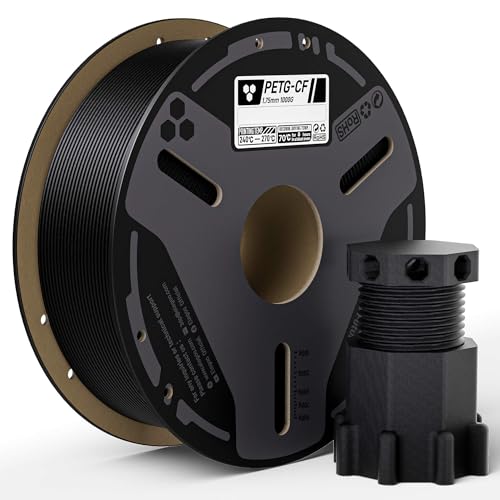
ELEGOO PETG-CF (Carbon Fiber Black, 1.75 mm, 1 kg)
- Best for
- Stiff matte functional parts on a printer with a 0.4 mm or larger hardened steel nozzle.
- Skip this if
- Your printer only has a brass nozzle, or the part will see temperatures near the listed 74 °C (0.45 MPa) heat deflection temperature.
Specs, strengths, and limitations
- Material
- PETG (carbon-fiber filled)
- Diameter
- 1.75 mm
- Net filament
- 1000 g (filament only, not packaged weight)
- Format
- other
- Maker's nozzle range
- 240–270 °C
- Nozzle
- Abrasive: the maker recommends a wear-resistant nozzle
- Manufacturer states carbon fiber adds strength and rigidity, with abrasion resistance and dimensional stability.
- Manufacturer states that, compared with PLA-CF, it has superior toughness and is less prone to fracture under stress and impact.
- Manufacturer states a premium matte finish that reduces visible layer lines.
- Abrasive: ELEGOO recommends a 0.4/0.6/0.8 mm hardened steel nozzle and says 0.2 mm nozzles are not compatible.
- Needs drying before use (60 ± 5 °C for 8 h per the spec table; the page's 'Important Notes' say 70 °C) and storage at ≤ 20% RH.
- Modest heat resistance: the spec table lists a heat deflection temperature of 74 °C at 0.45 MPa; no 1.8 MPa figure or TDS PDF is published.
Skip it if your nozzle isn't wear-resistant, or you can't dry filament before printing.
ELEGOO ASA-CF (Black, 1 kg)
ASA-CF is the carbon-fiber pick that uses the enclosure. ELEGOO lists a 250–280 °C nozzle, a 90–100 °C bed, a 45–60 °C chamber, enclosed printing "Required," and a "Hardened Steel Nozzle, ≥ 0.4 mm." ELEGOO also says to use it "in a well-ventilated area" because of odor. Its bed range reaches the 100 °C limit.
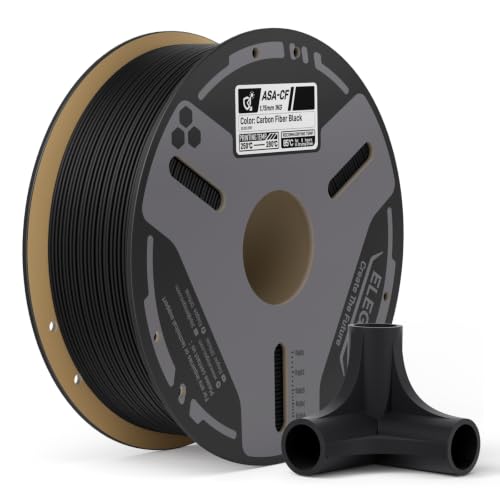
ELEGOO ASA-CF (Carbon Fiber Black, 1.75 mm, 1 kg)
- Best for
- Stiff outdoor and automotive parts printed on an enclosed printer with a hardened steel nozzle.
- Skip this if
- Your printer is open-frame or brass-nozzled, or it sits in an unventilated room.
Specs, strengths, and limitations
- Material
- ASA (carbon-fiber reinforced)
- Diameter
- 1.75 mm
- Net filament
- 1000 g (filament only, not packaged weight)
- Format
- other
- Maker's nozzle range
- 250–280 °C
- Nozzle
- Abrasive: the maker recommends a wear-resistant nozzle
- Manufacturer states ASA's UV and weather resistance for outdoor parts.
- Product page lists a heat deflection temperature of 108 °C (0.45 MPa).
- Manufacturer states lower warping and better dimensional control than standard ASA for large prints.
- Abrasive: ELEGOO recommends a hardened steel nozzle of 0.4 mm or larger.
- Needs an enclosed printer (45–60 °C chamber), a 90–100 °C bed with glue, and ventilation for odor.
- ELEGOO gives two drying temperatures (80 °C in the table, 85 °C in the note), and no TDS PDF is published.
Skip it if your nozzle isn't wear-resistant, or you can't ventilate the room.
Checklist before you buy for a K1, K1C or K1 Max
- Hotend and bed. 300 °C and 100 °C on all three. Check that the spool's published nozzle and bed ranges fit.
- Carbon fiber. Fine on a K1C. On a K1 or K1 Max, confirm a wear-resistant nozzle first.
- PLA and TPU. Creality's TPU guide for the K1C and K1 Max says to open the top cover for TPU. Its K1 Max 2025 guide says to remove it for PLA above 30 °C room temperature. Its clogging guides say to keep the bed at or below 50 °C for PLA.
- ABS and ASA. Keep the enclosure closed, and ventilate the room. Creality's K1C settings page recommends turning the chamber fan off for these.
- TPU hardness. 95A or harder, fed from above the printer, not through the stock PTFE tube.
- CFS. Only with the K1 Series CFS Upgrade Kit and an integrated-nozzle hotend. Creality recommends RFID plastic spools over paper spools for it.
Drying, storage and safety
Creality's parameter notes say moisture-sensitive materials "like PA/PA-CF/TPU should be dried before printing or kept dry during storage." ELEGOO lists drying as required for its Rapid PETG, TPU 95A and ASA-CF. Use the setting for your exact spool, and check the spool's own temperature rating before you dry it on the spool. Our filament dryer vs dry box guide and filament storage guide cover the options.
How this page was checked
This is a research-based page. We have not printed these spools on a K1, K1C or K1 Max for it, so it contains no test results or scores. The printer limits come from Creality's support spec pages and product pages for each printer, its K1 vs. K1 Max vs. K1C comparison, and Creality Wiki guides on TPU (written for the K1C and K1 Max), clogging (one for each printer), print settings, hotend versions and the CFS upgrade kit. The PLA top-cover note comes from Creality's K1 Max 2025 quick guide, a later version of the K1 Max. The spool details come from each filament maker's own pages and data sheets, listed in the sources section. All were retrieved on 2026-10-07. Creality's pages disagree on the K1 and K1 Max nozzle, so check your own printer. Makers update their pages, so check the current version before relying on a number. Read more in our editorial standards and affiliate disclosure.
PLA: what to check before you buy a spool ↗Head-to-head comparisons
Deciding between two products on this page? Each comparison puts both makers’ specs side by side and says who should choose which.
Sources
- The Buying Guide for Creality 3D Printing Materials, Creality
- K1 Support: Specs, Creality
- K1C Support: Specs, Creality
- K1 Max Support: Specs, Creality
- K1 3D Printer (product page), Creality
- K1C Carbon Fiber 3D Printer (product page), Creality
- K1 Max 3D Printer (product page), Creality
- Creality K1 vs. K1 Max vs. K1C: Comprehensive Comparison, Creality
- K1C/K1C 2025 Print Parameter Settings, Creality Wiki
- How to Print TPU for K1C & K1Max, Creality Wiki
- K1 Filament Feeding Issue/Clogging Issue, Creality Wiki
- K1C Filament Feeding Issue/Clogging Issue, Creality Wiki
- K1 Max Filament Feed Issue/Clog Handling Procedure, Creality Wiki
- K1 Max 2025 Quick Installation Guide V1.6, Creality Wiki
- How to distinguish if K1/K1 Max hotend kit is compatible with Multi-color upgrade kit?, Creality Wiki
- K1 Series CFS Upgrade Accessory Kit, Creality Wiki
- Upgrade Kit Modification for Printing ABS Filament, Creality Wiki
- K1 Series & CFS Upgrade Accessory Kit Combo, Creality
- "Unicorn" Quick-Swap Nozzle Kit for K1C/Ender-3 V3/Ender-3 V3 Plus, Creality
- Hyper PLA RFID 3D Printing Filament 1kg, Creality
- Hyper Series PLA 3D Printing Filament 1kg, Creality
- Hyper Series PETG 3D Printing Filament 1kg, Creality
- PolyLite PLA Technical Data Sheet V5.4, Polymaker
- Polymaker PETG product page, Polymaker
- PolyFlex TPU95 Technical Data Sheet V5.4, Polymaker
- PolyLite ABS product page, Polymaker
- PolyLite ABS Technical Data Sheet V5.5, Polymaker
- Polymaker ASA product page, Polymaker
- Polymaker ASA Technical Data Sheet, Polymaker
- PolyLite PLA-CF product page, Polymaker
- PolyLite PLA-CF Technical Data Sheet V5.4, Polymaker
- ELEGOO Rapid PLA Plus product page, ELEGOO
- ELEGOO Rapid PETG product page, ELEGOO
- ELEGOO TPU 95A product page, ELEGOO
- ELEGOO PETG-CF product page, ELEGOO
- ELEGOO ASA-CF product page, ELEGOO
- OVERTURE ASA product page, OVERTURE
- OVERTURE ASA Technical Data Sheet V5.1, OVERTURE
This page is research-based: we have not tested the products or methods ourselves. It draws on the manufacturer documentation and sources listed. Exact settings and fit always defer to your printer and filament makers.
Keep reading

Best Carbon Fiber Filament (2026): Spools by Base Material
The best carbon fiber filament by base material: fifteen spools from PLA-CF to nylon and PC, with each maker's nozzle, heat, enclosure and drying needs.

Best ASA Filament (2026): Outdoor-Part Spools by Printer
The best ASA filament for outdoor parts: seven 1.75 mm spools matched to the printers they suit, with each maker's UV, enclosure, heat and drying guidance.

TPU Compatibility: Extruder Path, Hardness, and Feeding Systems
Whether a TPU will feed in your printer depends on its Shore hardness, your extruder path, and whether it goes through an automatic material system.