eSUN PLA-Silk vs Overture Silk PLA
eSUN PLA-Silk vs Overture Silk PLA on maker data: temperatures, speed, gloss advice, drying, and spools. Pick eSUN to print fast, Overture to print slow.
On this page (13 sections)
Pick eSUN PLA-Silk if you print fast and want a wider nozzle window, a published heat-resistance figure, and Z-direction flexural and impact figures. Pick Overture Silk PLA if you're happy to print slowly and want a stated diameter tolerance, retraction settings, and a spool its maker says is vacuum-sealed with desiccant. Both are single-color silk PLA for display models, figurines, and decor, and neither maker calls for an enclosure. eSUN gives a speed below 200 mm/s and says to slow the outer walls for gloss. Overture gives a slow 30–70 mm/s and says gloss comes from higher temperature or lower speed. Both makers dry at the same temperature, and eSUN's data sheet dries for longer. Their strength figures can't be set side by side, because the makers printed their test bars differently and used different impact tests.
Who this comparison is for
This page is for anyone choosing between these two specific spools: eSUN PLA-Silk in Blue and Overture Silk PLA in Silk Gold, both 1.75 mm and 1 kg. eSUN's product page lists a 1.75 mm diameter and a "Net Weight" of "1KG/Spool," with Blue among 16 colors. Overture's store lists this variant as "Silk Gold / 1.75mm / 1 kg," SKU VFPSGO17511, and also sells a separate "Light Gold," so check the color name on the listing before you buy. For other silk finishes, see the silk PLA filament shortlist. For other silk matchups, see Bambu PLA Silk+ vs Polymaker Panchroma Silk and Polymaker Panchroma Dual Silk vs ELEGOO Silk Dual. If you're still choosing a finish, start with matte vs silk vs standard PLA.
| Product | Best for | Skip if | Link |
|---|---|---|---|
| eSUN PLA-Silk (eSilk-PLA) (Blue, 1.75 mm, 1 kg) | Budget-friendly glossy decorative prints in a wide range of solid colors. | Your parts will sit in a hot car or near heat. | View on Amazon (opens Amazon in a new tab) |
| OVERTURE Silk PLA (Silk Gold, 1.75 mm, 1 kg) | Classic shiny gold silk prints on standard-speed printers. | You want to print silk at high speed without tuning. | View on Amazon (opens Amazon in a new tab) |


How we compared them
This is a research-based comparison. Every figure below comes from the makers' own product pages, data sheets, wiki, and FAQ, listed in the sources. We haven't tested either filament, so nothing here is a measured result of ours. Where a maker describes its own product, such as eSUN's "no visible layer lines" or Overture's "mirror-smooth, high-gloss surface," we label it as the maker's claim.
We only put numbers side by side where both makers publish the same kind of value under the same test conditions. Print settings such as nozzle and bed temperature are each maker's guidance, so they sit in the table. The test figures don't qualify. The makers printed their test bars at different temperatures and beds, named different sets of standards, and used different impact tests, so we list each maker's figures separately.
Side-by-side specs
| eSUN PLA-Silk | Overture Silk PLA | |
|---|---|---|
| Variant | Blue, 1.75 mm, 1 kg | Silk Gold, 1.75 mm, 1 kg (VFPSGO17511) |
| Nozzle temperature | 190–230 °C (product page and TDS) | 200–220 °C (spec table and TDS); the marketing text says 190–230 °C |
| Bed temperature | 45–60 °C (product page and TDS); heated bed "Required" | 50–60 °C (spec table and TDS); the marketing text says "no heated bed required" |
| Build surface | PEI (TDS) | "OVERTURE Build Surface, Textured PEI"; treatment "None, Applying PVA glue to the build surface" (TDS) |
| Cooling fan | 100% (product page and TDS) | "Turned on" (spec table and TDS) |
| Maker's speed figure | Below 200 mm/s, labelled a "high-speed printing parameter" (product page); 200 mm/s (TDS) | 30–70 mm/s (spec table and TDS) |
| Gloss advice | "Slow down the outer-wall speed for better gloss" | Higher temperature and/or lower speed for more gloss (product page FAQ) |
| Retraction | Not stated | 1–3 mm at 20–40 mm/s (TDS) |
| Nozzle size | 0.2, 0.4, 0.6, or 0.8 mm (TDS) | Settings based on a 0.4 mm nozzle (TDS) |
| Drying | 50 °C for more than 8 h (TDS); "—" on the product page | 50 °C (122 °F) for 7 h (spec table) |
| Diameter tolerance | Not stated on the product page or TDS | ±0.02 mm (product page) |
| Packaging | Not stated on the product page | Vacuum-sealed with desiccant (product page) |
| Spool | Material and size not stated on the product page or TDS | Not stated on the product page; Overture's site-wide FAQ says it uses cardboard spools |
| Heat figure | Heat distortion 50 °C at 0.45 MPa (TDS) | Vicat softening listed as "N/A" (TDS) |
Temperatures, bed, and plate
eSUN gives the wider nozzle window, 190–230 °C, on both its product page and data sheet. Overture's spec table and data sheet give 200–220 °C, which sits inside eSUN's range. The bed ranges overlap at 50–60 °C, with eSUN's starting 5 °C lower, at 45 °C.
Overture's product page contradicts itself. Its marketing text says Silk PLA is "Compatible with most FDM printers at 190–230°C nozzle temperature with no heated bed required," while its own spec table and data sheet give 200–220 °C and a 50–60 °C bed. We follow the spec table and data sheet. eSUN lists a heated bed as "Required."
On the plate, eSUN's data sheet lists PEI. Overture's data sheet lists its own build surface or textured PEI, with the treatment given as "None, Applying PVA glue to the build surface," without saying when to use glue.
Speed and gloss
This is the clearest practical difference.
- eSUN PLA-Silk. The product page gives a speed below 200 mm/s as a "high-speed printing parameter," and the data sheet gives 200 mm/s. eSUN's notes say "Excessive printing speed can reduce surface gloss. When printing with PLA-Silk, slow down the outer wall speed to enhance the surface shine." Its data sheet also suggests Z seam alignment and to "appropriately reduce the printing speed to achieve the best printing effect."
- Overture Silk PLA. The spec table and data sheet give 30–70 mm/s, and the data sheet bases its settings on a 0.4 mm nozzle. The FAQ on Overture's product page says "To achieve a glossier finish, it is recommended to use higher printing temperatures and/or lower printing speeds," and that lowering the temperature or raising the speed gives a less glossy finish.
Both makers tie gloss to slower printing. eSUN's top figure is a ceiling and not a speed for best gloss, and neither maker says what layer height or line width its figure assumes, so these are each maker's guidance, not a measured race.
Cooling and heat in the chamber
eSUN runs the fan at 100%, and its notes say "PLA-Silk has slightly poorer cooling performance than regular PLA. A higher cooling fan speed is required when printing overhangs." It also recommends "keeping the printer enclosure open during printing to lower the chamber temperature," and turning on air conditioning if the room is above 32 °C, because "Excessive heat can cause the PLA filament to soften and deform at the extruder gears, leading to clogging." Overture lists the fan as "Turned on" and sets a 60° overhang threshold in its data sheet, without a fan percentage or any chamber advice.
Heat and strength figures: listed separately
These can't be set side by side. Both makers tested printed bars at 100% infill, but under different settings. eSUN printed on a Bambu Lab P1S with a 0.4 mm nozzle at 220 °C on a 60 °C bed, with two outer layers, three top and bottom layers, and the fan at 100%, and tested to GB/T standards only. Overture printed at 205 °C and 60 mm/s on a 40 °C bed, conditioned its specimens at room temperature for 24 hours, and named ISO and GB/T standards together. That 40 °C bed is below Overture's own recommended 50–60 °C, and Overture doesn't explain why. The impact tests differ too: Izod for eSUN and notched Charpy for Overture.
eSUN PLA-Silk (TDS V1.0, July 2024)
- Heat distortion temperature: 50 °C at 0.45 MPa (GB/T 1634)
- Tensile strength: 32.53 MPa X-Y, 17.36 MPa Z (GB/T 1040)
- Elongation at break: 11.65% X-Y, 1.84% Z (GB/T 1040)
- Flexural strength: 44.4 MPa X-Y, 23.1 MPa Z (GB/T 9341)
- Flexural modulus: 1917.35 MPa X-Y, 1858.86 MPa Z (GB/T 9341)
- Izod impact strength: 2.93 kJ/m² X-Y, 2.19 kJ/m² Z (GB/T 1843), notched or unnotched not stated
- Density: 1.21 g/cm³ (GB/T 1033)
- Melt flow index: 4.8, at 190 °C and 2.16 kg (GB/T 3682)
Overture Silk PLA (TDS V5.1)
- Tensile strength: 55.2 ± 2.1 MPa X-Y, 18.9 ± 3.4 MPa Z (ISO 527, GB/T 1040)
- Young's modulus: 3173 ± 97 MPa X-Y (ISO 527, GB/T 1040)
- Elongation at break: 3.5 ± 0.6% X-Y (ISO 527, GB/T 1040)
- Bending strength 87.1 ± 1.4 MPa, bending modulus 3518 ± 49 MPa, both X-Y (ISO 178, GB/T 9341)
- Notched Charpy impact strength: 2.87 ± 0.08 kJ/m² X-Y (ISO 179, GB/T 1043)
- Density: 1.19 g/cm³ at 21.5 °C (ISO 1183, GB/T 1033)
- Melt index: 12.8 g/10 min at 190 °C and 2.16 kg (no standard named)
- Melting temperature: 153 °C (DSC)
- Vicat softening temperature: listed as "N/A" (ISO 306, GB/T 1633)
In both makers' data, the Z figure, which measures strength between layers, is well below the X-Y figure. Overture's product page summarizes its data sheet as "Toughness" (the 2.87 kJ/m² impact figure), "Layer Adhesion" (the 18.9 MPa Z tensile figure), and "Elongation," and lists "Stiffness" as N/A even though its data sheet gives a Young's modulus. We used the data sheet. eSUN's product page labels its density "(unit to be confirmed)," so we've used the data sheet's g/cm³.
eSUN's 50 °C heat distortion figure is the only heat-resistance figure either maker publishes for these spools. Overture gives a 153 °C melting temperature and lists Vicat as "N/A." eSUN's data sheet also marks UV resistance "NO." Our reading, not a maker's, is that neither suits a hot car, a sunny windowsill, or parts near heat. Our parts deforming in heat guide covers what to try instead.
Drying and storage
Both makers dry at 50 °C, and they differ on the time and where they publish it.
- eSUN PLA-Silk. The product page lists drying as "—," but the data sheet linked from it gives "50℃ >8H," which is 50 °C for more than 8 hours. eSUN's wiki FAQ gives 50 °C for its PLA series, without a time. eSUN doesn't describe its packaging on the PLA-Silk page.
- Overture Silk PLA. The spec table gives "50°C (122°F) for 7 hours," matching the PLA row of Overture's drying guide, which rates PLA's moisture sensitivity "Low." The product page says "Each spool arrives vacuum-sealed with desiccant to protect against moisture."
Our filament dryer vs dry box guide covers the options. If you see stringing anyway, our stringing guide covers the causes.
Spools and multi-material feeders
eSUN doesn't state the spool's material or size on its PLA-Silk product page or data sheet. Overture's Silk PLA page and data sheet don't either. Overture's site-wide FAQ says it "uses cardboard spools as part of our environmental protection efforts," and suggests "a reusable spool adapter designed for cardboard spools" if you prefer plastic, but it doesn't name this product. Neither maker mentions the AMS or any other feeder on the pages we checked, so we make no compatibility claim for either. Our AMS filament compatibility guide covers spool sizes and adapters.
What each maker says it's for
- eSUN PLA-Silk. eSUN says it's made from modified PLA, "retaining the easy printing characteristics of standard PLA," with "a delicate surface with a silky luster and no visible layer lines," and that support structures "can be easily removed while the contact surface remains intact." It lists toys and decoration, and cultural and creative uses. Those are eSUN's claims.
- Overture Silk PLA. Overture says it's "specially formulated to produce a mirror-smooth, high-gloss surface," for "display models, jewelry, figurines, and premium decorative pieces," and that "every spool maintains a strict ±0.02mm tolerance on 1.75mm filament." Those are Overture's claims.

eSUN PLA-Silk (eSilk-PLA) (Blue, 1.75 mm, 1 kg)
- Best for
- Budget-friendly glossy decorative prints in a wide range of solid colors.
- Skip this if
- Your parts will sit in a hot car or near heat.
Specs, strengths, and limitations
- Material
- PLA (silk)
- Diameter
- 1.75 mm
- Net filament
- 1000 g (filament only, not packaged weight)
- Format
- other
- Maker's nozzle range
- 190–230 °C
- Manufacturer states a silky gloss that minimizes visible layer lines.
- Product page publishes printed-part properties, including a Z-axis tensile strength of 17.36 MPa.
- Wide color range on one product line (16 colors listed).
- Product page lists a heat distortion temperature of only 50 °C, and eSUN advises keeping an enclosure open.
- Gloss needs slower outer walls, per eSUN.
- Drying settings appear only in the TDS (50 °C for more than 8 h; the product page lists '—'), and spool details aren't published.
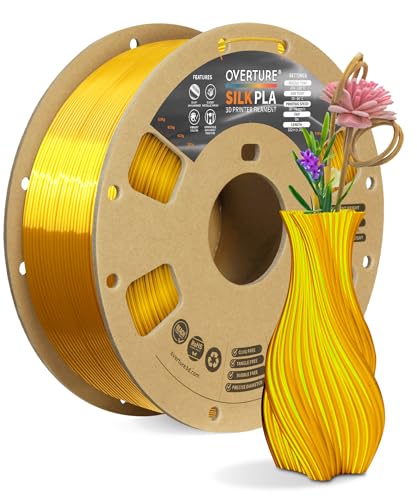
OVERTURE Silk PLA (Silk Gold, 1.75 mm, 1 kg)
- Best for
- Classic shiny gold silk prints on standard-speed printers.
- Skip this if
- You want to print silk at high speed without tuning.
Specs, strengths, and limitations
- Material
- PLA (silk)
- Diameter
- 1.75 mm
- Net filament
- 1000 g (filament only, not packaged weight)
- Format
- cardboard spool
- Maker's nozzle range
- 200–220 °C
- TDS lists an X-Y tensile strength of 55.2 MPa and a Z (layer) strength of 18.9 MPa.
- Manufacturer states each spool is vacuum-sealed with desiccant and held to ±0.02 mm diameter.
- Manufacturer publishes a TDS, SDS, and print profile for it.
- TDS print speed is slow (30–70 mm/s), so it isn't tuned for high-speed printers.
- Low impact resistance: TDS notched Charpy is 2.87 kJ/m² and elongation 3.5%.
- OVERTURE's product page contradicts itself on bed heating; follow the TDS (50–60 °C).
Verdict: which should you buy?
Choose eSUN PLA-Silk if…
- You print faster than 70 mm/s and want a maker figure that goes up to 200 mm/s, with slower outer walls for gloss.
- You want a wider 190–230 °C nozzle window and a bed that can start at 45 °C.
- You want a published heat-resistance figure and Z-direction figures for flexural strength and impact.
Choose Overture Silk PLA if…
- You're happy to print slowly, at 30–70 mm/s, and tune temperature against speed for gloss.
- You want a stated ±0.02 mm tolerance and a spool its maker says is vacuum-sealed with desiccant.
- You want retraction settings on the data sheet and a shorter 7-hour drying time.
Safety and limits
How this page was checked
Every temperature, speed, drying setting, spool detail, and test figure above comes from the manufacturer documents in the sources section, retrieved on 2026-10-13. We haven't printed with either filament for this page, so nothing here is a measured result of ours. Both makers disagree with themselves in places. Overture's marketing text gives a 190–230 °C nozzle and "no heated bed required," while its spec table and data sheet give 200–220 °C and a 50–60 °C bed; its test bars were printed on a 40 °C bed, below that range. eSUN's product page lists no drying setting, while its data sheet gives one, and its product page gives a speed below 200 mm/s against the data sheet's 200 mm/s. eSUN's data sheet file is dated June 2025 in its file name but reads "JUL.2024 Version 1.0" on the page, and its degree signs and "more than" sign only appear in one text extraction mode, so we checked those values against a second extraction and the product page. Overture's data sheet reads July 2024 in its header and August 2024 in its footer. eSUN's property table is shared across its PLA-Silk colors, and Overture's data sheet doesn't name a color. We found no diameter tolerance, retraction settings, or spool details for eSUN PLA-Silk on its product page or data sheet. Values vary by color and revision, so check the current data sheet for your spool. Read more in our editorial standards and affiliate disclosure.
Specialty materials: what to check before you buy a spool ↗Sources
- PLA-Silk product page, eSUN
- eSUN PLA-Silk Technical Data Sheet V1.0, eSUN
- Drying temperatures (eSUN Wiki FAQ), eSUN
- Overture Silk PLA 3D Printer Filament 1.75mm, Overture
- OVERTURE Silk PLA Technical Data Sheet V5.1, Overture
- Filament Drying Guide (Overture 3D Wiki), Overture
- FAQs, Overture
This page is research-based: we have not tested the products or methods ourselves. It draws on the manufacturer documentation and sources listed. Exact settings and fit always defer to your printer and filament makers.
Keep reading

Best Silk PLA Filament (2026): Shiny Spools by Finish and Printer
The best silk PLA filament by finish: fifteen single, dual, tri-color and gradient spools, with each maker's speed, strength and AMS notes.

Best Specialty Filament (2026): ASA, PC, Carbon Fiber and Silk Picks
The best specialty filament by job: nine spools from ASA and polycarbonate to carbon-fiber blends and silk PLA, with each maker's printer requirements.
Polymaker Panchroma Dual Silk vs ELEGOO Silk Dual
Panchroma Dual Silk vs ELEGOO's dual-color PLA Silk on maker data. Pick Polymaker for color-effect and speed guidance, ELEGOO for a full property table.