Best Silk PLA Filament (2026): Shiny Spools by Finish and Printer
The best silk PLA filament by finish: fifteen single, dual, tri-color and gradient spools, with each maker's speed, strength and AMS notes.
On this page (25 sections)
For a single shiny color on most printers, start with Polymaker Panchroma Silk: Polymaker says its gloss holds up to 150 mm/s, and it needs no enclosure. On a Bambu Lab printer with an AMS, choose Bambu Lab PLA Silk+, whose RFID tag the AMS reads. Overture, eSUN, ELEGOO, SUNLU and ERYONE are documented single-color alternatives with slower speed advice or thinner data. For two colors in one strand, Polymaker Panchroma Dual Silk gives the clearest instructions, and eSUN and SUNLU also explain how the effect shows on a print. The result depends on model orientation, geometry and viewing angle. For a color change along the spool, Polymaker Gradient Silk publishes how many grams each color cycle takes. The fit rule: choose the finish first, then match the spool's speed advice to your printer. Silk trades strength for shine, so none of these suits functional, load-bearing or hot parts.
Quick picks
| Need | Pick | Why |
|---|---|---|
| Default single-color silk | Polymaker Panchroma Silk PLA | Polymaker says the shine holds even at 150 mm/s; 25–60 °C bed, no enclosure needed |
| For a Bambu AMS | Bambu Lab PLA Silk+ | Bambu lists it as compatible with all AMS series, with settings on an RFID tag |
| Standard-speed printer, full data sheet | Overture Silk PLA | Data sheet (V5.1) with strength figures and a 30–70 mm/s speed range |
| Two colors in one strand | Polymaker Panchroma Dual Silk PLA | The clearest instructions in its group on orienting the model for the effect |
| Color change along the spool | Polymaker Panchroma Gradient Silk PLA | Polymaker publishes how much filament one color cycle uses (110 g for Fire) |
Picks are matched to documented needs, not scored.
Who is this silk PLA shortlist for?
This page is for anyone printing display pieces, vases, figurines, cosplay props, or gifts who wants a shiny, metallic-looking surface straight off the printer. It assumes a 1.75 mm printer and a 1 kg spool. If you need everyday PLA for prototypes and household parts, start with our PLA filament shortlist instead, because a standard grade will usually give stronger layers. If you print from a Bambu AMS or AMS lite, read our AMS filament compatibility guide alongside the spool notes below.
| Product | Best for | Skip if | Link |
|---|---|---|---|
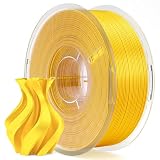
| Polymaker Panchroma Silk PLA (Silk Gold, 1.75 mm, 1 kg, spool (new formula)) | Shiny decorative prints, vases, cosplay props, and gifts on any standard PLA printer. | The part needs strength or heat resistance more than looks. | View on Amazon (opens Amazon in a new tab) |
| Bambu Lab PLA Silk+ (Gold, 1.75 mm, 1 kg, with spool) | Bambu Lab AMS users who want a glossy single-color silk with documented layer strength. | You print at full speed and won't slow outer walls, or you need parts that survive heat. | View on Amazon (opens Amazon in a new tab) |
| OVERTURE Silk PLA (Silk Gold, 1.75 mm, 1 kg) | Classic shiny gold silk prints on standard-speed printers. | You want to print silk at high speed without tuning. | View on Amazon (opens Amazon in a new tab) |
| eSUN PLA-Silk (eSilk-PLA) (Blue, 1.75 mm, 1 kg) | Budget-friendly glossy decorative prints in a wide range of solid colors. | Your parts will sit in a hot car or near heat. | View on Amazon (opens Amazon in a new tab) |
| ELEGOO PLA Silk (Gold, 1.75 mm, 1 kg) | Low-cost shiny gold decorative prints where strength doesn't matter. | The print is functional or will be stressed across layers. | View on Amazon (opens Amazon in a new tab) |
| SUNLU SILK PLA+ (Silk Light Gold, 1.75 mm, 1 kg) | Affordable everyday silk prints in a soft gold. | You want SUNLU's SILK PLA+ 2.0 formula specifically. | View on Amazon (opens Amazon in a new tab) |
| ERYONE PLA Silk (Silver, 1.75 mm, 1 kg) | Large, smooth decorative prints in a metallic silver. | You print small detailed models or want high-speed printing. | View on Amazon (opens Amazon in a new tab) |
| Polymaker Panchroma Dual Silk PLA (Crown (Gold-Silver), 1.75 mm, 1 kg) | Decorative prints and figurines where a two-tone gold-silver shift is the point. | You need the same color on every face of a part, or a plastic spool for an AMS. | View on Amazon (opens Amazon in a new tab) |
| eSUN PLA-Silk Magic (Black Gold (dual color), 1.75 mm, 1 kg) | Display pieces and figurines where an angle-dependent two-tone look matters more than strength. | The part has to take load across layers. | View on Amazon (opens Amazon in a new tab) |
| SUNLU Multi-Color SILK PLA+ (dual color) (Blue + Green, 1.75 mm, 1 kg) | Two-tone ocean-color decorative prints on a budget. | You need one consistent color across the part. | View on Amazon (opens Amazon in a new tab) |
| SUNLU Multi-Color SILK PLA+ (tri-color) (Blue + Green + Purple, 1.75 mm, 1 kg) | Bold multi-tone display pieces. | You want a documented TDS for the exact color type you're buying. | View on Amazon (opens Amazon in a new tab) |
| OVERTURE Silk PLA (dual color) (Silk Gold-Silver, 1.75 mm, 1 kg) | Two-tone metallic-look decorative prints. | You need consistent color across a whole part. | View on Amazon (opens Amazon in a new tab) |
| ELEGOO PLA Silk (dual color) (Blue Green, 1.75 mm, 1 kg) | Inexpensive two-tone decorative prints. | You want the maker to document how the two colors show up, or you need strong layers. | View on Amazon (opens Amazon in a new tab) |
| ELEGOO PLA Silk (triple color) (Blue Purple Black, 1.75 mm, 1 kg) | Eye-catching three-tone decorative prints on a budget. | You need predictable color placement or strong layers. | View on Amazon (opens Amazon in a new tab) |
| Polymaker Panchroma Gradient Silk PLA (Fire, 1.75 mm, 1 kg) | Vases and larger decorative prints that use enough filament to show the color transitions. | You print small parts that would only show one color. | View on Amazon (opens Amazon in a new tab) |




How we chose these spools
A product made the list only if it met all of these criteria:
- Manufacturer documentation we could read. Every maker publishes nozzle and bed temperatures on its own product page or data sheet. Polymaker, Bambu Lab, Overture, eSUN, and SUNLU publish a data sheet, and eSUN and ELEGOO also publish a property table on the product page. ERYONE publishes settings and an FAQ but no data sheet, and we say so in its section.
- An exact variant we could verify. Each catalog record ties one Amazon listing to one manufacturer product, color, diameter (1.75 mm), and net filament mass (1 kg), checked against the maker's own variant list or SKU where one exists.
- A documented finish. We grouped spools by what the maker says the finish does: one color, two or three colors in one strand, or a color that changes along the length of the spool.
Makers print and test their specimens differently, so a strength figure from one data sheet isn't a fair head-to-head against another. Read each number as that maker's own figure.
Single-color silk
These spools give one color with a glossy surface. They all print at PLA temperatures without an enclosure, but their speed advice ranges from 30–60 mm/s (ERYONE) to up to 250 mm/s (Polymaker), so match the spool to how fast you print.
Polymaker Panchroma Silk PLA (Silk Gold)
Polymaker says its new silk formula "solves brittleness and clogging" and gives better layer adhesion. It says the shine holds "even at 150mm/s", with a maximum print speed of 250 mm/s. Its page lists 190–230 °C at the nozzle, a 25–60 °C bed, no enclosure needed, and drying at 55 °C for 6 hours. The product page table gives 41.1 MPa tensile strength in X-Y and 23.8 MPa in Z, and the Panchroma data sheet lists a Vicat softening temperature of 64.7 °C for Silk (ISO 306). Polymaker's FAQ says it is compatible with AMS and other multi-material systems. It suits readers on faster printers who don't want to slow the whole print for gloss.
It ships on a cardboard spool, as all Polymaker filament now does. Bambu Lab recommends an adapter ring for cardboard spools in the AMS, so check our AMS filament compatibility guide. This listing is the new-formula spool (model CA03006). Polymaker also sells older-formula and refill versions, so check the model number before you buy.

Polymaker Panchroma Silk PLA (Silk Gold, 1.75 mm, 1 kg, spool (new formula))
- Best for
- Shiny decorative prints, vases, cosplay props, and gifts on any standard PLA printer.
- Skip this if
- The part needs strength or heat resistance more than looks.
Specs, strengths, and limitations
- Material
- PLA (silk)
- Diameter
- 1.75 mm
- Net filament
- 1000 g (filament only, not packaged weight)
- Format
- cardboard spool
- Maker's nozzle range
- 190–230 °C
- Manufacturer states the silk shine is maintained even at 150 mm/s.
- Manufacturer states it prints on most FDM printers without special hardware.
- Manufacturer states the new formula improves layer adhesion and resists brittleness and clogging.
- Low heat resistance: the data sheet's data table lists a Vicat softening temperature of 64.7 °C (ISO 306) for Silk.
- A decorative finish rather than a functional material; Polymaker markets it for décor, cosplay props, and display models.
- Cardboard spool: Polymaker says its spools are AMS compatible, but Bambu Lab's general AMS guidance recommends an adapter or ring for cardboard spools. Check your unit.
Skip it if you need a plastic spool for your feeder, or the part has to carry load.
Bambu Lab PLA Silk+ (Gold)
Bambu Lab says PLA Silk+ needs "no need to make any trade-offs between layer adhesion and appearance". Its data sheet lists 33 ± 4 MPa tensile strength in X-Y and 25 ± 4 MPa in Z, the smallest gap between the two among the figures published here. It prints at 210–240 °C with a 35–45 °C bed. Bambu's store page says it is compatible with all AMS series, and that its print settings are stored on an RFID tag the AMS reads. It ships on an ABS spool, 200 mm in diameter and 67 mm high, according to the data sheet. It suits Bambu Lab owners who want silk loaded into an AMS with no manual setup.
There are conditions. Bambu says to "Lower the outer wall speed to 50 mm/s for the best gloss," and strongly recommends drying it right after opening. The store page also says it is not compatible with Cool Plate SuperTack or with hotends fitted with 0.6 mm or 0.8 mm hardened steel nozzles, even though the data sheet lists SuperTack as a plate type. Follow the store page. The refill version needs a separate reusable spool.

Bambu Lab PLA Silk+ (Gold, 1.75 mm, 1 kg, with spool)
- Best for
- Bambu Lab AMS users who want a glossy single-color silk with documented layer strength.
- Skip this if
- You print at full speed and won't slow outer walls, or you need parts that survive heat.
Specs, strengths, and limitations
- Material
- PLA (silk)
- Diameter
- 1.75 mm
- Net filament
- 1000 g (filament only, not packaged weight)
- Format
- plastic spool
- Maker's nozzle range
- 210–240 °C
- Manufacturer states enhanced sheen and gloss with 'no need to make any trade-offs between layer adhesion and appearance'.
- TDS lists a Z-axis (layer) tensile strength of 25 ± 4 MPa, high for a silk PLA.
- Manufacturer states all printing parameters are embedded in an RFID tag read by the AMS.
- Gloss depends on slowing down: Bambu says to lower the outer-wall speed to 50 mm/s for the best gloss.
- Bambu says to dry it right after opening. Its store page lists 0.6/0.8 mm hardened steel nozzles and Cool Plate SuperTack as not compatible, while its data sheet lists 0.6 and 0.8 mm nozzles and the SuperTack plate; follow the stricter store-page note.
- Like other PLA, the TDS heat deflection temperature is low (about 56–60 °C).
Skip it if you print on Cool Plate SuperTack or a 0.6/0.8 mm hardened steel nozzle, or you won't slow your outer walls.
Overture Silk PLA (Silk Gold)
Overture's data sheet (V5.1) lists 55.2 ± 2.1 MPa tensile strength in X-Y and 18.9 ± 3.4 MPa in Z, with 200–220 °C at the nozzle, a 50–60 °C bed, and a print speed of 30–70 mm/s. Overture says each spool is vacuum-sealed with desiccant and held to ±0.02 mm, and gives drying at 50 °C for 7 hours. Its FAQ says a glossier finish comes from higher printing temperatures and/or lower speeds. It suits readers on standard-speed printers who want a published data sheet.
The product page contradicts itself. Its marketing text says 190–230 °C "with no heated bed required", while its own spec table and the data sheet say 200–220 °C and a 50–60 °C bed. Follow the data sheet. The product page and data sheet don't state the spool material or size, but Overture's site-wide FAQ says "Overture uses cardboard spools."

OVERTURE Silk PLA (Silk Gold, 1.75 mm, 1 kg)
- Best for
- Classic shiny gold silk prints on standard-speed printers.
- Skip this if
- You want to print silk at high speed without tuning.
Specs, strengths, and limitations
- Material
- PLA (silk)
- Diameter
- 1.75 mm
- Net filament
- 1000 g (filament only, not packaged weight)
- Format
- cardboard spool
- Maker's nozzle range
- 200–220 °C
- TDS lists an X-Y tensile strength of 55.2 MPa and a Z (layer) strength of 18.9 MPa.
- Manufacturer states each spool is vacuum-sealed with desiccant and held to ±0.02 mm diameter.
- Manufacturer publishes a TDS, SDS, and print profile for it.
- TDS print speed is slow (30–70 mm/s), so it isn't tuned for high-speed printers.
- Low impact resistance: TDS notched Charpy is 2.87 kJ/m² and elongation 3.5%.
- OVERTURE's product page contradicts itself on bed heating; follow the TDS (50–60 °C).
Skip it if you want to print silk fast without tuning, or need a plastic spool for your feeder.
eSUN PLA-Silk (Blue)
eSUN describes PLA-Silk as a modified PLA with a silky luster that minimizes layer lines. Its product page lists 190–230 °C at the nozzle, a 45–60 °C bed (a heated bed is listed as required), 100% fan, and under 200 mm/s, with the advice to "Slow down the outer-wall speed for better gloss." The property table gives 32.53 MPa tensile strength in XY and 17.36 MPa in Z, and a heat distortion temperature of 50 °C. eSUN also warns that PLA has low heat resistance and recommends keeping a printer enclosure open to keep the chamber cool. It suits readers who want a solid-color silk with published printed-part properties.
eSUN's product page lists drying as "—", but the PLA-Silk data sheet linked from that page gives "50℃ >8H", which is 50 °C for more than 8 hours. eSUN doesn't state the spool material or size.

eSUN PLA-Silk (eSilk-PLA) (Blue, 1.75 mm, 1 kg)
- Best for
- Budget-friendly glossy decorative prints in a wide range of solid colors.
- Skip this if
- Your parts will sit in a hot car or near heat.
Specs, strengths, and limitations
- Material
- PLA (silk)
- Diameter
- 1.75 mm
- Net filament
- 1000 g (filament only, not packaged weight)
- Format
- other
- Maker's nozzle range
- 190–230 °C
- Manufacturer states a silky gloss that minimizes visible layer lines.
- Product page publishes printed-part properties, including a Z-axis tensile strength of 17.36 MPa.
- Wide color range on one product line (16 colors listed).
- Product page lists a heat distortion temperature of only 50 °C, and eSUN advises keeping an enclosure open.
- Gloss needs slower outer walls, per eSUN.
- Drying settings appear only in the TDS (50 °C for more than 8 h; the product page lists '—'), and spool details aren't published.
Skip it if the part will sit near heat.
ELEGOO PLA Silk (Silk Gold)
ELEGOO's spec table lists 190–230 °C at the nozzle, a 35–65 °C bed, under 220 mm/s, and no enclosure required. It lists drying as "Required" at 50 ± 5 °C for 8 hours, and says spools are dried for 24 hours and vacuum-sealed with desiccant before shipping. The product page gives the filament weight as 1 kg per spool, plus an empty spool weight of 174 ± 5 g. It suits readers who want a low-cost gold silk for purely decorative prints.
Two things in the table stand out. First, it lists 26 ± 3 MPa tensile strength in X-Y but only 5 ± 2 MPa in Z, the weakest layer figure we found among these makers. Second, ELEGOO's table lists "Recommended Nozzle: Hardened Steel Nozzle, ≥ 0.4 mm" for this unfilled silk PLA. That is what ELEGOO's table says. ELEGOO's text doesn't call the filament abrasive, and our catalog doesn't flag it as abrasive. Ask ELEGOO if you're unsure what that line means for your printer. ELEGOO's text doesn't state the spool material. It offers a printable filament ring for AMS use "because AMS will rub the bottom paper tray," without saying which spools that applies to.

ELEGOO PLA Silk (Gold, 1.75 mm, 1 kg)
- Best for
- Low-cost shiny gold decorative prints where strength doesn't matter.
- Skip this if
- The print is functional or will be stressed across layers.
Specs, strengths, and limitations
- Material
- PLA (silk)
- Diameter
- 1.75 mm
- Net filament
- 1000 g (filament only, not packaged weight)
- Format
- other
- Maker's nozzle range
- 190–230 °C
- Manufacturer states a glossy silk finish with 'customizable gloss'.
- Manufacturer publishes a full spec table, including drying and strength data.
- Manufacturer states each spool is dried for 24 hours and vacuum-sealed with desiccant.
- Spec table lists a Z-axis tensile strength of 5 ± 2 MPa, against 23 ± 2 MPa for ELEGOO's standard PLA.
- ELEGOO lists drying as required (50 °C, 8 h), and its spec table also lists a hardened steel nozzle of 0.4 mm or larger.
- ELEGOO doesn't state the spool material or dimensions; it offers a printable ring for AMS use.
Skip it if the print will be stressed across its layers, or you don't want to dry a spool before first use.
SUNLU SILK PLA+ (Silk Light Gold)
SUNLU's store page lists 210–230 °C at 50–200 mm/s. For the bed, it says to use glue on an unheated bed or heat it to 50–60 °C with no glue. It states a net weight of 1 kg and a gross weight of 1.3 kg per roll, and says the surface needs no post-print polishing. SUNLU's data sheet gives a drying temperature of 50 °C but no drying time. SUNLU's wiki recommends 50–55 °C for 6–8 hours for silk PLA in general, without naming this product. It suits readers who want an inexpensive soft-gold silk with a wide speed window.
SUNLU calls this product "SILK PLA Plus" on its store, while the Amazon listing says "Silk PLA". SUNLU now also sells a newer SILK PLA+ 2.0, so check which version ships. SUNLU's data sheet doesn't publish a Z-direction tensile or flexural figure (its only Z-X figure is an unnotched Izod impact value), and SUNLU doesn't state the spool material or size.

SUNLU SILK PLA+ (Silk Light Gold, 1.75 mm, 1 kg)
- Best for
- Affordable everyday silk prints in a soft gold.
- Skip this if
- You want SUNLU's SILK PLA+ 2.0 formula specifically.
Specs, strengths, and limitations
- Material
- PLA (silk (PLA+))
- Diameter
- 1.75 mm
- Net filament
- 1000 g (filament only, not packaged weight)
- Format
- other
- Maker's nozzle range
- 210–230 °C
- Manufacturer states net filament weight (1 kg) and gross weight (1.3 kg) on the product page.
- Manufacturer states a glossy finish that needs no post-print polishing.
- Wide print-speed window (50–200 mm/s) per SUNLU.
- SUNLU's TDS and product page give a drying temperature but no drying time; only SUNLU's general wiki table gives one (6–8 h for silk PLA).
- Runs slightly hotter than other silks here (210–230 °C).
- Amazon and store names differ ('Silk PLA' vs 'SILK PLA Plus'), and a newer 2.0 version exists, so check which version ships.
Skip it if you want a drying time stated for this product itself, or SUNLU's 2.0 formula specifically.
ERYONE PLA Silk (Silver)
ERYONE lists 190–220 °C at the nozzle, a 55–70 °C bed, and a slow 30–60 mm/s print speed. For a glossy surface, its FAQ says to match temperature to speed and use 200–220 °C. ERYONE publishes the spool details: 1 kg net and 1.35 kg gross weight, a 57 mm inner diameter, a 200 mm outer diameter, and a 64 mm height. It suits readers printing large, smooth silver pieces on a standard-speed printer.
ERYONE's own FAQ says silk PLA "is not suitable for printing high-precision or small-sized models." It publishes no data sheet, strength figures, or drying settings.

ERYONE PLA Silk (Silver, 1.75 mm, 1 kg)
- Best for
- Large, smooth decorative prints in a metallic silver.
- Skip this if
- You print small detailed models or want high-speed printing.
Specs, strengths, and limitations
- Material
- PLA (silk)
- Diameter
- 1.75 mm
- Net filament
- 1000 g (filament only, not packaged weight)
- Format
- other
- Maker's nozzle range
- 190–220 °C
- Manufacturer states net (1 kg) and gross (1.35 kg) weight and spool dimensions.
- Manufacturer states it is tougher and glossier than standard PLA.
- Manufacturer gives tuning advice for gloss (200–220 °C).
- Slow recommended speed (30–60 mm/s).
- ERYONE says silk PLA isn't suited to small or high-precision models.
- No drying settings or TDS are published.
Skip it if you print small, detailed models or print fast.
Dual- and tri-color silk
These spools carry two or three colors in one strand, so a single-nozzle printer can show more than one color. Which color you see is not fully under your control. It depends on the model's orientation, its size and shape, and the viewing angle, in each maker's own words below. Some makers barely explain the effect, and we say where.
Polymaker Panchroma Dual Silk PLA (Crown, gold-silver)
Polymaker gives the clearest instructions in this group: "Orient the model to make the dual-color effect visible; transition placement and which color faces outward depend on geometry and spool orientation." It also says to reduce print speed if the dual-color effect looks muted at higher speed. Settings match Panchroma Silk: 190–230 °C, a 25–60 °C bed, up to 250 mm/s, no enclosure, and drying at 55 °C for 6 hours. Its page lists the same 41.1 MPa X-Y and 23.8 MPa Z tensile strength as the single-color silk. Polymaker's FAQ says it is compatible with AMS and other multi-material systems. It suits figurines and display pieces where a gold-silver shift is the point.
It ships on a cardboard spool. This listing is the new formula (model CA03027), and an old-formula version also exists.

Polymaker Panchroma Dual Silk PLA (Crown (Gold-Silver), 1.75 mm, 1 kg)
- Best for
- Decorative prints and figurines where a two-tone gold-silver shift is the point.
- Skip this if
- You need the same color on every face of a part, or a plastic spool for an AMS.
Specs, strengths, and limitations
- Material
- PLA (silk, dual-color)
- Diameter
- 1.75 mm
- Net filament
- 1000 g (filament only, not packaged weight)
- Format
- cardboard spool
- Maker's nozzle range
- 190–230 °C
- Manufacturer states the new dual silk formula addresses brittleness and clogging and keeps its shine at 150 mm/s.
- Product page lists a Z-axis tensile strength of 23.8 MPa against 41.1 MPa X-Y.
- Prints at standard PLA settings (190–230 °C, 25–60 °C bed) with no enclosure.
- Which color shows depends on model geometry and spool orientation, per Polymaker, so results vary from print to print.
- Polymaker says to slow down if the dual-color effect looks muted at higher speed.
- Cardboard spool: Polymaker says its spools are AMS compatible, but Bambu Lab's general AMS guidance recommends an adapter or ring for cardboard spools. Check your unit.
Skip it if you need every face of the part in the same color.
eSUN PLA-Silk Magic (Black Gold)
eSUN says the colors "shift beautifully with the viewing angle", from what it calls a "dual-color cross-section design." It prints at the same 190–230 °C, 45–60 °C bed, and under 200 mm/s as eSUN's single-color silk, again with the advice to slow the outer walls for better gloss. eSUN lists easy support removal. It suits display pieces where an angle-dependent two-tone look matters more than anything else.
eSUN's table shows the cost. The Z-direction tensile strength is 12.82 MPa with 1.47% elongation, and the heat distortion temperature is 54.7 °C. The product page gives no X-Y tensile figure. eSUN's older Magic data sheet (V4.0, 2022) lists 52 MPa tensile strength and a 40–100 mm/s print speed, but its strength figures come from injection-molded specimens, so they don't compare with printed-part numbers. eSUN publishes no drying setting and no spool details for it.

eSUN PLA-Silk Magic (Black Gold (dual color), 1.75 mm, 1 kg)
- Best for
- Display pieces and figurines where an angle-dependent two-tone look matters more than strength.
- Skip this if
- The part has to take load across layers.
Specs, strengths, and limitations
- Material
- PLA (silk, dual-color)
- Diameter
- 1.75 mm
- Net filament
- 1000 g (filament only, not packaged weight)
- Format
- other
- Maker's nozzle range
- 190–230 °C
- Manufacturer states the two colors shift with viewing angle, from a dual-color cross-section design.
- Product page states easy support removal and standard PLA temperatures.
- One of the widest dual-color ranges listed by a major maker (over 20 pairs).
- Product page lists a low Z-axis tensile strength (12.82 MPa) and 1.47% Z elongation, so layers separate easily.
- Heat distortion temperature is 54.7 °C per the product page.
- No drying settings (the TDS lists 'N/A') or spool details are published.
Skip it if the part has to take any load across its layers.
SUNLU Multi-Color SILK PLA+ (Dual-color, Blue + Green)
SUNLU says prints show "varying colors from different angles", and that dual-, triple-, and four-color "transitions create stunning color shifts from every angle." It prints at 210–230 °C at 50–200 mm/s, with the same glue-or-heated-bed advice as SUNLU's single-color silk. SUNLU publishes a separate data sheet for the dual-color version, which gives a drying temperature of 50 °C but no time. It suits two-tone decorative prints on a budget.
SUNLU's page also says Silk PLA+ has "50 times the toughness of regular PLA". SUNLU doesn't publish the test behind that, so we don't repeat it as fact.

SUNLU Multi-Color SILK PLA+ (dual color) (Blue + Green, 1.75 mm, 1 kg)
- Best for
- Two-tone ocean-color decorative prints on a budget.
- Skip this if
- You need one consistent color across the part.
Specs, strengths, and limitations
- Material
- PLA (silk (PLA+), dual-color)
- Diameter
- 1.75 mm
- Net filament
- 1000 g (filament only, not packaged weight)
- Format
- other
- Maker's nozzle range
- 210–230 °C
- Manufacturer states net filament weight (1 kg) and gross weight (1.3 kg).
- Manufacturer states the colors shift depending on viewing angle.
- Publishes a separate TDS for the dual-color version.
- Color shown depends on viewing angle and print geometry, per SUNLU's own description.
- TDS gives a drying temperature but no time.
- SUNLU's toughness claim isn't backed by a published test.
Skip it if you need one consistent color across the part.
SUNLU Multi-Color SILK PLA+ (Tri-color, Blue + Green + Purple)
This is the three-color version from the same SUNLU product page, with the same 210–230 °C, 50–200 mm/s, and bed advice, and the same angle-dependent color description. It suits bold display pieces where three tones are the point.
The data sheet SUNLU links covers the dual-color version only, so we found no tri-color data sheet. The product page's settings table, which covers the dual-, tri-, and four-color versions, gives a drying temperature of 50 °C but no time.

SUNLU Multi-Color SILK PLA+ (tri-color) (Blue + Green + Purple, 1.75 mm, 1 kg)
- Best for
- Bold multi-tone display pieces.
- Skip this if
- You want a documented TDS for the exact color type you're buying.
Specs, strengths, and limitations
- Material
- PLA (silk (PLA+), tri-color)
- Diameter
- 1.75 mm
- Net filament
- 1000 g (filament only, not packaged weight)
- Format
- other
- Maker's nozzle range
- 210–230 °C
- Manufacturer states net filament weight (1 kg/spool).
- Manufacturer states three-color shifts visible from different angles.
- Same simple PLA settings as SUNLU's single-color silk.
- Color placement depends on viewing angle and geometry.
- No tri-color-specific TDS is published, and the shared settings table gives a 50 °C drying temperature without a time.
- SUNLU's toughness claims for Silk PLA+ aren't backed by a published test.
Skip it if you want a data sheet for the exact color type you're buying.
Overture Silk PLA dual color (Silk Gold-Silver)
Overture sells this as a variant of its Silk PLA. It says the dual-color option "creates seamless gradient effects that shift naturally as your print builds up". That wording describes a change through the height of the print, and Overture doesn't say whether the colors run side by side in the strand. Its spec table and data sheet give 200–220 °C, a 50–60 °C bed, and 30–70 mm/s, though the data sheet doesn't say whether it covers the dual colors. It suits two-tone metallic-look prints on a standard-speed printer.
Like the single-color version, its product page doesn't state the spool material or size, and Overture's site-wide FAQ says "Overture uses cardboard spools."

OVERTURE Silk PLA (dual color) (Silk Gold-Silver, 1.75 mm, 1 kg)
- Best for
- Two-tone metallic-look decorative prints.
- Skip this if
- You need consistent color across a whole part.
Specs, strengths, and limitations
- Material
- PLA (silk, dual-color)
- Diameter
- 1.75 mm
- Net filament
- 1000 g (filament only, not packaged weight)
- Format
- cardboard spool
- Maker's nozzle range
- 200–220 °C
- Manufacturer states the dual colors create gradient effects with no painting or finishing.
- Shares the Silk PLA TDS (55.2 MPa X-Y tensile strength).
- Manufacturer states vacuum-sealed packaging with desiccant and ±0.02 mm tolerance.
- OVERTURE doesn't document how the two colors are combined, so the effect is hard to predict.
- The Amazon title doesn't state a weight; confirm 1 kg on the listing before publishing.
- TDS print speed is slow (30–70 mm/s).
Skip it if you need the color effect to behave predictably, or you print fast.
ELEGOO PLA Silk dual color (Silk Blue Green)
ELEGOO sells its dual colors as variants of the same PLA Silk product, with the same spec table as the single-color Silk Gold: 190–230 °C, a 35–65 °C bed, under 220 mm/s, drying required at 50 ± 5 °C for 8 hours, 26 ± 3 MPa X-Y and 5 ± 2 MPa Z tensile strength, and the same "Hardened Steel Nozzle, ≥ 0.4 mm" line in its recommended settings. It suits inexpensive two-tone decorative prints.
ELEGOO's page doesn't describe how the two colors are combined or how they show up on a print, so you can't plan the effect from the maker's documentation. ELEGOO's text doesn't state the spool material, and the same printable AMS ring is on offer.

ELEGOO PLA Silk (dual color) (Blue Green, 1.75 mm, 1 kg)
- Best for
- Inexpensive two-tone decorative prints.
- Skip this if
- You want the maker to document how the two colors show up, or you need strong layers.
Specs, strengths, and limitations
- Material
- PLA (silk, dual-color)
- Diameter
- 1.75 mm
- Net filament
- 1000 g (filament only, not packaged weight)
- Format
- other
- Maker's nozzle range
- 190–230 °C
- Manufacturer states a glossy silk finish with 'customizable gloss'.
- Same documented settings as ELEGOO's single-color silk (190–230 °C nozzle, 35–65 °C bed).
- Manufacturer states each spool is dried for 24 hours and vacuum-sealed.
- ELEGOO doesn't document how the dual-color effect behaves, so color placement is unpredictable.
- Spec table lists a Z-axis tensile strength of 5 ± 2 MPa.
- Drying is listed as required; ELEGOO doesn't state the spool material or dimensions, so check feeder fit.
Skip it if you want the maker to explain the color effect, or you need strong layers.
ELEGOO PLA Silk triple color (Silk Blue Purple Black)
This is the three-color variant of the same ELEGOO product, with the same shared spec table and the same gaps. ELEGOO doesn't explain how the three colors appear on a print. It suits eye-catching three-tone decorative prints where placement doesn't matter much.

ELEGOO PLA Silk (triple color) (Blue Purple Black, 1.75 mm, 1 kg)
- Best for
- Eye-catching three-tone decorative prints on a budget.
- Skip this if
- You need predictable color placement or strong layers.
Specs, strengths, and limitations
- Material
- PLA (silk, triple-color)
- Diameter
- 1.75 mm
- Net filament
- 1000 g (filament only, not packaged weight)
- Format
- other
- Maker's nozzle range
- 190–230 °C
- Manufacturer states a glossy silk finish with 'customizable gloss'.
- Same documented settings as ELEGOO's single-color silk.
- Manufacturer states each spool is dried for 24 hours and vacuum-sealed.
- ELEGOO doesn't document how the triple-color effect behaves.
- Spec table lists a Z-axis tensile strength of 5 ± 2 MPa.
- Drying is listed as required; ELEGOO doesn't state the spool material or dimensions, so check feeder fit.
Skip it if you need predictable color placement or strong layers.
Gradient silk
A gradient spool changes color along its length rather than across the strand. Every face of a layer is the same color, and the color changes as the print grows.
Polymaker Panchroma Gradient Silk PLA (Fire)
Polymaker publishes how much filament one full color cycle uses: 110 g for Silk Fire, against 145 g for Rainbow, 105 g for Water, 100 g for Air, and 85 g for Earth. A print that uses less than a cycle won't show every color. Polymaker says the silk finish stays glossy at high speed, but for best results to print up to 150 mm/s, with a maximum of 250 mm/s. Its FAQ says no enclosure is needed, the cardboard spools are "AMS / Multi Material compatible," and to dry at 55 °C for 6 hours only if you notice stringing or brittle filament. The table lists the same 41.1 MPa X-Y and 23.8 MPa Z tensile strength as the rest of the Panchroma silk line. It suits vases and larger decorative prints.

Polymaker Panchroma Gradient Silk PLA (Fire, 1.75 mm, 1 kg)
- Best for
- Vases and larger decorative prints that use enough filament to show the color transitions.
- Skip this if
- You print small parts that would only show one color.
Specs, strengths, and limitations
- Material
- PLA (silk, gradient)
- Diameter
- 1.75 mm
- Net filament
- 1000 g (filament only, not packaged weight)
- Format
- cardboard spool
- Maker's nozzle range
- 190–230 °C
- Manufacturer publishes the gradient cycle length (110 g per cycle for Fire), so you can plan how much color change a print will show.
- Manufacturer states the formula reduces brittleness and clogging and keeps its gloss up to 150 mm/s.
- Standard PLA settings: 190–230 °C nozzle, 25–60 °C bed.
- Prints smaller than one color cycle (about 110 g) won't show the full gradient.
- Gloss is best at or below 150 mm/s per Polymaker.
- Cardboard spool: Polymaker says its spools are AMS compatible, but Bambu Lab's general AMS guidance recommends an adapter or ring for cardboard spools. Check your unit.
Skip it if your prints are small enough to show only one or two colors.
What should you check before buying silk PLA?
- Is looks really the goal? Every maker that publishes Z-direction strength shows silk layers are weaker than the same spool's X-Y figure. If the part clips, flexes, or holds weight, choose a standard grade from our PLA filament shortlist.
- Your print speed. Speed advice ranges from 30–60 mm/s (ERYONE) and 30–70 mm/s (Overture) up to 150 mm/s for best gloss (Polymaker). Bambu Lab asks for 50 mm/s outer walls. Check the spool's advice against your slicer profile.
- Your bed. eSUN lists a heated bed as required, and ERYONE runs up to 70 °C. SUNLU allows an unheated bed only with glue. Polymaker's 25–60 °C starts lowest, and Bambu Lab (35–45 °C) and ELEGOO (35–65 °C) start at 35 °C.
- Your feeder and spool. Polymaker uses cardboard spools, and Overture's site-wide FAQ says it uses cardboard spools. Bambu Lab uses a plastic spool and says its silk works with all AMS series. ELEGOO, eSUN, SUNLU, and ERYONE don't state the spool material. Read our AMS filament compatibility guide before loading any cardboard spool into an AMS.
- Your nozzle. Bambu Lab lists PLA Silk+ as not compatible with 0.6/0.8 mm hardened steel nozzles. ELEGOO's spec table lists a hardened steel nozzle as recommended. Polymaker's Gradient Silk FAQ says standard nozzles are fine because the filament contains no abrasives. Follow each maker's own wording for its own spool. Our worn nozzle guide covers which filaments wear nozzles.
- Multicolor expectations. For dual- and tri-color spools, plan the orientation and size of the model, and expect the colors to vary with viewing angle. For gradients, compare your model's weight with the maker's cycle length.
- Drying. Bambu Lab strongly recommends drying right after opening, and ELEGOO lists drying as required. Polymaker says to dry its gradient silk only if you see stringing or brittleness. eSUN gives a drying setting for PLA-Silk only in its data sheet, and ERYONE publishes none.
Alternatives, and when you don't need to buy anything
- Your silk prints look dull? Before buying a different spool, try the maker's own advice: slow the outer walls, and for Overture and ERYONE, adjust temperature against speed. Damp filament can also cause stringing and a poor surface. See our filament dryer vs dry box guide and stringing guide.
- Need parts that hold up? A standard or tough PLA from our PLA filament shortlist is the better fit. Silk is decorative.
- Want multiple colors without silk? If your printer has an automatic material system, several solid colors from standard spools may give more control over where each color goes than a dual-color strand.
- Getting jams with silk? Work through our clog diagnosis guide before replacing parts. PLA printing problems covers mid-print jams and heat creep.
- Want other specialty materials? See our specialty filament shortlist.
Heat, emissions, drying, and safety
- Heat. Silk PLA softens at low temperatures. The published figures here include a 50 °C heat distortion temperature (eSUN PLA-Silk), 54 °C at 0.45 MPa (ELEGOO), and a 64.7 °C Vicat softening temperature (Polymaker). Keep silk prints out of hot cars and away from heaters and sunny windows.
- Ventilation. Every heated plastic releases particles and vapors. Print in a ventilated space, not where people sleep.
- Enclosures. No silk here needs one. eSUN recommends keeping an enclosure open when printing PLA, because heat can soften filament at the extruder gears and cause clogs.
- Drying. The oven or dryer settings published here sit around 50–55 °C. Check your dryer's rating and the spool's own limits, especially for cardboard spools. Bambu Lab's data sheet says not to use a microwave or kitchen oven for drying or annealing, and we agree that a kitchen food oven shouldn't be your default dryer.
- Rated temperatures. Never exceed your hotend's or bed's rated maximum to reach a filament's range, and never bypass thermal protection.
How this page was checked
This is a research-based shortlist. We have not printed with these spools for this page, so there are no test results, scores, or "we found" claims here. Every temperature, speed, strength figure, drying setting, spool detail, and AMS statement above comes from the manufacturer product pages and data sheets listed in the sources section. We retrieved them again on 2026-10-07 to confirm the quotes and numbers used here, and retrieved SUNLU's wiki and Silk PLA+ data sheet on 2026-10-14. Where a maker's documents contradict each other, as with Overture's bed temperature and Bambu Lab's SuperTack guidance, we say which one we followed and why. Where a maker publishes nothing, such as spool material or drying settings, we say so rather than fill the gap. Values vary by exact product, color, and revision, and makers do reformulate. Check the current data sheet for your spool before relying on a number. Read more about our process in our editorial standards and affiliate disclosure.
Specialty materials: what to check before you buy a spool ↗Head-to-head comparisons
Deciding between two products on this page? Each comparison puts both makers’ specs side by side and says who should choose which.
Sources
- Panchroma Silk PLA product page, Polymaker
- Panchroma Dual Silk PLA product page, Polymaker
- Panchroma Gradient Silk PLA product page, Polymaker
- Panchroma Product Data Sheet V2.1, Polymaker
- Polymaker transitions all filaments onto 100% recycled cardboard spools, Polymaker
- PLA Silk+ (Bambu Lab US Store), Bambu Lab
- Bambu PLA Silk+ Technical Data Sheet V1.0, Bambu Lab
- Notes for AMS, Bambu Lab
- Overture Silk PLA 3D Printer Filament 1.75mm, Overture
- OVERTURE Silk PLA Technical Data Sheet V5.1, Overture
- FAQs, Overture
- eSUN PLA-Silk product page, eSUN
- eSUN PLA-Silk Magic product page, eSUN
- eSUN PLA-Silk Technical Data Sheet V1.0, eSUN
- eSUN PLA-Silk Magic Technical Data Sheet V4.0, eSUN
- ELEGOO PLA Silk product page, ELEGOO
- SUNLU SILK PLA Plus (SILK PLA+) 3D Printer Filament 1KG, SUNLU
- SUNLU Silk PLA+ technical data sheet (SL-TE-WI-067), SUNLU
- Quick Start Guide for New Users (SUNLU Wiki), SUNLU
- SUNLU Multi-Color SILK Filament (Dual-color, Tri-color and Four-color) 1KG, SUNLU
- SUNLU Silk PLA+ Dual-Color technical data sheet (SL-TE-WI-144), SUNLU
- PLA Silk Filament - 1.75mm±0.03mm (1kg), ERYONE
This page is research-based: we have not tested the products or methods ourselves. It draws on the manufacturer documentation and sources listed. Exact settings and fit always defer to your printer and filament makers.
Keep reading

Best PLA Filament (2026): Everyday Spools Matched to Your Printer
The best PLA filament for your printer and job: standard, tough, high-speed and matte spools with published maker data, each matched to the reader it suits.

Best Specialty Filament (2026): ASA, PC, Carbon Fiber and Silk Picks
The best specialty filament by job: nine spools from ASA and polycarbonate to carbon-fiber blends and silk PLA, with each maker's printer requirements.
Which Filaments Work in Bambu's AMS and AMS lite
Bambu's own rules for the AMS and AMS lite: unsupported materials, TPU, damp or brittle filament, cardboard spools, spool sizes, and the external spool route.