Polymaker Panchroma Dual Silk vs ELEGOO Silk Dual
Panchroma Dual Silk vs ELEGOO's dual-color PLA Silk on maker data. Pick Polymaker for color-effect and speed guidance, ELEGOO for a full property table.
On this page (14 sections)
Pick Polymaker Panchroma Dual Silk PLA if you want the maker's guidance on orienting a model to show the two colors, and gloss Polymaker says holds up to 150 mm/s. Pick ELEGOO PLA Silk (dual color) if you'll dry the spool before use, as ELEGOO's table requires, and want a published diameter tolerance and a full property table. Both are two-tone silk PLA for display models, props, and decor, and both print at a 190–230 °C nozzle without an enclosure. Polymaker says which color faces outward depends on geometry and spool orientation, and its FAQ says the filament works with the AMS. ELEGOO sells Silk Blue Green as a color of its single PLA Silk product and doesn't describe the two-color effect at all. Its spec table recommends a hardened steel nozzle and gives test figures without naming standards, and its text doesn't state the spool material.
Who this comparison is for
This page is for anyone choosing between these two specific spools: Polymaker Panchroma Dual Silk PLA in Dual Silk Crown (Gold-Silver), SKU CA03027, "New Formula," and ELEGOO PLA Silk in Silk Blue Green, both 1.75 mm and 1 kg. Polymaker says Panchroma Dual Silk was "Formerly called PolyLite™ Dual Silk PLA," and it still sells an old-formula Crown spool (PA03027), so check the model number before you buy. ELEGOO's product page lists Silk Blue Green as one of its PLA Silk colors without calling it dual color; the Amazon listing we link calls it "Dual Color." That's our listing data, not something ELEGOO's page shows. For other silk finishes, see the silk PLA filament shortlist, and for other effect filaments, the specialty filament shortlist. For single-color silk from the same makers, see Bambu Lab PLA Silk+ vs Polymaker Panchroma Silk PLA and SUNLU Silk PLA+ vs ELEGOO PLA Silk.
| Product | Best for | Skip if | Link |
|---|---|---|---|
| Polymaker Panchroma Dual Silk PLA (Crown (Gold-Silver), 1.75 mm, 1 kg) | Decorative prints and figurines where a two-tone gold-silver shift is the point. | You need the same color on every face of a part, or a plastic spool for an AMS. | View on Amazon (opens Amazon in a new tab) |
| ELEGOO PLA Silk (dual color) (Blue Green, 1.75 mm, 1 kg) | Inexpensive two-tone decorative prints. | You want the maker to document how the two colors show up, or you need strong layers. | View on Amazon (opens Amazon in a new tab) |
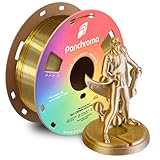

How we compared them
This is a research-based comparison. Every figure below comes from the makers' own product pages and Polymaker's data sheet, listed in the sources. We haven't tested either filament, so nothing here is a measured result of ours. Where a maker describes its own product, such as Polymaker's "Dynamic Color Effect" or ELEGOO's "customizable gloss," we label it as the maker's claim.
We only put numbers side by side where both makers publish the same kind of value under the same named test standard. Print settings line up directly. Test figures don't, because Polymaker names ISO standards and ELEGOO names none, so we list them separately.
Side-by-side specs
| Polymaker Panchroma Dual Silk PLA | ELEGOO PLA Silk (dual color) | |
|---|---|---|
| Variant | Dual Silk Crown (Gold-Silver), CA03027, new formula, 1.75 mm, 1 kg | Silk Blue Green, 1.75 mm, 1 kg |
| Nozzle temperature | 190–230 °C (product page and TDS) | 190–230 °C |
| Bed temperature | 25–60 °C (product page and TDS) | 35–65 °C, "Depends on Printer & Build Plate Type" |
| Build plate and glue | Glue when needed on PC or textured PEI | Textured or smooth PEI "or Other Plates"; glue "Not Required" |
| Enclosure | "Not needed" | Enclosed printing "Not Required"; chamber 20–45 °C |
| Maker's speed figure | Max 250 mm/s (product page); "Up to 250mm/s" at 0.4 mm line width and 0.2 mm layer height (TDS) | Below 220 mm/s |
| Gloss at speed | Silk effect kept "even at speeds up to 150mm/s" (FAQ) | Not stated |
| Nozzle | "0.4 mm or larger" | "Hardened Steel Nozzle, ≥ 0.4 mm" |
| Cooling | "full cooling" | Not stated |
| Color effect | Placement depends on geometry and spool orientation | Not described |
| Drying | 55 °C for 6 h, "Only if the material has absorbed moisture"; PolyDryer level 1 for Silk (TDS) | 50 ± 5 °C for 8 h; drying before use "Required" |
| Storage | Vacuum-sealed packaging (FAQ); no storage humidity given | 20% RH or below, sealed with desiccant |
| Diameter tolerance | Not stated on the product page | ±0.02 mm |
| Spool | Cardboard (Polymaker announcement); dimensions not published | Material not stated in text; 174 ± 5 g empty |
| AMS | "Compatible with AMS and other multi-material systems" (FAQ) | Not stated |
Temperatures and build plate
The nozzle ranges match at 190–230 °C. The bed ranges overlap at 35–60 °C, with Polymaker's starting lower, at 25 °C, and ELEGOO's reaching higher, to 65 °C. ELEGOO also gives a 20–45 °C chamber range and says no enclosure is required. Polymaker says an enclosure is "Not needed," and its FAQ says the filament prints on "both entry-level and advanced machines—no special upgrades, enclosures, or modifications are needed."
Polymaker's printing tips say to "Use standard PLA settings, a 0.4 mm or larger nozzle, and full cooling for the best surface quality," and to "Use glue when needed on PC or textured PEI and allow the plate to cool before removal." ELEGOO lists textured or smooth PEI "or Other Plates" and says glue is "Not Required."
The dual-color effect
This is where the documentation differs most.
- Polymaker Panchroma Dual Silk. Polymaker lists "Dynamic Color Effect" as a key feature. Its printing tips say to "Orient the model to make the dual-color effect visible; transition placement and which color faces outward depend on geometry and spool orientation," and to "Reduce printing speed when the intended shine, sparkle, or dual-color effect looks muted at higher speed."
- ELEGOO PLA Silk. ELEGOO's product page doesn't call Silk Blue Green dual color, and doesn't describe how the two colors are combined or how they show on a print. Its feature text describes "a glossy surface finish," and its key features list "Smooth and shiny finish, customizable gloss" without saying how to control the gloss.
Polymaker ties which color shows to geometry and spool orientation. ELEGOO says nothing on this, so only Polymaker gives you guidance for planning the effect.
Gloss and print speed
Polymaker's FAQ says "Our new formula maintains its high-gloss silk effect even at speeds up to 150mm/s," and the product page lists a maximum speed of 250 mm/s. Its data sheet says the "Up to 250mm/s" figure is "based on 0.4mm line width and 0.2mm layer height" and "varies with different line width and layer height." ELEGOO's spec table gives a printing speed below 220 mm/s, without stating a line width or layer height, and doesn't say whether gloss changes with speed.
These are each maker's own ceilings, not a measured race, and neither top speed is a speed for best gloss.
Nozzles
Polymaker says to use "a 0.4 mm or larger nozzle." ELEGOO's spec table lists "Hardened Steel Nozzle, ≥ 0.4 mm" as its recommended nozzle. ELEGOO doesn't explain that line, and its text doesn't call the filament abrasive or mention any filler. Neither maker publishes an abrasion note for these filaments. If you're unsure whether ELEGOO's line applies to your brass nozzle, ask ELEGOO.
Strength and heat figures: listed separately
These can't be set side by side. Polymaker names ISO standards and describes how its specimens were printed. ELEGOO's table names no test standard or specimen method. The two sets of figures don't tell you which filament is stronger.
Polymaker Panchroma Dual Silk (product page table and TDS V2.1 "Silk" column)
- Density: 1.24 g/cm³ (ISO 1183, product page)
- Tensile strength: 41.1 ± 0.8 MPa X-Y, 23.8 ± 2.8 MPa Z (ISO 527)
- Young's modulus, X-Y: 2403 ± 74.5 MPa (ISO 527)
- Notched Charpy impact, X-Y: 13.8 ± 1.3 kJ/m² (ISO 179)
- Vicat softening temperature: 64.7 °C (ISO 306, TDS)
Polymaker says the figures were "Tested on 100% infill specimens." Its data sheet says the specimens were printed at 230 °C on a 50 °C bed in an ambient environment, with two shells, three top and bottom layers, and the fan on. The data sheet covers all Panchroma silk finishes in one "Silk" column, and the Dual Silk product page links it and shows the same tensile, modulus, and impact values.
ELEGOO PLA Silk (product page spec table, no test standard named)
- Density: 1.25 g/cm³
- Melt index: 28.7 ± 2.1 g/10 min
- Melting temperature: 164 °C
- Vicat softening temperature: 58 °C
- Heat deflection temperature: 54 °C at 0.45 MPa
- Tensile strength: 26 ± 3 MPa X-Y, 5 ± 2 MPa Z
- Elongation at break: 9.7% ± 2.3% X-Y, 6.1% ± 1.5% Z
- Bending strength: 79 ± 2 MPa X-Y, 22 ± 3 MPa Z
- Bending modulus: 2816 ± 136 MPa X-Y, 2507 ± 144 MPa Z
- Impact strength: 25.5 ± 2.2 kJ/m² X-Y, 2.5 ± 1.5 kJ/m² Z, test type not stated
ELEGOO's table sits on its shared PLA Silk page and isn't labelled for any one color. In both makers' data, the Z figure, which measures strength between layers, is well below the X-Y figure. With a Vicat point in the 60s °C or lower for both and a 54 °C heat deflection figure from ELEGOO, our reading, not a maker's, is that neither suits a hot car, a sunny windowsill, or parts near heat.
Drying and storage
ELEGOO is stricter about drying.
- Polymaker Panchroma Dual Silk. The product page gives 55 °C for 6 hours, "Only if the material has absorbed moisture," and the data sheet lists PolyDryer level 1 for Silk. The FAQ says "Each spool is packaged using recyclable materials and vacuum-sealed for protection against moisture." Polymaker doesn't publish a temperature rating for its cardboard spool.
- ELEGOO PLA Silk. The spec table lists drying before use as "Required," at 50 ± 5 °C for 8 hours, and printing and storing at 20% RH or below, sealed with desiccant. ELEGOO also says its filament is "Complete dried for 24 hours before packaging and vacuum sealed with desiccants in the bag."
Our filament dryer vs dry box guide covers the options. If you see stringing anyway, our stringing guide covers the causes.
Spools and the AMS
Going by Polymaker's announcement, Panchroma Dual Silk ships on cardboard: Polymaker says it "will produce all filaments on a 100% recycled cardboard spools." Its FAQ says "Panchroma Dual Silk PLA is compatible with AMS and other multi-material systems." The product page doesn't publish the spool's dimensions.
ELEGOO's text doesn't state the spool material. The page lists an empty spool weight of 174 ± 5 g and says "A larger spool inner diameter design for easy feeding." It also offers a printable "Filament Ring" to "adapt to AMS (because AMS will rub the bottom paper tray, causing the paper tray to easily delaminate)," without saying which spools that note applies to. ELEGOO doesn't publish spool dimensions or claim AMS compatibility for PLA Silk.
Bambu Lab's AMS notes give a supported spool range of 50–68 mm wide and 197–202 mm across, "highly recommend" plastic spools that fit correctly, and "strongly advise" a spool adapter or adapter ring for cardboard spools. Polymaker's AMS claim is its own, and neither maker documents a tested fit with a named feeder, so check your feeder's documentation. Our AMS filament compatibility guide covers spool sizes and adapters.
What each maker says it's for
- Polymaker Panchroma Dual Silk. Polymaker says it's "perfect for home décor, cosplay props, flexi toys, sculptures, miniatures, and gifts." It also says "Dual Silk PLA is designed for aesthetics" and is "not meant for high-load or mechanical parts."
- ELEGOO PLA Silk. ELEGOO lists "Elegant silk-like appearance, luxurious beauty" and "Highly compatible and easy to print" among its key features, and says it has "Universal compatibility with most of the common 1.75mm FDM 3D printers." Those are ELEGOO's claims.

Polymaker Panchroma Dual Silk PLA (Crown (Gold-Silver), 1.75 mm, 1 kg)
- Best for
- Decorative prints and figurines where a two-tone gold-silver shift is the point.
- Skip this if
- You need the same color on every face of a part, or a plastic spool for an AMS.
Specs, strengths, and limitations
- Material
- PLA (silk, dual-color)
- Diameter
- 1.75 mm
- Net filament
- 1000 g (filament only, not packaged weight)
- Format
- cardboard spool
- Maker's nozzle range
- 190–230 °C
- Manufacturer states the new dual silk formula addresses brittleness and clogging and keeps its shine at 150 mm/s.
- Product page lists a Z-axis tensile strength of 23.8 MPa against 41.1 MPa X-Y.
- Prints at standard PLA settings (190–230 °C, 25–60 °C bed) with no enclosure.
- Which color shows depends on model geometry and spool orientation, per Polymaker, so results vary from print to print.
- Polymaker says to slow down if the dual-color effect looks muted at higher speed.
- Cardboard spool: Polymaker says its spools are AMS compatible, but Bambu Lab's general AMS guidance recommends an adapter or ring for cardboard spools. Check your unit.

ELEGOO PLA Silk (dual color) (Blue Green, 1.75 mm, 1 kg)
- Best for
- Inexpensive two-tone decorative prints.
- Skip this if
- You want the maker to document how the two colors show up, or you need strong layers.
Specs, strengths, and limitations
- Material
- PLA (silk, dual-color)
- Diameter
- 1.75 mm
- Net filament
- 1000 g (filament only, not packaged weight)
- Format
- other
- Maker's nozzle range
- 190–230 °C
- Manufacturer states a glossy silk finish with 'customizable gloss'.
- Same documented settings as ELEGOO's single-color silk (190–230 °C nozzle, 35–65 °C bed).
- Manufacturer states each spool is dried for 24 hours and vacuum-sealed.
- ELEGOO doesn't document how the dual-color effect behaves, so color placement is unpredictable.
- Spec table lists a Z-axis tensile strength of 5 ± 2 MPa.
- Drying is listed as required; ELEGOO doesn't state the spool material or dimensions, so check feeder fit.
Verdict: which should you buy?
Choose Polymaker Panchroma Dual Silk PLA if…
- You want the maker's guidance on orienting a model to show the two colors.
- You want gloss that Polymaker says holds up to 150 mm/s, with a lower 25 °C bed start.
- You're happy with a cardboard spool and will check its fit in your feeder.
Choose ELEGOO PLA Silk (dual color) if…
- You want a published ±0.02 mm diameter tolerance and a full property table, even without named test standards.
- You'll dry the spool before use, as ELEGOO's table requires, and store it at 20% RH or below.
- You're fine without maker guidance on how the two colors show up on a print.
Safety and limits
How this page was checked
Every temperature, speed, drying setting, spool detail, and test figure above comes from the manufacturer documents in the sources section, retrieved on 2026-10-13. We haven't printed with either filament for this page, so nothing here is a measured result of ours. Polymaker's Panchroma data sheet covers several finishes in one table, and we checked each Silk value against the Dual Silk product page's properties table. The data table gives a Vicat softening point of 64.7 °C for Silk, while the data sheet's summary chart shows 64 °C. We've used 64.7 °C. The product page lists Young's modulus as 2403 with a GPa label, while the data sheet gives 2403 ± 74.5 MPa. We've used the data sheet's unit. Polymaker's FAQ says Dual Silk "comes in 9 stunning colors," and its selector shows nine color names, with two old-formula spools listed again under slightly different names, so check the selector for current colors. ELEGOO's spec table is shared across its PLA Silk colors. ELEGOO's text doesn't state the spool material, so we don't name one. Answers in ELEGOO's store Q&A aren't clearly labelled as coming from ELEGOO in the page text we could read, so we haven't used them. Values vary by color and revision, so check the current pages for your spool. Read more in our editorial standards and affiliate disclosure.
Specialty materials: what to check before you buy a spool ↗Sources
- Panchroma Dual Silk PLA product page, Polymaker
- Panchroma Technical Data Sheet V2.1, Polymaker
- Polymaker transitions all filaments onto 100% recycled cardboard spools, Polymaker
- PLA Silk product page, ELEGOO
- Notes for AMS, Bambu Lab
This page is research-based: we have not tested the products or methods ourselves. It draws on the manufacturer documentation and sources listed. Exact settings and fit always defer to your printer and filament makers.
Keep reading

Best Silk PLA Filament (2026): Shiny Spools by Finish and Printer
The best silk PLA filament by finish: fifteen single, dual, tri-color and gradient spools, with each maker's speed, strength and AMS notes.

Best Specialty Filament (2026): ASA, PC, Carbon Fiber and Silk Picks
The best specialty filament by job: nine spools from ASA and polycarbonate to carbon-fiber blends and silk PLA, with each maker's printer requirements.
Bambu Lab PLA Silk+ vs Polymaker Panchroma Silk PLA
Bambu Lab PLA Silk+ and Polymaker Panchroma Silk PLA compared on maker data: temps, gloss, and AMS fit. Pick Bambu for an AMS, Panchroma for faster gloss.