Best Specialty Filament (2026): ASA, PC, Carbon Fiber and Silk Picks
The best specialty filament by job: nine spools from ASA and polycarbonate to carbon-fiber blends and silk PLA, with each maker's printer requirements.
On this page (12 sections)
Pick the material first and the spool second, because "specialty" covers very different jobs. For outdoor, sun-exposed parts, start with Polymaker ASA, the best-documented ASA here; Overture ASA and eSUN ASA+ are the alternatives, and all three need an enclosed printer. For heat-stressed parts without an enclosure, Prusament PC Blend Carbon Fiber is a filled PC that Prusa says needs no enclosure but does need a hardened nozzle. For translucent or heat-resistant parts, Polymaker PolyLite PC needs a hot, enclosed printer. For stiff, matte parts, PolyLite PLA-CF prints with standard PLA settings, and ELEGOO PETG-CF and Fiberon PA612-CF15 are the PETG and nylon options; all three need a wear-resistant nozzle. Polymaker Panchroma Silk PLA is for shiny decorative prints on any standard PLA printer. The fit rule: check the enclosure, nozzle and bed each material demands before you compare brands.
Quick picks
| Need | Pick | Why |
|---|---|---|
| Outdoor, sun-exposed parts | Polymaker ASA | The best-documented ASA here, on an enclosed printer whose bed reaches 95 °C |
| Heat-stressed parts without an enclosure | Prusament PC Blend Carbon Fiber | Prusa says no enclosure is needed and states it resists up to 114 °C; needs a hardened nozzle |
| Translucent covers and light diffusers | Polymaker PolyLite PC | 89% light transmission per its data sheet; needs a hot, enclosed printer |
| Stiff, matte parts at PLA settings | Polymaker PolyLite PLA-CF | Prints with standard PLA settings and no enclosure; needs a hardened nozzle |
| Shiny decorative prints | Polymaker Panchroma Silk PLA | Prints on most FDM printers without special hardware |
Picks are matched to documented needs, not scored.
Who is this specialty filament guide for?
This page is for readers who have outgrown standard PLA and PETG and know roughly what they need the part to do: survive sunlight, take heat, stay stiff, look shiny, or print with dissolvable supports. Each material comes with its own hardware demands, such as an enclosure, a hardened nozzle, a hot bed, or a second extruder. Check those before you compare brands. If you're not sure which material you need, start with the filament finder or the specialty materials hub.
This page is an overview with one or a few picks per material. For more choices, see the dedicated shortlists: ASA filament (seven spools), carbon fiber filament (fifteen, from PLA-CF to nylon and PC), and silk PLA (fifteen, including dual-color and gradient).
| Product | Best for | Skip if | Link |
|---|---|---|---|
| Polymaker ASA (Black, 1.75 mm, 1 kg) | Outdoor and sun-exposed functional parts printed on an enclosed machine. | Your printer is open-frame or can't reach a 95 °C bed and 260 °C nozzle. | View on Amazon (opens Amazon in a new tab) |
| OVERTURE ASA (Black, 1.75 mm, 1 kg) | Outdoor, sun-exposed functional parts printed on an enclosed printer. | Your printer is open-frame, you want fast printing (the TDS lists 30–50 mm/s), or you need a published heat deflection temperature. | View on Amazon (opens Amazon in a new tab) |
| eSUN ASA+ (Black, 1.75 mm, 1 kg) | Outdoor functional parts on an enclosed printer that can reach a 110 °C bed. | Your printer is open-frame or its bed tops out below 100 °C. | View on Amazon (opens Amazon in a new tab) |
| Polymaker PolyLite PC (Transparent, 1.75 mm, 1 kg) | Heat-resistant, translucent parts such as light diffusers, printed on an enclosed, high-temperature printer. | Your printer is open-frame, has a PTFE-lined hotend, or can't reach a 105 °C bed. | View on Amazon (opens Amazon in a new tab) |
| Prusa Research Prusament PC Blend Carbon Fiber (Black, 1.75 mm, 800 g) | Heat-stressed functional parts such as fan shrouds, on a printer with a hardened nozzle and a 120 °C-capable bed. | Your printer has a brass nozzle or can't reach about 285 °C at the nozzle. | View on Amazon (opens Amazon in a new tab) |
| Polymaker PolyLite PLA-CF (Black, 1.75 mm, 1 kg) | Stiff, matte-finish PLA parts and prototypes on a printer fitted with a hardened nozzle. | Your printer only has a brass nozzle, or the part will see heat. | View on Amazon (opens Amazon in a new tab) |
| ELEGOO PETG-CF (Carbon Fiber Black, 1.75 mm, 1 kg) | Stiff matte functional parts on a printer with a 0.4 mm or larger hardened steel nozzle. | Your printer only has a brass nozzle, or the part will see temperatures near the listed 74 °C (0.45 MPa) heat deflection temperature. | View on Amazon (opens Amazon in a new tab) |
| Polymaker Fiberon PA612-CF15 (Black, 1.75 mm, 1 kg) | Stiff, heat-resistant engineering parts such as jigs and fixtures, on a printer with a hardened nozzle and a dry box. | Your printer has a brass nozzle or a hotend that can't reach 250 °C, or you can't keep filament below 20% RH. | View on Amazon (opens Amazon in a new tab) |
| Polymaker Panchroma Silk PLA (Silk Gold, 1.75 mm, 1 kg, spool (new formula)) | Shiny decorative prints, vases, cosplay props, and gifts on any standard PLA printer. | The part needs strength or heat resistance more than looks. | View on Amazon (opens Amazon in a new tab) |


How we chose these nine
A product made the list only if it met these criteria:
- Manufacturer documentation we could read. Most have a technical data sheet. Overture's ASA and ELEGOO's PETG-CF have product-page specs only, and we say what's missing.
- An exact variant we could verify. Each catalog record ties one Amazon listing to one manufacturer product, color, diameter (1.75 mm), and net mass. One is not 1 kg: Prusament PC Blend Carbon Fiber holds 800 g.
- A clear abrasive flag. We recorded whether each maker calls its filament abrasive or recommends a hardened nozzle, because that decides whether your current nozzle will last.
We don't compare across groups: an ASA and a silk PLA aren't competing for the same job.
ASA: outdoor and sun-exposed parts
ASA prints much like ABS but is generally chosen for better UV and weather resistance. All three makers here call for an enclosed printer. Our ABS vs ASA guide covers the trade-offs, including emissions and ventilation, which apply to ASA as much as to ABS. If you're coming from PLA, our PLA vs ASA guide compares the two.
Polymaker ASA (Black, 1.75 mm, 1 kg)
Polymaker describes its ASA as an alternative to ABS with improved weather and UV resistance, printed with settings very similar to ABS. Its data sheet lists a closed chamber as "Needed", the cooling fan off, and a heat deflection temperature of 100 °C at 1.8 MPa. It suits readers who want the best-documented ASA here, on an enclosed printer whose bed reaches 95 °C.
It was formerly sold as PolyLite ASA, and Polymaker notes that old packaging may still ship. Like Polymaker's other filaments, it comes on a cardboard spool.

Polymaker ASA (Black, 1.75 mm, 1 kg)
- Best for
- Outdoor and sun-exposed functional parts printed on an enclosed machine.
- Skip this if
- Your printer is open-frame or can't reach a 95 °C bed and 260 °C nozzle.
Specs, strengths, and limitations
- Material
- ASA
- Diameter
- 1.75 mm
- Net filament
- 1000 g (filament only, not packaged weight)
- Format
- cardboard spool
- Maker's nozzle range
- 230–260 °C
- Manufacturer states it is an alternative to ABS with improved weather and UV resistance.
- Manufacturer TDS lists a heat deflection temperature of 100 °C (1.8 MPa).
- Manufacturer states it prints with settings very similar to ABS.
- Needs an enclosed printer per the TDS.
- Requires higher nozzle and bed temperatures (230–260 °C, 75–95 °C) than PLA or PETG.
- Cardboard spool: Bambu Lab strongly advises a spool adapter or adapter ring for cardboard spools in the AMS.
Skip it if your printer is open-frame, or can't reach a 95 °C bed and a 260 °C nozzle.
Overture ASA (Black, 1.75 mm, 1 kg)
Overture says its ASA is formulated for maximum UV protection for outdoor use, and its product page lists "Enclosed Printer Required". Overture states that every spool is dried for 24 hours before vacuum sealing in a resealable foil bag, and gives a dimensional accuracy of ±0.02 mm. It suits readers who want ASA that arrives dry, with a straightforward spec list.
Overture doesn't publish a data sheet, a heat deflection figure, or the spool material for this product, so you can't compare its heat rating with the others.

OVERTURE ASA (Black, 1.75 mm, 1 kg)
- Best for
- Outdoor, sun-exposed functional parts printed on an enclosed printer.
- Skip this if
- Your printer is open-frame, you want fast printing (the TDS lists 30–50 mm/s), or you need a published heat deflection temperature.
Specs, strengths, and limitations
- Material
- ASA
- Diameter
- 1.75 mm
- Net filament
- 1000 g (filament only, not packaged weight)
- Format
- other
- Maker's nozzle range
- 240–270 °C
- Manufacturer states it is formulated for maximum UV protection, for outdoor use.
- Manufacturer states each spool is dried for 24 hours and vacuum-sealed in a resealable foil bag.
- Manufacturer states a dimensional accuracy of ±0.02 mm.
- Needs an enclosed printer: the product page lists 'Enclosed Printer Required'.
- Needs a 240–270 °C nozzle and a 70–95 °C bed per the product page; dry at 75 °C for 7 h when needed.
- Slow and fussy to print: Overture's TDS V5.1 lists 30–50 mm/s and PVA glue on the build surface, and it gives a Vicat softening point (106.2 °C) but no heat deflection temperature.
Skip it if your printer is open-frame, or you want published data sheet values.
eSUN ASA+ (Black, 1.75 mm, 1 kg)
eSUN ASA+ is eSUN's modified grade of ASA. eSUN recommends enclosed-chamber printing. It runs hotter than the other two, with the data sheet listing a 250–280 °C nozzle and a 100–110 °C bed, based on eSUN's test settings for a Bambu Lab P1S with a 0.4 mm nozzle.
The data sheet gives a heat distortion temperature of 95.5 °C at 0.45 MPa, but eSUN states its data sheet properties come from injection-molded specimens, not printed parts. eSUN publishes no drying settings for it.

eSUN ASA+ (Black, 1.75 mm, 1 kg)
- Best for
- Outdoor functional parts on an enclosed printer that can reach a 110 °C bed.
- Skip this if
- Your printer is open-frame or its bed tops out below 100 °C.
Specs, strengths, and limitations
- Material
- ASA (ASA+ (eSUN modified ASA))
- Diameter
- 1.75 mm
- Net filament
- 1000 g (filament only, not packaged weight)
- Format
- other
- Maker's nozzle range
- 250–280 °C
- Manufacturer states outstanding weatherability, with UV resistance against fading and yellowing.
- TDS lists a heat distortion temperature of 95.5 °C (0.45 MPa).
- Needs enclosed-chamber printing per eSUN's product page.
- Runs hot: the TDS lists a 250–280 °C nozzle and a 100–110 °C bed.
- eSUN publishes no drying settings, and its TDS values are from injection-molded, not printed, specimens.
Skip it if your printer is open-frame, or its bed tops out below 100 °C.
Polycarbonate: heat resistance and translucency
Polycarbonate grades handle more heat than ABS or ASA, but ask more of the printer. The two here are very different: one is unfilled and wants a hot chamber, while the other is carbon-fiber filled and abrasive. For the filled one, read our abrasive filament nozzle guide before buying.
Polymaker PolyLite PC (Transparent, 1.75 mm, 1 kg)
Polymaker's data sheet (V5.4) lists a heat deflection temperature of 107 °C at 1.8 MPa and 89% light transmission, which suits light diffusers and translucent covers. It's sold only in Transparent. It is demanding. The data sheet lists a closed chamber of 70–100 °C as needed, and Polymaker's product page strongly recommends a heated chamber of at least 60 °C and an all-metal hotend that reaches at least 250 °C. Polymaker also recommends annealing parts at 90 °C for 2 hours right after printing.
It must be dry. Polymaker gives 75 °C for 6 hours in the data sheet and 12 hours on the product page if the filament has absorbed moisture.

Polymaker PolyLite PC (Transparent, 1.75 mm, 1 kg)
- Best for
- Heat-resistant, translucent parts such as light diffusers, printed on an enclosed, high-temperature printer.
- Skip this if
- Your printer is open-frame, has a PTFE-lined hotend, or can't reach a 105 °C bed.
Specs, strengths, and limitations
- Material
- PC
- Diameter
- 1.75 mm
- Net filament
- 1000 g (filament only, not packaged weight)
- Format
- cardboard spool
- Maker's nozzle range
- 250–270 °C
- Manufacturer states good stiffness and heat resistance with light-diffusing properties.
- TDS lists a heat deflection temperature of 107 °C (1.8 MPa).
- TDS lists 89% light transmission, suited to light diffusers.
- Needs an enclosure: the TDS lists a closed chamber (70–100 °C) as needed, and the product page recommends a heated chamber for large parts.
- Needs an all-metal hotend reaching 250–270 °C and a 90–105 °C bed; Polymaker recommends annealing parts at 90 °C for 2 h.
- Must be dried before use if it has absorbed moisture (75 °C; 6 h per TDS, 12 h per product page).
Skip it if your printer is open-frame, has a PTFE-lined hotend, or can't reach a 105 °C bed.
Prusament PC Blend Carbon Fiber (Black, 1.75 mm, 800 g)
Prusa states this filled PC blend resists temperatures up to 114 °C, and up to 130 °C after annealing. Its material page says an enclosure is not needed, a heated bed is necessary, and a hardened steel nozzle is needed because the material is abrasive. Prusa also states there's no need to dry it before printing. It suits heat-stressed functional parts such as fan shrouds.
There are trade-offs. The spool holds 800 g, not 1 kg. Prusa lists a diameter tolerance of ±0.04 mm, looser than its unfilled filaments because of the carbon fibers. It needs a nozzle around 285 °C and a bed around 110 °C per Prusa's data sheet. The top of that range is above the 290 °C nozzle maximum Prusa lists for its own MK4S, CORE One, and XL, so on those printers stay at or below 290 °C.

Prusa Research Prusament PC Blend Carbon Fiber (Black, 1.75 mm, 800 g)
- Best for
- Heat-stressed functional parts such as fan shrouds, on a printer with a hardened nozzle and a 120 °C-capable bed.
- Skip this if
- Your printer has a brass nozzle or can't reach about 285 °C at the nozzle.
Specs, strengths, and limitations
- Material
- PC (PC blend, carbon-fiber filled)
- Diameter
- 1.75 mm
- Net filament
- 800 g (filament only, not packaged weight)
- Format
- plastic spool
- Maker's nozzle range
- 275–295 °C
- Nozzle
- Abrasive: the maker recommends a wear-resistant nozzle
- Manufacturer states excellent temperature resistance (114 °C), up to 130 °C with annealing.
- Manufacturer states an enclosure is not needed, with good UV stability and resistance to common chemicals.
- Manufacturer states a professional-looking matte finish and lighter weight than unmodified PC Blend.
- Abrasive: Prusa states a hardened steel nozzle is needed.
- Needs a hotend reaching 285 ± 10 °C and a heated bed at 110 ± 10 °C per the TDS.
- Spool holds 800 g, and diameter tolerance is ±0.04 mm, looser than Prusa's unfilled filaments.
- The data sheet's 285 ± 10 °C nozzle range tops out above the 290 °C maximum Prusa lists for the MK4S, CORE One, and XL hotends; stay at or below your printer's limit.
Skip it if your printer has a brass nozzle or can't reach about 285 °C at the nozzle.
Carbon-fiber PLA and PETG: stiff, matte parts
Chopped carbon fiber adds stiffness and a matte finish, but it wears nozzles, as our worn nozzle guide explains. Both makers here recommend a hardened nozzle. Our PLA-CF vs PETG-CF guide compares the two base materials. Our abrasive filament nozzle guide explains the nozzle options, and our replacement nozzle guide covers finding one that fits your exact hotend.
Polymaker PolyLite PLA-CF (Black, 1.75 mm, 1 kg)
Polymaker says 8% chopped carbon fiber gives this PLA "exceptional rigidity and strength", with a matte black finish, virtually invisible layer lines, and low shrinkage. It prints with standard PLA settings, and the data sheet lists no enclosure needed. Polymaker's product page says the material is abrasive and a hardened nozzle is strongly recommended. It suits stiff, good-looking prototypes and fixtures that won't see heat.
Heat is the caveat. The data sheet lists a heat deflection temperature of 50 °C at 1.8 MPa, below the 58 °C Polymaker lists for its unfilled PolyLite PLA. The Amazon listing's model number (PA10001) and title match PLA-CF, but its bullet points describe plain PolyLite PLA, so confirm the title before you buy.

Polymaker PolyLite PLA-CF (Black, 1.75 mm, 1 kg)
- Best for
- Stiff, matte-finish PLA parts and prototypes on a printer fitted with a hardened nozzle.
- Skip this if
- Your printer only has a brass nozzle, or the part will see heat.
Specs, strengths, and limitations
- Material
- PLA (carbon-fiber filled (8 wt% chopped carbon fiber))
- Diameter
- 1.75 mm
- Net filament
- 1000 g (filament only, not packaged weight)
- Format
- cardboard spool
- Maker's nozzle range
- 190–230 °C
- Nozzle
- Abrasive: the maker recommends a wear-resistant nozzle
- Manufacturer states 8% chopped carbon fiber gives exceptional rigidity and strength.
- Manufacturer states a matte black finish with virtually invisible layer lines and low shrinkage.
- Manufacturer states it prints with standard PLA settings; the TDS lists no enclosure needed.
- Abrasive: Polymaker strongly recommends a hardened nozzle.
- Not suited to heat: the TDS lists a heat deflection temperature of 50 °C (1.8 MPa).
- Cardboard spool: Bambu Lab strongly advises a spool adapter or adapter ring for cardboard spools in the AMS.
- The Amazon listing's bullet points describe plain PolyLite PLA, though its title and model number (PA10001) are the carbon-fiber version. Check that the title says Carbon Fiber PLA before you buy.
Skip it if your printer only has a brass nozzle, or the part will see heat.
ELEGOO PETG-CF (Carbon Fiber Black, 1.75 mm, 1 kg)
ELEGOO says carbon fiber adds strength, rigidity, and dimensional stability, and that, compared with PLA-CF, its PETG-CF has "superior toughness" and "is less prone to fracture under external stress and impact." Its product page recommends a 0.4, 0.6, or 0.8 mm hardened steel nozzle and says 0.2 mm nozzles are not compatible. ELEGOO's spec table says to dry it at 60 ± 5 °C for 8 hours before use (its "Important Notes" say 70 °C), and to print and store it at or below 20% RH. It suits stiff, matte PETG parts on a printer with a 0.4 mm or larger hardened steel nozzle.
ELEGOO publishes no data sheet, heat deflection figure, or carbon-fiber percentage, so you can't compare its heat rating with PLA-CF directly.
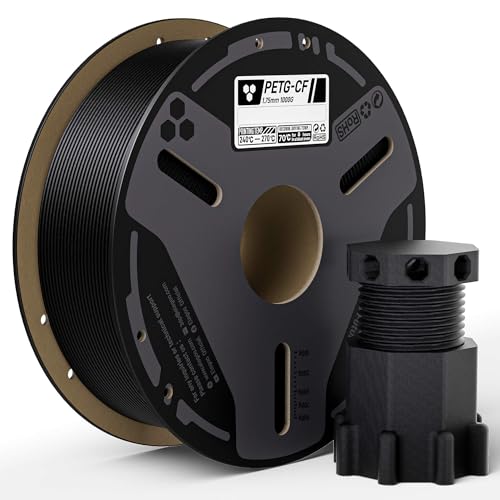
ELEGOO PETG-CF (Carbon Fiber Black, 1.75 mm, 1 kg)
- Best for
- Stiff matte functional parts on a printer with a 0.4 mm or larger hardened steel nozzle.
- Skip this if
- Your printer only has a brass nozzle, or the part will see temperatures near the listed 74 °C (0.45 MPa) heat deflection temperature.
Specs, strengths, and limitations
- Material
- PETG (carbon-fiber filled)
- Diameter
- 1.75 mm
- Net filament
- 1000 g (filament only, not packaged weight)
- Format
- other
- Maker's nozzle range
- 240–270 °C
- Nozzle
- Abrasive: the maker recommends a wear-resistant nozzle
- Manufacturer states carbon fiber adds strength and rigidity, with abrasion resistance and dimensional stability.
- Manufacturer states that, compared with PLA-CF, it has superior toughness and is less prone to fracture under stress and impact.
- Manufacturer states a premium matte finish that reduces visible layer lines.
- Abrasive: ELEGOO recommends a 0.4/0.6/0.8 mm hardened steel nozzle and says 0.2 mm nozzles are not compatible.
- Needs drying before use (60 ± 5 °C for 8 h per the spec table; the page's 'Important Notes' say 70 °C) and storage at ≤ 20% RH.
- Modest heat resistance: the spec table lists a heat deflection temperature of 74 °C at 0.45 MPa; no 1.8 MPa figure or TDS PDF is published.
Skip it if your printer only has a brass nozzle, or you need published heat-resistance data.
Carbon-fiber nylon: engineering parts
Filled nylon is the most demanding material here. It wears nozzles and needs careful moisture control. Read our abrasive filament nozzle guide and dryer vs dry box guide first.
Polymaker Fiberon PA612-CF15 (Black, 1.75 mm, 1 kg)
Polymaker states PA612-CF15 has significantly lower moisture sensitivity than PA6, PA66, and PA6-based nylons. Its data sheet (V1.1) lists X-Y tensile strength of 91.9 MPa dry and 83.1 MPa after moisture conditioning, on annealed specimens, and a heat deflection temperature of 175 °C at 0.45 MPa. The sheet's annealing note sits under its mechanical tables, not the thermal table. Polymaker's "Warp-Free" guidance is to keep the chamber at room temperature and the build plate and ambient air below 50 °C, so it doesn't need a hot enclosure. It suits stiff jigs, fixtures, and brackets.
The data sheet highly recommends a wear-resistant nozzle, such as hardened steel or ruby, and estimates brass nozzle life at about 9 hours. Lower moisture sensitivity isn't moisture immunity. Polymaker says to store and print it below 20% RH, dry it at 100 °C for 10 hours, and anneal parts at 100 °C for 16 hours for full properties. It was formerly sold as PolyMide PA612-CF, and Polymaker says the new version may print a slightly darker black.

Polymaker Fiberon PA612-CF15 (Black, 1.75 mm, 1 kg)
- Best for
- Stiff, heat-resistant engineering parts such as jigs and fixtures, on a printer with a hardened nozzle and a dry box.
- Skip this if
- Your printer has a brass nozzle or a hotend that can't reach 250 °C, or you can't keep filament below 20% RH.
Specs, strengths, and limitations
- Material
- PA (PA612, 15% carbon-fiber filled)
- Diameter
- 1.75 mm
- Net filament
- 1000 g (filament only, not packaged weight)
- Format
- other
- Maker's nozzle range
- 250–300 °C
- Nozzle
- Abrasive: the maker recommends a wear-resistant nozzle
- Manufacturer states significantly lower moisture sensitivity than PA6/66 and PA6-based nylons.
- TDS lists 91.9 MPa X-Y tensile strength dry and 83.1 MPa after moisture conditioning (annealed specimens).
- Manufacturer states Warp-Free technology for print size stability.
- Abrasive: the TDS highly recommends a hardened steel or ruby nozzle (brass lasts about 9 h).
- Needs a 250–300 °C hotend; Polymaker's product page recommends an enclosure, and the TDS recommends annealing at 100 °C for 16 h for full properties.
- Still hygroscopic: the TDS says to store and print below 20% RH and dry at 100 °C for 10 h.
Skip it if your printer has a brass nozzle or can't reach 250 °C, or you can't keep filament below 20% RH.
Silk PLA: decorative finishes
Silk PLA is about appearance, not strength. It prints like PLA, so it suits most standard printers. If you want everyday PLA instead, see our PLA filament shortlist.
Polymaker Panchroma Silk PLA (Silk Gold, 1.75 mm, 1 kg)
Polymaker says its new silk formula improves layer adhesion and addresses the brittleness and clogging associated with silk PLA, and that the silk shine holds even at 150 mm/s. It prints on most FDM printers without special hardware, and Polymaker markets it for décor, cosplay props, and display models.
The Panchroma data sheet lists a Vicat softening temperature of 64.7 °C for Silk, so keep it away from heat. Polymaker sells older-formula and refill versions too. This listing is the new-formula spool (model CA03006), so check the model number on the listing.

Polymaker Panchroma Silk PLA (Silk Gold, 1.75 mm, 1 kg, spool (new formula))
- Best for
- Shiny decorative prints, vases, cosplay props, and gifts on any standard PLA printer.
- Skip this if
- The part needs strength or heat resistance more than looks.
Specs, strengths, and limitations
- Material
- PLA (silk)
- Diameter
- 1.75 mm
- Net filament
- 1000 g (filament only, not packaged weight)
- Format
- cardboard spool
- Maker's nozzle range
- 190–230 °C
- Manufacturer states the silk shine is maintained even at 150 mm/s.
- Manufacturer states it prints on most FDM printers without special hardware.
- Manufacturer states the new formula improves layer adhesion and resists brittleness and clogging.
- Low heat resistance: the data sheet's data table lists a Vicat softening temperature of 64.7 °C (ISO 306) for Silk.
- A decorative finish rather than a functional material; Polymaker markets it for décor, cosplay props, and display models.
- Cardboard spool: Polymaker says its spools are AMS compatible, but Bambu Lab's general AMS guidance recommends an adapter or ring for cardboard spools. Check your unit.
Skip it if the part needs strength or heat resistance more than looks.
What should you check before buying specialty filament?
- Nozzle material. Prusament PC Blend Carbon Fiber, PolyLite PLA-CF, ELEGOO PETG-CF, and Fiberon PA612-CF15 are flagged by their makers as needing a hardened or wear-resistant nozzle. Check your exact hotend model before you buy one, using the abrasive filament nozzle guide.
- Nozzle diameter. ELEGOO says its PETG-CF is not compatible with 0.2 mm nozzles. Check each maker's minimum nozzle size for filled filaments.
- Hotend temperature. The ranges here go up to 280 °C (eSUN ASA+), around 285 °C (Prusament PC Blend Carbon Fiber), and 300 °C (Fiberon PA612-CF15's upper bound). Check your hotend's documented maximum, including any PTFE-lined parts.
- Bed temperature. ASA and PC grades want 95–120 °C at the top of their ranges. Silk PLA, PLA-CF, and PA612-CF15 run much cooler.
- Enclosure. All three ASAs and PolyLite PC call for one. Prusa says PC Blend Carbon Fiber doesn't need one, and Polymaker wants PA612-CF15 printed at room temperature.
- Spool format and size. Polymaker's spools are cardboard. One product here is under 1 kg. Check your material system and dryer documentation.
Alternatives, and when you don't need to buy anything
- Need heat resistance indoors, without UV exposure? Standard ABS may be enough. Read our ABS vs ASA guide or browse the ABS hub.
- Only need a bit more toughness or warmth than PLA? PETG is easier to print. See our PETG filament shortlist.
- Don't have a hardened nozzle? Before buying a carbon-fiber spool, price in a nozzle, and check fit with our replacement nozzle guide. If you only want a matte look, an unfilled matte PLA avoids the nozzle question entirely.
- Supports are hard to remove on a single-nozzle printer? Try support interface settings in your slicer before buying PVA and a second extruder.
- Prints are clogging after switching materials? Work through our clog diagnosis guide before replacing parts.
Heat, emissions, drying, and safety
- Ventilation. ASA is a high-emitting material, as our ABS vs ASA guide explains, and every heated plastic releases particles and vapors. Print in a ventilated space, not where people sleep.
- Enclosure heat. PolyLite PC's data sheet calls for a 70–100 °C chamber. That is far hotter than most enclosures and printer electronics are built for. Check your printer maker's ratings, and read our enclosure planning guide for electronics heat and fire safety.
- Rated temperatures. Never exceed your hotend's or bed's rated maximum to reach a filament's range, and never bypass thermal protection.
- Drying and spool limits. Settings here run from 55 °C (Silk PLA) to 100 °C (PA612-CF15). Check your dryer's maximum and the spool's rating before drying on the spool, especially for cardboard spools. Don't use a kitchen food oven as your default dryer or annealing oven.
- Abrasive filaments. Follow your printer maker's procedure for nozzle changes, and let the hotend cool as they direct.
How this page was checked
This is a research-based shortlist. We have not printed with these spools for this page, so there are no test results, scores, or "we found" claims here. Every temperature, heat figure, drying setting, nozzle requirement, and enclosure statement above comes from the manufacturer documents listed in the sources section, and from the product pages and data sheets recorded in our catalog for each spool, including Polymaker's Panchroma data sheet, all retrieved on 2026-10-06. Values vary by exact product, color, and revision, and makers do reformulate. Check the current data sheet for your spool before relying on a number. Read more about our process in our editorial standards and affiliate disclosure.
Specialty materials: what to check before you buy a spool ↗Head-to-head comparisons
Deciding between two products on this page? Each comparison puts both makers’ specs side by side and says who should choose which.
Sources
- Polymaker ASA Technical Data Sheet, Polymaker
- Overture ASA 3D Printer Filament 1.75mm, Overture
- eSUN ASA+ Technical Data Sheet, eSUN
- PolyLite PC Technical Data Sheet V5.4, Polymaker
- Prusament PC Blend Carbon Fiber material page, Prusa Polymers
- PolyLite PLA-CF product page, Polymaker
- ELEGOO PETG-CF Filament 1.75mm 1kg, ELEGOO
- Fiberon PA612-CF15 Technical Data Sheet V1.1, Polymaker
This page is research-based: we have not tested the products or methods ourselves. It draws on the manufacturer documentation and sources listed. Exact settings and fit always defer to your printer and filament makers.
Keep reading

Nozzles for Abrasive Filaments: Carbon Fiber, Glass Fiber, and Glow
Which filaments wear out nozzles, how brass, stainless, hardened, coated, and ruby-tipped nozzles differ, and how to find the right part for your exact hotend.

ABS vs ASA: Heat, UV, Warping, and Ventilation
How ABS and ASA compare for heat-resistant and outdoor parts: UV behavior, warping, enclosure needs, emissions and ventilation, and when PETG is enough.
How to Choose a Replacement Nozzle for Your Exact Hotend
Match a replacement nozzle to your exact printer, hotend revision, and filament: nozzle systems, diameters, wear-resistant materials, and a fit checklist.