SUNLU Silk PLA+ vs ELEGOO PLA Silk
SUNLU Silk PLA+ vs ELEGOO PLA Silk in gold on maker data: temperatures, bed, drying, spools, tests. Pick SUNLU for ISO-tested data, ELEGOO for a 190 °C start.
On this page (13 sections)
Pick SUNLU SILK PLA+ if you want test figures with named ISO standards and the option of an unheated bed with glue. Pick ELEGOO PLA Silk if you want a nozzle range that starts at 190 °C, maker figures for strength between layers, and an empty spool weight. Both are single-color gold silk PLA for display models and decor, and neither maker calls for an enclosure. SUNLU's data sheet says how its test bars were printed, and SUNLU also publishes retraction and support settings. ELEGOO lists drying before use as "Required," and its table lists a hardened steel nozzle without explaining why. ELEGOO's Z tensile strength is 5 ± 2 MPa, but it names no test standard, and SUNLU publishes no Z tensile figure. Neither maker says what speed gives the best shine.
Who this comparison is for
This page is for anyone choosing between two specific gold silk spools: SUNLU SILK PLA+ in Silk Light Gold and ELEGOO PLA Silk in Silk Gold, both 1.75 mm and 1 kg. SUNLU's page lists "Net Weight: 1 kg/roll," "Gross Weight: 1.3 kg/roll," and 330 m of filament per kilogram, and publishes a hex code of #f1be48 for Light Gold. ELEGOO's page lists "Filament weight: 1 kg/spool" and doesn't publish hex codes. SUNLU's store menu also lists a separate SILK PLA+ 2.0. This page covers the original SILK PLA+, so check which one you're buying. For other silk finishes, see the silk PLA filament shortlist, or our eSUN PLA Silk vs Overture Silk PLA and Bambu PLA Silk+ vs Polymaker Panchroma Silk comparisons. If you're still choosing a finish, start with matte vs silk vs standard PLA.
| Product | Best for | Skip if | Link |
|---|---|---|---|
| SUNLU SILK PLA+ (Silk Light Gold, 1.75 mm, 1 kg) | Affordable everyday silk prints in a soft gold. | You want SUNLU's SILK PLA+ 2.0 formula specifically. | View on Amazon (opens Amazon in a new tab) |
| ELEGOO PLA Silk (Gold, 1.75 mm, 1 kg) | Low-cost shiny gold decorative prints where strength doesn't matter. | The print is functional or will be stressed across layers. | View on Amazon (opens Amazon in a new tab) |

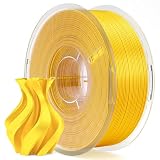
How we compared them
This is a research-based comparison. Every figure below comes from the makers' own product pages, SUNLU's data sheet and SUNLU's wiki, listed in the sources. We haven't tested either filament, so nothing here is a measured result of ours. Where a maker describes its own product, such as SUNLU's "glossy finish that outshines standard PLA PLUS" or ELEGOO's "customizable gloss," we label it as the maker's claim.
We put print settings side by side because they are each maker's guidance. We don't put the test figures side by side. SUNLU names ISO standards and says how its test bars were printed, while ELEGOO's table names no standard and no specimen method. So we list each maker's figures separately.
Side-by-side specs
| SUNLU SILK PLA+ | ELEGOO PLA Silk | |
|---|---|---|
| Variant | Silk Light Gold, 1.75 mm, 1 kg | Silk Gold, 1.75 mm, 1 kg |
| Nozzle temperature | 210–230 °C (product page and TDS) | 190–230 °C (spec table) |
| Maker's speed figure | 50–200 mm/s (product page and TDS) | Below 220 mm/s (spec table) |
| Bed temperature | 50–60 °C without glue, or unheated with glue (product page); 50–60 °C (TDS) | 35–65 °C, "Depends on Printer & Build Plate Type" |
| Build plate and glue | Textured PEI, no treatment needed (TDS) | Textured or smooth PEI "or Other Plates"; glue "Not Required" |
| Enclosure and room | Ambient room temperature (TDS) | Enclosed printing "Not Required"; chamber 20–45 °C |
| Cooling fan | "On/off" (TDS), no percentage | Not stated |
| Retraction | 0.8–1.2 mm at 30–40 mm/s (TDS) | Not stated |
| Nozzle | Not stated | "Hardened Steel Nozzle, ≥ 0.4 mm" |
| Gloss advice | None beyond the finish claim | "customizable gloss," without saying how |
| Drying | 50 °C (TDS; the product page says "Blast Drying Oven"), no time; 50–55 °C for 6–8 h for silk PLA, "Recommendation" (wiki) | 50 ± 5 °C for 8 h; drying before use "Required" |
| Storage humidity | Below 20% RH, sealed with desiccant | 20% RH or below, sealed with desiccant |
| Packaging | Not described on the product page | "Complete dried for 24 hours before packaging and vacuum sealed with desiccants in the bag" |
| Diameter tolerance | ±0.02 mm | ±0.02 mm |
| Spool | Material, size and weight not stated | Material and size not stated; empty spool 174 ± 5 g |
| AMS | Not mentioned | Printable "Filament Ring" offered to "adapt to AMS" |
Temperatures, bed, and plate
ELEGOO's nozzle range, 190–230 °C, is wider and starts 20 °C lower than SUNLU's 210–230 °C. Both top out at 230 °C.
The bed advice differs more. SUNLU's key features say "Adhesive required without heating" and "Adhesive not required with 50-60°C heating." Its data sheet gives a 50–60 °C plate, textured PEI, and no surface treatment. Further down the same product page, SUNLU's marketing text says the filament "requires no heated bed," without mentioning glue. We follow the key features and the data sheet: an unheated bed only with glue. ELEGOO gives 35–65 °C, says it "Depends on Printer & Build Plate Type," lists textured or smooth PEI "or Other Plates," and says glue is "Not Required."
Neither maker calls for an enclosure. ELEGOO says enclosed printing is "Not Required" and gives a 20–45 °C chamber range. SUNLU's data sheet lists the room temperature as ambient.
Speed and shine
Neither maker says what speed gives the best gloss on these spools.
- SUNLU SILK PLA+. The product page and data sheet both give 50–200 mm/s at 210–230 °C. SUNLU's finish claims are that the filament "offers a stunning, glossy finish that outshines standard PLA PLUS" and that "Its smooth, silky surface requires no post-print polishing." SUNLU doesn't link gloss to speed or temperature on these pages.
- ELEGOO PLA Silk. The spec table gives a speed below 220 mm/s. ELEGOO lists "Smooth and shiny finish, customizable gloss" as a key feature and describes "a luxurious silky sheen and ultra-smooth glossy finish," but doesn't say how to change the gloss.
Neither maker gives the layer height or line width behind its speed figure. These are each maker's limits, not a measured race and not a speed for best shine. Our silk PLA problems guide covers dull or patchy shine, but for these two spools that advice is ours, not SUNLU's or ELEGOO's.
Nozzle, cooling, and retraction
ELEGOO's spec table lists "Hardened Steel Nozzle, ≥ 0.4 mm" as its recommended nozzle. ELEGOO doesn't explain that line, and its text doesn't call this silk PLA abrasive or mention any filler. If you're unsure whether it applies to your brass nozzle, ask ELEGOO. SUNLU doesn't state a nozzle.
SUNLU's data sheet gives the cooling fan as "on/off," without a percentage, a 0.8–1.2 mm retraction at 30–40 mm/s, a raft gap of 0.2–0.4 mm, and PVA as the recommended support material. ELEGOO doesn't publish fan, retraction, or support settings on its page.
Strength and heat figures: listed separately
These can't be set side by side. SUNLU names an ISO standard for each figure and says its test bars were printed at 90 mm/s and 220 °C, with 100% infill and a 90-degree raster. ELEGOO's table names no standard, no specimen method, and no impact test type. The two sets of figures don't tell you which filament is stronger.
SUNLU SILK PLA+ (data sheet SL-TE-WI-067, version A/1)
- Tensile strength, X-Y: 50 ± 4 MPa (ISO 527/2, 50 mm/min)
- Young's modulus, X-Y: not given ("/")
- Elongation at break, X-Y: 11 ± 3% (ISO 527/2, 50 mm/min)
- Flexural strength, X-Y: 78 ± 5 MPa (ISO 178, 2 mm/min)
- Flexural modulus, X-Y: 2600 ± 300 MPa (ISO 178, 2 mm/min)
- Notched Izod impact, X-Y: 3.5 ± 1.5 kJ/m² (ISO 180, 23 °C)
- Unnotched Izod impact, labelled Z-X: 4 ± 1.5 kJ/m² (ISO 180, 23 °C)
- Heat distortion temperature: 57 ± 3 °C at 0.45 MPa (ISO 75)
- Vicat softening temperature: 54 °C (ISO 306, 5 kg, 50 °C/h)
- Glass transition: 60.9 °C; melting temperature: 164 °C (ISO 11357, 10 °C/min)
- Melt flow rate: 7 ± 2.5 g/10 min at 190 °C and 2.16 kg (ISO 1133)
- Density: 1.23 g/cm³ (ISO 1183)
SUNLU's product page repeats the main figures and lists the impact figure as "Impact Strength 3.5±1.5 kJ/m²" without saying it's notched Izod. We used the data sheet's label. SUNLU publishes no Z-direction tensile or flexural figure.
ELEGOO PLA Silk (product page spec table, no test standard named)
- Tensile strength: 26 ± 3 MPa X-Y, 5 ± 2 MPa Z
- Elongation at break: 9.7% ± 2.3% X-Y, 6.1% ± 1.5% Z
- Bending strength: 79 ± 2 MPa X-Y, 22 ± 3 MPa Z
- Bending modulus: 2816 ± 136 MPa X-Y, 2507 ± 144 MPa Z
- Impact strength: 25.5 ± 2.2 kJ/m² X-Y, 2.5 ± 1.5 kJ/m² Z, test type not stated
- Heat deflection temperature: 54 °C at 0.45 MPa
- Vicat softening temperature: 58 °C
- Melting temperature: 164 °C
- Melt index: 28.7 ± 2.1 g/10 min, conditions not stated
- Density: 1.25 g/cm³
ELEGOO's Z strength figures are well below its X-Y figures. Our reading, not ELEGOO's, is that a 5 ± 2 MPa Z tensile strength means layers separate easily under load. SUNLU's data sheet has no Z tensile or flexural figure, only the unnotched Z-X impact value above, so you can't check the same thing for its filament. Both makers' heat deflection and Vicat figures sit in the 50s °C. SUNLU's data sheet adds that "The product may yellow under the action of ultraviolet light, so it should be stored away from direct sunlight." Our reading, not a maker's, is that neither suits a hot car, a sunny windowsill, or parts near heat. Our parts deforming in heat guide covers what to try instead.
Drying and storage
ELEGOO is stricter on paper, and SUNLU's drying time is only on its wiki.
- SUNLU SILK PLA+. The product page lists "Drying Settings (Blast Drying Oven)" as 50 °C, and the data sheet gives a 50 °C drying temperature. Neither gives a time. SUNLU's wiki drying table lists "Silk PLA / Multi-color PLA" with drying as a "Recommendation" at 50–55 °C for 6–8 hours, without naming this product. The product page gives the printing and storage humidity as below 20% RH, sealed with desiccant, but doesn't describe how the spool is packed.
- ELEGOO PLA Silk. The spec table lists drying before use as "Required," at 50 ± 5 °C for 8 hours, and printing and storing at 20% RH or below, sealed with desiccant. The product page also says the filament is "Complete dried for 24 hours before packaging and vacuum sealed with desiccants in the bag."
Both makers land around 50 °C, and 8 hours covers both makers' times. Our filament dryer vs dry box guide covers the options, and our stringing guide covers what else to check if strings appear after drying.
Spools and the AMS
SUNLU's SILK PLA+ page and data sheet don't state the spool's material, size, or empty weight. SUNLU's store links a separate article about its different spool generations, but the SILK PLA+ page doesn't say which one this filament ships on, so we don't name one.
ELEGOO's text doesn't state the spool material or size either. It lists an empty spool weight of 174 ± 5 g, which helps if you weigh a spool to see how much is left. It says "A larger spool inner diameter design for easy feeding," and offers a printable "Filament Ring" to "adapt to AMS (because AMS will rub the bottom paper tray, causing the paper tray to easily delaminate)," with a tip to print it in PETG. ELEGOO doesn't say which spools that note applies to, or claim AMS compatibility for PLA Silk.
Bambu Lab's AMS notes say the AMS supports spools 50–68 mm wide and 197–202 mm across. They "highly recommend" plastic spools that fit correctly and "strongly advise" a spool adapter or adapter ring for cardboard spools. Neither maker documents a fit with a named feeder for these spools, so we make no compatibility claim for either. Our AMS filament compatibility guide covers spool sizes and adapters.
What each maker says it's for
- SUNLU SILK PLA+. SUNLU says it's "perfect for artistic and craft projects," and that it "Prints smoothly like standard PLA+, ideal for both beginners and display models." The data sheet lists ornaments, toys, accessories, and figurines as its main uses. SUNLU also says it "Works perfectly with most FDM 3D printers (Bambu Lab, Creality, Prusa, Anycubic, etc.)." Those are SUNLU's claims.
- ELEGOO PLA Silk. ELEGOO lists "High-End Home Decor," "Creative Art Pieces," and "Customized Gifts" as best uses, and says it has "Universal compatibility with most of the common 1.75mm FDM 3D printers." Those are ELEGOO's claims.

SUNLU SILK PLA+ (Silk Light Gold, 1.75 mm, 1 kg)
- Best for
- Affordable everyday silk prints in a soft gold.
- Skip this if
- You want SUNLU's SILK PLA+ 2.0 formula specifically.
Specs, strengths, and limitations
- Material
- PLA (silk (PLA+))
- Diameter
- 1.75 mm
- Net filament
- 1000 g (filament only, not packaged weight)
- Format
- other
- Maker's nozzle range
- 210–230 °C
- Manufacturer states net filament weight (1 kg) and gross weight (1.3 kg) on the product page.
- Manufacturer states a glossy finish that needs no post-print polishing.
- Wide print-speed window (50–200 mm/s) per SUNLU.
- SUNLU's TDS and product page give a drying temperature but no drying time; only SUNLU's general wiki table gives one (6–8 h for silk PLA).
- Runs slightly hotter than other silks here (210–230 °C).
- Amazon and store names differ ('Silk PLA' vs 'SILK PLA Plus'), and a newer 2.0 version exists, so check which version ships.

ELEGOO PLA Silk (Gold, 1.75 mm, 1 kg)
- Best for
- Low-cost shiny gold decorative prints where strength doesn't matter.
- Skip this if
- The print is functional or will be stressed across layers.
Specs, strengths, and limitations
- Material
- PLA (silk)
- Diameter
- 1.75 mm
- Net filament
- 1000 g (filament only, not packaged weight)
- Format
- other
- Maker's nozzle range
- 190–230 °C
- Manufacturer states a glossy silk finish with 'customizable gloss'.
- Manufacturer publishes a full spec table, including drying and strength data.
- Manufacturer states each spool is dried for 24 hours and vacuum-sealed with desiccant.
- Spec table lists a Z-axis tensile strength of 5 ± 2 MPa, against 23 ± 2 MPa for ELEGOO's standard PLA.
- ELEGOO lists drying as required (50 °C, 8 h), and its spec table also lists a hardened steel nozzle of 0.4 mm or larger.
- ELEGOO doesn't state the spool material or dimensions; it offers a printable ring for AMS use.
Verdict: which should you buy?
Choose SUNLU SILK PLA+ if…
- You want test figures with named ISO standards and a stated print setup for the test bars.
- Your bed is unheated and you'll use glue, which SUNLU's key features allow.
- You want retraction and support settings from the maker, and you're fine printing at 210 °C or hotter.
Choose ELEGOO PLA Silk if…
- You want a nozzle range that starts at 190 °C and a bed range from 35 to 65 °C.
- You want maker figures for strength between layers, accepting the 5 ± 2 MPa Z tensile figure and the lack of named test standards.
- You'll follow ELEGOO's required drying and want an empty spool weight and a printable AMS ring from the maker.
Safety and limits
How this page was checked
Every temperature, speed, drying setting, spool detail, and test figure above comes from the manufacturer documents in the sources section, retrieved on 2026-10-14. We haven't printed with either filament for this page, so nothing here is a measured result of ours. SUNLU's documents disagree in two places. Its product page's key features say an unheated bed needs glue, while its marketing text says the filament "requires no heated bed." We followed the key features and the data sheet. Its product page and data sheet give a 50 °C drying temperature with no time, while its wiki gives 50–55 °C for 6–8 hours for silk PLA in general. We give both. SUNLU's data sheet prints its notes, plate, treatment, fan and room temperature values in Chinese, and we translated them. We checked its tables in three text extraction modes, because one mode shifted rows. The data sheet has no date. ELEGOO's spec table is shared across its PLA Silk colors and isn't labelled for Silk Gold. Answers in ELEGOO's store Q&A are labelled "Customer" rather than as ELEGOO's, so we haven't used them. We found no spool material for either product, no gloss-versus-speed advice from either maker, and no explanation from ELEGOO for its hardened steel nozzle line. Values vary by color and revision, so check the current pages for your spool. Read more in our editorial standards and affiliate disclosure.
Specialty materials: what to check before you buy a spool ↗Sources
- SUNLU SILK PLA Plus (SILK PLA+) 3D Printer Filament 1KG, SUNLU
- SUNLU Silk PLA+ technical data sheet (SL-TE-WI-067, version A/1), SUNLU
- Quick Start Guide for New Users (SUNLU Wiki), SUNLU
- ELEGOO PLA Silk product page, ELEGOO
- Notes for AMS, Bambu Lab
This page is research-based: we have not tested the products or methods ourselves. It draws on the manufacturer documentation and sources listed. Exact settings and fit always defer to your printer and filament makers.
Keep reading

Best Silk PLA Filament (2026): Shiny Spools by Finish and Printer
The best silk PLA filament by finish: fifteen single, dual, tri-color and gradient spools, with each maker's speed, strength and AMS notes.

Best Specialty Filament (2026): ASA, PC, Carbon Fiber and Silk Picks
The best specialty filament by job: nine spools from ASA and polycarbonate to carbon-fiber blends and silk PLA, with each maker's printer requirements.
eSUN PLA-Silk vs Overture Silk PLA
eSUN PLA-Silk vs Overture Silk PLA on maker data: temperatures, speed, gloss advice, drying, and spools. Pick eSUN to print fast, Overture to print slow.