Best Filament for the Bambu Lab H2C (2026)
PLA, PETG, TPU, ASA, ABS, PC and carbon-fiber spools for the H2C, with Bambu's left and right hotend limits, Vortek tips, chamber rules and AMS setup.
On this page (15 sections)
For the H2C, start with Bambu Lab PLA Basic and PETG Basic for everyday and functional parts, Bambu TPU for AMS for flexible parts in the AMS, and Polymaker ASA or Bambu ABS for heat-resistant parts with the 65 °C chamber heated. Its nozzles and extruder gear are hardened steel as standard, so carbon-fiber spools such as Polymaker PolyLite PLA-CF need no upgrade. Feed third-party carbon fiber from an external spool, not the AMS. The fit rules come from the Vortek system. Soft TPU (95A HF, 90A, 85A) prints only from the right hotend for now, and PET-CF, PPA-CF and PPS-CF only from the left. Bambu says PLA, PETG, TPU, PLA-CF and PETG-CF can soften in the extruder once the chamber passes 45 °C, so keep chamber heating off for them. Bambu Studio won't mix them with ABS, ASA, PC or nylon in one print.
Quick picks
| Need | Pick | Why |
|---|---|---|
| Everyday PLA | Bambu Lab PLA Basic | RFID settings help when it's loaded across several Vortek hotends |
| PETG for functional parts | Bambu Lab PETG Basic | Bambu says it's compatible with all its printers, AMS, plates and nozzles |
| TPU through the AMS | Bambu Lab TPU for AMS | Bambu's H2 TPU guide says it can go directly in the AMS series |
| Heat-resistant parts, chamber heated | Polymaker ASA | Polymaker lists an enclosure as needed; either hotend can run it |
| Carbon fiber | Polymaker PolyLite PLA-CF | The stock hardened steel hotends need no upgrade; prints on standard PLA settings |
These are defaults by need, not a ranking.
Who this page is for
This page is for owners of a Bambu Lab H2C AMS Combo or Laser Full Combo who want to know which spools suit the printer, and which hotend to load them into. Bambu's spec page lists a 1.75 mm filament diameter, and every spool here is 1.75 mm. If you have an H2D or H2S, see our H2D and H2S filament page instead. The core temperature limits match, but the H2C's hotend rules don't apply to those printers. For nozzles, hotends and build plates that fit the H2C, see the H2C printer page.
| Product | Best for | Skip if | Link |
|---|---|---|---|
| Bambu Lab PLA Basic (Black (10101), 1.75 mm, 1 kg, with spool) | Everyday PLA on Bambu Lab printers and AMS units (the TDS lists AMS-friendly 200 × 67 mm spool dimensions). | The part will see heat, or you'd rather buy the cheaper refill and reuse a spool. | View on Amazon (opens Amazon in a new tab) |
| Polymaker PolyLite PLA (Black, 1.75 mm, 1 kg) | Everyday PLA prints, prototypes, and display models where a documented, easy-printing PLA is wanted. | The part will sit in a hot car, near heat sources, or needs toughness beyond standard PLA. | View on Amazon (opens Amazon in a new tab) |
| Bambu Lab PETG Basic (Black (30105), 1.75 mm, 1 kg, with spool) | Functional and outdoor-use parts on Bambu Lab printers and AMS. | The part needs heat resistance above about 68 °C (TDS HDT at 1.8 MPa). | View on Amazon (opens Amazon in a new tab) |
| Polymaker PETG (Black, 1.75 mm, 1 kg (new formula)) | Functional brackets and fixtures, indoors or in shade, that need more toughness than PLA. | You can't keep filament dry, or the part needs heat resistance well above 65 °C (TDS HDT at 1.8 MPa). | View on Amazon (opens Amazon in a new tab) |
| Bambu Lab TPU for AMS (Gray (53102), 1.75 mm, 1 kg, filament with spool) | Multicolor prints on a Bambu Lab printer with AMS where you need tough, impact-resistant TPU parts. | You need a soft, highly flexible part (85A–95A) rather than a firm 68D one. | View on Amazon (opens Amazon in a new tab) |
| Bambu Lab TPU 95A HF (Black (51100), 1.75 mm, 1 kg, filament with spool) | Fast single-color flexible parts such as bumpers, grips, and cases, fed from an external spool on a Bambu Lab printer. | You want to run flexible filament through an AMS or AMS lite for multicolor prints. | View on Amazon (opens Amazon in a new tab) |
| Polymaker PolyFlex TPU90 (Black, 1.75 mm, 0.75 kg) | Soft, comfortable parts such as phone cases and watch straps on a geared direct-drive printer. | Your printer uses a Bowden extruder, or you need 1 kg spools. | View on Amazon (opens Amazon in a new tab) |
| Polymaker ASA (Black, 1.75 mm, 1 kg) | Outdoor and sun-exposed functional parts printed on an enclosed machine. | Your printer is open-frame or can't reach a 95 °C bed and 260 °C nozzle. | View on Amazon (opens Amazon in a new tab) |
| Bambu Lab Bambu ABS (Black (40101), 1.75 mm, 1 kg refill (no spool)) | Bambu Lab enclosed-printer owners who want ABS with Bambu's tuned profiles and a reusable spool. | You don't have a reusable Bambu spool or an enclosed printer. | View on Amazon (opens Amazon in a new tab) |
| Polymaker PolyLite PC (Transparent, 1.75 mm, 1 kg) | Heat-resistant, translucent parts such as light diffusers, printed on an enclosed, high-temperature printer. | Your printer is open-frame, has a PTFE-lined hotend, or can't reach a 105 °C bed. | View on Amazon (opens Amazon in a new tab) |
| Polymaker PolyLite PLA-CF (Black, 1.75 mm, 1 kg) | Stiff, matte-finish PLA parts and prototypes on a printer fitted with a hardened nozzle. | Your printer only has a brass nozzle, or the part will see heat. | View on Amazon (opens Amazon in a new tab) |
| ELEGOO PETG-CF (Carbon Fiber Black, 1.75 mm, 1 kg) | Stiff matte functional parts on a printer with a 0.4 mm or larger hardened steel nozzle. | Your printer only has a brass nozzle, or the part will see temperatures near the listed 74 °C (0.45 MPa) heat deflection temperature. | View on Amazon (opens Amazon in a new tab) |
| ELEGOO ASA-CF (Carbon Fiber Black, 1.75 mm, 1 kg) | Stiff outdoor and automotive parts printed on an enclosed printer with a hardened steel nozzle. | Your printer is open-frame or brass-nozzled, or it sits in an unventilated room. | View on Amazon (opens Amazon in a new tab) |
| Polymaker Fiberon PET-CF17 (Black, 1.75 mm, 1 kg) | Stiff, heat-resistant jigs and tooling on an enclosed printer, when you want nylon-like performance with less moisture fuss. | Your hotend tops out below 270 °C, or you can't anneal parts at 120 °C. | View on Amazon (opens Amazon in a new tab) |
| Bambu Lab Bambu Hotend - H2/P2S (Standard Flow) (0.4 mm hardened steel, standard flow (Amazon model FAH023)) | H2D, H2S or P2S owners, or H2C owners for the left hotend only, who need a spare or replacement 0.4 mm hardened steel hotend. | You own an X1/P1 or A1-series printer, or want the higher-flow version. | View on Amazon (opens Amazon in a new tab) |






The table is grouped by material, not ranked. The first four are everyday filaments, the next three are TPU, the next three are engineering materials that use the heated chamber, and the next four are carbon-fiber filaments. The last item is a spare left hotend, not a filament.
What the H2C can print, per Bambu
Hardware. Bambu's H2C spec page and FAQ list these limits:
| Bambu Lab H2C | |
|---|---|
| Max nozzle temperature | 350 °C (all seven hotends) |
| Max heatbed temperature | 120 °C |
| Active chamber heating | Supported, 65 °C max |
| Nozzle and extruder gear | Hardened steel |
| Supported nozzle diameters | 0.2, 0.4, 0.6 and 0.8 mm |
| Included build plate | Textured PEI (H2C-only size) |
| Filtration | G3 pre-filter, H12 HEPA filter, activated carbon filter |
Materials. Bambu's spec page lists these supported filaments: "PLA, PETG, TPU, PVA, BVOH, ABS, ASA, PC, PA, PET, PPS;Carbon/Glass Fiber Reinforced PLA, PETG, PA, PET, PC, ABS, ASA, PPA, PPS." Bambu's filament guide lists the "Bambu H2 Series" among the enclosed printers it recommends for ABS, ASA, PC, PA and their fiber-reinforced versions.
Temperatures. Every spool on this page has a published nozzle range that tops out at 300 °C or less and a bed range that tops out at 105 °C or less, inside the H2C's limits. Fiberon PET-CF17 is the hottest, at up to 300 °C.
Build plates. Bambu's H2C introduction says the H2C plate is not compatible with H2D plates, because the hotend rack takes up some of the bed. The spec page lists the Textured PEI plate and the Engineering Plate as supported. Check that a plate is sold for the H2C before you buy one for a filament.
Which filament goes in the left hotend and which in the right?
Bambu's nozzle page says the H2C has two nozzle assemblies, like the H2D. The difference is that "the right nozzle of the H2C is an induction nozzle, while the left one is a standard H2 Series nozzle."
Left hotend. Bambu's H2C introduction says the left hotend is the same type as the H2D and H2S hotends, and comes in standard flow, high flow and tungsten carbide versions. Bambu's introduction says a lifting motor raises and lowers it, and Bambu's Vortek FAQ calls it the left "lifting" hotend.
Right hotend (Vortek). The right hotend is a Vortek induction hotend. Bambu's Vortek pages say the printer can swap up to six of them automatically (one on the toolhead and five on the rack), heat each to 350 °C, and reach printing temperature in about 8 seconds. Each hotend stores filament information, and Bambu's store page says you can "dedicate one of its six interchangeable hotends to specific filaments." Bambu's nozzle page lists Vortek hotends in 0.2, 0.4, 0.6 and 0.8 mm, in hardened steel or stainless steel, with standard and high-flow versions.
What comes in the box. Bambu's H2C FAQ says the AMS Combo and Laser Full Combo include four 0.4 mm hardened steel induction hotends (one fitted), one 0.2 mm and one 0.6 mm induction hotend, and two 0.4 mm hardened steel standard hotends for the left side (one fitted). It also says the firmware doesn't yet support mixing nozzle sizes in one print, though it does support mixing standard and high-flow hotends of the same size. So the 0.2 and 0.6 mm hotends are for prints where every hotend in use is that size.
Per-filament limits. Bambu's H2C filament printing guide sets these rules:
- Soft TPU. The right hotend supports TPU 95A HF, 90A and 85A. The left hotend "currently does not support printing TPU 85A due to a high risk of nozzle clogging," and Bambu says support for TPU 95A HF and 90A on the left is planned for a future firmware update. Bambu's TPU guide likewise says the H2C can feed TPU 85A only from the right hotend.
- PET-CF, PPA-CF and PPS-CF. Left hotend only. Bambu says these brittle filaments can snap when the right-side feed tube bends sharply as the toolhead homes toward the rear.
- Soft and hard in one print. Soft TPU "cannot be automatically unloaded," so Bambu says you can't mix soft and hard filament using only the Vortek hotends. Put the hard filament in the left hotend and the TPU in the right.
- PVA with PETG. Don't print PVA from one hotend and PETG from the other at the same time. Bambu says the 70 °C PETG bed can overheat the PVA and clog the nozzle.
Two colors. Bambu's FAQ recommends using both the left and right hotends for two-color printing, because switching sides skips the AMS unload and reload. It also recommends involving the left hotend in any multicolor print.
Can you mix PLA and ABS on the H2C?
The H2C's heated chamber helps ABS, ASA, PC and nylon, but can clog low-temperature filament. Bambu's H2D/H2C multi-material guide and H2C filament printing guide sort filament into three groups:
- High-temperature filaments "require printing at the highest possible chamber temperature." Bambu lists ABS, ASA, ASA-CF, PC, PA, PA-CF, PA-GF, PA6-CF, PET-CF, PPS, PPS-CF, PPA-CF, PPA-GF, ABS-GF and ASA-Aero.
- Medium-temperature filaments such as HIPS, PE, PP and EVA print well without chamber heating. Bambu says to take care when printing them alongside high-temperature filaments.
- Low-temperature filaments may soften in the extruder or hotend once the chamber exceeds 45 °C, so "they are strictly prohibited in high-temperature chamber environments." Bambu lists PLA, PETG, PETG-CF, TPU, TPU-AMS, PLA-CF, PLA-Aero, PVA, BVOH and PCTG.
- Mixing. "High-temperature and low-temperature filaments must not be printed together." Bambu Studio enforces this when slicing, so even with spare Vortek hotends you can't combine PLA and ABS in one job.
For third-party filament, Bambu says to treat anything with a heat deflection temperature below 80 °C (ISO 75, 1.8 MPa) as low-temperature, or to ask the filament maker.
Cooling and heating modes. Bambu's H2C introduction says that when chamber heating is off, the printer runs in cooling mode, with the automatic top vent and rear chamber exhaust open and the exhaust fan running. When you set a chamber temperature, it closes both and heats with a PTC heater and circulation fan. It also says that without a laser module fitted, an open door brings up a warning but doesn't pause the print.
Door and top cover for PLA, PETG and TPU. Bambu's filament guide says that for filaments that soften below 60 °C, such as PLA and TPU, you should open the front door and/or remove the upper glass cover when the bed is set above 45 °C. It gives the same advice for PETG when the bed is above 60 °C, though its build-plate table puts the PETG and PETG-CF threshold at 70 °C. Bambu says this matters more in a warm room. Bambu's H2C spec page lists a 10–30 °C working temperature.
AMS rules to check before you buy
Bambu's H2C FAQ says the printer supports up to four AMS 2 Pro and eight AMS HT units at once, 24 slots in all. The first-generation AMS works too, without its drying function. The AMS lite does not work with the H2C. Both Combos include one AMS 2 Pro.
Which AMS feeds which hotend. Bambu's AMS connection guide recommends connecting two AMS units to the right (Vortek) hotends for multicolor printing. Its store FAQ suggests two AMS 2 Pro units on the right and an AMS HT on the left for full hotend-swap use. Connecting more than two AMS units needs the H2C's dedicated 4-in-1 PTFE Adapter II, which is in the box. Bambu says a filament track switch, expected in 2026, will let filament move between the left and right feed paths.
These limits apply to the spools on this page:
- Spool size. Bambu's AMS notes say the AMS "supports spools with a width of 50-68 mm and a diameter of 197-202 mm." Bambu's own spools are 200 mm × 67 mm according to its technical data sheets.
- Cardboard spools. Bambu says: "We highly recommend using filament with plastic spools that fit correctly inside the AMS." For cardboard spools, it "strongly" advises a spool adapter or adapter ring "to reduce the risk of slippage and debris getting left behind in the AMS." Polymaker ships on cardboard spools and says they have redesigned edges that work in the AMS. Plan on an adapter anyway.
- Fiber-reinforced filament. Bambu's AMS notes say to avoid "third-party fiber reinforcement materials" such as PA-CF/GF, PET-CF/GF and PLA-CF/GF, which may wear the AMS PTFE tubes or break. Bambu exempts its own optimized fiber filaments, which aren't on this page. Feed all four carbon-fiber spools below from an external spool.
- TPU. Only TPU for AMS goes in the AMS. Bambu's H2 TPU guide says all other TPU "requires manual feeding." The guide marks the AMS HT as compatible with 95A HF and 90A TPU, but you still feed them by hand.
- Drying in the AMS. Bambu's AMS guide says an H2 series printer can power drying for one AMS 2 Pro. More AMS 2 Pro units need Bambu's power adapter, and drying in an AMS HT needs its own AC power cable. Bambu's filament guide gives AMS 2 Pro and AMS HT settings of 45 °C for 12 hours for PLA and 65 °C for 12 hours for PETG. For ABS, ASA and PC, it marks AMS 2 Pro drying "Not recommended" and lists 80 °C for 8 hours in the AMS HT.
For the full list, see which filaments work in Bambu's AMS.
Everyday PLA
Both hotends handle PLA. Print it with chamber heating off, and follow the door and top-cover advice above if you run the bed above 45 °C.
Bambu Lab PLA Basic (Black 10101, 1 kg, with spool)
PLA Basic is Bambu's everyday PLA, and the filament Bambu uses for its 8-second induction heating figure. Its store page marks it "All AMS Series Compatible." Its TDS (V3.0) lists a 190–230 °C nozzle, a 35–45 °C bed and a 200 mm × 67 mm spool, within the AMS limits. The RFID tag lets the AMS read its settings automatically, which helps when it's loaded across several Vortek hotends. This listing includes a spool.
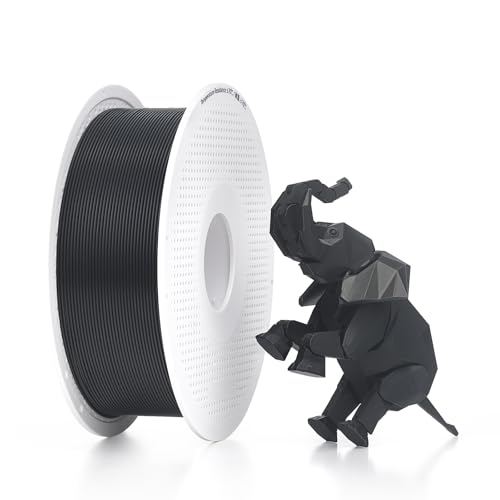
Bambu Lab PLA Basic (Black (10101), 1.75 mm, 1 kg, with spool)
- Best for
- Everyday PLA on Bambu Lab printers and AMS units (the TDS lists AMS-friendly 200 × 67 mm spool dimensions).
- Skip this if
- The part will see heat, or you'd rather buy the cheaper refill and reuse a spool.
Specs, strengths, and limitations
- Material
- PLA
- Diameter
- 1.75 mm
- Net filament
- 1000 g (filament only, not packaged weight)
- Format
- plastic spool
- Maker's nozzle range
- 190–230 °C
- Manufacturer states it is designed for high-speed printing, reaching 250–300 mm/s.
- Manufacturer states excellent toughness and Z-layer strength compared with general PLA.
- Manufacturer TDS lists AMS-friendly spool dimensions (200 mm × 67 mm).
- Not suited to parts exposed to heat: the TDS lists a heat deflection temperature of 54 °C (1.8 MPa).
- The ABS spool is rated to 70 °C, which limits drying temperature on the spool.
Skip it if the part will see heat, or you already have empty Bambu spools and would rather buy a refill.
Polymaker PolyLite PLA (Black, 1 kg)
PolyLite PLA is a standard PLA on a cardboard spool, an alternative to PLA Basic for either hotend with chamber heating off. Polymaker lists a 190–230 °C nozzle and a 25–60 °C bed. Polymaker answers "Is this material AMS compatible?" with "Yes! All Polymaker spools now have hardened edges that roll great in the AMS." Bambu still recommends an adapter for cardboard spools in the AMS.

Polymaker PolyLite PLA (Black, 1.75 mm, 1 kg)
- Best for
- Everyday PLA prints, prototypes, and display models where a documented, easy-printing PLA is wanted.
- Skip this if
- The part will sit in a hot car, near heat sources, or needs toughness beyond standard PLA.
Specs, strengths, and limitations
- Material
- PLA
- Diameter
- 1.75 mm
- Net filament
- 1000 g (filament only, not packaged weight)
- Format
- cardboard spool
- Maker's nozzle range
- 190–230 °C
- Manufacturer states PolyLite PLA is designed for reliability and ease of printing.
- Manufacturer TDS lists no enclosure needed and a wide 190–230 °C nozzle window.
- Manufacturer publishes a full TDS with mechanical, thermal, and drying data.
- Not suited to parts exposed to heat: the TDS lists a heat deflection temperature of 58 °C (1.8 MPa).
- Cardboard spool: Polymaker says its spools have hardened edges that work in the AMS, but Bambu Lab's general AMS guidance recommends an adapter or ring for cardboard spools. Check your unit.
Skip it if you want RFID auto-settings, or the part will see heat.
PETG for functional parts
Bambu classes PETG as a low-temperature filament on the H2C, so print it with chamber heating off. Don't pair it with PVA support across both hotends, as described above.
Bambu Lab PETG Basic (Black 30105, 1 kg, with spool)
PETG Basic is Bambu's general PETG. Its store page marks it "All AMS Series Compatible" and says it's compatible with "all printers, AMS, build plate, and nozzles." The TDS (V3.0) lists a 230–260 °C nozzle and a 65–75 °C bed, so follow Bambu's door and top-cover advice. Bambu says to dry it if it has sat in air above 50% humidity for more than 72 hours.
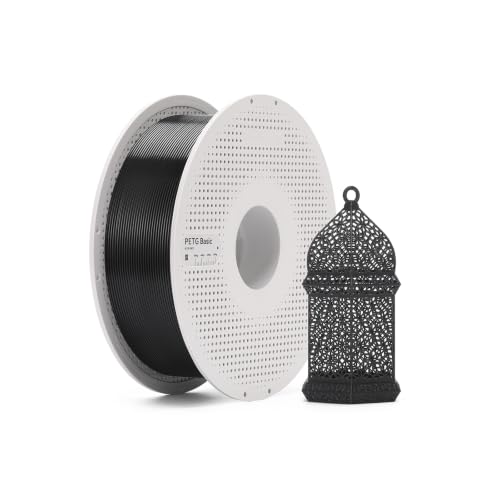
Bambu Lab PETG Basic (Black (30105), 1.75 mm, 1 kg, with spool)
- Best for
- Functional and outdoor-use parts on Bambu Lab printers and AMS.
- Skip this if
- The part needs heat resistance above about 68 °C (TDS HDT at 1.8 MPa).
Specs, strengths, and limitations
- Material
- PETG
- Diameter
- 1.75 mm
- Net filament
- 1000 g (filament only, not packaged weight)
- Format
- plastic spool
- Maker's nozzle range
- 230–260 °C
- Manufacturer states the upgraded formula delivers PLA-level strength while keeping PETG toughness.
- Manufacturer states enhanced resistance to water, UV, and temperature for outdoor accessories.
- Manufacturer states the refined formula reduces stringing.
- Heat resistance tops out around 68 °C: the TDS lists HDT 68 °C at 1.8 MPa (71 °C at 0.45 MPa).
- Needs drying and storage below 20% RH per the TDS; the ABS spool is rated only to 70 °C.
Skip it if the part needs more heat resistance than PETG offers. ASA is the better fit for that.
Polymaker PETG (Black, 1 kg)
Polymaker's PETG page says it "prints smoothly without requiring an enclosure and works seamlessly with AMS and multi-material systems." It lists a 240–260 °C nozzle, a 60–70 °C bed and a heat deflection temperature of 65 °C at 1.8 MPa (ISO 75), below Bambu's 80 °C line, so treat it as low-temperature. Polymaker calls it "very hygroscopic." It's on a cardboard spool, so use an adapter in the AMS.

Polymaker PETG (Black, 1.75 mm, 1 kg (new formula))
- Best for
- Functional brackets and fixtures, indoors or in shade, that need more toughness than PLA.
- Skip this if
- You can't keep filament dry, or the part needs heat resistance well above 65 °C (TDS HDT at 1.8 MPa).
Specs, strengths, and limitations
- Material
- PETG (high-flow)
- Diameter
- 1.75 mm
- Net filament
- 1000 g (filament only, not packaged weight)
- Format
- cardboard spool
- Maker's nozzle range
- 240–260 °C
- Manufacturer states it is less brittle and more impact-resistant than PLA.
- Manufacturer states it prints without an enclosure and works with AMS and multi-material systems.
- Manufacturer states a high-flow formulation for speeds up to 300 mm/s with a 0.4 mm nozzle.
- Moisture-sensitive: the TDS recommends drying at 60 °C for 6 h and printing from a dry box.
- Heat resistance is limited: the TDS lists HDT 65 °C at 1.8 MPa (69 °C at 0.45 MPa).
- Cardboard spool: Polymaker says its spools have hardened edges that work in the AMS, but Bambu Lab's general AMS guidance recommends an adapter or ring for cardboard spools. Check your unit.
Skip it if you can't keep filament dry, or don't want to fit a cardboard-spool adapter.
TPU: mostly a right-hotend job
On the H2C, hotend choice matters most for TPU. Bambu's TPU guide covers the H2 series, and says the H2C feeds TPU the same way as the H2D. It recommends 0.4, 0.6 or 0.8 mm nozzles for TPU for AMS, 95A HF and 90A, and says 0.2 mm nozzles aren't supported. It also recommends not printing TPU through a hotend that has run carbon- or glass-fiber filament, because leftover fibers raise extrusion resistance. If you must, do 3–5 cold pulls first. With up to six Vortek hotends, you can keep fiber filament and TPU in different ones. Our TPU compatibility guide covers hardness and feeding.
Bambu Lab TPU for AMS (Gray 53102, 1 kg, with spool)
This is the TPU to choose for flexible parts in multicolor AMS prints. Bambu's H2 TPU guide says TPU for AMS "can be directly placed in the AMS series" and marks it compatible with the AMS, AMS 2 Pro and AMS HT. Its store page marks it "All AMS Series Compatible." Bambu's H2C product page names it for the joints of a model printed in PLA Matte. At a Shore hardness of 68D, which Bambu states on the store page, it is much firmer than 95A TPU. The TDS lists a 220–240 °C nozzle and a 30–35 °C bed, and Bambu says it "must be dried before use."

Bambu Lab TPU for AMS (Gray (53102), 1.75 mm, 1 kg, filament with spool)
- Best for
- Multicolor prints on a Bambu Lab printer with AMS where you need tough, impact-resistant TPU parts.
- Skip this if
- You need a soft, highly flexible part (85A–95A) rather than a firm 68D one.
Specs, strengths, and limitations
- Material
- TPU (AMS-compatible)
- Diameter
- 1.75 mm
- Net filament
- 1000 g (filament only, not packaged weight)
- Hardness
- 68D
- Format
- plastic spool
- Maker's nozzle range
- 220–240 °C
- Manufacturer states it is optimized for the AMS, and its store page marks it compatible with all AMS series, including the AMS lite.
- Manufacturer states it prints up to 60% faster than Bambu TPU 95A HF and greatly reduces stringing.
- Manufacturer states its RFID tag carries the print settings, which the AMS reads.
- At 68D it is much stiffer than typical 95A TPU, so parts are tough rather than soft and squishy.
- Manufacturer says it must be dried before use and kept moisture-free during printing to prevent stringing.
- Not compatible with a 0.2 mm stainless steel nozzle, per Bambu Lab's store page.
Skip it if you need a soft, squishy part rather than a firm, tough one.
Bambu Lab TPU 95A HF (Black 51100, 1 kg, with spool)
TPU 95A HF is Bambu's high-speed 95A TPU, which Bambu says prints 3 times faster than its standard TPU 95A, for soft parts that need to withstand impact, collision and falling. Its store page marks it "All AMS Series NOT Compatible." On the H2C it prints from the right hotend only, until Bambu adds left-hotend support. Bambu's TPU guide says to feed it from an AMS HT or a 5.8 L rice-bucket dry box, through a PTFE tube to the dedicated TPU inlet on the back of the printer, after disconnecting the right hotend's tube at the buffer. It also describes a top-feed rack. The TDS lists a 220–240 °C nozzle and a 30–35 °C bed.

Bambu Lab TPU 95A HF (Black (51100), 1.75 mm, 1 kg, filament with spool)
- Best for
- Fast single-color flexible parts such as bumpers, grips, and cases, fed from an external spool on a Bambu Lab printer.
- Skip this if
- You want to run flexible filament through an AMS or AMS lite for multicolor prints.
Specs, strengths, and limitations
- Material
- TPU (high-flow)
- Diameter
- 1.75 mm
- Net filament
- 1000 g (filament only, not packaged weight)
- Hardness
- 95A
- Format
- plastic spool
- Maker's nozzle range
- 220–240 °C
- Manufacturer states it prints 3 times faster than standard Bambu TPU 95A.
- TDS lists breaking elongation above 650% (X-Y) and impact strength of 123.2 kJ/m² (X-Y).
- Manufacturer states it comes on a high-temperature reusable spool (PC + ABS, rated 90 °C).
- Not fed by any AMS: Bambu's store page lists all AMS series NOT compatible. Bambu's TPU and X/A2L guides allow the AMS HT only as a sealed drying chamber, fed via its TPU outlet.
- Manufacturer calls it highly sensitive to humidity and says to dry it before use and after storage.
- Bed temperature window is narrow, 30–35 °C, and the TDS calls for glue on the plate.
- Color per the listing's selected variant; check the color before buying.
Skip it if you want flexible filament fed automatically from the AMS.
Polymaker PolyFlex TPU90 (Black, 0.75 kg)
PolyFlex TPU90 is softer still, at Shore 90A according to its TDS (V5.5). Polymaker says a direct extruder is required and warns against Bowden setups. Bambu's H2C introduction places the extruder on the toolhead. Its TDS lists a 210–230 °C nozzle, a 25–60 °C bed, 30–70 mm/s and drying at 70 °C for 8 hours. The product page's print settings give 30–60 mm/s, and the page says it "will be very difficult to print with a small nozzle diameter." Bambu's TPU guide lists 90A TPU for 0.4, 0.6 or 0.8 mm nozzles, and as not compatible with the AMS or AMS 2 Pro. Like 95A HF, it prints from the right hotend on the H2C and is hand-fed through the rear TPU inlet. If 90A prints show errors or missing material, Bambu suggests feeding it straight into the extruder or using the top-feed rack.

Polymaker PolyFlex TPU90 (Black, 1.75 mm, 0.75 kg)
- Best for
- Soft, comfortable parts such as phone cases and watch straps on a geared direct-drive printer.
- Skip this if
- Your printer uses a Bowden extruder, or you need 1 kg spools.
Specs, strengths, and limitations
- Material
- TPU
- Diameter
- 1.75 mm
- Net filament
- 750 g (filament only, not packaged weight)
- Hardness
- 90A
- Format
- cardboard spool
- Maker's nozzle range
- 210–230 °C
- Manufacturer states 90A is its softest PolyFlex grade.
- TDS lists Shore hardness 90A and elongation at break of 592.1%.
- Manufacturer TDS states it resists UV light and sunlight (Polymaker says it adds UV additives to all its TPUs).
- Polymaker's own page conflicts: its printing requirements say a direct extruder with gear-ratio mechanical advantage is 'required', while its spec line says 'Direct-drive recommended'. It warns against Bowden setups but also lists Indirect Drive retraction (6 mm at 60 mm/s).
- Polymaker says it will be very difficult to print with a small nozzle diameter. Its TDS recommends 30–70 mm/s; the product page print settings say 30–60 mm/s, and its spec panel gives a 60 mm/s maximum.
- Spool holds 0.75 kg, not 1 kg.
Skip it if you want a 1 kg spool, or don't want to feed TPU by hand.
ASA, ABS and PC (with the chamber heated)
These are the filaments the H2C's 65 °C chamber is for. Bambu's grouping says they need "the highest possible chamber temperature," and bars printing them with PLA, PETG or TPU. Either hotend can run them. For a wider comparison, see the ASA filament shortlist and our ABS vs ASA guide. If you're deciding whether a part needs ASA at all, our PLA vs ASA guide covers that choice.
Polymaker ASA (Black, 1 kg)
Polymaker says its ASA prints with settings very similar to ABS: "Simply use an enclosed 3D printer to ensure optimal temperature control and minimize warping." Its specifications list a 230–260 °C nozzle, a 75–95 °C bed, an enclosure as "Needed" and drying at 70 °C for 7 hours. Its printing tips say to keep the cooling fan off and print in a well-ventilated area. It's on a cardboard spool, so use an adapter in the AMS.

Polymaker ASA (Black, 1.75 mm, 1 kg)
- Best for
- Outdoor and sun-exposed functional parts printed on an enclosed machine.
- Skip this if
- Your printer is open-frame or can't reach a 95 °C bed and 260 °C nozzle.
Specs, strengths, and limitations
- Material
- ASA
- Diameter
- 1.75 mm
- Net filament
- 1000 g (filament only, not packaged weight)
- Format
- cardboard spool
- Maker's nozzle range
- 230–260 °C
- Manufacturer states it is an alternative to ABS with improved weather and UV resistance.
- Manufacturer TDS lists a heat deflection temperature of 100 °C (1.8 MPa).
- Manufacturer states it prints with settings very similar to ABS.
- Needs an enclosed printer per the TDS.
- Requires higher nozzle and bed temperatures (230–260 °C, 75–95 °C) than PLA or PETG.
- Cardboard spool: Bambu Lab strongly advises a spool adapter or adapter ring for cardboard spools in the AMS.
Skip it if you have nowhere well ventilated to print.
Bambu Lab ABS (Black 40101, 1 kg refill)
Bambu ABS has its settings in the RFID tag. Its store page says "Enclosure Printers Required" and lists the AMS 2 Pro, AMS HT and AMS as compatible. The TDS (V3.0) lists a 240–270 °C nozzle, an 80–100 °C bed and a 45–60 °C chamber, which fits under the H2C's 65 °C maximum. Bambu warns that at printing temperatures ABS "may release harmful gases, including styrene," and says to keep the printer in a well-ventilated area. This is a refill with no spool, so you need an empty Bambu reusable spool to load it.

Bambu Lab Bambu ABS (Black (40101), 1.75 mm, 1 kg refill (no spool))
- Best for
- Bambu Lab enclosed-printer owners who want ABS with Bambu's tuned profiles and a reusable spool.
- Skip this if
- You don't have a reusable Bambu spool or an enclosed printer.
Specs, strengths, and limitations
- Material
- ABS
- Diameter
- 1.75 mm
- Net filament
- 1000 g (filament only, not packaged weight)
- Format
- refill
- Maker's nozzle range
- 240–270 °C
- Manufacturer states Bambu ABS is designed to reduce warping and cracking while keeping strong impact resistance.
- TDS lists print speeds under 300 mm/s and nozzle sizes from 0.2 to 0.8 mm.
- Manufacturer publishes a full TDS with drying, annealing, and mechanical data.
- Bambu Lab's store page says enclosed printers are required and recommends a well-ventilated area or air filtration, warning that it may release styrene at printing temperatures.
- Refill only: it needs a reusable spool to load in an AMS or on a spool holder.
- TDS calls for glue on the build plate.
Skip it if you don't have a spare reusable spool, or nowhere well ventilated to print.
Polymaker PolyLite PC (Transparent, 1 kg)
PolyLite PC is a translucent polycarbonate for stiff, heat-resistant parts. Polymaker lists a 250–270 °C nozzle and a 90–105 °C bed. Its printing requirements say "Enclosed printer that can trap heat required" and "Minimum 60˚C chamber temp highly recommended." The H2C's 65 °C chamber meets that minimum, but Polymaker's TDS (V5.4) lists a 70–100 °C chamber, above the H2C's maximum, so large PC parts may still warp. Polymaker recommends annealing at 90 °C for 2 hours right after printing. Its pages give several drying settings, with 75 °C for 6 hours on the TDS. It's on a cardboard spool.

Polymaker PolyLite PC (Transparent, 1.75 mm, 1 kg)
- Best for
- Heat-resistant, translucent parts such as light diffusers, printed on an enclosed, high-temperature printer.
- Skip this if
- Your printer is open-frame, has a PTFE-lined hotend, or can't reach a 105 °C bed.
Specs, strengths, and limitations
- Material
- PC
- Diameter
- 1.75 mm
- Net filament
- 1000 g (filament only, not packaged weight)
- Format
- cardboard spool
- Maker's nozzle range
- 250–270 °C
- Manufacturer states good stiffness and heat resistance with light-diffusing properties.
- TDS lists a heat deflection temperature of 107 °C (1.8 MPa).
- TDS lists 89% light transmission, suited to light diffusers.
- Needs an enclosure: the TDS lists a closed chamber (70–100 °C) as needed, and the product page recommends a heated chamber for large parts.
- Needs an all-metal hotend reaching 250–270 °C and a 90–105 °C bed; Polymaker recommends annealing parts at 90 °C for 2 h.
- Must be dried before use if it has absorbed moisture (75 °C; 6 h per TDS, 12 h per product page).
Skip it if you can't dry and anneal parts, or need an opaque color. PolyLite PC is sold only in Transparent.
Carbon-fiber filament
The H2C's stock hotends on both sides are 0.4 mm hardened steel, so these four spools need no upgrade. Bambu's filament guide says never to use a 0.2 mm nozzle or a stainless steel or brass nozzle for fiber-filled filament. It names a 0.6 mm hardened steel nozzle as the first choice for third-party fiber filament and 0.4 mm as the second, at layer heights of 0.15–0.3 mm and about 100 mm/s at most. Bambu's H2C FAQ adds that CF filament isn't recommended in 0.4 mm high-flow hotends, because it's hard to clear once clogged. Bambu's store page says the Vortek system lets you dedicate a hotend to specific filaments, which suits valuable engineering materials. Feed all four from an external spool, as Bambu's AMS notes advise. Our abrasive filament nozzle guide and carbon fiber filament shortlist go further, and our worn nozzle guide covers when a hotend dedicated to fiber filament needs replacing.
Polymaker PolyLite PLA-CF (Black, 1 kg)
Polymaker says PolyLite PLA-CF "can be printed using standard PLA settings," and that "this material is abrasive so you will need a hardened nozzle." Its specifications list "0.4mm+ hardened nozzle required," a 190–230 °C nozzle and a 25–60 °C bed, with no enclosure needed. Its print settings block gives 210–230 °C and 30–70 °C, so start in the overlap. Bambu classes PLA-CF as low-temperature, so keep chamber heating off.

Polymaker PolyLite PLA-CF (Black, 1.75 mm, 1 kg)
- Best for
- Stiff, matte-finish PLA parts and prototypes on a printer fitted with a hardened nozzle.
- Skip this if
- Your printer only has a brass nozzle, or the part will see heat.
Specs, strengths, and limitations
- Material
- PLA (carbon-fiber filled (8 wt% chopped carbon fiber))
- Diameter
- 1.75 mm
- Net filament
- 1000 g (filament only, not packaged weight)
- Format
- cardboard spool
- Maker's nozzle range
- 190–230 °C
- Nozzle
- Abrasive: the maker recommends a wear-resistant nozzle
- Manufacturer states 8% chopped carbon fiber gives exceptional rigidity and strength.
- Manufacturer states a matte black finish with virtually invisible layer lines and low shrinkage.
- Manufacturer states it prints with standard PLA settings; the TDS lists no enclosure needed.
- Abrasive: Polymaker strongly recommends a hardened nozzle.
- Not suited to heat: the TDS lists a heat deflection temperature of 50 °C (1.8 MPa).
- Cardboard spool: Bambu Lab strongly advises a spool adapter or adapter ring for cardboard spools in the AMS.
- The Amazon listing's bullet points describe plain PolyLite PLA, though its title and model number (PA10001) are the carbon-fiber version. Check that the title says Carbon Fiber PLA before you buy.
Skip it if the part will see heat.
ELEGOO PETG-CF (Carbon Fiber Black, 1 kg)
ELEGOO's specification table lists a "Hardened Steel Nozzle, ≥ 0.4 mm," a 240–270 °C nozzle, a 65–75 °C bed, a 25–50 °C chamber and enclosed printing "Not Required." Its notes say a 0.2 mm nozzle is not compatible. Drying is "Required" at 60 ± 5 °C for 8 hours in the table, though a note elsewhere on the page says 70 °C. Bambu classes PETG-CF as low-temperature, so keep chamber heating off.
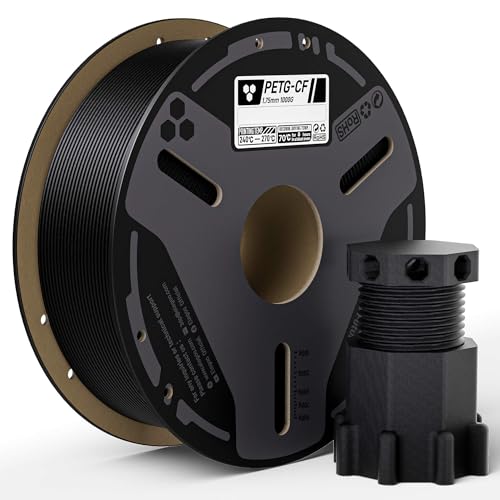
ELEGOO PETG-CF (Carbon Fiber Black, 1.75 mm, 1 kg)
- Best for
- Stiff matte functional parts on a printer with a 0.4 mm or larger hardened steel nozzle.
- Skip this if
- Your printer only has a brass nozzle, or the part will see temperatures near the listed 74 °C (0.45 MPa) heat deflection temperature.
Specs, strengths, and limitations
- Material
- PETG (carbon-fiber filled)
- Diameter
- 1.75 mm
- Net filament
- 1000 g (filament only, not packaged weight)
- Format
- other
- Maker's nozzle range
- 240–270 °C
- Nozzle
- Abrasive: the maker recommends a wear-resistant nozzle
- Manufacturer states carbon fiber adds strength and rigidity, with abrasion resistance and dimensional stability.
- Manufacturer states that, compared with PLA-CF, it has superior toughness and is less prone to fracture under stress and impact.
- Manufacturer states a premium matte finish that reduces visible layer lines.
- Abrasive: ELEGOO recommends a 0.4/0.6/0.8 mm hardened steel nozzle and says 0.2 mm nozzles are not compatible.
- Needs drying before use (60 ± 5 °C for 8 h per the spec table; the page's 'Important Notes' say 70 °C) and storage at ≤ 20% RH.
- Modest heat resistance: the spec table lists a heat deflection temperature of 74 °C at 0.45 MPa; no 1.8 MPa figure or TDS PDF is published.
Skip it if you can't dry filament before printing.
ELEGOO ASA-CF (Carbon Fiber Black, 1 kg)
ASA-CF is the carbon-fiber pick that uses the heated chamber. ELEGOO's specification table lists a "Hardened Steel Nozzle, ≥ 0.4 mm," a 250–280 °C nozzle, a 90–100 °C bed, enclosed printing "Required" and a 45–60 °C chamber, which fits under the H2C's 65 °C maximum. It requires glue on the build plate and drying at 80 ± 5 °C for 8 hours, though a page note says 85 °C. ELEGOO says it "may produce a more noticeable odor" than standard filaments, so print in a well-ventilated area.
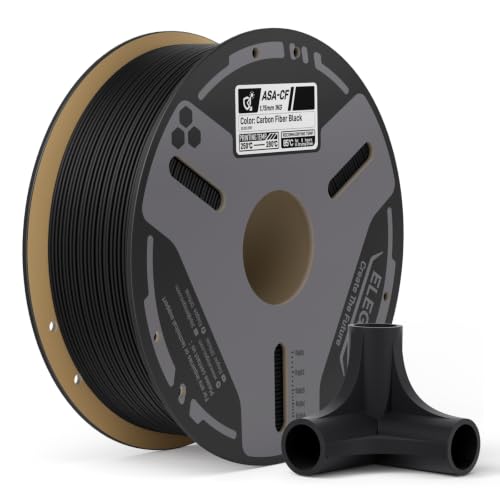
ELEGOO ASA-CF (Carbon Fiber Black, 1.75 mm, 1 kg)
- Best for
- Stiff outdoor and automotive parts printed on an enclosed printer with a hardened steel nozzle.
- Skip this if
- Your printer is open-frame or brass-nozzled, or it sits in an unventilated room.
Specs, strengths, and limitations
- Material
- ASA (carbon-fiber reinforced)
- Diameter
- 1.75 mm
- Net filament
- 1000 g (filament only, not packaged weight)
- Format
- other
- Maker's nozzle range
- 250–280 °C
- Nozzle
- Abrasive: the maker recommends a wear-resistant nozzle
- Manufacturer states ASA's UV and weather resistance for outdoor parts.
- Product page lists a heat deflection temperature of 108 °C (0.45 MPa).
- Manufacturer states lower warping and better dimensional control than standard ASA for large prints.
- Abrasive: ELEGOO recommends a hardened steel nozzle of 0.4 mm or larger.
- Needs an enclosed printer (45–60 °C chamber), a 90–100 °C bed with glue, and ventilation for odor.
- ELEGOO gives two drying temperatures (80 °C in the table, 85 °C in the note), and no TDS PDF is published.
Skip it if you can't dry filament first, or have nowhere well ventilated to print.
Polymaker Fiberon PET-CF17 (Black, 1 kg)
This is the pick that shows the H2C's hotend split most clearly. Bambu's H2C filament guide says PET-CF prints from the left hotend only, so feed it to the left side from an external spool. Polymaker lists a 270–300 °C nozzle, a 70–80 °C bed, "0.4mm+ hardened nozzle required" and drying at 100 °C for 10 hours. It recommends an enclosure with the door kept closed, and annealing at 120 °C for 10 hours for the heat resistance in its TDS. Polymaker winds Fiberon on a larger core, so 1 kg won't fit a standard 1 kg spool.
Bambu and Polymaker treat the chamber differently. Bambu lists PET-CF as a high-temperature filament that wants the hottest chamber. Polymaker's print settings call for a room-temperature chamber, and its FAQ says annealing raises the heat deflection temperature "from around 70°C to over 100°C." That unannealed figure falls below Bambu's 80 °C line for third-party filament, but Polymaker doesn't say which load it was measured at. Follow Polymaker's settings, print it on its own, and ask Polymaker before you mix it with other filaments.

Polymaker Fiberon PET-CF17 (Black, 1.75 mm, 1 kg)
- Best for
- Stiff, heat-resistant jigs and tooling on an enclosed printer, when you want nylon-like performance with less moisture fuss.
- Skip this if
- Your hotend tops out below 270 °C, or you can't anneal parts at 120 °C.
Specs, strengths, and limitations
- Material
- PET (17% carbon-fiber filled)
- Diameter
- 1.75 mm
- Net filament
- 1000 g (filament only, not packaged weight)
- Format
- other
- Maker's nozzle range
- 270–300 °C
- Nozzle
- Abrasive: the maker recommends a wear-resistant nozzle
- Manufacturer states 17% carbon fiber for a high modulus, stiffness and dimensional stability.
- TDS lists a heat deflection temperature of 105 °C at 1.8 MPa.
- Manufacturer states that, unlike many engineering filaments, it is less sensitive to moisture, reducing the need for pre-drying.
- Abrasive: Polymaker requires a hardened nozzle of 0.4 mm or larger and an all-metal hotend.
- Needs a 270–300 °C hotend and annealing at 120 °C for 10 h for the stated heat resistance.
- Polymaker recommends an enclosure; its pages give a long 100 °C / 10 h drying cycle.
Skip it if you can't dry at 100 °C or anneal parts.
A spare left hotend for abrasive filament
Bambu Lab Hotend H2/P2S (0.4 mm hardened steel, standard flow)
On the H2C, this hotend fits the left hotend only. Bambu's nozzle page lists the H2 Series/P2S hotend for the "H2C (left hotend)." The right side takes Vortek induction hotends, which this is not. It's rated to 350 °C and swaps by unlocking a latch. Bambu's store page says PET-CF, PPA-CF and PPS-CF are supported only on the liftable (left) hotend of its dual-nozzle printers. A spare lets you keep one left hotend for carbon fiber and another for everything else. The Combos already include two 0.4 mm left hotends, so you need this only for a third, or as a replacement. Bambu recommends a 0.6 mm hardened steel nozzle as the first choice for third-party fiber filament, but the firmware doesn't yet mix nozzle sizes in one print, so this 0.4 mm version matches the stock Vortek hotends.

Bambu Lab Bambu Hotend - H2/P2S (Standard Flow) (0.4 mm hardened steel, standard flow (Amazon model FAH023))
- Best for
- H2D, H2S or P2S owners, or H2C owners for the left hotend only, who need a spare or replacement 0.4 mm hardened steel hotend.
- Skip this if
- You own an X1/P1 or A1-series printer, or want the higher-flow version.
- Verified fit
- Bambu Lab H2D; Bambu Lab P2S; Bambu Lab H2S; Bambu Lab H2C (stock configuration, per the manufacturer)
Specs, strengths, and limitations
- Interface
- Bambu Lab H2 Series/P2S quick-swap hotend (latch release, thermal and electronic components separate)
- Hotend design
- Quick-swap hotend with nozzle, standard flow
- Part rated to
- 350 °C (your printer's own hotend limit may be lower)
- Wear-resistant
- Yes, per the manufacturer
- Does not fit
- Not for X1/P1 Series or A1/A1 mini printers, which use different hotends (Bambu Lab nozzle compatibility table).; On the H2C, Bambu Lab lists this hotend for the left hotend only. The right hotend uses the Vortek induction hotend.
- Maker notes
- Bambu Lab nozzle compatibility: the H2 Series/P2S Hotend fits H2D (both left and right), H2S, H2C (left hotend), P2S and X2D. The H2C record covers the left hotend only. The X2D is not in the printers list. The Amazon listing says the H2 dual-nozzle function currently supports only nozzles of the same size. Bambu Lab wiki: the A2L can take quick-release nozzles from the whole Bambu lineup but performance is not guaranteed, and A-series nozzles are recommended for it. No A2L record is made. Bambu Lab store: Max. Printing Temp. 350 °C, length 49.2 mm, box contains Hotend with Nozzle x1. Printer limit: Bambu Lab's US store spec tables list a 350 °C max nozzle temperature for the H2D but 300 °C for the P2S.
- Manufacturer states a quick-swap design: unlock the latch to remove and install the hotend.
- Manufacturer lists a 350 °C max printing temperature.
- Bambu Lab's compatibility table names the H2D (both hotends), H2S, H2C (left hotend only) and P2S.
- Printer limit on the P2S: Bambu Lab's P2S spec table lists a 300 °C max nozzle temperature, below this hotend's 350 °C rating. The H2D is listed at 350 °C.
- Bambu Lab recommends a 0.6 mm hardened steel nozzle for carbon- and glass-fiber filaments to minimize clogging.
- Standard flow: Bambu Lab sells a separate High Flow version.
Skip it if you need a part for the right (Vortek) side, or want Bambu's high-flow version. For more options, see our replacement nozzle guide.
Checklist before you buy for an H2C
- Material. PLA, PETG, TPU, ASA, ABS, PC, PET and nylon are on Bambu's H2C list, plus fiber-reinforced versions of all of them except TPU.
- Temperatures. Every hotend tops out at 350 °C, the bed at 120 °C and the heated chamber at 65 °C. Check the spool's published ranges.
- Hotend side. Soft TPU goes right for now. PET-CF, PPA-CF and PPS-CF go left. Everything else on this page can use either side.
- Chamber heat. Keep chamber heating off for PLA, PETG, TPU, PLA-CF and PETG-CF, and don't mix them with ABS, ASA, PC or nylon in one print.
- Nozzle size. The firmware doesn't yet mix nozzle sizes in one print. Use hardened steel and 0.4 mm or larger for carbon fiber, and avoid 0.4 mm high-flow hotends for it.
- AMS. AMS 2 Pro, AMS HT and first-generation AMS, not the AMS lite. Spools 50–68 mm wide and 197–202 mm across, with an adapter for cardboard spools. Third-party fiber filament and soft TPU stay out of the AMS.
Drying, storage and safety
TPU, PC and carbon-fiber filament are the most moisture-sensitive materials here. Bambu's filament guide lists TPU and PC drying as "Required" and PLA, PETG, ABS and ASA drying as "Recommended." Bambu's TPU guide says to store TPU below 20% RH. Use the setting for your exact spool, and check the spool's own temperature rating before drying it on the spool. Our filament dryer vs dry box guide and filament storage guide cover the options.
How this page was checked
This is a research-based page. We have not printed these spools on an H2C for it, so it contains no test results or scores. The printer limits come from Bambu Lab's H2C spec page, product page, store page, H2C FAQ, introduction and packing list, Vortek pages, H2C filament printing guide, H2D/H2C multi-material guide, H2 TPU guide, AMS connection guides, AMS notes, nozzle page, hotend store page and filament guide. The spool statements come from each filament maker's own pages, listed in the sources section. All were retrieved on 2026-10-14. Bambu says it will add hotend support through firmware updates, and makers update their pages, so check the current version before relying on a limit. Read more in our editorial standards and affiliate disclosure.
PLA: what to check before you buy a spool ↗Head-to-head comparisons
Deciding between two products on this page? Each comparison puts both makers’ specs side by side and says who should choose which.
Sources
- Bambu Lab H2C - Technical Specifications, Bambu Lab
- Bambu Lab H2C, Bambu Lab
- Bambu Lab H2C (store page, what's in the box and FAQ), Bambu Lab
- H2C FAQs, Bambu Lab
- H2C Introduction, Bambu Lab
- H2C Packing List, Bambu Lab
- Introduction to the Vortek Workflow and Function, Bambu Lab
- Introduction to the Workflow of the Induction Hotend Rack, Bambu Lab
- Vortek system FAQ, Bambu Lab
- H2C Filament Printing Guide, Bambu Lab
- H2D/H2C Filament Multi-Material Printing Guide, Bambu Lab
- Preparation for TPU Printing for H2 Series, Bambu Lab
- H2C + Multiple AMS Connection Guide, Bambu Lab
- Connection Guide for AMS and Different Printer Models, Bambu Lab
- Notes for AMS, Bambu Lab
- Filament guide: printer, nozzle, AMS, build plate and glue compatibility, Bambu Lab
- Introduction to Bambu Nozzles (nozzle-printer compatibility), Bambu Lab
- Bambu Hotend - H2/P2S, Bambu Lab
- Bambu PLA Basic Technical Data Sheet V3.0, Bambu Lab
- Bambu PETG Basic Technical Data Sheet V3.0, Bambu Lab
- Bambu ABS Technical Data Sheet V3.0, Bambu Lab
- Bambu TPU for AMS Technical Data Sheet V1.0, Bambu Lab
- Bambu TPU 95A HF Technical Data Sheet V1.0, Bambu Lab
- PLA Basic, Bambu Lab
- PETG Basic, Bambu Lab
- TPU for AMS, Bambu Lab
- TPU 95A HF, Bambu Lab
- ABS, Bambu Lab
- PolyLite PLA product page, Polymaker
- Polymaker PETG product page, Polymaker
- PolyFlex TPU90 product page, Polymaker
- PolyFlex TPU90 Technical Data Sheet V5.5, Polymaker
- Polymaker ASA product page, Polymaker
- PolyLite PC product page, Polymaker
- PolyLite PC Technical Data Sheet V5.4, Polymaker
- PolyLite PLA-CF product page, Polymaker
- Fiberon PET-CF17 product page, Polymaker
- Fiberon PET-CF17 Technical Data Sheet V1.0, Polymaker
- Polymaker transitions all filaments onto 100% recycled cardboard spools, Polymaker
- ELEGOO PETG-CF product page, ELEGOO
- ELEGOO ASA-CF product page, ELEGOO
This page is research-based: we have not tested the products or methods ourselves. It draws on the manufacturer documentation and sources listed. Exact settings and fit always defer to your printer and filament makers.
Keep reading

Best Filament for the Bambu Lab H2D and H2S (2026)
PLA, PETG, TPU, ASA, ABS, PC and carbon-fiber spools that fit the H2D and H2S limits, with Bambu's chamber-heat, AMS 2 Pro and AMS HT rules.
Which Filaments Work in Bambu's AMS and AMS lite
Bambu's own rules for the AMS and AMS lite: unsupported materials, TPU, damp or brittle filament, cardboard spools, spool sizes, and the external spool route.
TPU Compatibility: Extruder Path, Hardness, and Feeding Systems
Whether a TPU will feed in your printer depends on its Shore hardness, your extruder path, and whether it goes through an automatic material system.