Best Filament for the Bambu Lab A2L (2026)
PLA, PETG and TPU spools that suit the open-frame A2L, with what Bambu says about its 80 °C bed, the AMS lite, TPU and carbon fiber.
On this page (12 sections)
For the A2L, start with Bambu Lab PLA Basic for everyday prints and Bambu Lab PETG Basic for functional parts. Both are sold as compatible with all AMS series, and PETG Basic's 65–75 °C bed range fits the A2L's 80 °C bed. Polymaker and ELEGOO are cardboard-spool alternatives. For flexible parts in the AMS lite, Bambu TPU for AMS is the only TPU here that Bambu clears. Bambu's A2L TPU guide says TPU 95A HF works only with the AMS HT, and Polymaker PolyFlex TPU95 goes on the external spool holder. The fit rule: Bambu's spec page lists PLA, PETG, TPU and PVA as "Suitable for Printing," and PLA-CF and PETG-CF only after you fit a hardened steel nozzle. ABS, ASA, PC and nylon aren't on the A2L's list, so this page sticks to PLA, PETG and TPU, plus one carbon-fiber PLA for owners who upgrade the hotend.
Quick picks
| Need | Pick | Why |
|---|---|---|
| Everyday PLA | Bambu Lab PLA Basic | Marked "All AMS Series Compatible"; Bambu uses it for the A2L's published flow figure |
| PETG for functional parts | Bambu Lab PETG Basic | AMS-compatible; its 65–75 °C bed range is within the A2L's 80 °C limit |
| TPU through the AMS lite | Bambu Lab TPU for AMS | The A2L TPU guide marks it compatible with all AMS series |
| Soft 95A TPU | Polymaker PolyFlex TPU95 | A non-Bambu 95A option for the external spool holder |
| Carbon fiber (hardened nozzle) | Polymaker PolyLite PLA-CF | Prints on standard PLA settings once a hardened nozzle is fitted |
These are defaults by need, not a ranking.
Who this page is for
This page is for owners of a Bambu Lab A2L, standalone or with the AMS lite combo, who want to know which spools suit the printer before buying. The A2L takes 1.75 mm filament, and every spool here is 1.75 mm. The A2L is newer and larger than the A1, but Bambu documents some rules differently for it, so this page cites the A2L's own pages wherever they exist. For nozzles and build plates that fit, see the A2L printer page.
| Product | Best for | Skip if | Link |
|---|---|---|---|
| Bambu Lab PLA Basic (Black (10101), 1.75 mm, 1 kg, with spool) | Everyday PLA on Bambu Lab printers and AMS units (the TDS lists AMS-friendly 200 × 67 mm spool dimensions). | The part will see heat, or you'd rather buy the cheaper refill and reuse a spool. | View on Amazon (opens Amazon in a new tab) |
| Bambu Lab PLA Matte (Charcoal (11101), 1.75 mm, 1 kg, with spool) | Matte-finish models and decor on Bambu Lab printers with AMS. | The part will see heat, or you don't need a matte finish. | View on Amazon (opens Amazon in a new tab) |
| Polymaker PolyLite PLA (Black, 1.75 mm, 1 kg) | Everyday PLA prints, prototypes, and display models where a documented, easy-printing PLA is wanted. | The part will sit in a hot car, near heat sources, or needs toughness beyond standard PLA. | View on Amazon (opens Amazon in a new tab) |
| Polymaker PolyLite PLA Pro (Black, 1.75 mm, 1 kg) | Functional PLA parts, props, and prototypes that need more drop resistance than standard PLA. | The part will see heat above about 55 °C (TDS HDT 58 °C at 1.8 MPa) or needs to flex. | View on Amazon (opens Amazon in a new tab) |
| ELEGOO PLA (Black, 1.75 mm, 1 kg) | Budget everyday PLA prints on most 1.75 mm printers. | You run an AMS and don't want to print a spool ring, or the part will see heat. | View on Amazon (opens Amazon in a new tab) |
| Bambu Lab PETG Basic (Black (30105), 1.75 mm, 1 kg, with spool) | Functional and outdoor-use parts on Bambu Lab printers and AMS. | The part needs heat resistance above about 68 °C (TDS HDT at 1.8 MPa). | View on Amazon (opens Amazon in a new tab) |
| Polymaker PETG (Black, 1.75 mm, 1 kg (new formula)) | Functional brackets and fixtures, indoors or in shade, that need more toughness than PLA. | You can't keep filament dry, or the part needs heat resistance well above 65 °C (TDS HDT at 1.8 MPa). | View on Amazon (opens Amazon in a new tab) |
| ELEGOO PETG HF (Black, 1.75 mm, 1 kg) | Fast everyday PETG on high-speed printers, at the usual PETG temperature range. | You can't dry filament before printing, or need heat resistance above about 65 °C (product page HDT 69 °C at 0.45 MPa). | View on Amazon (opens Amazon in a new tab) |
| Bambu Lab TPU for AMS (Gray (53102), 1.75 mm, 1 kg, filament with spool) | Multicolor prints on a Bambu Lab printer with AMS where you need tough, impact-resistant TPU parts. | You need a soft, highly flexible part (85A–95A) rather than a firm 68D one. | View on Amazon (opens Amazon in a new tab) |
| Bambu Lab TPU 95A HF (Black (51100), 1.75 mm, 1 kg, filament with spool) | Fast single-color flexible parts such as bumpers, grips, and cases, fed from an external spool on a Bambu Lab printer. | You want to run flexible filament through an AMS or AMS lite for multicolor prints. | View on Amazon (opens Amazon in a new tab) |
| Polymaker PolyFlex TPU95 (Black, 1.75 mm, 0.75 kg) | Flexible covers, grips, bumpers, and seals on printers that handle 95A TPU. | You need a softer TPU than 95A, or fast print times, or your printer is set up as Bowden and you can't print very slowly (Polymaker highly recommends direct drive and says Bowden is possible only at very slow speeds). | View on Amazon (opens Amazon in a new tab) |
| Polymaker PolyLite PLA-CF (Black, 1.75 mm, 1 kg) | Stiff, matte-finish PLA parts and prototypes on a printer fitted with a hardened nozzle. | Your printer only has a brass nozzle, or the part will see heat. | View on Amazon (opens Amazon in a new tab) |




The table is grouped by material, not ranked.
What can the A2L print, per Bambu?
Materials. Bambu's A2L spec page lists PLA, PETG, TPU and PVA as "Suitable for Printing," and PLA-CF and PETG-CF as "Suitable for Printing (Replace with Hardened Steel Nozzle)." The A2L FAQ says the printer "supports low-temperature materials such as PLA, PETG, TPU, and support filaments compatible with PLA and PETG." Neither page lists ABS, ASA, PC or nylon for the A2L. Bambu's general filament guide recommends an enclosed printer for ABS, ASA, PC and PA, and marks ABS, ASA, PC and fiber-filled nylon "Not Recommended" on open-frame printers, which it says include the A Series. This page doesn't recommend any of them.
Bed temperature. The A2L's heatbed tops out at 80 °C, according to its spec page and FAQ. That is lower than the A1's. Bambu's FAQ explains that the A2L "adopts an open-frame design, primarily targeting non-engineering filaments like PLA and PETG," and that its larger bed would use much more energy at higher temperatures. Every spool on this page has a published bed range of 75 °C or less.
Hotend. The maximum nozzle temperature is 300 °C (spec page and FAQ). Every spool here has a published nozzle range below 300 °C.
Enclosure. Don't assume the A1's enclosure advice carries over. The A2L FAQ says the A2L has a built-in ambient temperature sensor that alerts you when the temperature passes a threshold, so "enclosed printing of high-temperature materials is not recommended. However, if the ambient temperature can be kept within a reasonable range, enclosed use is acceptable." Bambu doesn't define that range in the FAQ, but its spec page lists an operating environment of 15–30 °C. An enclosure doesn't turn the A2L into an ABS printer, because the 80 °C bed and the material list stay the same. Bambu's filament guide lists 90–100 °C beds for ABS and ASA.
PETG caveat. Bambu's filament guide lists PETG as compatible with open-frame printers. It also notes that "an enclosed printer is recommended to prevent low ambient temperatures from reducing the model's interlayer strength." On an A2L, print PETG in a room that isn't cold, and don't rely on it for highly loaded parts.
Nozzle. The A2L ships with a 0.4 mm stainless steel nozzle, "using the same hotend as the A1 series" (A2L FAQ). The FAQ says that for filaments with hard particles, such as PLA-CF/GF, PETG-CF/GF or glow-in-the-dark filaments, "we recommend switching to a hardened steel hotend to reduce nozzle wear." The extruder gear is already hardened steel. Only the carbon-fiber pick at the end of this page needs the upgrade.
Heat in use. Bambu's filament guide says PLA is "not recommended for environments at about 50 ℃ or higher." For parts that will sit somewhere warm, PETG is the better fit of the materials the A2L handles well. Our PLA vs PETG guide covers the trade-off.
Which AMS units work with the A2L?
The A2L AMS Combo comes with an AMS lite, according to Bambu's A2L packing list. The A2L can also take the full-size AMS, AMS 2 Pro or AMS HT. Bambu's A2L AMS connection guide says it supports up to 4 AMS units and 1 AMS lite at once, for up to 19 colors. The A2L's filament hub has a built-in buffer, so you don't need the A1 series AMS hub. Each AMS connects through the PTFE tube coupler in the toolbox, and two or more AMS units also need a 4-in-1 PTFE adapter, sold separately. The A2L FAQ says to use the first-generation adapter, because the 4-in-1 PTFE Adapter II isn't supported yet. The A2L can't power AMS drying. The AMS 2 Pro needs its power adapter and the AMS HT its power cable.
For the AMS lite, Bambu's A2L First Print Guide and AMS lite pages document these limits:
- Spool size. "The AMS lite supports spools with a width of 40–68 mm and an inner diameter of 53–58 mm." Bambu's A2L pages don't publish a maximum spool weight. Its AMS lite FAQ suggests putting heavier spools in slots 2 and 3 to keep the unit stable.
- Cardboard spools. Bambu's AMS lite store page says the spring-loaded rotary spool holder "grips the spool at the center hole, improving spool compatibility especially for those paper spools." That isn't a guarantee for every cardboard spool, so check the width and center hole against the limits above.
- TPU. The A2L First Print Guide says to avoid flexible materials in the AMS lite, "including TPU (except for AMS-specific TPU)." See the TPU section below.
- Too hard, brittle or abrasive. The same guide says to avoid "third-party fiber-reinforced materials such as PA-CF/GF, PET-CF/GF, and PLA-CF/GF" and to use the external spool instead.
The A2L comes with an external spool holder, so any spool that misses these limits can still be printed. If a spool that fits still tangles or jams, see our AMS feeding problems guide. Bambu's A2L pages don't list separate spool-size limits for the full-size AMS units. Our guide to which filaments work in Bambu's AMS and AMS lite covers those.
Everyday PLA
Bambu Lab PLA Basic (Black 10101, 1 kg, with spool)
PLA Basic is Bambu's everyday PLA for its own printers. Bambu's store page marks it "All AMS Series Compatible." Its TDS (V3.0) lists a 190–230 °C nozzle, a 35–45 °C bed and a 200 mm × 67 mm ABS spool, which is within the AMS lite's 40–68 mm width range. Bambu doesn't publish the spool's center-hole size in the TDS. The RFID tag lets the AMS read the settings automatically. Bambu also uses PLA Basic for the A2L's published 28 mm³/s maximum hotend flow. This listing is the version with a spool. Bambu also sells refills without one.
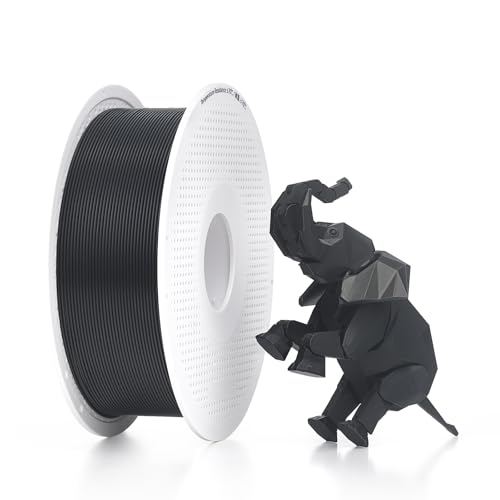
Bambu Lab PLA Basic (Black (10101), 1.75 mm, 1 kg, with spool)
- Best for
- Everyday PLA on Bambu Lab printers and AMS units (the TDS lists AMS-friendly 200 × 67 mm spool dimensions).
- Skip this if
- The part will see heat, or you'd rather buy the cheaper refill and reuse a spool.
Specs, strengths, and limitations
- Material
- PLA
- Diameter
- 1.75 mm
- Net filament
- 1000 g (filament only, not packaged weight)
- Format
- plastic spool
- Maker's nozzle range
- 190–230 °C
- Manufacturer states it is designed for high-speed printing, reaching 250–300 mm/s.
- Manufacturer states excellent toughness and Z-layer strength compared with general PLA.
- Manufacturer TDS lists AMS-friendly spool dimensions (200 mm × 67 mm).
- Not suited to parts exposed to heat: the TDS lists a heat deflection temperature of 54 °C (1.8 MPa).
- The ABS spool is rated to 70 °C, which limits drying temperature on the spool.
Skip it if the part will see heat, or you already have empty Bambu spools and would rather buy a refill.
Polymaker PolyLite PLA (Black, 1 kg)
PolyLite PLA is a standard PLA, and on an A2L with the AMS lite combo the question is its cardboard spool. It ships on cardboard, following Polymaker's switch of all its filaments to recycled cardboard. On the product page, Polymaker answers "Is this material AMS compatible?" with "Yes! All Polymaker spools now have hardened edges that roll great in the AMS." That answer doesn't name the AMS lite, and Polymaker doesn't publish the spool's width or center hole. Before loading it in an AMS lite, measure the spool against Bambu's 40–68 mm width and 53–58 mm center-hole limits, or use the external spool holder.

Polymaker PolyLite PLA (Black, 1.75 mm, 1 kg)
- Best for
- Everyday PLA prints, prototypes, and display models where a documented, easy-printing PLA is wanted.
- Skip this if
- The part will sit in a hot car, near heat sources, or needs toughness beyond standard PLA.
Specs, strengths, and limitations
- Material
- PLA
- Diameter
- 1.75 mm
- Net filament
- 1000 g (filament only, not packaged weight)
- Format
- cardboard spool
- Maker's nozzle range
- 190–230 °C
- Manufacturer states PolyLite PLA is designed for reliability and ease of printing.
- Manufacturer TDS lists no enclosure needed and a wide 190–230 °C nozzle window.
- Manufacturer publishes a full TDS with mechanical, thermal, and drying data.
- Not suited to parts exposed to heat: the TDS lists a heat deflection temperature of 58 °C (1.8 MPa).
- Cardboard spool: Polymaker says its spools have hardened edges that work in the AMS, but Bambu Lab's general AMS guidance recommends an adapter or ring for cardboard spools. Check your unit.
Skip it if you want RFID auto-settings in the AMS, or the part will see heat.
ELEGOO PLA (Black, 1 kg)
ELEGOO PLA is a standard PLA on a cardboard spool. ELEGOO offers a downloadable filament ring and says it reduces delamination and adapts the spool to the AMS, "because AMS will rub the bottom paper tray." It suits A2L owners who don't mind printing that ring first. ELEGOO doesn't publish the spool's dimensions, so check them against the AMS lite limits above.

ELEGOO PLA (Black, 1.75 mm, 1 kg)
- Best for
- Budget everyday PLA prints on most 1.75 mm printers.
- Skip this if
- You run an AMS and don't want to print a spool ring, or the part will see heat.
Specs, strengths, and limitations
- Material
- PLA
- Diameter
- 1.75 mm
- Net filament
- 1000 g (filament only, not packaged weight)
- Format
- cardboard spool
- Maker's nozzle range
- 190–230 °C
- Manufacturer states dimensional accuracy of ±0.02 mm.
- Manufacturer says neither an enclosure nor build-plate glue is required, and lists a minimum nozzle of 0.2 mm.
- Manufacturer publishes full print settings and mechanical data on the product page.
- Not suited to heat: the product page lists a heat deflection temperature of 57 °C (0.45 MPa).
- Cardboard spool: ELEGOO itself notes AMS units can rub the paper spool and offers a printable ring.
Skip it if you don't want to print a spool ring, or the part will see heat.
Tougher or better-looking PLA
Polymaker PolyLite PLA Pro (Black, 1 kg)
PolyLite PLA Pro is Polymaker's toughened PLA. It suits household parts, props and prototypes that may get dropped, and the A2L's 330 × 320 × 325 mm build volume leaves room for larger pieces. It's on the same cardboard spool as PolyLite PLA, so the same AMS lite checks apply. It still has PLA's heat limit.

Polymaker PolyLite PLA Pro (Black, 1.75 mm, 1 kg)
- Best for
- Functional PLA parts, props, and prototypes that need more drop resistance than standard PLA.
- Skip this if
- The part will see heat above about 55 °C (TDS HDT 58 °C at 1.8 MPa) or needs to flex.
Specs, strengths, and limitations
- Material
- PLA (PLA Pro (toughened PLA))
- Diameter
- 1.75 mm
- Net filament
- 1000 g (filament only, not packaged weight)
- Format
- cardboard spool
- Maker's nozzle range
- 190–230 °C
- Manufacturer states it combines high toughness and high rigidity with the ease of printing of regular PLA.
- TDS lists notched Charpy impact strength of 17.1 kJ/m² (X-Y).
- Manufacturer publishes a full TDS with mechanical, thermal, and drying data.
- Not for heat: the TDS lists a heat deflection temperature of 58 °C (1.8 MPa), and Polymaker says it is not for projects needing high heat resistance or flexibility.
- Cardboard spool: Bambu Lab strongly advises a spool adapter or adapter ring for cardboard spools in the AMS.
- Polymaker now calls this the 'Old Formula' and sells a separate 'New Formula' Polymaker PLA Pro; check which version an Amazon listing ships.
Skip it if the part will sit somewhere warm or needs to flex.
Bambu Lab PLA Matte (Charcoal 11101, 1 kg, with spool)
PLA Matte is Bambu's low-gloss PLA. Its store page also marks it "All AMS Series Compatible," and its TDS (V3.0) lists the same 200 mm × 67 mm ABS spool as PLA Basic. It suits display models and decorative prints in the AMS lite. Check that the listing names Charcoal and includes the spool before buying.

Bambu Lab PLA Matte (Charcoal (11101), 1.75 mm, 1 kg, with spool)
- Best for
- Matte-finish models and decor on Bambu Lab printers with AMS.
- Skip this if
- The part will see heat, or you don't need a matte finish.
Specs, strengths, and limitations
- Material
- PLA (matte)
- Diameter
- 1.75 mm
- Net filament
- 1000 g (filament only, not packaged weight)
- Format
- plastic spool
- Maker's nozzle range
- 190–230 °C
- Manufacturer states a matte finish and printing speeds up to 250–300 mm/s.
- Manufacturer TDS lists AMS-friendly spool dimensions (200 mm × 67 mm), and the store page lists an RFID tag with embedded print settings.
- Manufacturer publishes a full TDS with drying, thermal, and mechanical data.
- Not suited to heat: the TDS lists a heat deflection temperature of 52 °C (1.8 MPa).
- The ABS spool is rated to 70 °C, which limits drying temperature on the spool.
Skip it if you want a glossy finish, or the part will see heat.
PETG for functional parts
Bambu Lab PETG Basic (Black 30105, 1 kg, with spool)
PETG Basic is Bambu's general PETG, and its store page marks it "All AMS Series Compatible." The TDS (V3.0) lists a 230–260 °C nozzle and a 65–75 °C bed, which is within the A2L's 80 °C bed limit. The spool is ABS rated to 70 °C. It suits brackets, clips and fixtures that need more heat resistance than PLA. Bambu has discontinued PETG HF and points buyers to PETG Basic instead.
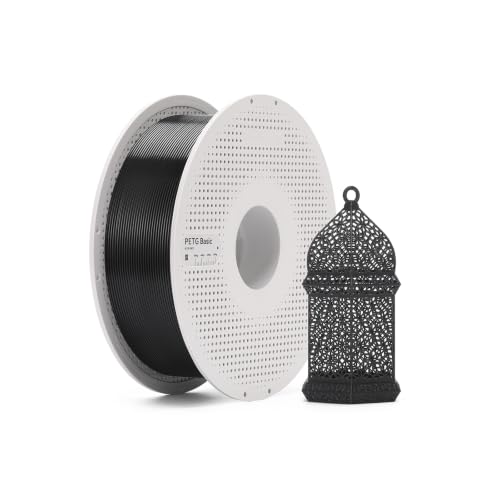
Bambu Lab PETG Basic (Black (30105), 1.75 mm, 1 kg, with spool)
- Best for
- Functional and outdoor-use parts on Bambu Lab printers and AMS.
- Skip this if
- The part needs heat resistance above about 68 °C (TDS HDT at 1.8 MPa).
Specs, strengths, and limitations
- Material
- PETG
- Diameter
- 1.75 mm
- Net filament
- 1000 g (filament only, not packaged weight)
- Format
- plastic spool
- Maker's nozzle range
- 230–260 °C
- Manufacturer states the upgraded formula delivers PLA-level strength while keeping PETG toughness.
- Manufacturer states enhanced resistance to water, UV, and temperature for outdoor accessories.
- Manufacturer states the refined formula reduces stringing.
- Heat resistance tops out around 68 °C: the TDS lists HDT 68 °C at 1.8 MPa (71 °C at 0.45 MPa).
- Needs drying and storage below 20% RH per the TDS; the ABS spool is rated only to 70 °C.
Skip it if the part needs to withstand much more heat than PETG offers, or you print in a cold room. See the PETG caveat above.
Polymaker PETG (Black, 1 kg)
Polymaker's PETG product page says it "prints smoothly without requiring an enclosure and works seamlessly with AMS and multi-material systems." It lists a 240–260 °C nozzle and a 60–70 °C bed. Polymaker calls it "very hygroscopic," so plan on dry storage. It's on a cardboard spool, so check the width and center hole against the AMS lite limits above.

Polymaker PETG (Black, 1.75 mm, 1 kg (new formula))
- Best for
- Functional brackets and fixtures, indoors or in shade, that need more toughness than PLA.
- Skip this if
- You can't keep filament dry, or the part needs heat resistance well above 65 °C (TDS HDT at 1.8 MPa).
Specs, strengths, and limitations
- Material
- PETG (high-flow)
- Diameter
- 1.75 mm
- Net filament
- 1000 g (filament only, not packaged weight)
- Format
- cardboard spool
- Maker's nozzle range
- 240–260 °C
- Manufacturer states it is less brittle and more impact-resistant than PLA.
- Manufacturer states it prints without an enclosure and works with AMS and multi-material systems.
- Manufacturer states a high-flow formulation for speeds up to 300 mm/s with a 0.4 mm nozzle.
- Moisture-sensitive: the TDS recommends drying at 60 °C for 6 h and printing from a dry box.
- Heat resistance is limited: the TDS lists HDT 65 °C at 1.8 MPa (69 °C at 0.45 MPa).
- Cardboard spool: Polymaker says its spools have hardened edges that work in the AMS, but Bambu Lab's general AMS guidance recommends an adapter or ring for cardboard spools. Check your unit.
Skip it if you can't keep filament dry.
ELEGOO PETG HF (Black, 1 kg)
ELEGOO PETG HF is a high-flow PETG on a cardboard spool. ELEGOO says to dry it at 60 °C for 8 hours before use, and offers the same printable filament ring for AMS use as its PLA. Spool dimensions aren't published.

ELEGOO PETG HF (Black, 1.75 mm, 1 kg)
- Best for
- Fast everyday PETG on high-speed printers, at the usual PETG temperature range.
- Skip this if
- You can't dry filament before printing, or need heat resistance above about 65 °C (product page HDT 69 °C at 0.45 MPa).
Specs, strengths, and limitations
- Material
- PETG (high-flow)
- Diameter
- 1.75 mm
- Net filament
- 1000 g (filament only, not packaged weight)
- Format
- cardboard spool
- Maker's nozzle range
- 230–260 °C
- Manufacturer states it supports print speeds up to 600 mm/s with smooth extrusion.
- Manufacturer lists it as impact resistant and easy to print.
- Manufacturer publishes full print settings and mechanical data on the product page.
- ELEGOO says drying is required before use (60 °C for 8 h).
- Heat resistance is limited: the product page lists a heat deflection temperature of 69 °C (0.45 MPa).
- ELEGOO says the AMS can rub the spool's paper tray and cause it to delaminate; it offers a printable ring.
Skip it if you can't dry filament before printing, or don't want to print a spool ring.
TPU for flexible parts
The A2L prints TPU, but which feeder it can go through depends on the grade. Bambu's TPU Printing Guide for the A2L has a hardware table for its own TPUs. It marks TPU 90A and TPU 95A HF "Only compatible with AMS HT," and TPU for AMS "Compatible with all AMS series." It lists 0.4, 0.6 and 0.8 mm hotends as recommended for all three and the 0.2 mm hotend as not supported. High-flow hotends are "Not supported" for TPU 95A HF and TPU for AMS, and "Not recommended" for TPU 90A. The guide recommends drying TPU at 70 °C for 8 hours in a blast drying oven, or 75 °C for 18 hours in an AMS HT. Read our TPU compatibility guide for the background on hardness and feeding.
Bambu Lab TPU for AMS (Gray 53102, 1 kg, with spool)
This is the TPU to choose if you want flexible filament in the AMS lite or another AMS. Bambu's store page lists "Seamless AMS & AMS lite Integration" and "All AMS Series Compatible." The A2L First Print Guide excludes "AMS-specific TPU" from its warning against TPU in the AMS lite, and the A2L TPU guide marks it compatible with all AMS series. At 68D it is much firmer than 95A TPU, so parts are tough rather than soft. Bambu says to dry it before use.
Bambu's general pages don't all agree. The AMS lite store page lists TPU under "Unsupported Filament," and the filament guide's AMS table marks TPU "Not Compatible," without naming TPU for AMS. The AMS lite FAQ, on the other hand, says TPU of "77D, 55D, or higher hardness" can be used with the AMS lite, which would cover a 68D TPU. We follow the A2L's own guides and the product page, but check Bambu's current guidance for your unit.

Bambu Lab TPU for AMS (Gray (53102), 1.75 mm, 1 kg, filament with spool)
- Best for
- Multicolor prints on a Bambu Lab printer with AMS where you need tough, impact-resistant TPU parts.
- Skip this if
- You need a soft, highly flexible part (85A–95A) rather than a firm 68D one.
Specs, strengths, and limitations
- Material
- TPU (AMS-compatible)
- Diameter
- 1.75 mm
- Net filament
- 1000 g (filament only, not packaged weight)
- Hardness
- 68D
- Format
- plastic spool
- Maker's nozzle range
- 220–240 °C
- Manufacturer states it is optimized for the AMS, and its store page marks it compatible with all AMS series, including the AMS lite.
- Manufacturer states it prints up to 60% faster than Bambu TPU 95A HF and greatly reduces stringing.
- Manufacturer states its RFID tag carries the print settings, which the AMS reads.
- At 68D it is much stiffer than typical 95A TPU, so parts are tough rather than soft and squishy.
- Manufacturer says it must be dried before use and kept moisture-free during printing to prevent stringing.
- Not compatible with a 0.2 mm stainless steel nozzle, per Bambu Lab's store page.
Skip it if you need a soft, squishy part rather than a firm, tough one.
Bambu Lab TPU 95A HF (Black 51100, 1 kg, with spool)
TPU 95A HF is Bambu's high-speed 95A TPU, which Bambu says prints 3 times faster than its standard TPU 95A, for soft parts that need to withstand impact, collision and falling. Bambu's A2L TPU guide marks it "Only compatible with AMS HT." Its store page goes further and marks it "All AMS Series NOT Compatible." Either way, keep it out of the AMS lite. Feed it from the external spool holder, or from an AMS HT's dedicated TPU outlet as the A2L guide describes. Without an AMS HT, that guide suggests feeding from a 5.8 L dry box. The store page also says it isn't compatible with the Cool Plate SuperTack, one of the A2L's supported plates.

Bambu Lab TPU 95A HF (Black (51100), 1.75 mm, 1 kg, filament with spool)
- Best for
- Fast single-color flexible parts such as bumpers, grips, and cases, fed from an external spool on a Bambu Lab printer.
- Skip this if
- You want to run flexible filament through an AMS or AMS lite for multicolor prints.
Specs, strengths, and limitations
- Material
- TPU (high-flow)
- Diameter
- 1.75 mm
- Net filament
- 1000 g (filament only, not packaged weight)
- Hardness
- 95A
- Format
- plastic spool
- Maker's nozzle range
- 220–240 °C
- Manufacturer states it prints 3 times faster than standard Bambu TPU 95A.
- TDS lists breaking elongation above 650% (X-Y) and impact strength of 123.2 kJ/m² (X-Y).
- Manufacturer states it comes on a high-temperature reusable spool (PC + ABS, rated 90 °C).
- Not fed by any AMS: Bambu's store page lists all AMS series NOT compatible. Bambu's TPU and X/A2L guides allow the AMS HT only as a sealed drying chamber, fed via its TPU outlet.
- Manufacturer calls it highly sensitive to humidity and says to dry it before use and after storage.
- Bed temperature window is narrow, 30–35 °C, and the TDS calls for glue on the plate.
- Color per the listing's selected variant; check the color before buying.
Skip it if you want flexible filament in multicolor AMS lite prints.
Polymaker PolyFlex TPU95 (Black, 0.75 kg)
PolyFlex TPU95 is a non-Bambu 95A option. Polymaker says it lets users get quality flexible prints "without specialized hardware or complex setup," and it highly recommends a direct drive printer, meaning the extruder sits on top of the hot end. On the A2L, the extruder is part of the toolhead, according to Bambu's A2L introduction. Bambu's A2L TPU guide covers only its own TPUs, so it says nothing about this spool. Keep it out of the AMS lite like any 95A TPU and use the external spool holder. The spool holds 0.75 kg and is cardboard.

Polymaker PolyFlex TPU95 (Black, 1.75 mm, 0.75 kg)
- Best for
- Flexible covers, grips, bumpers, and seals on printers that handle 95A TPU.
- Skip this if
- You need a softer TPU than 95A, or fast print times, or your printer is set up as Bowden and you can't print very slowly (Polymaker highly recommends direct drive and says Bowden is possible only at very slow speeds).
Specs, strengths, and limitations
- Material
- TPU
- Diameter
- 1.75 mm
- Net filament
- 750 g (filament only, not packaged weight)
- Hardness
- 95A
- Format
- cardboard spool
- Maker's nozzle range
- 210–230 °C
- Manufacturer states it is engineered to work on most desktop 3D printers without specialized hardware.
- Manufacturer states it can stretch over three times its original length.
- Manufacturer TDS lists shore hardness 95A and no enclosure needed.
- Slow printing: the TDS recommends 30–50 mm/s.
- Spool holds 0.75 kg, not 1 kg.
- Cardboard spool: Polymaker says it redesigned its spool edges to spin well in the AMS, but its Flexible TPU FAQ says TPU is often too soft to feed through the AMS and suggests avoiding it. Bambu Lab also advises against TPU in the AMS and recommends an adapter or ring for cardboard spools.
Skip it if you want a 1 kg spool or AMS lite feeding.
Can the A2L print carbon fiber?
The A2L's stock stainless steel nozzle isn't meant for carbon fiber. Bambu's A2L spec page lists PLA-CF and PETG-CF only with a hardened steel nozzle fitted, and its A2L FAQ says "a hardened steel nozzle is required" for carbon- or glass-fiber materials. Bambu's nozzle compatibility table lists the A1 Series Hotend as fitting the A1 mini, A1 and A2L, and its store sells that hotend in hardened steel with the A2L as a printer option. Bambu's nozzle page also says that, although the A2L accepts quick-release nozzles from Bambu's other printers, you should use A-series nozzles on it for the best print quality. For nozzle size, Bambu's filament guide makes a 0.6 mm hardened steel nozzle the first choice for carbon- and glass-fiber filaments, and reserves the 0.4 mm first choice for Bambu's own PLA-CF and PETG-CF. Its hotend store page marks other brands' CF/GF filaments "Not Recommended" in a 0.4 mm nozzle. See our replacement nozzle shortlist for the hardened A-series hotend and other options, and our PLA-CF vs PETG-CF guide for choosing between the two carbon-fiber materials.
Polymaker PolyLite PLA-CF (Black, 1 kg)
Polymaker says PolyLite PLA-CF "can be printed using standard PLA settings," and that it is abrasive, "so you will need a hardened nozzle." Its product page's technical specifications list a 190–230 °C nozzle and a 25–60 °C bed, but a separate print-settings block on the same page gives 210–230 °C and 30–70 °C. Both sets are inside the A2L's limits. The specifications say a "0.4mm+ hardened nozzle" is required. Given Bambu's guidance above, a 0.6 mm hardened steel hotend is the safer choice on the A2L. It suits stiff, matte prototypes and fixtures. It still has PLA's heat limit. The A2L First Print Guide says to keep third-party PLA-CF out of the AMS lite, and Bambu's filament guide says some brands of PLA-CF can wear the AMS feed channel. Feed it from the external spool holder.

Polymaker PolyLite PLA-CF (Black, 1.75 mm, 1 kg)
- Best for
- Stiff, matte-finish PLA parts and prototypes on a printer fitted with a hardened nozzle.
- Skip this if
- Your printer only has a brass nozzle, or the part will see heat.
Specs, strengths, and limitations
- Material
- PLA (carbon-fiber filled (8 wt% chopped carbon fiber))
- Diameter
- 1.75 mm
- Net filament
- 1000 g (filament only, not packaged weight)
- Format
- cardboard spool
- Maker's nozzle range
- 190–230 °C
- Nozzle
- Abrasive: the maker recommends a wear-resistant nozzle
- Manufacturer states 8% chopped carbon fiber gives exceptional rigidity and strength.
- Manufacturer states a matte black finish with virtually invisible layer lines and low shrinkage.
- Manufacturer states it prints with standard PLA settings; the TDS lists no enclosure needed.
- Abrasive: Polymaker strongly recommends a hardened nozzle.
- Not suited to heat: the TDS lists a heat deflection temperature of 50 °C (1.8 MPa).
- Cardboard spool: Bambu Lab strongly advises a spool adapter or adapter ring for cardboard spools in the AMS.
- The Amazon listing's bullet points describe plain PolyLite PLA, though its title and model number (PA10001) are the carbon-fiber version. Check that the title says Carbon Fiber PLA before you buy.
Skip it if you're still on the stock stainless steel nozzle, or you want carbon fiber in multicolor AMS prints.
Checklist before you buy for an A2L
- Material. PLA, PETG or TPU. Carbon-fiber PLA or PETG only with a hardened steel nozzle. Bambu doesn't list ABS, ASA, PC or nylon for the A2L.
- Bed temperature. The A2L tops out at 80 °C. Check the spool's published range.
- Spool for the AMS lite. Width 40–68 mm and center hole 53–58 mm. Bambu's own spools are 200 × 67 mm. The third-party makers here don't publish spool dimensions, so measure first.
- Cardboard. Bambu says the AMS lite holder improves compatibility with paper spools. ELEGOO offers a printable ring for its paper spools.
- TPU. Only TPU for AMS goes in the AMS lite. Bambu limits TPU 95A HF to the AMS HT on the A2L. Everything else goes on the external spool holder.
- Hard particles. Fit a hardened steel hotend first, and keep third-party fiber-filled spools out of the AMS lite.
- Enclosure. Bambu doesn't recommend enclosed printing of high-temperature materials, and says enclosed use is acceptable if the ambient temperature stays within a reasonable range. Its spec page lists 15–30 °C for operation.
Drying, storage and safety
Bambu's filament guide lists drying before use as "Required" for TPU and PETG HF, and "Recommended" for PLA and standard PETG. Polymaker calls its PETG "very hygroscopic," and ELEGOO says to dry its PETG HF before use. Use the setting for your exact spool, and check the spool's own temperature rating before you dry it on the spool. The A2L can't power the drying function of an AMS 2 Pro or AMS HT, so connect the unit's own power supply first. Our filament dryer vs dry box guide and filament storage guide cover the options.
How this page was checked
This is a research-based page. We have not printed these spools on an A2L for it, so it contains no test results or scores. The printer limits come from Bambu Lab's A2L spec page, A2L FAQ, A2L introduction, A2L First Print Guide, A2L AMS connection guide, A2L TPU printing guide and A2L packing list, plus Bambu's nozzle page, A-series hotend store page, filament guide, AMS lite FAQ and AMS lite store page. The spool and AMS statements come from each filament maker's own pages, listed in the sources section. All were retrieved on 2026-10-09. Makers update their pages, so check the current version before relying on a number. Read more in our editorial standards and affiliate disclosure.
PLA: what to check before you buy a spool ↗Head-to-head comparisons
Deciding between two products on this page? Each comparison puts both makers’ specs side by side and says who should choose which.
Sources
- Bambu Lab A2L - Technical Specifications, Bambu Lab
- A2L FAQ, Bambu Lab
- A2L Introduction, Bambu Lab
- A2L First Print Guide, Bambu Lab
- AMS Connection Guide for A2L, Bambu Lab
- TPU Printing Guide for A2L, Bambu Lab
- Packaging List for A2L, Bambu Lab
- Introduction to Bambu Nozzles (nozzle-printer compatibility), Bambu Lab
- Bambu Hotend - A1/A2 (store page), Bambu Lab
- Filament guide: printer, nozzle, AMS, build plate and glue compatibility, Bambu Lab
- AMS lite FAQ, Bambu Lab
- AMS lite (store page and tech specs), Bambu Lab
- Bambu PLA Basic Technical Data Sheet V3.0, Bambu Lab
- Bambu PLA Matte Technical Data Sheet V3.0, Bambu Lab
- Bambu PETG Basic Technical Data Sheet V3.0, Bambu Lab
- PLA Basic, Bambu Lab
- PLA Matte, Bambu Lab
- PETG Basic, Bambu Lab
- PETG HF, Bambu Lab
- TPU for AMS, Bambu Lab
- TPU 95A HF, Bambu Lab
- PolyLite PLA product page, Polymaker
- PolyLite PLA Pro product page, Polymaker
- Polymaker PETG product page, Polymaker
- PolyFlex TPU95 product page, Polymaker
- PolyLite PLA-CF product page, Polymaker
- Polymaker transitions all filaments onto 100% recycled cardboard spools, Polymaker
- ELEGOO PLA product page, ELEGOO
- ELEGOO PETG HF product page, ELEGOO
This page is research-based: we have not tested the products or methods ourselves. It draws on the manufacturer documentation and sources listed. Exact settings and fit always defer to your printer and filament makers.
Keep reading

Which Filaments Work in Bambu's AMS and AMS lite
Bambu's own rules for the AMS and AMS lite: unsupported materials, TPU, damp or brittle filament, cardboard spools, spool sizes, and the external spool route.
TPU Compatibility: Extruder Path, Hardness, and Feeding Systems
Whether a TPU will feed in your printer depends on its Shore hardness, your extruder path, and whether it goes through an automatic material system.
PLA vs PETG: Choosing for the Actual Project
How to choose between PLA and PETG by what the part has to do: heat, stiffness, toughness, print ease, stringing, and build-plate release.