Filament Spool Weights: Net, Gross and Empty Spool
What 1 kg on a spool means, how makers state net weight, published empty spool weights, and the methods makers give for tracking what's left.
On this page (10 sections)
On a filament spool, "1 kg" should mean the net weight: the mass of the filament itself. The empty spool and the box are extra, and empty spools aren't light. ELEGOO gives 154 ± 10 g for most of the spools we checked, Overture about 147 g, and Polymaker 140 ± 7 g for its 1 kg cardboard spool. SUNLU lists both a net weight (1 kg) and a gross weight (1.3 kg). Makers word the filament weight differently, and only some use the word "net"; the table below shows each one's phrasing. Bambu Lab's filament data sheets give the spool's size but not its weight. For tracking what's left, Prusa has a remaining-filament calculator for each spool, Polymaker has said its cardboard spools carry a rough weight guide, and Bambu's AMS estimates the remainder from RFID readings. Every filament in our catalog records the net filament mass from its maker's own documentation.
Who this guide is for
This guide is for anyone who has put a "1 kg" spool on a kitchen scale and wondered why it reads well over a kilogram, or who wants to know how much filament is left before starting a long print. It covers what the weight on the label refers to, how each maker words it, the empty spool weights and sizes makers publish, the tracking methods they describe, and refills that go on reusable spools. It doesn't repeat the spool size limits for Bambu Lab's AMS and AMS lite. Those are in our AMS compatibility guide.
Filament storage: what to check before you buy ↗What is the difference between net and gross spool weight?
Three different weights come up on spool labels and product pages:
- Net weight is the filament alone. This is what "1 kg" or "750 g" on a product name is meant to describe, and it's the figure that tells you how much you can print.
- Empty spool weight is the spool the filament is wound on. A few makers publish it. It matters if you weigh a part-used spool.
- Gross weight is a heavier total figure. SUNLU's ASA page lists "Net Weight: 1 kg/spool" and "Gross Weight: 1.3 kg/spool". SUNLU doesn't break down what makes up the extra 0.3 kg on that page.
The gap between the net and empty spool figures is not small. Prusa's sample spool data page shows a Prusament PLA spool with 1023 g of filament on a 193 g spool, so a full spool on a scale would read about 1.2 kg.
How each maker states the weight
The wording varies, and only some makers use the word "net." These are the phrasings on the maker pages we checked:
| Maker | How the filament weight is stated | Where |
|---|---|---|
| ELEGOO | "Filament weight: 1 kg/spool", with a separate "Empty spool weight" line | Specification section of each product page |
| Bambu Lab | "Net Filament Weight 1 kg" | Technical data sheet (PLA Basic, PETG Basic, ABS) |
| Polymaker | A size selector labelled "Net Weight" (for PolyLite PLA: 1kg, 3kg, 5kg) | Store product page |
| SUNLU | "Net Weight: 1 kg/spool" and "Gross Weight: 1.3 kg/spool" | ASA store page |
| Overture | A "Weight" option of "1 kg", without the word "net" | Product page; the wiki lists the empty spool weight separately |
| Prusa Research | Product names such as "Prusament PLA Jet Black 1kg"; per-spool data gives filament weight and spool weight separately | Store page and per-spool data page |
Overture's product page doesn't say "net." Its wiki lists an empty spool weight on its own line, though the wiki pages don't give a filament weight. Prusa's store page says that "Every Prusament spool comes with the actual measured data from manufacturing: diameter readings along the entire length, weight, and ovality." On its sample data page, the weight field is described as "The exact weight of the filament and of the spool," and shows them as two numbers: 1023 g, "+ 193 g spool".
How much does an empty filament spool weigh?
Only some makers publish what the empty spool weighs, and fewer publish its dimensions. These figures come from each maker's own pages:
| Maker and spool | Empty spool weight | Dimensions the maker gives |
|---|---|---|
| ELEGOO PLA, ABS, Rapid PLA+, Rapid PETG, PETG HF, PLA-CF, PETG-CF, PAHT-CF, ASA-CF | 154 ± 10 g | Not published on these pages |
| ELEGOO Silk PLA | 174 ± 5 g | Not published |
| ELEGOO TPU | 165 ± 5 g | Not published |
| Overture PLA, PETG and TPU | About 147 g | 200 mm outer diameter × 65.6 mm spool height, 55 mm hub diameter |
| Polymaker 1 kg cardboard spool | 140 ± 7 g | 200 ± 1 mm diameter, 65.6 ± 2 mm wide, 55 ± 1 mm inner hole |
| Polymaker 0.75 kg cardboard spool | 125 ± 7 g | 200 ± 1 mm diameter, 50.6 ± 2 mm wide, 55 ± 1 mm inner hole |
| Polymaker 0.5 kg cardboard spool | 190 ± 7 g | 200 ± 1 mm diameter, 65.6 ± 2 mm wide, 55 ± 1 mm inner hole |
| Polymaker 2 kg cardboard spool | 370 ± 18.5 g | 250 ± 1 mm diameter, 117.2 ± 2 mm wide, 55 ± 1 mm inner hole |
| Polymaker 3 kg cardboard spool | 425 ± 21.3 g | 250 ± 1 mm diameter, 117.2 ± 2 mm wide, 55 ± 1 mm inner hole |
| Polymaker 5 kg plastic spool (PP) | 819 ± 30 g | 300 ± 1 mm diameter, 160 ± 1 mm wide, 32 ± 1 mm inner hole |
| Prusament (sample spool, made 2018) | 193 g on that spool's data page | Not published |
| Bambu Lab PLA Basic, PETG Basic and ABS (with spool) | Not given in the data sheets or the PLA Basic store page | 200 mm diameter, 67 mm height |
A few things stand out:
- ELEGOO's spools are not all the same. Most of the product pages we checked give 154 ± 10 g, but its Silk PLA page gives 174 ± 5 g and its TPU page 165 ± 5 g. Check the page for the exact filament.
- A smaller Polymaker spool can weigh more. Polymaker lists its 0.5 kg cardboard spool at 190 ± 7 g, heavier than its 1 kg spool at 140 ± 7 g. Polymaker's FAQ doesn't explain the difference. It does say that its brittle carbon and glass fiber filaments are wound "with a larger core," and gives that as the reason it doesn't offer 1 kg Fiberon spools, apart from Fiberon PET-GF15, which it says is less brittle. Its store now lists 1 kg versions of some Fiberon grades anyway, so Polymaker's own pages disagree there.
- Prusament's spool has changed. The 193 g figure comes from a sample spool made in 2018. Prusa says that starting October 2025 all Prusament filaments ship on a redesigned spool that is "3 mm slimmer," with a plastic core in place of the paper one. We didn't find a published weight for the new spool.
- Bambu Lab's data sheets give the spool's size and material, not its weight. Its PLA Basic and PETG Basic data sheets list an ABS spool rated to 70 °C. Its ABS data sheet lists a PC + ABS spool rated to 90 °C.
Spool width and center hole decide whether a spool fits an automatic material system. Bambu Lab's limits for the AMS and AMS lite are in our AMS compatibility guide.
How can you tell how much filament is left on a spool?
Makers document different ways to estimate what's left on a spool. None of them is a precise scale method for every brand, so use the one that matches the spool you have.
- Prusament: the per-spool calculator. Each Prusament spool's data page has a "What is left on my spool?" tool. Prusa says: "Do you need to know how many meters/feets are remaining on your spool? Just enter the weight (including spool) and find out." The same page lists the spool's length when new. For the sample spool, that's 346 m.
- Polymaker: the weight guide on the spool. Announcing its cardboard spools in 2021, Polymaker said they carry "the rough filament weight guide, a feature pioneered by Polymaker." Polymaker calls it rough, so treat it as an estimate.
- Bambu Lab: the AMS estimate. Bambu's AMS wiki says the AMS can "estimate the percentage of the remaining filament on the spool by the length of the filament sent out after the RFID tag on the spool rotates a full circle." It adds that "The complete 1kg filament roll is 100% capacity by default." This works by reading the RFID tags on Bambu's own spools, not by weighing. On the P1 series, Bambu says to enable "Update remaining capacity" and check the figure in Bambu Studio or Bambu Handy.
- Prusament with OpenPrintTag. Prusa says its new spools carry a rewritable NFC tag that can store "remaining filament," and that "Your printer or a mobile app can write the exact remaining filament length back to the tag after every print." Prusa's announcement said reader support for its printers would follow, so check what your printer supports.
ELEGOO and Overture publish an empty spool weight but don't describe a weighing method on the pages we checked. If you weigh one of their spools, the published empty weight is the number that matters, and its tolerance (±10 g for most ELEGOO spools) carries into any estimate you make.
Refills and reusable spools
A refill is filament sold without a spool, wound to fit a reusable one. These makers document refills:
- Bambu Lab. Its PLA Basic store page offers the filament as "Refill" or "Filament with spool," and says "The refill needs to be used with a spool." Bambu's wiki lists two reusable spools. The low-temperature one (ABS, up to 70 °C) is for PLA and PETG. The high-temperature one (ABS + PC, up to 90 °C) covers PLA, PETG, ABS, ASA, PA6-GF, ABS-GF, PAHT-CF, PET-CF, PA6-CF, PC and TPU. Bambu's wiki shows loading both 1 kg and 250 g refills. After loading, Bambu says to press the edge of the coil by hand if there's a gap between the filament and the spool, because "This prevents the filament from getting tangled."
- Prusa Research. Prusa says its new spool's locking mechanism makes refilling "a matter of seconds." With the redesign, Prusa "changed the refill weight from 1000 to 900 grams for a comfortable fit on the spool," and says a 1000 g refill "would be too close to the spool edge and might cause printing errors." Old refills don't fit the new spools. New refills fit on the old paper core, but Prusa says the larger clearance "increases the risk of errors" and recommends new refills with new spools only.
- Polymaker. Its Panchroma PLA refills are sold without the cardboard spool. Polymaker says they fit "Bambu Lab's reusable spools as well as other master spool systems including Creality, Prusa, and Sunlu Reusable Spools," and it offers a printable master spool.
Overture's FAQ says that if you prefer plastic spools, "you can choose Overture refill products or use a reusable spool adapter designed for cardboard spools."
A refill's net weight is still the filament weight. The difference is that you supply the spool, so the spool weight is whatever your reusable spool weighs. Bambu's reusable spool store page lists "Weight" as 250 g for both types, next to a 200 × 200 × 67 mm packing size, and doesn't say whether that figure includes packaging. Its wiki doesn't give a weight.
How this site handles spool weight
Every filament in our catalog records a net filament mass taken from the maker's own documentation, never the packaged or gross weight. A filament record can't be published without one. When a maker's net weight isn't documented, we leave the product out. Our PLA shortlist notes one listing we dropped for that reason.
Not every maker uses the word "net." Overture's pages say "1 kg" and its wiki lists the empty spool separately. Prusa names spools by weight, and its per-spool data gives the filament and spool weights separately. For Creality Hyper PLA RFID, the "1kg" comes from the spool label in Creality's own product photo, which doesn't say "net," and our PLA shortlist says so. Most spools here are 1 kg, but not all. Prusament ASA and Prusament PC Blend Carbon Fiber are 800 g, Polymaker's PolyFlex TPU95 and TPU90 are 0.75 kg, and some Polymaker Fiberon grades and NinjaTek Cheetah are 0.5 kg. Check the variant before comparing prices per spool. Our comparisons of PolyFlex TPU90 vs PolyFlex TPU95 and NinjaTek Cheetah vs Bambu TPU 95A HF list the net weight of each spool.
Examples from the catalog
ELEGOO PLA
ELEGOO's page states "Filament weight: 1 kg/spool" and "Empty spool weight: 154±10 g." ELEGOO also offers a printable filament ring because, it says, the AMS "will rub the bottom paper tray."

ELEGOO PLA (Black, 1.75 mm, 1 kg)
- Best for
- Budget everyday PLA prints on most 1.75 mm printers.
- Skip this if
- You run an AMS and don't want to print a spool ring, or the part will see heat.
Specs, strengths, and limitations
- Material
- PLA
- Diameter
- 1.75 mm
- Net filament
- 1000 g (filament only, not packaged weight)
- Format
- cardboard spool
- Maker's nozzle range
- 190–230 °C
- Manufacturer states dimensional accuracy of ±0.02 mm.
- Manufacturer says neither an enclosure nor build-plate glue is required, and lists a minimum nozzle of 0.2 mm.
- Manufacturer publishes full print settings and mechanical data on the product page.
- Not suited to heat: the product page lists a heat deflection temperature of 57 °C (0.45 MPa).
- Cardboard spool: ELEGOO itself notes AMS units can rub the paper spool and offers a printable ring.
Overture High Speed PLA
Overture's wiki gives the spool as 200 mm across, 65.6 mm high, with a 55 mm hub and an empty weight of about 147 g. Its FAQ says Overture uses cardboard spools.

Overture High Speed PLA (Black, 1.75 mm, 1 kg)
- Best for
- Budget-friendly everyday PLA prints from a brand that publishes a TDS.
- Skip this if
- You need a plastic spool or a documented high-speed profile.
Specs, strengths, and limitations
- Material
- PLA
- Diameter
- 1.75 mm
- Net filament
- 1000 g (filament only, not packaged weight)
- Format
- cardboard spool
- Maker's nozzle range
- 190–220 °C
- Manufacturer states diameter tolerance of ±0.02 mm using CCD cameras and closed-loop extrusion control.
- Manufacturer states each spool is dried for 24 hours and vacuum-sealed.
- Manufacturer publishes a TDS plus nozzle, bed, and drying settings on the product page.
- Not suited to heat: the TDS lists a Vicat softening temperature of 64.2 °C.
- Overture's own speed guidance conflicts (product page up to 300 mm/s, TDS 40–70 mm/s).
- Cardboard spool: for plastic spools, Overture's FAQ suggests its refill products or 'a reusable spool adapter designed for cardboard spools.'
Prusament PLA
Each spool has its own data page listing the filament weight, the spool weight and the length, with Prusa's remaining-filament calculator.

Prusa Research Prusament PLA (Jet Black, 1.75 mm, 1 kg)
- Best for
- Precise everyday PLA prints, especially on Prusa printers with stock profiles.
- Skip this if
- The part needs heat, UV, or mechanical-stress resistance.
Specs, strengths, and limitations
- Material
- PLA
- Diameter
- 1.75 mm
- Net filament
- 1000 g (filament only, not packaged weight)
- Format
- plastic spool
- Maker's nozzle range
- 200–220 °C
- Manufacturer states diameter precision of ±0.02 mm and publishes measured data for every spool.
- Manufacturer states low warping, suitable for large prints.
- Manufacturer states guaranteed color consistency between batches.
- Not suited to heat or outdoor use: Prusa lists 55 °C temperature resistance and low UV resistance.
- Prusa suggests PETG or PC Blend for mechanically stressed parts, and lists PLA as difficult to sand.
Bambu Lab PLA Basic (with spool) and ABS (refill)
The PLA Basic data sheet gives "Net Filament Weight 1 kg" on a 200 × 67 mm ABS spool. The ABS refill comes without a spool, so you need a reusable spool for it. Bambu's high-temperature reusable spool is the one its wiki lists for ABS.
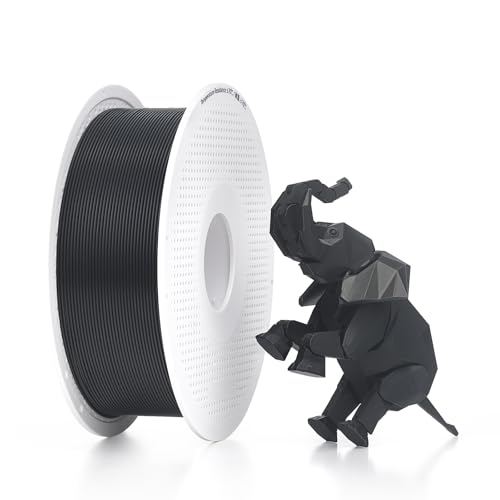
Bambu Lab PLA Basic (Black (10101), 1.75 mm, 1 kg, with spool)
- Best for
- Everyday PLA on Bambu Lab printers and AMS units (the TDS lists AMS-friendly 200 × 67 mm spool dimensions).
- Skip this if
- The part will see heat, or you'd rather buy the cheaper refill and reuse a spool.
Specs, strengths, and limitations
- Material
- PLA
- Diameter
- 1.75 mm
- Net filament
- 1000 g (filament only, not packaged weight)
- Format
- plastic spool
- Maker's nozzle range
- 190–230 °C
- Manufacturer states it is designed for high-speed printing, reaching 250–300 mm/s.
- Manufacturer states excellent toughness and Z-layer strength compared with general PLA.
- Manufacturer TDS lists AMS-friendly spool dimensions (200 mm × 67 mm).
- Not suited to parts exposed to heat: the TDS lists a heat deflection temperature of 54 °C (1.8 MPa).
- The ABS spool is rated to 70 °C, which limits drying temperature on the spool.

Bambu Lab Bambu ABS (Black (40101), 1.75 mm, 1 kg refill (no spool))
- Best for
- Bambu Lab enclosed-printer owners who want ABS with Bambu's tuned profiles and a reusable spool.
- Skip this if
- You don't have a reusable Bambu spool or an enclosed printer.
Specs, strengths, and limitations
- Material
- ABS
- Diameter
- 1.75 mm
- Net filament
- 1000 g (filament only, not packaged weight)
- Format
- refill
- Maker's nozzle range
- 240–270 °C
- Manufacturer states Bambu ABS is designed to reduce warping and cracking while keeping strong impact resistance.
- TDS lists print speeds under 300 mm/s and nozzle sizes from 0.2 to 0.8 mm.
- Manufacturer publishes a full TDS with drying, annealing, and mechanical data.
- Bambu Lab's store page says enclosed printers are required and recommends a well-ventilated area or air filtration, warning that it may release styrene at printing temperatures.
- Refill only: it needs a reusable spool to load in an AMS or on a spool holder.
- TDS calls for glue on the build plate.
Polymaker PolyLite PLA
Polymaker's store sells it by "Net Weight." Its FAQ lists the 1 kg cardboard spool at 140 ± 7 g, and Polymaker's 2021 cardboard spool announcement says its spools carry a rough filament weight guide.

Polymaker PolyLite PLA (Black, 1.75 mm, 1 kg)
- Best for
- Everyday PLA prints, prototypes, and display models where a documented, easy-printing PLA is wanted.
- Skip this if
- The part will sit in a hot car, near heat sources, or needs toughness beyond standard PLA.
Specs, strengths, and limitations
- Material
- PLA
- Diameter
- 1.75 mm
- Net filament
- 1000 g (filament only, not packaged weight)
- Format
- cardboard spool
- Maker's nozzle range
- 190–230 °C
- Manufacturer states PolyLite PLA is designed for reliability and ease of printing.
- Manufacturer TDS lists no enclosure needed and a wide 190–230 °C nozzle window.
- Manufacturer publishes a full TDS with mechanical, thermal, and drying data.
- Not suited to parts exposed to heat: the TDS lists a heat deflection temperature of 58 °C (1.8 MPa).
- Cardboard spool: Polymaker says its spools have hardened edges that work in the AMS, but Bambu Lab's general AMS guidance recommends an adapter or ring for cardboard spools. Check your unit.
Quick checklist
- Read the weight on a product page as the filament weight. Look for "net" or "filament weight" to confirm it.
- If a maker lists a gross weight, as SUNLU does, don't compare it with another maker's net weight.
- Find the maker's empty spool weight for the exact product. ELEGOO's differs between its standard, Silk PLA and TPU spools.
- Weigh the spool without its box, desiccant or adapter ring.
- Use the maker's own tool where there is one: Prusament's spool calculator, Polymaker's weight guide, or Bambu's AMS estimate.
- Before buying a refill, check that it fits your reusable spool and that the spool's temperature rating suits the material.
- Check spool width and hole size against your AMS or other material system before you load it.
How this guide was checked
This is a research-based guide. We haven't weighed spools for it. Every weight, dimension and quotation comes from the makers' own product pages, data sheets, wikis, FAQs and blog posts listed in the sources, retrieved on 2026-10-13. Makers change spools over time, as Prusa did in October 2025, so check the current page for the spool you buy. Read more in our editorial standards.
Ready to choose? The PLA filament shortlist lists verified spools with each maker's published net weight and spool details, and the filament storage gear shortlist covers boxes and bags for the spools you already have.
Sources
- ELEGOO PLA product page (Specification), ELEGOO
- ELEGOO Silk PLA product page (Specification), ELEGOO
- ELEGOO TPU product page (Specification), ELEGOO
- ELEGOO Rapid PLA+ product page, ELEGOO
- ELEGOO ABS product page, ELEGOO
- ELEGOO Rapid PETG product page, ELEGOO
- ELEGOO PETG HF product page, ELEGOO
- ELEGOO PLA-CF product page, ELEGOO
- ELEGOO PETG-CF product page, ELEGOO
- ELEGOO PAHT-CF product page, ELEGOO
- ELEGOO ASA-CF product page, ELEGOO
- PLA Filament (wiki), Overture
- PETG Filament (wiki), Overture
- TPU Filament (wiki), Overture
- Overture High Speed PLA product page, Overture
- FAQs, Overture
- Prusament spool data (sample), Prusa Research
- Prusament PLA Jet Black 1kg, Prusa Research
- The OpenPrintTag Is Here! (new Prusament spool and refills), Prusa Research
- Bambu PLA Basic Technical Data Sheet, Bambu Lab
- Bambu PETG Basic Technical Data Sheet, Bambu Lab
- Bambu ABS Technical Data Sheet V3, Bambu Lab
- PLA Basic (store page), Bambu Lab
- Bambu Reusable Spool (store page), Bambu Lab
- Refill Filament with Bambu Reusable Spool / Refill, Bambu Lab
- AMS function introduction (Remaining Filament Estimation), Bambu Lab
- PolyLite PLA (store page), Polymaker
- Polymaker FAQ (Spool Questions), Polymaker
- Polymaker Switches All Products to 100% Recycled Spools, Polymaker
- Introducing Polymaker Cardboard Spool Adapter, Polymaker
- Panchroma PLA Refill (wiki), Polymaker
- SUNLU ASA filament (store page), SUNLU
This page is research-based: we have not tested the products or methods ourselves. It draws on the manufacturer documentation and sources listed. Exact settings and fit always defer to your printer and filament makers.
Keep reading

Which Filaments Work in Bambu's AMS and AMS lite
Bambu's own rules for the AMS and AMS lite: unsupported materials, TPU, damp or brittle filament, cardboard spools, spool sizes, and the external spool route.

Filament storage: sealed containers, desiccant, and moisture exposure
How to keep opened spools dry with sealed containers, the right desiccant and a hygrometer, and why storage cannot fix filament that is already wet.
1.75 mm vs 2.85 mm Filament: Which Does Your Printer Use?
The two filament diameters, why a printer takes only one, how to check yours on the maker's spec page, and why the slicer's diameter setting must match.