PLA-CF vs PETG-CF: Which Carbon Fiber Filament to Choose
PLA-CF vs PETG-CF on maker data from Bambu Lab, Polymaker and ELEGOO: stiffness, impact, heat, drying, enclosures and AMS rules, and which one to pick.
On this page (15 sections)
Pick PLA-CF for stiff, matte parts that stay cool, and PETG-CF when the part needs more heat resistance or has to take knocks. Bambu Lab's data sheets, on annealed specimens, give its PETG-CF a heat deflection temperature (HDT) of 68 °C at 1.8 MPa against 54 °C for its PLA-CF. In both Bambu's and ELEGOO's lineups, PLA-CF is the stiffer of the two in bending, while PETG-CF has much higher impact figures and an HDT about 14 to 19 °C higher. Polymaker's two products don't follow that stiffness and impact pattern, so treat it as a tendency, not a rule. Both are abrasive and need a hardened nozzle. PLA-CF prints at PLA-like temperatures, 190–240 °C across these makers. PETG-CF runs at 240–270 °C on a 60–80 °C bed, and Bambu Lab recommends an enclosed printer for its layer strength. In Bambu's own range, PLA-CF is listed for every AMS model, while PETG-CF is listed as not compatible with the AMS lite.
Who this guide is for
You've decided you want a carbon fiber filament, probably for a bracket, jig, fixture, or enclosure part, and you're choosing between the two easiest ones. This guide compares PLA-CF and PETG-CF using only what makers publish: Bambu Lab's data sheets, product pages, and wiki, Polymaker's data sheets and product pages, ELEGOO's product pages, and Siraya Tech's data sheet and product page. We haven't printed these filaments for this page.
If you're new to carbon fiber, start with our carbon fiber filament guide, which covers what the fibers add and cost across every base plastic. For the unfilled plastics, see PLA vs PETG.
How to read the numbers
"PLA-CF" and "PETG-CF" aren't standard grades. Each maker chooses its own fiber content, and only some say what it is: Polymaker states 8% for both its products, Siraya Tech states 10% for its PETG-CF, and Bambu Lab and ELEGOO don't publish a percentage.
Test numbers are only comparable when the method and specimens match. So this guide compares PLA-CF with PETG-CF inside one maker's lineup first, and never ranks one brand against another on figures from different methods. Our guide to which filament is strongest explains why cross-brand rankings mislead. Even inside one maker, the specimen settings differ, as each section notes.
Bambu Lab's two data sheets
Bambu Lab is the cleanest comparison we found. Both data sheets use the same ISO methods and 100% infill specimens, and both say "All the specimens were annealed and dried" for 8 hours before testing: at 55 °C for PLA-CF and 65 °C for PETG-CF. The print settings differ: PLA-CF specimens were printed at 230 °C, 180 mm/s, on a 35 °C bed, and PETG-CF at 255 °C, 150 mm/s, on a 70 °C bed.
| Property (method) | Bambu PLA-CF (TDS V2.0) | Bambu PETG-CF (TDS V3.0) |
|---|---|---|
| Young's modulus, X-Y (ISO 527) | 2790 ± 120 MPa | 2460 ± 230 MPa |
| Bending modulus, X-Y (ISO 178) | 3950 ± 190 MPa | 2910 ± 260 MPa |
| Bending strength, X-Y (ISO 178) | 89 ± 4 MPa | 70 ± 5 MPa |
| Tensile strength, X-Y (ISO 527) | 38 ± 4 MPa | 35 ± 5 MPa |
| Tensile strength, Z (ISO 527) | 26 ± 2 MPa | 29 ± 4 MPa |
| Elongation at break, X-Y (ISO 527) | 8.4 ± 3.2% | 10.4 ± 0.6% |
| Impact strength, X-Y (ISO 179) | 23.2 ± 3.7 kJ/m² | 41.2 ± 2.6 kJ/m² |
| Impact strength, X-Y, notched (ISO 179) | 7.6 ± 2.6 kJ/m² | 15.7 ± 1.6 kJ/m² |
| HDT at 1.8 MPa / 0.45 MPa (ISO 75) | 54 °C / 55 °C | 68 °C / 74 °C |
| Saturated water absorption (25 °C, 55% RH) | 0.42% | 0.30% |
On Bambu's figures, PLA-CF is stiffer and stronger in bending, and slightly stronger in tension along the layers. PETG-CF roughly doubles the impact figures, stretches a little further before breaking, has slightly higher tensile strength between layers (Z), and has a higher HDT. Bambu's filament guide points the same way in its material table: on its relative scales it places PETG-CF one step higher than PLA-CF for heat deflection temperature and impact resistance, and PLA-CF one step higher for tensile strength.
The product pages match that split. Bambu says PLA-CF has "a stiffness of 3950 MPa" and is "ideal for functional and load-bearing parts that resist bending." It says PETG-CF "overcomes the low stiffness of regular PETG and delivers improved strength and toughness," and calls it "Ready for Outdoor Use" thanks to "enhanced resistance to heat and moisture." That last line is Bambu's claim about its own product.
Two oddities in the PLA-CF sheet: its second impact row is also labelled "X-Y" (7.8 ± 0.7 kJ/m²), where the PETG-CF sheet labels that row Z, and its annealing note suggests 55–60 °C for 6–12 hours, while the PETG-CF note suggests 55–60 °C for 65–70 hours. We report both as printed.
ELEGOO's two product pages
ELEGOO publishes both grades in the same specification table format, but names no test method, specimen type, or print settings. Treat these as ELEGOO's figures, comparable only with each other.
| Property (no method named) | ELEGOO PLA-CF | ELEGOO PETG-CF |
|---|---|---|
| Bending modulus, X-Y | 3341 ± 172 MPa | 3040 ± 21 MPa |
| Bending strength, X-Y | 78 ± 2 MPa | 75 ± 2 MPa |
| Tensile strength, X-Y / Z | 39 ± 3 / 23 ± 4 MPa | 51 ± 8 / 38 ± 5 MPa |
| Impact strength, X-Y / Z (test type not stated) | 24.7 ± 1.5 / 7.9 ± 1.6 kJ/m² | 70.7 ± 6.2 / 14.6 ± 2.1 kJ/m² |
| HDT at 0.45 MPa | 56 °C | 74 °C |
| Vicat softening temperature | 64 °C | 83 °C |
The direction matches Bambu's: PLA-CF is a little stiffer in bending, and PETG-CF has far higher impact figures and an HDT 18 °C higher. Unlike Bambu, ELEGOO's table also gives PETG-CF the higher tensile strength. ELEGOO states the trade-off directly: "Compared to PLA-CF, Elegoo PETG-CF provides superior toughness and is less prone to fracture under external stress and impact. It prints more smoothly with less filament breakage." That's ELEGOO's claim about its own two products.
Polymaker's two products don't follow the pattern
Polymaker publishes data sheets for PolyLite PLA-CF (V5.4) and Fiberon PETG-rCF08 (V1.0). Both use ISO 527, ISO 178, ISO 179, and ISO 75, on 100% infill specimens, and neither lists an annealing setting. But they come from two product lines with different sheet versions, and the specimens were printed differently: PLA-CF at 230 °C on a 50 °C bed with the fan on, PETG-rCF08 at 270 °C on a 60 °C bed with 0–50% fan.
| Property | PolyLite PLA-CF (8% fiber) | Fiberon PETG-rCF08 (8% recycled fiber) |
|---|---|---|
| Young's modulus, X-Y | 3280.7 ± 79.6 MPa | 3710.1 ± 151.1 MPa |
| Bending modulus, X-Y | 3380.5 ± 52.1 MPa | 3779.1 ± 40.6 MPa |
| Bending strength, X-Y | 51.7 ± 0.6 MPa | 94.6 ± 1.3 MPa |
| Tensile strength, X-Y / Z | 31.2 ± 0.7 / 15.1 ± 0.7 MPa | 59.8 ± 0.3 / 41.1 ± 4.1 MPa |
| Notched Charpy impact, X-Y | 5.5 ± 0.2 kJ/m² | 4.0 ± 0.9 kJ/m² |
| HDT at 1.8 MPa / 0.45 MPa | 50 °C / 54 °C | 65.7 °C / 68.6 °C |
| Equilibrium water absorption (70% RH, 23 °C) | 0.38% | 0.55% |
Here the PETG-CF is the stiffer one, it's much stronger in bending and in tension, especially between layers, and its notched impact figure is slightly lower than the PLA-CF's. The PLA-CF sheet also lists the higher X-Y elongation at break (13.2% against 5.7%). The heat gap is the one result that matches the other two makers: about 15 °C higher HDT for PETG-CF. Polymaker also reports PETG-rCF08 absorbing more water at equilibrium than PolyLite PLA-CF, the opposite of Bambu's ranking.
So only two results hold across all three makers: PETG-CF has the higher HDT and the higher Z (between-layer) tensile strength. Stiffness, X-Y strength, and impact depend on the specific product, which is why it's worth reading the data sheet for the spool you're buying.
Is PETG-CF more heat resistant than PLA-CF?
Here are the HDT figures each maker publishes for the products in this guide. Compare them only at the same load, and remember that Bambu's specimens were annealed, while the Polymaker, ELEGOO, and Siraya Tech documents don't say whether theirs were.
| Product (document) | HDT at 1.8 MPa | HDT at 0.45 MPa | Method |
|---|---|---|---|
| Polymaker PolyLite PLA-CF (TDS V5.4) | 50 °C | 54 °C | ISO 75 |
| Bambu PLA-CF (TDS V2.0) | 54 °C | 55 °C | ISO 75, annealed specimens |
| ELEGOO PLA-CF (product page) | Not published | 56 °C | Not named |
| Polymaker Fiberon PETG-rCF08 (TDS V1.0) | 65.7 °C | 68.6 °C | ISO 75 |
| Bambu PETG-CF (TDS V3.0) | 68 °C | 74 °C | ISO 75, annealed specimens |
| Siraya Tech Fibreheart PETG-CF Pro HF (TDS) | 69 °C | 75 °C | "Method A" and "Method B" |
| ELEGOO PETG-CF (product page) | Not published | 74 °C | Not named |
Every PLA-CF figure sits in the 50s, and every PETG-CF figure sits in the mid-60s to mid-70s. Siraya Tech's product page headline gives "HDT (76°C)" without naming a load, one degree above its data sheet's 0.45 MPa figure. Bambu's filament guide says PLA is "Not recommended for environments at about 50 ℃ or higher, as it may slowly degrade, soften, and deform," and groups PETG among materials that "Offer better heat resistance." If the part could get close to 50 °C, PLA-CF is the wrong choice. PETG-CF isn't a high-heat material either, and an HDT is a test result, not a safe working temperature. For hotter parts, see the PET-CF and nylon CF options in our carbon fiber filament guide, and for sun and weather, our outdoor filament guide.
Print settings side by side
PLA-CF prints like PLA and PETG-CF prints like PETG. These are each maker's published ranges.
| Setting | PLA-CF | PETG-CF |
|---|---|---|
| Nozzle temperature | Bambu 210–240 °C; Polymaker 190–230 °C (TDS and specification block; the page's print settings say 210–230 °C); ELEGOO 210–240 °C | Bambu 240–270 °C; Polymaker 240–270 °C; ELEGOO 240–270 °C; Siraya Tech 250–270 °C |
| Bed temperature | Bambu 35–45 °C (TDS), 35–65 °C (filament guide glue table) or 45–65 °C on every plate (filament guide plate table); Polymaker 25–60 °C (TDS and specification block; the page's print settings say 30–70 °C); ELEGOO 35–65 °C | Bambu 65–75 °C (TDS) or 60–80 °C (filament guide); Polymaker 60–70 °C; ELEGOO 65–75 °C; Siraya Tech 70–80 °C |
| Cooling fan | Bambu "Turn on"; Polymaker on | Bambu 0–60%; Polymaker 0–50%; Siraya Tech "Off or run very low (10-20%)" |
| Enclosure | Bambu: open-frame or enclosed; Polymaker: "Not needed"; ELEGOO: "Not Required" | Bambu: enclosed recommended (see below); Polymaker: conflicting; ELEGOO: "Not Required"; Siraya Tech: recommended |
| Bambu build plates | Cool Plate, High Temperature Plate or Textured PEI, with glue (TDS) | Engineering Plate, High Temperature Plate or Textured PEI, with glue (TDS); Cool Plate "Not recommended" (filament guide) |
PLA-CF is the easier fit for an open-frame printer. Bambu's filament guide says both are "Not prone to warping" and suit "Open-frame or enclosed" printers, but adds: "For PETG and PETG-CF/GF, an enclosed printer is recommended to prevent low ambient temperatures from reducing the model's interlayer strength." Its PETG-CF product page goes further: "Avoid using an open-frame printer and refrain from setting the cooling fan speed too high, as overcooling can weaken layer bonding."
Other makers split on PETG-CF:
- ELEGOO says enclosed printing is "Not Required."
- Siraya Tech's data sheet says an enclosure is "Not mandatory, but it is recommended."
- Polymaker contradicts itself: the PETG-rCF08 page's specification block says "Enclosure Not needed," while its printing tips say "An enclosed printer is recommended."
If you print PLA-CF inside an enclosed printer, the opposite problem applies. Bambu's filament guide recommends removing the upper glass cover for PLA-CF once the bed is above 45 °C, and, in its plate table, for PETG-CF above 70 °C (its text gives 60 °C for PETG-type filaments, and also suggests opening the front door), so excess chamber heat doesn't soften the filament inside the extruder. Our enclosure planning guide covers what an enclosure does and doesn't do.
Do PLA-CF and PETG-CF need a hardened nozzle?
Both grades are abrasive. Every maker here calls for a hardened nozzle, and Bambu's product pages for both say "0.2 mm Nozzle NOT Compatible" and "Stainless Steel Nozzle NOT Recommended." Polymaker's pages for both say "0.4mm+ hardened nozzle required," and ELEGOO's tables for both list a "Hardened Steel Nozzle, ≥ 0.4 mm."
Bambu's filament guide says a 0.4 mm hardened steel nozzle is "highly recommended as the first choice" for its own PLA-CF and PETG-CF. For fiber-filled filaments in general, it names a 0.6 mm hardened steel nozzle as the first choice and a 0.4 mm as the second, with a maximum speed of about 100 mm/s on the 0.4 mm. Its PETG-CF page also says "a 0.6 mm hardened steel nozzle is recommended to further reduce the risk of clogging." Polymaker's nozzle guide notes that hardened steel "Requires higher nozzle temperatures due to reduced thermal conductivity," so you may need to sit higher in the maker's range. Our abrasive filament nozzle guide covers the options.
Do PLA-CF and PETG-CF need drying?
The makers' drying advice runs hotter for PETG-CF, but they don't agree on which grade is more moisture-sensitive.
- Bambu Lab lists drying as "Recommended" for both in its filament guide, at 55 ℃ for 8 hours for PLA-CF and 70 ℃ for 8 hours for PETG-CF, with desiccant during use "Optional." Its data sheets give 55 °C and 65 °C in a blast drying oven, each for 8 hours, and its drying guide gives 50–60 °C and 60–65 °C in a forced-air oven, each for 8 hours. Its PETG-CF page calls the filament "highly moisture-absorbent," yet its data sheets give PETG-CF the lower saturated water absorption (0.30% against 0.42%).
- Polymaker gives 55 °C for 6 hours for PolyLite PLA-CF and 65 °C for 3 hours for Fiberon PETG-rCF08, and both product pages' print settings say to dry "Only if the material has absorbed moisture." The PETG-rCF08 page's printing tips instead say to dry it "before use," and its data sheet is stricter still, saying it "is sensitive to moisture and should always be stored and used under dry conditions (relative humidity below 20%)."
- ELEGOO marks drying as "Required" for both: 50 ± 5 °C for 8 hours for PLA-CF and 60 ± 5 °C for 8 hours for PETG-CF, though one note on the PETG-CF page says 70 °C. It says to print and store both at or below 20% RH, sealed with desiccant.
- Siraya Tech gives 70–80 °C for 4–6 hours for its PETG-CF Pro HF.
Check that your dryer reaches the PETG-CF settings, and that the spool can take them. Bambu rates its own ABS spool to 70 °C. Our filament dryer vs dry box guide covers the options.
Can PLA-CF and PETG-CF go in a Bambu AMS?
If you print on a Bambu Lab printer with an AMS, this may decide it for you.
- Bambu's own spools: its PLA-CF page says "All AMS Series Compatible." Its PETG-CF page lists "AMS 2 Pro, AMS HT & AMS Compatible" and "AMS lite NOT Compatible." The filament guide explains that the AMS lite lacks the AMS's extra feed gear, so "PETG-CF and PLA Wood filaments are compatible with the AMS but not recommended for the AMS lite."
- Other brands: Bambu's Notes for AMS say to avoid "third-party fiber reinforcement materials (PA-CF/GF, PET-CF/GF, PLA-CF /GF, etc.)," because they "may wear AMS PTFE tubes," while its own "PLA-CF, PETG-CF, PAHT-CF and other official filaments are specially optimized." Its filament guide lists "certain brands of" PLA-CF/GF as "Too hard and rough."
Siraya Tech says its PETG-CF Pro HF "is rigid enough for smooth loading in systems like the AMS." That's the filament maker's claim. Bambu's notes are the printer maker's advice, and we'd follow the printer maker. Our AMS filament compatibility guide covers the external spool route.
Finish
Both hide layer lines, but they don't look the same. Bambu says its PETG-CF "features a carbon fiber texture that conceals layer lines, while its surface finish is glossier than that of PLA-CF," and that "For a shinier appearance, use lower printing speeds and slightly higher nozzle temperatures." Polymaker describes PolyLite PLA-CF's "matte black finish with virtually invisible layer lines," and calls PETG-rCF08's finish "matte, professional-looking." ELEGOO lists a matte finish for its PETG-CF too. If the flattest, most matte look matters most, Bambu's description points to PLA-CF, but compare your own spools.
Choose PLA-CF if…
- The part stays near room temperature, well below the 50s °C HDT figures above.
- You want a stiff part with the least setup. Bambu's and ELEGOO's data both put PLA-CF ahead in bending stiffness, though Polymaker's pair reverses that.
- You print on an open-frame printer. No maker here asks for an enclosure for PLA-CF.
- You use a Bambu AMS lite with Bambu's own spool. Bambu lists its PLA-CF as compatible with every AMS model, but advises against third-party PLA-CF in the AMS.
Choose PETG-CF if…
- The part will see more warmth than PLA-CF can take. PETG-CF's HDT figures here run from about 66 to 75 °C, so leave a margin below them, and for hotter parts look at PET-CF or nylon CF.
- The part takes knocks or drops. Bambu's and ELEGOO's X-Y impact figures for PETG-CF are roughly 1.8 to 2.9 times their PLA-CF figures (Polymaker's notched figures don't follow this).
- You have an enclosed printer, or can keep drafts off the part, and a dryer that reaches the maker's PETG-CF drying temperature (60–80 °C across these makers).
- You need strength between layers. Bambu's, ELEGOO's, and Polymaker's PETG-CF figures all give higher Z tensile strength than the same maker's PLA-CF.
Whichever you choose, orient parts so the main load runs along the layers. Bambu's PLA-CF page says "The XY axis offers better strength for load-bearing parts," and every Z figure above is lower than its X-Y figure.
Spools we've checked
These are the PLA-CF and PETG-CF spools on our carbon fiber filament shortlist. For head-to-heads, see ELEGOO PLA-CF vs PolyLite PLA-CF and ELEGOO PETG-CF vs Siraya Tech PETG-CF Pro HF.

Polymaker PolyLite PLA-CF (Black, 1.75 mm, 1 kg)
- Best for
- Stiff, matte-finish PLA parts and prototypes on a printer fitted with a hardened nozzle.
- Skip this if
- Your printer only has a brass nozzle, or the part will see heat.
Specs, strengths, and limitations
- Material
- PLA (carbon-fiber filled (8 wt% chopped carbon fiber))
- Diameter
- 1.75 mm
- Net filament
- 1000 g (filament only, not packaged weight)
- Format
- cardboard spool
- Maker's nozzle range
- 190–230 °C
- Nozzle
- Abrasive: the maker recommends a wear-resistant nozzle
- Manufacturer states 8% chopped carbon fiber gives exceptional rigidity and strength.
- Manufacturer states a matte black finish with virtually invisible layer lines and low shrinkage.
- Manufacturer states it prints with standard PLA settings; the TDS lists no enclosure needed.
- Abrasive: Polymaker strongly recommends a hardened nozzle.
- Not suited to heat: the TDS lists a heat deflection temperature of 50 °C (1.8 MPa).
- Cardboard spool: Bambu Lab strongly advises a spool adapter or adapter ring for cardboard spools in the AMS.
- The Amazon listing's bullet points describe plain PolyLite PLA, though its title and model number (PA10001) are the carbon-fiber version. Check that the title says Carbon Fiber PLA before you buy.
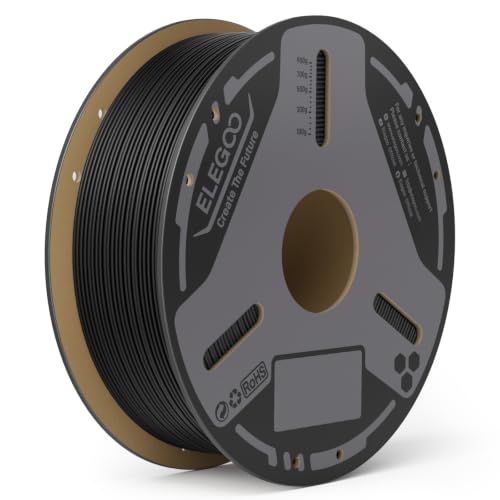
ELEGOO PLA-CF (Carbon Fiber Black, 1.75 mm, 1 kg)
- Best for
- Stiff, textured-finish PLA parts and assembly prototypes on an open or enclosed printer fitted with a hardened steel nozzle.
- Skip this if
- Your printer only has a brass nozzle, or the part will sit somewhere warm such as a car interior.
Specs, strengths, and limitations
- Material
- PLA (carbon-fiber reinforced)
- Diameter
- 1.75 mm
- Net filament
- 1000 g (filament only, not packaged weight)
- Format
- other
- Maker's nozzle range
- 210–240 °C
- Nozzle
- Abrasive: the maker recommends a wear-resistant nozzle
- Manufacturer states carbon fiber reinforcement gives 'higher strength and stiffness'.
- Manufacturer states minimal shrinkage and warping for dimensionally accurate assembly parts.
- Manufacturer states a textured finish that hides layer lines, and it prints at PLA temperatures (210–240 °C) with no enclosure.
- Abrasive: ELEGOO recommends a hardened steel nozzle of 0.4 mm or larger.
- Low heat resistance: the product page lists a heat deflection temperature of 56 °C (0.45 MPa).
- Drying is listed as required (50 °C for 8 h), and no TDS PDF or fiber percentage is published.
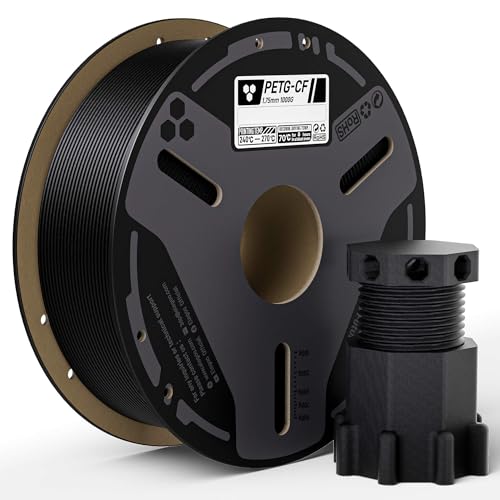
ELEGOO PETG-CF (Carbon Fiber Black, 1.75 mm, 1 kg)
- Best for
- Stiff matte functional parts on a printer with a 0.4 mm or larger hardened steel nozzle.
- Skip this if
- Your printer only has a brass nozzle, or the part will see temperatures near the listed 74 °C (0.45 MPa) heat deflection temperature.
Specs, strengths, and limitations
- Material
- PETG (carbon-fiber filled)
- Diameter
- 1.75 mm
- Net filament
- 1000 g (filament only, not packaged weight)
- Format
- other
- Maker's nozzle range
- 240–270 °C
- Nozzle
- Abrasive: the maker recommends a wear-resistant nozzle
- Manufacturer states carbon fiber adds strength and rigidity, with abrasion resistance and dimensional stability.
- Manufacturer states that, compared with PLA-CF, it has superior toughness and is less prone to fracture under stress and impact.
- Manufacturer states a premium matte finish that reduces visible layer lines.
- Abrasive: ELEGOO recommends a 0.4/0.6/0.8 mm hardened steel nozzle and says 0.2 mm nozzles are not compatible.
- Needs drying before use (60 ± 5 °C for 8 h per the spec table; the page's 'Important Notes' say 70 °C) and storage at ≤ 20% RH.
- Modest heat resistance: the spec table lists a heat deflection temperature of 74 °C at 0.45 MPa; no 1.8 MPa figure or TDS PDF is published.

Polymaker Fiberon PETG-rCF08 (Black, 1.75 mm, 0.5 kg)
- Best for
- An easy first carbon-fiber PETG for matte functional parts and fixtures on a printer with a hardened nozzle.
- Skip this if
- You need parts that hold up above about 65 °C, or you want a 1 kg spool.
Specs, strengths, and limitations
- Material
- PETG (8% recycled carbon-fiber filled)
- Diameter
- 1.75 mm
- Net filament
- 500 g (filament only, not packaged weight)
- Format
- other
- Maker's nozzle range
- 240–270 °C
- Nozzle
- Abrasive: the maker recommends a wear-resistant nozzle
- Manufacturer states 8% recycled carbon fiber for added stiffness over standard PETG.
- Manufacturer states a matte finish that hides layer lines and PETG-level low warping.
- Prints at ordinary PETG temperatures (240–270 °C nozzle, 60–70 °C bed) per the TDS, with only a short 65 °C / 3 h dry.
- Abrasive: Polymaker requires a hardened (or ruby) nozzle of 0.4 mm or larger; brass lasts about 9 h.
- Modest heat resistance: TDS heat deflection temperature is 65.7 °C at 1.8 MPa.
- Only sold in 0.5 kg and 3 kg spools, and Polymaker's enclosure guidance is inconsistent between page sections.

Siraya Tech Fibreheart PETG-CF Pro HF (High Flow Black, 1.75 mm, 1 kg)
- Best for
- Fast, matte carbon-fiber PETG parts such as drone frames and fixtures on high-flow printers with a hardened nozzle.
- Skip this if
- Your printer has a brass nozzle, or the part must survive temperatures above about 70 °C.
Specs, strengths, and limitations
- Material
- PETG (high-flow, 10% short-cut carbon-fiber reinforced)
- Diameter
- 1.75 mm
- Net filament
- 1000 g (filament only, not packaged weight)
- Format
- other
- Maker's nozzle range
- 250–270 °C
- Nozzle
- Abrasive: the maker recommends a wear-resistant nozzle
- Manufacturer states a high-flow formula good for up to 25 mm³/s, which it says cuts production time by half.
- Manufacturer states chopped (not powdered) carbon fiber for stiffness; TDS lists a 3450 MPa bending modulus.
- Product page FAQ says it is rigid enough to load smoothly in AMS-type systems.
- Abrasive: Siraya Tech requires a hardened steel or ruby nozzle of 0.4 mm or larger.
- Modest heat resistance: TDS heat deflection temperature is 69 °C at 1.8 MPa.
- Siraya Tech recommends an enclosure: the TDS says 'Not mandatory, but it is recommended', and the product page FAQ calls one 'highly recommended'.
If prints fail, start with our carbon fiber printing problems guide.
How this page was checked
Every figure and quote above comes from the manufacturer documents in the sources section, retrieved on 2026-10-14. We used only visible page text and data sheet text, not hidden page code or images. Where a maker's documents disagree, we report each value. Bambu's PLA-CF and PETG-CF data sheets come from different versions (V2.0 and V3.0), and Polymaker's from two product lines, so even same-maker comparisons carry some differences in specimen settings, as noted in each section. Figures vary by color, batch, and revision, so check the current data sheet for your spool. Read more in our editorial standards and affiliate disclosure.
Specialty materials: what to check before you buy a spool ↗Sources
- Bambu PLA-CF Technical Data Sheet V2.0, Bambu Lab
- Bambu PETG-CF Technical Data Sheet V3.0, Bambu Lab
- PLA-CF product page, Bambu Lab
- PETG-CF product page, Bambu Lab
- Filament guide: printer, nozzle, AMS, build plate, glue compatibility and required parameters, Bambu Lab
- Filament drying recommendations, Bambu Lab
- Notes for AMS, Bambu Lab
- PolyLite PLA-CF product page, Polymaker
- PolyLite PLA-CF Technical Data Sheet V5.4, Polymaker
- Fiberon PETG-rCF08 product page, Polymaker
- Fiberon PETG-rCF08 Technical Data Sheet V1.0, Polymaker
- Nozzles, Polymaker
- ELEGOO PLA-CF Filament 1.75mm 1kg, ELEGOO
- ELEGOO PETG-CF Filament 1.75mm 1kg, ELEGOO
- Fibreheart PETG-CF Pro HF product page, Siraya Tech
- Fibreheart PETG-CF Pro TDS, Siraya Tech
This page is research-based: we have not tested the products or methods ourselves. It draws on the manufacturer documentation and sources listed. Exact settings and fit always defer to your printer and filament makers.
Keep reading

Carbon Fiber Filament Explained: What the Fibers Add and Cost
What carbon fiber adds to PLA, PETG, PET and nylon, what it costs, and what makers say about nozzles, drying, enclosures, annealing and AMS feeding.

Best Carbon Fiber Filament (2026): Spools by Base Material
The best carbon fiber filament by base material: fifteen spools from PLA-CF to nylon and PC, with each maker's nozzle, heat, enclosure and drying needs.
PLA vs PETG: Choosing for the Actual Project
How to choose between PLA and PETG by what the part has to do: heat, stiffness, toughness, print ease, stringing, and build-plate release.