Best Filament for Beginners (2026): What to Buy First
A first spool and the next upgrades for a new 3D printer: standard PLA, then PETG, then TPU if your extruder suits it, plus drying and storage basics.
On this page (10 sections)
Start with a 1 kg spool of standard PLA in the diameter your printer takes, such as Polymaker PolyLite PLA, Prusament PLA on a Prusa, or Bambu Lab PLA Basic on a Bambu Lab machine. Add PETG when a part needs to be tougher or cope with more warmth, and add TPU only if your printer's extruder suits flexible filament. Printer and filament makers describe PLA as the easy material: Prusa calls it "one of the easiest materials to print," and Bambu Lab's filament guide puts PLA in the group that is "not prone to warping." Leave carbon or glass-filled filaments (which need a hardened nozzle), ABS and ASA (which want an enclosure and ventilation), and nylon or PC until later. A dryer and some indicating desiccant keep the PETG and TPU you add later printable.
Quick picks
| Need | Pick | Why |
|---|---|---|
| First spool, most printers | Polymaker PolyLite PLA | Polymaker lists no special printing requirements for stock printers |
| First spool on a Prusa | Prusament PLA | Prusa lists print profiles for all its own FDM printers |
| First spool on a Bambu Lab printer | Bambu Lab PLA Basic | Bambu lists it as "Easy to Print & Beginner Friendly" and AMS-compatible |
| Tougher, warmer parts | Polymaker PETG | Polymaker says it prints without an enclosure and is less brittle than PLA |
| Flexible parts (direct drive only) | Polymaker PolyFlex TPU95 | 95A is the firmer, easier end of TPU, per Prusa's hardness rule |
These are defaults by need, not a ranking.
Who this page is for
This page is for someone who has just got a filament (FDM) 3D printer and wants to know what to buy first, and what to add after that. Every spool here is 1.75 mm, the size most current desktop printers take. Check your printer's manual or its page in our printer directory before you buy. If your printer uses 2.85 mm filament, none of these listings fits.
| Product | Best for | Skip if | Link |
|---|---|---|---|
| Polymaker PolyLite PLA (Black, 1.75 mm, 1 kg) | Everyday PLA prints, prototypes, and display models where a documented, easy-printing PLA is wanted. | The part will sit in a hot car, near heat sources, or needs toughness beyond standard PLA. | View on Amazon (opens Amazon in a new tab) |
| Prusa Research Prusament PLA (Jet Black, 1.75 mm, 1 kg) | Precise everyday PLA prints, especially on Prusa printers with stock profiles. | The part needs heat, UV, or mechanical-stress resistance. | View on Amazon (opens Amazon in a new tab) |
| Bambu Lab PLA Basic (Black (10101), 1.75 mm, 1 kg, with spool) | Everyday PLA on Bambu Lab printers and AMS units (the TDS lists AMS-friendly 200 × 67 mm spool dimensions). | The part will see heat, or you'd rather buy the cheaper refill and reuse a spool. | View on Amazon (opens Amazon in a new tab) |
| ELEGOO PLA (Black, 1.75 mm, 1 kg) | Budget everyday PLA prints on most 1.75 mm printers. | You run an AMS and don't want to print a spool ring, or the part will see heat. | View on Amazon (opens Amazon in a new tab) |
| Polymaker PETG (Black, 1.75 mm, 1 kg (new formula)) | Functional brackets and fixtures, indoors or in shade, that need more toughness than PLA. | You can't keep filament dry, or the part needs heat resistance well above 65 °C (TDS HDT at 1.8 MPa). | View on Amazon (opens Amazon in a new tab) |
| Prusa Research Prusament PETG (Jet Black, 1.75 mm, 1 kg) | Functional parts, brackets, and larger prints that need more toughness than PLA. | The part needs heat resistance above about 68 °C (TDS HDT at 0.45 and 1.8 MPa), or you want a matte finish that hides layer lines. | View on Amazon (opens Amazon in a new tab) |
| Bambu Lab PETG Basic (Black (30105), 1.75 mm, 1 kg, with spool) | Functional and outdoor-use parts on Bambu Lab printers and AMS. | The part needs heat resistance above about 68 °C (TDS HDT at 1.8 MPa). | View on Amazon (opens Amazon in a new tab) |
| Polymaker PolyFlex TPU95 (Black, 1.75 mm, 0.75 kg) | Flexible covers, grips, bumpers, and seals on printers that handle 95A TPU. | You need a softer TPU than 95A, or fast print times, or your printer is set up as Bowden and you can't print very slowly (Polymaker highly recommends direct drive and says Bowden is possible only at very slow speeds). | View on Amazon (opens Amazon in a new tab) |
| SUNLU FilaDryer S2 (Black, single-spool dryer) | Drying and feeding one standard 1 kg spool of PLA, PETG, or TPU at a time. | You need to dry several spools at once or need temperatures above 70 °C. | View on Amazon (opens Amazon in a new tab) |
| Dry & Dry 5 Gram Aiwa Orange Indicating Silica Gel Packets (50 packets × 5 g) | Dropping small pre-filled packets into vacuum bags, dry boxes or AMS-style units. | You prefer loose beads to refill a desiccant container. | View on Amazon (opens Amazon in a new tab) |


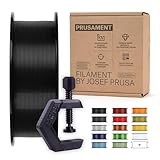


The table is grouped by what you buy first, then next. It isn't a ranking.
Why start with PLA?
Low temperatures. Prusa's PLA guide uses 215 °C at the nozzle for the first layer and 210 °C after that, with a 60 °C bed. The Prusament PLA material page goes further: "Heated Bed Optional," "Enclosure not required" and "No special hot-end required." Every PLA on this page publishes a nozzle range that tops out at 230 °C or below.
Low warping. Prusa lists "Good detail and low warping" among PLA's pros, says PLA "is not prone to significant warping," and calls it "suitable (not only) for beginners." Bambu's filament guide groups PLA, PETG and TPU as "Not prone to warping; no mandatory temperature requirements," on an open-frame or enclosed printer. Warping, where corners lift off the bed as the plastic cools, is one of the first problems new owners hit, so a material that resists it helps. If PLA corners do lift, our PLA printing problems guide covers the fixes makers suggest.
No enclosure. Bambu's guide says ABS, ASA, PC and PA "require higher heatbed and chamber temperatures to suppress warping and layer separation" and recommends an enclosed printer for them. PLA has no such requirement.
The catch is heat. Prusa says PLA "gets soft and deforms at temperatures over 60 °C" and "degrades under UV light." Bambu is more cautious and says PLA is "not recommended for environments at about 50 ℃ or higher." Don't print PLA parts for a car, a sunny windowsill or anything near a heater. That's the main reason to add PETG later. Our PLA vs PETG guide covers the trade-off in detail.
Labels like "PLA+" and "PLA Pro" are each maker's own modified recipe, not a standard grade. All four PLA picks below are standard PLA. Read PLA vs PLA+ if a "plus" spool tempts you.
Your first spool: standard PLA
Polymaker PolyLite PLA (Black, 1 kg)
Polymaker describes PolyLite PLA as "designed for reliability and ease of printing." Under printing requirements, its product page says "None! This will print great on any stock 3D printer!" and adds that you should print slower on stock, older-style printers. It lists a 190–230 °C nozzle and a 25–60 °C bed, and the TDS lists no enclosure needed. Polymaker's speed figures disagree with each other: the product page gives a 60 mm/s maximum, while the TDS gives 50–200 mm/s. If your printer runs fast profiles by default, keep it slower for this spool. PolyLite PLA ships on a cardboard spool, following Polymaker's switch of all its filaments to recycled cardboard.

Polymaker PolyLite PLA (Black, 1.75 mm, 1 kg)
- Best for
- Everyday PLA prints, prototypes, and display models where a documented, easy-printing PLA is wanted.
- Skip this if
- The part will sit in a hot car, near heat sources, or needs toughness beyond standard PLA.
Specs, strengths, and limitations
- Material
- PLA
- Diameter
- 1.75 mm
- Net filament
- 1000 g (filament only, not packaged weight)
- Format
- cardboard spool
- Maker's nozzle range
- 190–230 °C
- Manufacturer states PolyLite PLA is designed for reliability and ease of printing.
- Manufacturer TDS lists no enclosure needed and a wide 190–230 °C nozzle window.
- Manufacturer publishes a full TDS with mechanical, thermal, and drying data.
- Not suited to parts exposed to heat: the TDS lists a heat deflection temperature of 58 °C (1.8 MPa).
- Cardboard spool: Polymaker says its spools have hardened edges that work in the AMS, but Bambu Lab's general AMS guidance recommends an adapter or ring for cardboard spools. Check your unit.
Skip it if your printer only runs high-speed profiles, or your feeder or dryer needs a plastic spool.
Prusament PLA (Jet Black, 1 kg)
Prusament PLA is made by Prusa Research, which also makes printers. The material page lists a 210 ± 10 °C nozzle and a 40–60 °C bed, with the heated bed optional and no enclosure required. Prusa states a diameter tolerance of ±0.02 mm and says you can check each spool's measured data. Its product page says drying "is not usually necessary" and points to PETG or PC Blend for mechanically stressed parts. The material page warns that parts start to lose mechanical strength above 60 °C. Prusa lists print profiles for all its own FDM printers, so it's a natural fit on a Prusa machine. Its store page says that starting in October 2025, all Prusament filaments ship on a redesigned spool with an NFC tag. Prusa's knowledge base says older spools, which are still on the market, have black plastic sides pressed onto a cardboard core.

Prusa Research Prusament PLA (Jet Black, 1.75 mm, 1 kg)
- Best for
- Precise everyday PLA prints, especially on Prusa printers with stock profiles.
- Skip this if
- The part needs heat, UV, or mechanical-stress resistance.
Specs, strengths, and limitations
- Material
- PLA
- Diameter
- 1.75 mm
- Net filament
- 1000 g (filament only, not packaged weight)
- Format
- plastic spool
- Maker's nozzle range
- 200–220 °C
- Manufacturer states diameter precision of ±0.02 mm and publishes measured data for every spool.
- Manufacturer states low warping, suitable for large prints.
- Manufacturer states guaranteed color consistency between batches.
- Not suited to heat or outdoor use: Prusa lists 55 °C temperature resistance and low UV resistance.
- Prusa suggests PETG or PC Blend for mechanically stressed parts, and lists PLA as difficult to sand.
Skip it if the part needs heat or UV resistance, or will carry mechanical stress.
Bambu Lab PLA Basic (Black 10101, 1 kg, with spool)
PLA Basic is Bambu Lab's everyday PLA. Its store page lists "Easy to Print & Beginner Friendly" and "All AMS Series Compatible." The TDS (V3.0) lists a 190–230 °C nozzle, a 35–45 °C bed, and an ABS spool rated to 70 °C that measures 200 mm across and 67 mm high. It suits owners of Bambu Lab printers, especially with an AMS. This listing includes the spool. Bambu also sells refills that need a spool you already have.
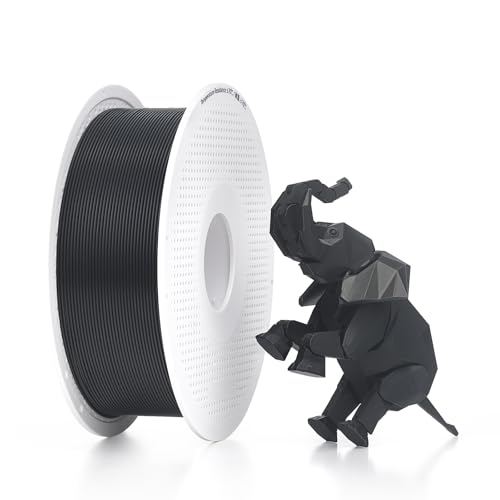
Bambu Lab PLA Basic (Black (10101), 1.75 mm, 1 kg, with spool)
- Best for
- Everyday PLA on Bambu Lab printers and AMS units (the TDS lists AMS-friendly 200 × 67 mm spool dimensions).
- Skip this if
- The part will see heat, or you'd rather buy the cheaper refill and reuse a spool.
Specs, strengths, and limitations
- Material
- PLA
- Diameter
- 1.75 mm
- Net filament
- 1000 g (filament only, not packaged weight)
- Format
- plastic spool
- Maker's nozzle range
- 190–230 °C
- Manufacturer states it is designed for high-speed printing, reaching 250–300 mm/s.
- Manufacturer states excellent toughness and Z-layer strength compared with general PLA.
- Manufacturer TDS lists AMS-friendly spool dimensions (200 mm × 67 mm).
- Not suited to parts exposed to heat: the TDS lists a heat deflection temperature of 54 °C (1.8 MPa).
- The ABS spool is rated to 70 °C, which limits drying temperature on the spool.
Skip it if you don't print on a Bambu Lab machine and don't need the AMS-ready spool, or the part will see heat.
ELEGOO PLA (Black, 1 kg)
ELEGOO says its PLA prints "with excellent layer adhesion and minimal warping," and pitches it at "both beginners and pros." The product page lists a 190–230 °C nozzle, a 35–65 °C bed and a ±0.02 mm tolerance. The spool is cardboard, and ELEGOO offers a printable ring for AMS use because, it says, the AMS "will rub the bottom paper tray." It suits everyday printing on most 1.75 mm printers.

ELEGOO PLA (Black, 1.75 mm, 1 kg)
- Best for
- Budget everyday PLA prints on most 1.75 mm printers.
- Skip this if
- You run an AMS and don't want to print a spool ring, or the part will see heat.
Specs, strengths, and limitations
- Material
- PLA
- Diameter
- 1.75 mm
- Net filament
- 1000 g (filament only, not packaged weight)
- Format
- cardboard spool
- Maker's nozzle range
- 190–230 °C
- Manufacturer states dimensional accuracy of ±0.02 mm.
- Manufacturer says neither an enclosure nor build-plate glue is required, and lists a minimum nozzle of 0.2 mm.
- Manufacturer publishes full print settings and mechanical data on the product page.
- Not suited to heat: the product page lists a heat deflection temperature of 57 °C (0.45 MPa).
- Cardboard spool: ELEGOO itself notes AMS units can rub the paper spool and offers a printable ring.
Skip it if you run an AMS and don't want to print a spool ring, or the part will see heat.
For more PLA options, including matte and high-speed grades, see the PLA filament shortlist.
When should you move to PETG?
Add PETG when you start printing functional parts such as brackets, clips and holders, especially ones that may get warm. Prusa describes PETG as "tough and durable," lists low warping, and says it suits interior and most exterior use "with temperatures below 80 °C." Polymaker says its PETG is "less brittle and more impact-resistant than PLA."
PETG asks a little more of you than PLA. It runs hotter at the nozzle and bed, Prusa lists stringing as a con, and its PETG guide says "Do not print on the smooth PEI sheet" because adhesion can be too strong. Use a textured sheet, or glue stick on smooth PEI as a release layer. Bambu's filament guide also recommends an enclosed printer for PETG to keep low room temperatures from weakening layer bonds. So on an open printer, print it in a room that isn't cold. Our PETG printing problems guide covers stringing, sticking and weak layers. More PETG options are on the PETG filament shortlist.
Polymaker PETG (Black, 1 kg)
Polymaker says this PETG "prints smoothly without requiring an enclosure" on most FDM printers. Its spec block lists a 240–260 °C nozzle and a 60–70 °C bed, so check your printer's maximum temperatures first. The TDS gives a heat deflection temperature of 65 °C at 1.8 MPa. Polymaker also warns it is "very hygroscopic," meaning it absorbs moisture from the air, and says wet PETG leads to stringing and poor surfaces. The TDS gives drying at 60 °C for 6 hours. It's on a cardboard spool.

Polymaker PETG (Black, 1.75 mm, 1 kg (new formula))
- Best for
- Functional brackets and fixtures, indoors or in shade, that need more toughness than PLA.
- Skip this if
- You can't keep filament dry, or the part needs heat resistance well above 65 °C (TDS HDT at 1.8 MPa).
Specs, strengths, and limitations
- Material
- PETG (high-flow)
- Diameter
- 1.75 mm
- Net filament
- 1000 g (filament only, not packaged weight)
- Format
- cardboard spool
- Maker's nozzle range
- 240–260 °C
- Manufacturer states it is less brittle and more impact-resistant than PLA.
- Manufacturer states it prints without an enclosure and works with AMS and multi-material systems.
- Manufacturer states a high-flow formulation for speeds up to 300 mm/s with a 0.4 mm nozzle.
- Moisture-sensitive: the TDS recommends drying at 60 °C for 6 h and printing from a dry box.
- Heat resistance is limited: the TDS lists HDT 65 °C at 1.8 MPa (69 °C at 0.45 MPa).
- Cardboard spool: Polymaker says its spools have hardened edges that work in the AMS, but Bambu Lab's general AMS guidance recommends an adapter or ring for cardboard spools. Check your unit.
Skip it if your hotend can't reach 240 °C, or you have no way to keep filament dry.
Prusament PETG (Jet Black, 1 kg)
Prusa lists Prusament PETG as "Easy to print, suitable for beginners and professionals alike," with "Low shrinking and warping." Its cons include possible stringing that "may require occasional drying" and poor bridging. The TDS lists a 250 ± 10 °C nozzle and an 80 ± 10 °C heatbed, and calls for glue stick on smooth PEI. Check that your bed reaches 80 °C before choosing it. Spools made from October 2025 are all plastic; older stock has plastic sides on a cardboard core.

Prusa Research Prusament PETG (Jet Black, 1.75 mm, 1 kg)
- Best for
- Functional parts, brackets, and larger prints that need more toughness than PLA.
- Skip this if
- The part needs heat resistance above about 68 °C (TDS HDT at 0.45 and 1.8 MPa), or you want a matte finish that hides layer lines.
Specs, strengths, and limitations
- Material
- PETG
- Diameter
- 1.75 mm
- Net filament
- 1000 g (filament only, not packaged weight)
- Format
- plastic spool
- Maker's nozzle range
- 240–260 °C
- Manufacturer states high strength and durability with low shrinking and warping.
- Manufacturer states diameter precision of ±0.02 mm and publishes measured data for every spool.
- Manufacturer states it is easier to sand than PLA.
- Prusa lists possible stringing that may require occasional drying, and poor bridging.
- Strong bed adhesion: Prusa warns to take care removing prints, recommends textured, satin or PP sheets, and says to avoid smooth PEI (glue stick if used).
- Heat resistance tops out around 68 °C: the TDS gives HDT 68 °C at both 0.45 and 1.8 MPa.
Skip it if your bed can't reach about 80 °C, or you print on smooth PEI and don't want to use glue stick.
Bambu Lab PETG Basic (Black 30105, 1 kg, with spool)
PETG Basic's store page lists "Strong and Tough," "All AMS Series Compatible" and "Dry Out Before Use." The TDS (V3.0) lists a 230–260 °C nozzle, a 65–75 °C bed and a heat deflection temperature of 68 °C at 1.8 MPa. Its drying setting is 65 °C for 8 hours in a blast drying oven. It comes on the same 200 × 67 mm ABS spool as PLA Basic, rated to 70 °C. It suits Bambu Lab owners moving on from PLA.
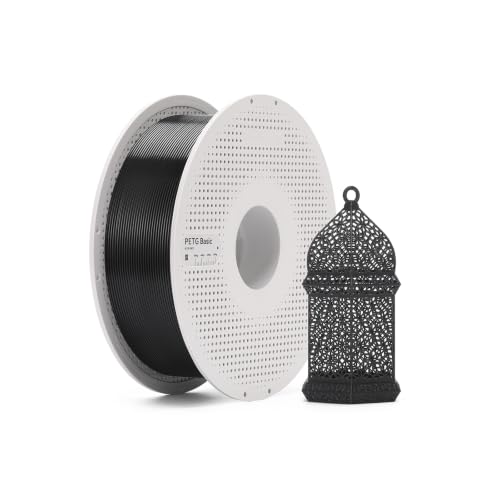
Bambu Lab PETG Basic (Black (30105), 1.75 mm, 1 kg, with spool)
- Best for
- Functional and outdoor-use parts on Bambu Lab printers and AMS.
- Skip this if
- The part needs heat resistance above about 68 °C (TDS HDT at 1.8 MPa).
Specs, strengths, and limitations
- Material
- PETG
- Diameter
- 1.75 mm
- Net filament
- 1000 g (filament only, not packaged weight)
- Format
- plastic spool
- Maker's nozzle range
- 230–260 °C
- Manufacturer states the upgraded formula delivers PLA-level strength while keeping PETG toughness.
- Manufacturer states enhanced resistance to water, UV, and temperature for outdoor accessories.
- Manufacturer states the refined formula reduces stringing.
- Heat resistance tops out around 68 °C: the TDS lists HDT 68 °C at 1.8 MPa (71 °C at 0.45 MPa).
- Needs drying and storage below 20% RH per the TDS; the ABS spool is rated only to 70 °C.
Skip it if you can't dry filament before printing, or the part needs heat resistance well above about 68 °C.
Can a beginner print TPU?
TPU is flexible filament for bumpers, grips and protective covers. Prusa's flexible-materials guide calls these materials "suitable mostly for advanced users due to high print difficulty." It says "the softer the filament is, the harder it is to print," and gives a typical speed of about 20 mm/s. Prusa gives 60A–90A as the usual TPU hardness range, so 95A is on the firmer side, and by Prusa's rule firmer means easier to print. Read our TPU compatibility guide before you buy.
Polymaker PolyFlex TPU95 (Black, 0.75 kg)
Polymaker says PolyFlex TPU95 lets users get quality flexible prints "without specialized hardware or complex setup." Its FAQ is more specific: "We highly recommend to use a direct drive printer," meaning the extruder sits on top of the hot end. The product page also warns, "Make sure your printer is not setup as Bowden," because a large gap between extruder and hotend causes problems. It adds that the filament "will be very difficult to print with a small nozzle diameter." Print settings are 210–230 °C, a 25–60 °C bed and 20–40 mm/s. The spool holds 0.75 kg, not 1 kg, and is cardboard.

Polymaker PolyFlex TPU95 (Black, 1.75 mm, 0.75 kg)
- Best for
- Flexible covers, grips, bumpers, and seals on printers that handle 95A TPU.
- Skip this if
- You need a softer TPU than 95A, or fast print times, or your printer is set up as Bowden and you can't print very slowly (Polymaker highly recommends direct drive and says Bowden is possible only at very slow speeds).
Specs, strengths, and limitations
- Material
- TPU
- Diameter
- 1.75 mm
- Net filament
- 750 g (filament only, not packaged weight)
- Hardness
- 95A
- Format
- cardboard spool
- Maker's nozzle range
- 210–230 °C
- Manufacturer states it is engineered to work on most desktop 3D printers without specialized hardware.
- Manufacturer states it can stretch over three times its original length.
- Manufacturer TDS lists shore hardness 95A and no enclosure needed.
- Slow printing: the TDS recommends 30–50 mm/s.
- Spool holds 0.75 kg, not 1 kg.
- Cardboard spool: Polymaker says it redesigned its spool edges to spin well in the AMS, but its Flexible TPU FAQ says TPU is often too soft to feed through the AMS and suggests avoiding it. Bambu Lab also advises against TPU in the AMS and recommends an adapter or ring for cardboard spools.
Skip it if your printer is a Bowden design, or you want to feed it through an automatic multi-material unit. Check that unit's TPU rules first: Bambu's filament guide, for example, lists TPU as not compatible with the AMS and AMS lite.
What to leave until later
- Carbon or glass-filled filaments (CF/GF), glow and other particle-filled spools. Prusa says these fibers "are highly abrasive, so it is necessary to use a hardened nozzle." Bambu's guide says not to use a stainless steel or brass nozzle for them. Check which nozzle your printer shipped with. Our abrasive filament nozzle guide explains the swap.
- ABS and ASA. Prusa names "significant warping and toxic fumes" as ABS's main disadvantages and says to print it in a well-ventilated room, inside an enclosure. It says ASA's main disadvantage is "significant warping, which requires printing at higher ambient temperatures." See enclosure planning.
- Nylon (PA) and polycarbonate (PC). Bambu's guide groups PC and PA with ABS and ASA as materials that need higher bed and chamber temperatures and an enclosed printer, and lists drying PC as "Required."
Not sure which material a project needs? Try the filament finder.
Care basics: drying and storage
PLA is the least fussy of the three. Bambu's guide lists drying PLA as "Recommended" and protecting it with desiccant during use as "Optional." PETG and TPU are fussier. Polymaker calls its PETG "very hygroscopic," Prusa lists flexible filaments as hygroscopic, and Bambu's guide marks drying TPU as "Required." Bambu says damp filament can cause stringing, holes and rough surfaces. A dryer removes moisture from a spool. A sealed box or bag with desiccant slows moisture getting back in, but it doesn't dry a wet spool. Our filament dryer vs dry box guide covers when you need each.
SUNLU FilaDryer S2 (one spool)
SUNLU lists a 35–70 °C temperature setting range, heating plates above and below the spool with a bottom fan, humidity monitoring, and built-in drying programs for different filament types. It holds one spool up to 210 mm across and 85 mm wide, so a Bambu 200 × 67 mm spool fits. The oven or dryer settings the makers give for every filament on this page are 70 °C or below. Bambu's plastic spools are rated to 70 °C, so check each spool's own rating before drying it on the spool.

SUNLU FilaDryer S2 (Black, single-spool dryer)
- Best for
- Drying and feeding one standard 1 kg spool of PLA, PETG, or TPU at a time.
- Skip this if
- You need to dry several spools at once or need temperatures above 70 °C.
Specs, strengths, and limitations
- Capacity
- One spool up to 210 mm diameter × 85 mm wide (SUNLU wiki: max capacity φ210×85(H) mm; SUNLU comparison: one standard 1 kg spool)
- Outer size
- 265 × 274 × 118 mm
- Part rated to
- 70 °C (your printer's own hotend limit may be lower)
- Maker notes
- Temperature setting range 35–70 °C (SUNLU wiki). Max working power 48 W (SUNLU product page and wiki). SUNLU describes dual upper and lower heating plates with a bottom fan ('360° Enclosed Heating') and a real-time humidity readout. Filament diameters 1.75 / 2.85 / 3.00 mm (SUNLU store page); SUNLU wiki lists 1.75 / 2.85 / 3.01 mm. SUNLU dimensions are 265(L) × 274(W) × 118(H) mm; recorded here as width = L, depth = W. SUNLU pages give different screen sizes (4.6-inch on sunlu.com, other figures on the store page), so screen size is not recorded. Timer range is not stated on SUNLU's product pages.
- Manufacturer states a 35–70 °C setting range with heating plates above and below the spool and a bottom fan.
- Manufacturer states filament can keep drying while it feeds to the printer.
- Manufacturer lists a low 48 W maximum working power.
- Holds a single spool, and SUNLU lists a maximum spool size of 210 mm diameter × 85 mm width, so wide or 2–3 kg spools will not fit.
- 70 °C maximum is below the drying temperature some engineering filaments call for; check the filament maker's drying guidance.
Skip it if you need to dry several spools at once, or need temperatures above 70 °C for engineering filaments later.
Dry & Dry orange indicating silica gel packets (50 × 5 g)
These are small desiccant packets to drop into a sealed bag or box with a spool. Dry & Dry says the mix of white and orange beads changes from "Orange(Dry) to Dark Green(Saturated)" and contains no cobalt chloride. It says the packets can be recharged "via oven only (do not use microwave)" at 150–200 °F for 0.5 to 1.5 hours. They keep a dry spool dry. They won't fix one that is already damp.

Dry & Dry 5 Gram Aiwa Orange Indicating Silica Gel Packets (50 packets × 5 g)
- Best for
- Dropping small pre-filled packets into vacuum bags, dry boxes or AMS-style units.
- Skip this if
- You prefer loose beads to refill a desiccant container.
Specs, strengths, and limitations
- Capacity
- 50 packets of 5 g silica gel (Dry & Dry '5g 50 aiwa' variant)
- Maker notes
- Dry & Dry store variant '50 Packet' is SKU '5g 50 aiwa'; the Amazon model number is DD5G50-AIWA. Dry & Dry: a mixture of white silica gel beads with a few orange indicating beads; orange means dry, dark green means saturated; no cobalt chloride. Dry & Dry: 'Packets are rechargeable via oven only (do not use microwave); Bake the packets at 150 to 200 F for 0.5 to 1.5 hours.' Dry & Dry: packets ship in a resealable self-standing bag. The Amazon listing gives a 1.75 × 2.5 in packet size and coverage of about 600 cubic inches per packet; Dry & Dry's own page does not state either figure, so they are not recorded as specifications.
- Manufacturer states the orange beads turn dark green when the packet is saturated.
- Manufacturer states the packets can be recharged in an oven at 150–200 °F for 0.5–1.5 hours.
- Manufacturer states the silica gel contains no cobalt chloride.
- Desiccant only slows moisture uptake in a sealed container; it does not dry wet filament.
- Manufacturer says recharge in an oven only, never a microwave, and only a few beads in each packet change colour.
Skip it if you'd rather refill a desiccant container with loose beads.
Checklist before you buy your first spools
- Diameter. Confirm 1.75 mm against your printer's manual.
- Temperatures. PLA here needs up to 230 °C at the nozzle. PETG needs 230–260 °C, and Prusament PETG wants an 80 ± 10 °C bed. Check your printer's maximums.
- Build surface. PLA sticks well to most sheets. For PETG on smooth PEI, use glue stick as a release layer, or a textured sheet.
- Extruder type for TPU. Polymaker highly recommends a direct drive printer for PolyFlex TPU95 and says not to run it on a Bowden setup.
- Nozzle. If your printer has a brass or stainless steel nozzle, skip CF, GF, glow and other particle-filled spools until you fit a hardened nozzle.
- Spool format. Cardboard (Polymaker, ELEGOO), plastic (Bambu, and Prusament from October 2025) and older Prusament spools with a cardboard core behave differently in some feeders and dryers. Check your unit's documentation.
- Dry storage. Plan a dryer or sealed storage before your first PETG or TPU spool.
How this page was checked
This is a research-based page. We have not printed these spools or used this dryer for it, so it contains no test results or scores. The material advice comes from Prusa Research's material guides and Bambu Lab's filament guide. Each product's temperatures, spool details and drying settings come from its maker's product page or technical data sheet, listed in the sources section and retrieved on 2026-10-09 (the Prusament spool notes on 2026-10-14). Makers update their pages and reformulate products, so check the current data sheet before relying on a number. Read more in our editorial standards and affiliate disclosure.
PLA: what to check before you buy a spool ↗Head-to-head comparisons
Deciding between two products on this page? Each comparison puts both makers’ specs side by side and says who should choose which.
Sources
- PLA material guide, Prusa Research
- PETG material guide, Prusa Research
- ABS material guide, Prusa Research
- ASA material guide, Prusa Research
- Flexible materials guide, Prusa Research
- Composite materials filled with carbon, kevlar or glass, Prusa Research
- Filament guide: printer, nozzle, AMS, build plate and glue compatibility, Bambu Lab
- PolyLite PLA product page, Polymaker
- PolyLite PLA Technical Data Sheet V5.4, Polymaker
- Prusament PLA Jet Black 1kg, Prusa Research
- Prusament PLA material page, Prusa Research (Prusament)
- PLA Basic, Bambu Lab
- Bambu PLA Basic Technical Data Sheet V3.0, Bambu Lab
- ELEGOO PLA product page, ELEGOO
- Polymaker PETG product page, Polymaker
- Polymaker PETG Technical Data Sheet V3.0, Polymaker
- Drying filament (Prusa Knowledge Base), Prusa Research
- Prusament PETG Jet Black 1kg, Prusa Research
- Prusament PETG Technical Data Sheet, Prusa Research (Prusament)
- PETG Basic, Bambu Lab
- Bambu PETG Basic Technical Data Sheet V3.0, Bambu Lab
- PolyFlex TPU95 product page, Polymaker
- PolyFlex TPU95 Technical Data Sheet V5.4, Polymaker
- Polymaker transitions all filaments onto 100% recycled cardboard spools, Polymaker
- FilaDryer S2 product page, SUNLU
- Filament Dryer wiki, SUNLU
- 5 Gram Aiwa Orange Indicating Packets, Dry & Dry
This page is research-based: we have not tested the products or methods ourselves. It draws on the manufacturer documentation and sources listed. Exact settings and fit always defer to your printer and filament makers.
Keep reading

PLA vs PETG: Choosing for the Actual Project
How to choose between PLA and PETG by what the part has to do: heat, stiffness, toughness, print ease, stringing, and build-plate release.
PLA vs PLA+: What the 'Plus' Actually Means
PLA+ is a label, not a standard. What eSUN, Polymaker, and ELEGOO actually publish for their PLA+ and PLA Pro, and when plain PLA is enough.

Filament dryer vs dry box: drying and storage explained
A dry box keeps dry filament dry; a dryer removes moisture that is already in it. How to tell which problem you have, and what to do safely.