Best Filament for the Prusa MINI and MINI+ (2026)
PLA, PETG, firm TPU, ABS, ASA and carbon-fiber spools for the Bowden-fed Prusa MINI and MINI+, checked against Prusa's 280 °C and 100 °C limits.
On this page (12 sections)
For a MINI or MINI+, start with Prusament PLA or Polymaker PolyLite PLA for everyday prints and Prusament PETG for functional parts. PLA and PETG are the easy fits on this open-frame printer. TPU works best as a firm 95A grade printed slowly, because the Bowden tube makes soft filament hard to push. ABS and ASA need an enclosure, per Prusa's material guides. Carbon-fiber spools need a hardened V6 nozzle first, such as the Micro Swiss CM2, because Prusa's printers ship with a brass nozzle. The fit rule is temperature. The MINI and MINI+ have a 280 °C nozzle limit and a 100 °C heatbed limit, and every spool here lists a nozzle range starting at or below 280 °C and a bed range at or below 100 °C. Prusa's MINI+ page lists many more materials, from PC to nylon, but this page sticks to what the hardware handles in practice.
Quick picks
| Need | Pick | Why |
|---|---|---|
| Everyday PLA | Prusament PLA | Prusa's own PLA; its material page says "Enclosure not required" |
| PETG for functional parts | Prusament PETG | Its nozzle and bed ranges sit within the MINI's 280 °C and 100 °C limits |
| Firm TPU, printed slowly | Overture TPU 95A | A firm 95A grade; Overture rates Bowden support as "Limited," so expect trial and error |
| ABS (enclosed) | Polymaker PolyLite ABS | Its bed range tops out at the MINI's 100 °C, the bed Prusa's ABS guide recommends |
| Carbon fiber | Micro Swiss CM2 nozzle, then Polymaker PolyLite PLA-CF | Micro Swiss names the Prusa Mini; a brass nozzle degrades quickly with abrasives |
These are defaults by need, not a ranking.
Who this page is for
This page is for owners of an Original Prusa MINI or MINI+ who want to know which spools suit their printer before buying. Prusa treats the two as one family in its help pages, and the material advice here applies to both. The one exception is the DELACK enclosure kit below, whose maker names only the "Prusa Mini." For nozzles and print sheets that fit, see the MINI and MINI+ printer page. For the wider PLA picture, see the PLA filament shortlist.
| Product | Best for | Skip if | Link |
|---|---|---|---|
| Prusa Research Prusament PLA (Jet Black, 1.75 mm, 1 kg) | Precise everyday PLA prints, especially on Prusa printers with stock profiles. | The part needs heat, UV, or mechanical-stress resistance. | View on Amazon (opens Amazon in a new tab) |
| Polymaker PolyLite PLA (Black, 1.75 mm, 1 kg) | Everyday PLA prints, prototypes, and display models where a documented, easy-printing PLA is wanted. | The part will sit in a hot car, near heat sources, or needs toughness beyond standard PLA. | View on Amazon (opens Amazon in a new tab) |
| Polymaker PolyLite PLA Pro (Black, 1.75 mm, 1 kg) | Functional PLA parts, props, and prototypes that need more drop resistance than standard PLA. | The part will see heat above about 55 °C (TDS HDT 58 °C at 1.8 MPa) or needs to flex. | View on Amazon (opens Amazon in a new tab) |
| Prusa Research Prusament PETG (Jet Black, 1.75 mm, 1 kg) | Functional parts, brackets, and larger prints that need more toughness than PLA. | The part needs heat resistance above about 68 °C (TDS HDT at 0.45 and 1.8 MPa), or you want a matte finish that hides layer lines. | View on Amazon (opens Amazon in a new tab) |
| Polymaker PETG (Black, 1.75 mm, 1 kg (new formula)) | Functional brackets and fixtures, indoors or in shade, that need more toughness than PLA. | You can't keep filament dry, or the part needs heat resistance well above 65 °C (TDS HDT at 1.8 MPa). | View on Amazon (opens Amazon in a new tab) |
| Polymaker PolyFlex TPU95 (Black, 1.75 mm, 0.75 kg) | Flexible covers, grips, bumpers, and seals on printers that handle 95A TPU. | You need a softer TPU than 95A, or fast print times, or your printer is set up as Bowden and you can't print very slowly (Polymaker highly recommends direct drive and says Bowden is possible only at very slow speeds). | View on Amazon (opens Amazon in a new tab) |
| Overture TPU 95A (Black, 1.75 mm, 1 kg) | General-purpose 95A flexible parts such as gaskets, seals, and protective cases. | You plan to feed it through a Bambu Lab AMS or AMS lite, or you want a TPU whose maker recommends it for Bowden printers. | View on Amazon (opens Amazon in a new tab) |
| 3D Sourcerer DELACK 3D Printer Enclosure Kit with LED Light (DELACK_V1 kit, 550 x 486 x 450 mm, printed parts not included) | Prusa MINI and MK4 owners who want a compact clear box they can customize and print parts for. | You don't have a working printer to print the parts, or you want a ready-to-use enclosure. | View on Amazon (opens Amazon in a new tab) |
| Polymaker PolyLite ABS (Black, 1.75 mm, 1 kg) | Heat-resistant functional parts, enclosures, and prototypes printed on an enclosed printer. | Your printer is open-frame or its bed can't reach 90 °C. | View on Amazon (opens Amazon in a new tab) |
| Polymaker ASA (Black, 1.75 mm, 1 kg) | Outdoor and sun-exposed functional parts printed on an enclosed machine. | Your printer is open-frame or can't reach a 95 °C bed and 260 °C nozzle. | View on Amazon (opens Amazon in a new tab) |
| Micro Swiss CM2 RepRap (V6) 1.75 Nozzle (0.4 mm, single nozzle (M2902-04)) | Prusa MINI/MINI+ owners who want a hardened-tip nozzle with a copper body. | You only print non-abrasive filaments and want the cheapest genuine spare. | View on Amazon (opens Amazon in a new tab) |
| Polymaker PolyLite PLA-CF (Black, 1.75 mm, 1 kg) | Stiff, matte-finish PLA parts and prototypes on a printer fitted with a hardened nozzle. | Your printer only has a brass nozzle, or the part will see heat. | View on Amazon (opens Amazon in a new tab) |
| Polymaker Fiberon PETG-rCF08 (Black, 1.75 mm, 0.5 kg) | An easy first carbon-fiber PETG for matte functional parts and fixtures on a printer with a hardened nozzle. | You need parts that hold up above about 65 °C, or you want a 1 kg spool. | View on Amazon (opens Amazon in a new tab) |


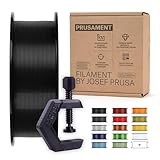


The table is grouped by job, not ranked.
What can the MINI and MINI+ print, per Prusa?
Limits. Prusa's MINI+ specifications list a maximum nozzle temperature of 280 °C, a maximum heatbed temperature of 100 °C, 1.75 mm filament, a 0.4 mm default nozzle and a 180 × 180 × 180 mm build volume. Prusa's 2019 launch post for the original MINI gives the same "280 °C / 100 °C" hotend and heatbed maximums, 1.75 mm filament and Bowden extruder. Those two temperatures are the hard limits for every spool on this page.
Materials. Prusa's MINI+ page lists a "wide range of thermoplastics, including PLA, PETG, ASA, ABS, PC (Polycarbonate), CPE, PVA/BVOH, PVB, HIPS, PP (Polypropylene), Flex, nGen, Nylon, Woodfill and other filled materials." The original MINI's launch post names a shorter list: "PLA, PETG, ASA, ABS." Either list says what the hardware can reach, not what it handles easily in an open room. Prusa's own material guides add conditions for several of them, covered below.
Bowden extruder. Prusa describes the extruder as a "Bowden system with 3:1 gearing." Its glossary explains that on the MINI, the extruder motor "is not installed on the print head," but is "fixed on the side and pushes filament through the extruder PTFE tube (bowden tube), to the print head." That matters most for flexible filament.
Open frame. The MINI has no built-in enclosure. Prusa sells a separate Original Prusa MINI Enclosure, and bundles one with the MINI+ in some listings.
Heat in use. Prusa's PLA guide says PLA "gets soft and deforms at temperatures over 60 °C." Its PETG guide calls PETG suitable for interior and most exterior use "with temperatures below 80 °C."
Everyday PLA
PLA is the easiest material on a MINI. All three picks here print at 230 °C or below and need no enclosure.
Prusament PLA (Jet Black, 1 kg)
Prusament is Prusa's own filament brand, which makes it a straightforward choice on a Prusa printer. Prusa's material page lists a 210 ± 10 °C nozzle, a 40–60 °C bed, "Enclosure not required," and a temperature resistance of 55 °C. It also lists low UV resistance and says it's "not ideal for outdoor use."

Prusa Research Prusament PLA (Jet Black, 1.75 mm, 1 kg)
- Best for
- Precise everyday PLA prints, especially on Prusa printers with stock profiles.
- Skip this if
- The part needs heat, UV, or mechanical-stress resistance.
Specs, strengths, and limitations
- Material
- PLA
- Diameter
- 1.75 mm
- Net filament
- 1000 g (filament only, not packaged weight)
- Format
- plastic spool
- Maker's nozzle range
- 200–220 °C
- Manufacturer states diameter precision of ±0.02 mm and publishes measured data for every spool.
- Manufacturer states low warping, suitable for large prints.
- Manufacturer states guaranteed color consistency between batches.
- Not suited to heat or outdoor use: Prusa lists 55 °C temperature resistance and low UV resistance.
- Prusa suggests PETG or PC Blend for mechanically stressed parts, and lists PLA as difficult to sand.
Skip it if the part will see heat, sun or repeated bending.
Polymaker PolyLite PLA (Black, 1 kg)
PolyLite PLA is a non-Prusament alternative that, like Prusament, needs no enclosure on the open MINI. Its TDS (V5.4) lists a 190–230 °C nozzle, a 25–60 °C bed, "Closure Chamber: No Needed," and a heat deflection temperature of 58 °C at 1.8 MPa. It ships on a cardboard spool.

Polymaker PolyLite PLA (Black, 1.75 mm, 1 kg)
- Best for
- Everyday PLA prints, prototypes, and display models where a documented, easy-printing PLA is wanted.
- Skip this if
- The part will sit in a hot car, near heat sources, or needs toughness beyond standard PLA.
Specs, strengths, and limitations
- Material
- PLA
- Diameter
- 1.75 mm
- Net filament
- 1000 g (filament only, not packaged weight)
- Format
- cardboard spool
- Maker's nozzle range
- 190–230 °C
- Manufacturer states PolyLite PLA is designed for reliability and ease of printing.
- Manufacturer TDS lists no enclosure needed and a wide 190–230 °C nozzle window.
- Manufacturer publishes a full TDS with mechanical, thermal, and drying data.
- Not suited to parts exposed to heat: the TDS lists a heat deflection temperature of 58 °C (1.8 MPa).
- Cardboard spool: Polymaker says its spools have hardened edges that work in the AMS, but Bambu Lab's general AMS guidance recommends an adapter or ring for cardboard spools. Check your unit.
Skip it if the part will see heat, or you'd rather stay with Prusa's own filament.
Polymaker PolyLite PLA Pro (Black, 1 kg)
PolyLite PLA Pro is Polymaker's toughened PLA, for household parts and prototypes that may get dropped. Its TDS lists the same 190–230 °C nozzle range, a 30–60 °C bed, no closed chamber needed, and a heat deflection temperature of 58 °C at 1.8 MPa. So it still has PLA's heat limit.

Polymaker PolyLite PLA Pro (Black, 1.75 mm, 1 kg)
- Best for
- Functional PLA parts, props, and prototypes that need more drop resistance than standard PLA.
- Skip this if
- The part will see heat above about 55 °C (TDS HDT 58 °C at 1.8 MPa) or needs to flex.
Specs, strengths, and limitations
- Material
- PLA (PLA Pro (toughened PLA))
- Diameter
- 1.75 mm
- Net filament
- 1000 g (filament only, not packaged weight)
- Format
- cardboard spool
- Maker's nozzle range
- 190–230 °C
- Manufacturer states it combines high toughness and high rigidity with the ease of printing of regular PLA.
- TDS lists notched Charpy impact strength of 17.1 kJ/m² (X-Y).
- Manufacturer publishes a full TDS with mechanical, thermal, and drying data.
- Not for heat: the TDS lists a heat deflection temperature of 58 °C (1.8 MPa), and Polymaker says it is not for projects needing high heat resistance or flexibility.
- Cardboard spool: Bambu Lab strongly advises a spool adapter or adapter ring for cardboard spools in the AMS.
- Polymaker now calls this the 'Old Formula' and sells a separate 'New Formula' Polymaker PLA Pro; check which version an Amazon listing ships.
Skip it if the part will sit somewhere warm or needs to flex.
PETG for functional parts
PETG suits brackets, clips and fixtures that need more heat resistance than PLA. Both picks start at 240 °C, well under the 280 °C limit. Prusa's PETG guide warns, "Do not print on the smooth PEI sheet as the adhesion may be too strong!" It recommends the powder-coated or satin sheet, or glue stick if you must use smooth PEI. Prusa sells both a satin powder-coated sheet and a smooth PEI sheet for the MINI and MINI+. Our PETG printing problems guide covers sticking, stringing and blobs. For the trade-offs between the two materials, see our PLA vs PETG guide.
Prusament PETG (Jet Black, 1 kg)
Prusament PETG is Prusa's own PETG. Its TDS lists a 250 ± 10 °C nozzle and an 80 ± 10 °C heatbed, both within the MINI's limits. Prusa's material page warns of "Strong adhesion to the bed - be careful when you're removing the print," and lists possible stringing as a con.

Prusa Research Prusament PETG (Jet Black, 1.75 mm, 1 kg)
- Best for
- Functional parts, brackets, and larger prints that need more toughness than PLA.
- Skip this if
- The part needs heat resistance above about 68 °C (TDS HDT at 0.45 and 1.8 MPa), or you want a matte finish that hides layer lines.
Specs, strengths, and limitations
- Material
- PETG
- Diameter
- 1.75 mm
- Net filament
- 1000 g (filament only, not packaged weight)
- Format
- plastic spool
- Maker's nozzle range
- 240–260 °C
- Manufacturer states high strength and durability with low shrinking and warping.
- Manufacturer states diameter precision of ±0.02 mm and publishes measured data for every spool.
- Manufacturer states it is easier to sand than PLA.
- Prusa lists possible stringing that may require occasional drying, and poor bridging.
- Strong bed adhesion: Prusa warns to take care removing prints, recommends textured, satin or PP sheets, and says to avoid smooth PEI (glue stick if used).
- Heat resistance tops out around 68 °C: the TDS gives HDT 68 °C at both 0.45 and 1.8 MPa.
Skip it if the part needs more heat resistance than PETG offers.
Polymaker PETG (Black, 1 kg)
Polymaker's current PETG is a high-flow formula. Its TDS (V3.0) lists a 240–260 °C nozzle, a 60–70 °C bed and "Closure chamber: Not Needed." It recommends drying at 60 °C for 6 hours. It ships on a cardboard spool.

Polymaker PETG (Black, 1.75 mm, 1 kg (new formula))
- Best for
- Functional brackets and fixtures, indoors or in shade, that need more toughness than PLA.
- Skip this if
- You can't keep filament dry, or the part needs heat resistance well above 65 °C (TDS HDT at 1.8 MPa).
Specs, strengths, and limitations
- Material
- PETG (high-flow)
- Diameter
- 1.75 mm
- Net filament
- 1000 g (filament only, not packaged weight)
- Format
- cardboard spool
- Maker's nozzle range
- 240–260 °C
- Manufacturer states it is less brittle and more impact-resistant than PLA.
- Manufacturer states it prints without an enclosure and works with AMS and multi-material systems.
- Manufacturer states a high-flow formulation for speeds up to 300 mm/s with a 0.4 mm nozzle.
- Moisture-sensitive: the TDS recommends drying at 60 °C for 6 h and printing from a dry box.
- Heat resistance is limited: the TDS lists HDT 65 °C at 1.8 MPa (69 °C at 0.45 MPa).
- Cardboard spool: Polymaker says its spools have hardened edges that work in the AMS, but Bambu Lab's general AMS guidance recommends an adapter or ring for cardboard spools. Check your unit.
Skip it if you can't keep filament dry.
Can the Bowden-fed MINI print TPU?
Prusa lists Flex for the MINI+, and its flexible materials guide applies to the MINI family. The guide's advice is general, not written for Bowden printers. That guide says "the softer the filament is, the harder it is to print." It recommends a typical speed of about 20 mm/s and a maximum "somewhere between 30 and 40 mm/s." It says to "Loosen the idler so the gears push the filament through only very gently," and that "It's alright to turn the retractions off completely." It also says to keep flexible filament dry.
The Bowden tube is the catch. Soft filament has to be pushed the full length of the tube from the side-mounted motor to the print head, and it can buckle on the way. Polymaker says the same thing. Its PolyFlex TPU95 product page FAQ says, "We highly recommend to use a direct drive printer to print PolyFlex™ TPU95," and the page's printing requirements say, "Make sure your printer is not setup as Bowden." So on a stock MINI, stick to a firm 95A grade, go slowly and keep retraction low or off. Expect some trial and error. Read our TPU compatibility guide before buying.
Polymaker PolyFlex TPU95 (Black, 0.75 kg)
PolyFlex TPU95's TDS (V5.4) lists Shore 95A, a 210–230 °C nozzle, a 25–60 °C bed, no closed chamber needed, and drying at 70 °C for 8 hours. Its temperatures sit well within the MINI's limits. Polymaker's Bowden warning above applies, so treat it as a careful experiment on a stock MINI. The spool holds 0.75 kg on cardboard.

Polymaker PolyFlex TPU95 (Black, 1.75 mm, 0.75 kg)
- Best for
- Flexible covers, grips, bumpers, and seals on printers that handle 95A TPU.
- Skip this if
- You need a softer TPU than 95A, or fast print times, or your printer is set up as Bowden and you can't print very slowly (Polymaker highly recommends direct drive and says Bowden is possible only at very slow speeds).
Specs, strengths, and limitations
- Material
- TPU
- Diameter
- 1.75 mm
- Net filament
- 750 g (filament only, not packaged weight)
- Hardness
- 95A
- Format
- cardboard spool
- Maker's nozzle range
- 210–230 °C
- Manufacturer states it is engineered to work on most desktop 3D printers without specialized hardware.
- Manufacturer states it can stretch over three times its original length.
- Manufacturer TDS lists shore hardness 95A and no enclosure needed.
- Slow printing: the TDS recommends 30–50 mm/s.
- Spool holds 0.75 kg, not 1 kg.
- Cardboard spool: Polymaker says it redesigned its spool edges to spin well in the AMS, but its Flexible TPU FAQ says TPU is often too soft to feed through the AMS and suggests avoiding it. Bambu Lab also advises against TPU in the AMS and recommends an adapter or ring for cardboard spools.
Skip it if you want a maker that supports Bowden printing, or a 1 kg spool.
Overture TPU 95A (Black, 1 kg)
Overture's product page lists 95A hardness, a 210–240 °C nozzle and a 35–50 °C bed. It recommends drying at 70 °C for 7 hours, and warns that drying too long can make it brittle. Overture's product page doesn't mention Bowden printers. Its TPU wiki guide says to "Use either a direct-drive system or a printer with an external extruder attachment," and its extruder wiki rates Bowden support for flexible filament as "Limited." If you try it on the MINI, Prusa's general flex advice above applies.

Overture TPU 95A (Black, 1.75 mm, 1 kg)
- Best for
- General-purpose 95A flexible parts such as gaskets, seals, and protective cases.
- Skip this if
- You plan to feed it through a Bambu Lab AMS or AMS lite, or you want a TPU whose maker recommends it for Bowden printers.
Specs, strengths, and limitations
- Material
- TPU
- Diameter
- 1.75 mm
- Net filament
- 1000 g (filament only, not packaged weight)
- Hardness
- 95A
- Format
- cardboard spool
- Maker's nozzle range
- 210–240 °C
- Manufacturer states its 95A Shore hardness balances softness and toughness for impact absorption and rebound.
- Manufacturer states it resists oil and recovers its shape after repeated stress.
- Manufacturer states unopened spools have a 1-year shelf life with proper storage.
- The TPU printing tips on Overture's product page say 'Not compatible with AMS or other multi-material systems.'
- Overture marks it 'AMS & AMS lite NOT Compatible', and its FAQ says TPU is too soft for the AMS and can jam or extrude inconsistently.
- Overture's own documents disagree on bed temperature, drying time, and elongation (see notes).
- Manufacturer says to keep it dry before use.
- Overture's TPU wiki says to use a direct-drive system or an external extruder attachment, and its extruder wiki rates Bowden support for flexible filament as 'Limited'; the product page doesn't mention Bowden.
Skip it if you want a TPU whose maker recommends it for Bowden printers.
ABS and ASA: only with an enclosure
Prusa lists ABS and ASA for the MINI, but its material guides, which both apply to the MINI family, add a condition. The ABS guide says "the printer should be inside an enclosure with a higher ambient temperature," and lists "significant warping" as a main disadvantage. The ASA guide says "the bed should be heated to at least 100 °C, and the printer should be inside an enclosure to keep a higher ambient temperature." Both guides warn about fumes. Prusa's ABS guide says to print "in a well-ventilated room because the material releases fumes and substances that could pose a potential health risk."
The MINI is open-frame, so plan on an enclosure before buying either material. Our ABS vs ASA guide and enclosure planning guide cover the choice.
Prusa's own enclosure. Prusa's Original Prusa MINI Enclosure is "Passive, heating provided only by the 3D printer's heatbed." Prusa says it suits "demanding high-temperature materials otherwise prone to warping - such as PC Blend, Nylon, PP, and more," and offers an optional HEPA filtration system that it says "prevents the spread of ultra-fine particles (UFPS) and reduces the odor when printing from certain materials." The product page names the Original Prusa MINI.
A kit alternative. The DELACK kit below is the enclosure in our catalog with a documented MINI fit. For other options, see the printer enclosures shortlist.
3D Sourcerer DELACK Enclosure Kit with LED Light
3D Sourcerer says the DELACK kit is "designed for the Bambu Lab A1 Mini, Prusa MK4, Prusa Mini, and Prusa MK3 series." It names the "Prusa Mini" but not the MINI+ separately, so MINI+ owners should measure first. The maker gives its size as 550 × 486 × 450 mm without saying which figure is width, depth or height. It's a kit: the 3D-printed connector parts aren't included, and you print them from the maker's files. An LED light is included. No fan or filter comes in the box. The back panel has a cutout for an optional 120 mm fan, and the maker offers printable mounts for a HEPA filter or a 4-inch exhaust duct. 3D Sourcerer publishes no heat limits for printer electronics inside the box. Prusa's ABS guide, which covers the MINI family, warns that "Printing inside an enclosure can lead to deformation of the fan shroud and other plastic parts."

3D Sourcerer DELACK 3D Printer Enclosure Kit with LED Light (DELACK_V1 kit, 550 x 486 x 450 mm, printed parts not included)
- Best for
- Prusa MINI and MK4 owners who want a compact clear box they can customize and print parts for.
- Skip this if
- You don't have a working printer to print the parts, or you want a ready-to-use enclosure.
- Verified fit
- Prusa Research MINI / MINI+ (MINI); Prusa Research MK4 (stock configuration, per the manufacturer)
Specs, strengths, and limitations
- Maker notes
- 3D Sourcerer SKU DELACK_V1. The maker states the size as '550MM x 486MM x 450MM (21.7" x 19.1" x 17.7")', with a length matching an IKEA LACK table. It does not say which figure is width, depth, or height. The maker states it is 'designed for the Bambu Lab A1 Mini, Prusa MK4, Prusa Mini, and Prusa MK3 series'. The MK4 has a compatibility record. 'MK3 series' names a family, not an exact model, so no MK3S record is made; the MK4S is not named. KIT ONLY: 3D-printed parts are not included and must be printed from the maker's downloadable files. An LED light with a 5V power brick is included. The back panel has a cutout for an optional 120 mm fan. The maker offers printable mounts for a HEPA filter or a 4-inch exhaust duct, which are sold or printed separately. Bambu Lab's A1 mini FAQ says: 'We don't recommend enclosing the A1 mini.' We therefore do not list this kit for the A1 mini, even though 3D Sourcerer names it.
- Manufacturer states it is designed for the Bambu Lab A1 Mini, Prusa MK4, Prusa Mini and Prusa MK3 series.
- Manufacturer states an LED light with a 5V power brick is included.
- Manufacturer provides printable mounts for a 120 mm fan, a HEPA filter, or a 4-inch exhaust duct.
- Not for the Bambu Lab A1 mini: Bambu Lab says it doesn't recommend enclosing the A1 mini.
- Not a ventilation solution as shipped. No fan or filter is included; ventilation needs the optional fan plus a duct or filter you add. Plan ventilation separately.
- Follow your printer maker's guidance on enclosed operation and electronics heat. 3D Sourcerer publishes no heat limits for printer electronics inside.
- You must print the connector parts yourself, and the size suits small printers only.
Skip it if you want a ready-to-use enclosure, or you need ventilation without adding a fan and duct or filter yourself.
Polymaker PolyLite ABS (Black, 1 kg)
Polymaker's PolyLite ABS data sheet (V5.5) lists a 245–265 °C nozzle, a 90–100 °C bed, the cooling fan off and a closed chamber as "Needed." Its bed range tops out at the MINI's 100 °C limit, which also matches the 100 °C bed Prusa's ABS guide recommends. The TDS lists a heat deflection temperature of 98 °C at 1.8 MPa and drying at 70 °C for 6 hours. Polymaker says it uses a resin with lower volatile content for less odor, but lower odor is not the same as no emissions. It ships on a cardboard spool.

Polymaker PolyLite ABS (Black, 1.75 mm, 1 kg)
- Best for
- Heat-resistant functional parts, enclosures, and prototypes printed on an enclosed printer.
- Skip this if
- Your printer is open-frame or its bed can't reach 90 °C.
Specs, strengths, and limitations
- Material
- ABS
- Diameter
- 1.75 mm
- Net filament
- 1000 g (filament only, not packaged weight)
- Format
- cardboard spool
- Maker's nozzle range
- 245–265 °C
- Manufacturer states PolyLite ABS uses a bulk-polymerized ABS resin with significantly lower volatile content than traditional ABS, for minimal odor.
- TDS lists a heat deflection temperature of 98 °C at 1.8 MPa.
- Manufacturer publishes a full TDS with mechanical, thermal, and drying data.
- TDS lists a closed chamber as 'Needed'. Polymaker's product page says a non-enclosed printer with a 90 °C bed and 260 °C nozzle can handle models smaller than fist size, larger prints need an enclosed printer (about 40–50 °C), and models over about 15–20 cm need a heated chamber (about 70 °C or more).
- Needs a 90–100 °C bed (TDS), so printers with low-temperature beds aren't suitable.
- Cardboard spool: Bambu Lab strongly advises a spool adapter or adapter ring for cardboard spools in the AMS.
Skip it if your MINI isn't enclosed or you can't ventilate the room.
Polymaker ASA (Black, 1 kg)
ASA is the outdoor material. Prusa's ASA guide calls it "suitable for outdoor use, due to its high UV light and temperature resistance." Prusa's guide recommends 105 °C for the first layer and 110 °C after that, which is above the MINI's 100 °C bed limit. Polymaker's ASA data sheet lists a lower 75–95 °C bed, so its own range fits the MINI. It also lists a 230–260 °C nozzle, "Closure chamber: Needed," and a heat deflection temperature of 100 °C at 1.8 MPa. It recommends drying at 70 °C for 7 hours. It ships on a cardboard spool.

Polymaker ASA (Black, 1.75 mm, 1 kg)
- Best for
- Outdoor and sun-exposed functional parts printed on an enclosed machine.
- Skip this if
- Your printer is open-frame or can't reach a 95 °C bed and 260 °C nozzle.
Specs, strengths, and limitations
- Material
- ASA
- Diameter
- 1.75 mm
- Net filament
- 1000 g (filament only, not packaged weight)
- Format
- cardboard spool
- Maker's nozzle range
- 230–260 °C
- Manufacturer states it is an alternative to ABS with improved weather and UV resistance.
- Manufacturer TDS lists a heat deflection temperature of 100 °C (1.8 MPa).
- Manufacturer states it prints with settings very similar to ABS.
- Needs an enclosed printer per the TDS.
- Requires higher nozzle and bed temperatures (230–260 °C, 75–95 °C) than PLA or PETG.
- Cardboard spool: Bambu Lab strongly advises a spool adapter or adapter ring for cardboard spools in the AMS.
Skip it if your MINI isn't enclosed, or you'd rather follow Prusa's 105–110 °C bed advice on a printer that can reach it.
Can the MINI print carbon fiber?
Prusa's MINI nozzle guide says "The printer is compatible with E3D V6 nozzles," and "Unless you print abrasive materials with a brass nozzle, the stock nozzle will last you many hundreds of printing hours." Prusa's E3D V6 nozzle article says "The Prusa FFF printers are equipped with a brass nozzle," and that the V6 nozzles "fit into the MK3, MK3S, MK3S+, as well as MK2-series and previous, and the MINI/+ hotend." It warns that "Some filaments have particles added to them that can make them abrasive," and that "A regular brass nozzle will degrade quickly and lose its properties when printing these."
So don't buy the carbon-fiber spools below until you've fitted a wear-resistant V6 nozzle. Our worn nozzle guide covers the signs of a worn one. Prusa says you may need to "increase the hotend temperature by about 5°C to print successfully with the hardened steel nozzle," and that you should redo the First Layer Calibration after changing the nozzle. Both carbon-fiber picks top out at 270 °C or lower, leaving room for that under the 280 °C limit. See the replacement nozzles shortlist and our abrasive filament nozzle guide.
Micro Swiss CM2 RepRap (V6) 1.75 Nozzle (0.4 mm)
Micro Swiss names the Prusa "Mini" in its fit list, along with "All printers with a E3D V4 / V5 / V6 1.75 Hotend." It describes an "M2 Hardened High Speed Steel" tip with a "heat-treated hardness: 68 HRC," a nonstick WS2 coating, and a copper chromium zirconium body. Micro Swiss doesn't state a maximum temperature on its page.

Micro Swiss CM2 RepRap (V6) 1.75 Nozzle (0.4 mm, single nozzle (M2902-04))
- Best for
- Prusa MINI/MINI+ owners who want a hardened-tip nozzle with a copper body.
- Skip this if
- You only print non-abrasive filaments and want the cheapest genuine spare.
- Verified fit
- Prusa Research MINI / MINI+ (stock configuration, per the manufacturer)
Specs, strengths, and limitations
- Interface
- M6x1.0 thread, 7.5 mm thread length, 13 mm overall length, 1.75 mm filament
- Hotend design
- Copper chromium zirconium body, electroless nickel plated, M2 hardened high speed steel tip (68 HRC), WS2 nonstick coating
- Wear-resistant
- Yes, per the manufacturer
- Maker notes
- Micro Swiss product page: fits all printers with an E3D V4/V5/V6 1.75 hotend and names Prusa i3 MK2 / MK2S / MK3 / Mini. It does not name the MK3S/MK3S+, so only the MINI is recorded. Micro Swiss CM2 warranty page: covers wear related to shape (not blockages, jams or coating wear); valid only with filaments with glass, carbon or less abrasive fillers, not Boron Carbide or Tungsten; void above 450°C or if cleaned with cold pulls or needles; ends when CM2 is discontinued. Prusa Knowledge Base also states the MINI is compatible with E3D V6 nozzles. Amazon listing model M2902 matches the Micro Swiss SKU family (M2902-04 for 0.4 mm). Micro Swiss: made in USA, limited lifetime warranty against wear.
- Manufacturer names the Prusa Mini as a fit.
- Manufacturer lists an M2 hardened high speed steel tip heat-treated to 68 HRC with a nonstick WS2 coating.
- Manufacturer states a copper alloy body that keeps its strength at higher temperatures than regular copper.
- Micro Swiss does not state a maximum temperature on the product page; its CM2 warranty page voids the warranty above 450°C and if cleaned with cold pulls or needles.
- Swap requires tools and a hot nozzle, plus First Layer Calibration afterwards (Prusa).
Skip it if you only print plain PLA and PETG, where the stock brass nozzle is enough.
Polymaker PolyLite PLA-CF (Black, 1 kg)
PolyLite PLA-CF is PLA with 8% chopped carbon fiber, for stiff, matte parts. Polymaker's product page says a hardened nozzle is strongly recommended. The TDS (V5.4) lists a 190–230 °C nozzle, a 25–60 °C bed and no closed chamber needed, while the product page's print settings give 210–230 °C and 30–70 °C. Either range fits the MINI. The TDS lists a heat deflection temperature of 50 °C at 1.8 MPa, lower than plain PLA.

Polymaker PolyLite PLA-CF (Black, 1.75 mm, 1 kg)
- Best for
- Stiff, matte-finish PLA parts and prototypes on a printer fitted with a hardened nozzle.
- Skip this if
- Your printer only has a brass nozzle, or the part will see heat.
Specs, strengths, and limitations
- Material
- PLA (carbon-fiber filled (8 wt% chopped carbon fiber))
- Diameter
- 1.75 mm
- Net filament
- 1000 g (filament only, not packaged weight)
- Format
- cardboard spool
- Maker's nozzle range
- 190–230 °C
- Nozzle
- Abrasive: the maker recommends a wear-resistant nozzle
- Manufacturer states 8% chopped carbon fiber gives exceptional rigidity and strength.
- Manufacturer states a matte black finish with virtually invisible layer lines and low shrinkage.
- Manufacturer states it prints with standard PLA settings; the TDS lists no enclosure needed.
- Abrasive: Polymaker strongly recommends a hardened nozzle.
- Not suited to heat: the TDS lists a heat deflection temperature of 50 °C (1.8 MPa).
- Cardboard spool: Bambu Lab strongly advises a spool adapter or adapter ring for cardboard spools in the AMS.
- The Amazon listing's bullet points describe plain PolyLite PLA, though its title and model number (PA10001) are the carbon-fiber version. Check that the title says Carbon Fiber PLA before you buy.
Skip it if you still have the brass nozzle fitted, or the part will see heat.
Polymaker Fiberon PETG-rCF08 (Black, 0.5 kg)
Fiberon PETG-rCF08 is PETG with 8% recycled carbon fiber, per Polymaker's product page. Its TDS (V1.0) lists a 240–270 °C nozzle, a 60–70 °C build plate and a room-temperature chamber. The product page's spec block says "Enclosure Not needed," but its printing tips say "An enclosed printer is recommended," and suggest Polymaker's preset files on open-frame printers. It says brass nozzle wear "happens frequently," with a brass nozzle lasting "approximately 9h," and highly recommends a wear-resistant nozzle such as hardened steel or ruby. It recommends drying at 65 °C for 3 hours. The spool holds 0.5 kg. For more filled options, see the carbon fiber filament shortlist.

Polymaker Fiberon PETG-rCF08 (Black, 1.75 mm, 0.5 kg)
- Best for
- An easy first carbon-fiber PETG for matte functional parts and fixtures on a printer with a hardened nozzle.
- Skip this if
- You need parts that hold up above about 65 °C, or you want a 1 kg spool.
Specs, strengths, and limitations
- Material
- PETG (8% recycled carbon-fiber filled)
- Diameter
- 1.75 mm
- Net filament
- 500 g (filament only, not packaged weight)
- Format
- other
- Maker's nozzle range
- 240–270 °C
- Nozzle
- Abrasive: the maker recommends a wear-resistant nozzle
- Manufacturer states 8% recycled carbon fiber for added stiffness over standard PETG.
- Manufacturer states a matte finish that hides layer lines and PETG-level low warping.
- Prints at ordinary PETG temperatures (240–270 °C nozzle, 60–70 °C bed) per the TDS, with only a short 65 °C / 3 h dry.
- Abrasive: Polymaker requires a hardened (or ruby) nozzle of 0.4 mm or larger; brass lasts about 9 h.
- Modest heat resistance: TDS heat deflection temperature is 65.7 °C at 1.8 MPa.
- Only sold in 0.5 kg and 3 kg spools, and Polymaker's enclosure guidance is inconsistent between page sections.
Skip it if you still have the brass nozzle fitted, or want a 1 kg spool.
What we left out
- Prusament ASA. Prusa's data sheet lists a 110 ± 5 °C heatbed, above the MINI's 100 °C limit.
- Softer TPU (below 95A). Prusa says softer filament is harder to print, and Polymaker recommends direct drive even for 95A. We kept to the firmer grade.
- PC. Prusa lists PC for the MINI+, but neither PC spool in our catalog suits it. Polymaker PolyLite PC lists a 70–100 °C closed chamber in its data sheet, and Prusa describes its MINI Enclosure as passive, heated only by the bed. Prusament PC Blend Carbon Fiber's data sheet lists a 285 ± 10 °C nozzle and a 110 ± 10 °C heatbed, both centered above the MINI's limits.
- Carbon-fiber nylon. Prusa lists nylon for the MINI+, but most of the carbon-fiber nylons in our catalog list nozzle ranges that run past 280 °C, and we'd rather not plan a page around the top of the hotend's range.
- Spools that need more than 280 °C or a bed above 100 °C. We skipped any spool whose published range starts above either limit.
Checklist before you buy for a MINI or MINI+
- Temperatures. The nozzle reaches 280 °C and the bed 100 °C. Check the spool's published ranges against both.
- Material vs. enclosure. PLA, PETG and firm TPU work in the open, though Polymaker's Fiberon PETG-rCF08 page recommends an enclosed printer. ABS and ASA need an enclosure, per Prusa's guides.
- TPU on a Bowden printer. Use 95A, print at 20–40 mm/s, loosen the idler and keep retraction low or off.
- PETG on smooth PEI. Use glue stick, or switch to a powder-coated or satin sheet.
- Abrasive fills. Carbon fiber and other filled filaments need a hardened V6 nozzle, not the stock brass. Redo the First Layer Calibration after the swap.
- Spool weight. PolyFlex TPU95 is 0.75 kg and Fiberon PETG-rCF08 is 0.5 kg. Everything else here is 1 kg.
Drying, storage and safety
Keep TPU and PETG especially dry. Prusa says flexible filaments "tend to absorb moisture," and Polymaker's PETG data sheet highly recommends printing and storing it from a PolyBox or PolyDryer box. Each maker's drying setting is on its product card above. Use the setting for your exact spool, and check the spool's own temperature rating before drying it on the spool. Our filament dryer vs dry box guide covers the options.
How this page was checked
This is a research-based page. We have not printed these spools on a MINI or MINI+ for it, so it contains no test results or scores. The printer limits come from Prusa's MINI+ product page, Prusa's launch post for the original MINI, the MINI extruder glossary entry, the Prusa Knowledge Base material guides for PLA, PETG, ABS, ASA and flexible materials, the MINI nozzle guide, the E3D V6 nozzle article and the Original Prusa MINI Enclosure page. The spool, nozzle and enclosure statements come from each maker's own pages and data sheets, listed in the sources section. All were retrieved on 2026-10-09. Makers update their pages, so check the current version before relying on a number. Read more in our editorial standards and affiliate disclosure.
PLA: what to check before you buy a spool ↗Head-to-head comparisons
Deciding between two products on this page? Each comparison puts both makers’ specs side by side and says who should choose which.
Sources
- Original Prusa MINI+ Semi-assembled 3D Printer - Enclosure Bundle (specifications), Prusa Research
- Original Prusa MINI is here: smart and compact 3D printer (launch specifications), Prusa Research
- MINI Satin Powder-coated Print Sheet, Prusa Research
- MINI Smooth PEI Print Sheet, Prusa Research
- Original Prusa MINI Enclosure product page, Prusa Research
- Extruder / Extruder motor (Mini) - Glossary, Prusa Research
- Flexible materials guide, Prusa Research
- PLA material guide, Prusa Research
- PETG material guide, Prusa Research
- ABS material guide, Prusa Research
- ASA material guide, Prusa Research
- Changing/replacing the nozzle (MINI), Prusa Research
- E3D V6 Nozzles, Prusa Research
- Prusament PLA material page, Prusa Polymers
- Prusament PETG material page, Prusa Polymers
- Prusament PETG Technical Data Sheet, Prusa Polymers
- PolyLite PLA Technical Data Sheet V5.4, Polymaker
- PolyLite PLA Pro Technical Data Sheet, Polymaker
- Polymaker PETG Technical Data Sheet V3.0, Polymaker
- PolyFlex TPU95 product page, Polymaker
- PolyFlex TPU95 Technical Data Sheet V5.4, Polymaker
- Overture TPU 95A product page, Overture 3D
- TPU Flexible Guide (wiki), Overture
- Bowden vs Direct Drive Extruder (wiki), Overture
- PolyLite ABS Technical Data Sheet V5.5, Polymaker
- Polymaker ASA Technical Data Sheet, Polymaker
- PolyLite PLA-CF product page, Polymaker
- PolyLite PLA-CF Technical Data Sheet V5.4, Polymaker
- Fiberon PETG-rCF08 Technical Data Sheet V1.0, Polymaker
- Fiberon PETG-rCF08 product page, Polymaker
- Prusament ASA Technical Datasheet v1.1, Prusa Polymers
- PolyLite PC Technical Data Sheet V5.4, Polymaker
- Prusament PC Blend Carbon Fiber Technical Data Sheet, Prusa Polymers
- Micro Swiss CM2 - RepRap (V6) 1.75 Nozzle, Micro Swiss
- DELACK 3D Printer Enclosure Kit with LED Light, 3D Sourcerer
This page is research-based: we have not tested the products or methods ourselves. It draws on the manufacturer documentation and sources listed. Exact settings and fit always defer to your printer and filament makers.
Keep reading

TPU Compatibility: Extruder Path, Hardness, and Feeding Systems
Whether a TPU will feed in your printer depends on its Shore hardness, your extruder path, and whether it goes through an automatic material system.

ABS vs ASA: Heat, UV, Warping, and Ventilation
How ABS and ASA compare for heat-resistant and outdoor parts: UV behavior, warping, enclosure needs, emissions and ventilation, and when PETG is enough.

Nozzles for Abrasive Filaments: Carbon Fiber, Glass Fiber, and Glow
Which filaments wear out nozzles, how brass, stainless, hardened, coated, and ruby-tipped nozzles differ, and how to find the right part for your exact hotend.